Thank you for visiting SNEWPapers!
Sign up free
The Recorder
Richmond, Virginia
What is this article about?
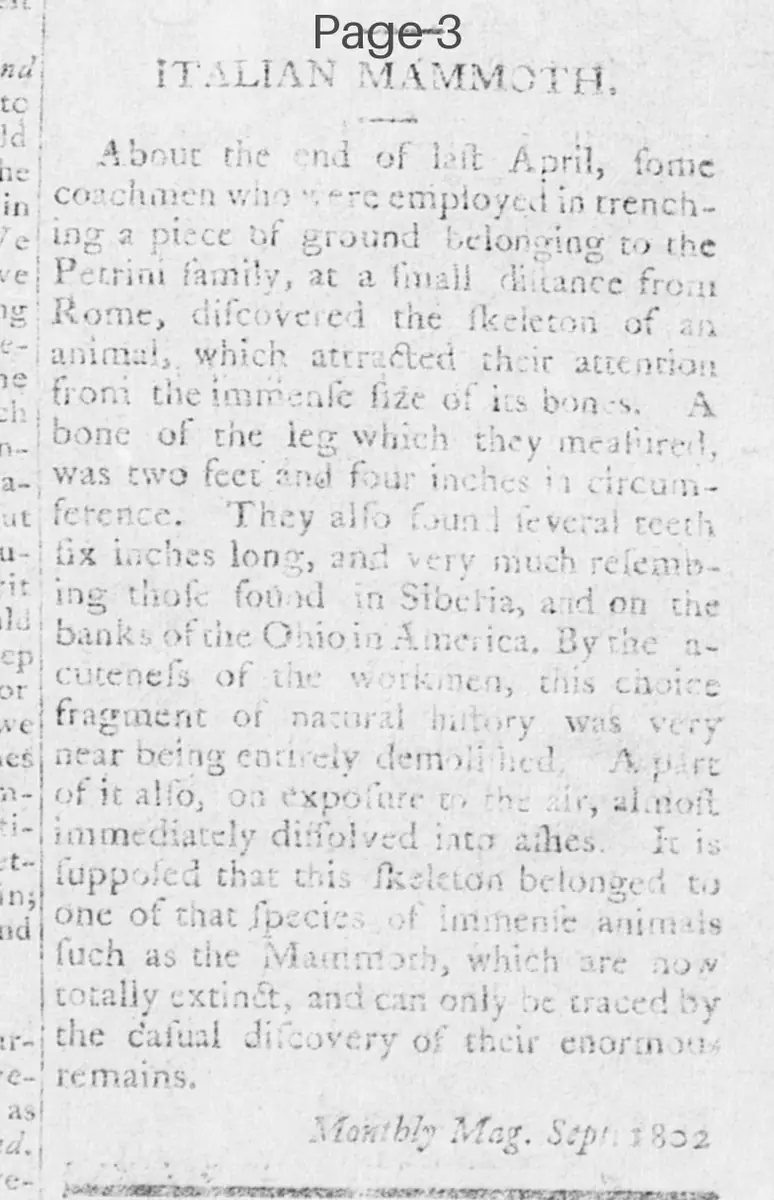
In late April 1802, workers trenching land owned by the Petrini family near Rome unearthed a large animal skeleton, likely a mammoth, with bones two feet four inches in circumference and teeth six inches long similar to those from Siberia and Ohio. Parts dissolved upon exposure.
Clipping
OCR Quality
Full Text
About the end of last April, some countrymen were employed in trenching a piece of ground belonging to the Petrini family, at a small distance from Rome, discovered the skeleton of an animal, which attracted their attention from the immense size of its bones. A bone of the leg which they measured, was two feet and four inches in circumference. They also found several teeth six inches long, and very much resembling those found in Siberia, and on the banks of the Ohio in America. By the accident of the workmen, this choice fragment of natural history was very near being entirely demolished. A part of it also, on exposure to the air, almost immediately dissolved into ashes. It is supposed that this skeleton belonged to one of that species of immense animals such as the Mammoth, which are now totally extinct, and can only be traced by the casual discovery of their enormous remains.
Monthly Mag. Sept 1802
What sub-type of article is it?
What keywords are associated?
What entities or persons were involved?
Where did it happen?
Foreign News Details
Primary Location
Near Rome
Event Date
About The End Of Last April
Key Persons
Outcome
skeleton partially demolished by workmen and dissolved into ashes upon exposure to air; supposed to be a mammoth, now extinct
Event Details
Countrymen trenching ground belonging to the Petrini family near Rome discovered a large skeleton with a leg bone two feet four inches in circumference and teeth six inches long resembling those from Siberia and Ohio. The discovery was nearly destroyed by workmen, and parts dissolved in air.