Thank you for visiting SNEWPapers!
Sign up free
Letter to Editor
January 23, 1856
Morning Star
Limerick, York County, Maine
What is this article about?
Theological letter analyzing the Greek preposition 'eis' in Acts 2:38, arguing it does not require baptism as a precondition for remission of sins. The author uses biblical examples to show 'eis' can mean various things and must align with other scriptures.
Clipping
OCR Quality
95%
Excellent
Full Text
For the Morning Star.
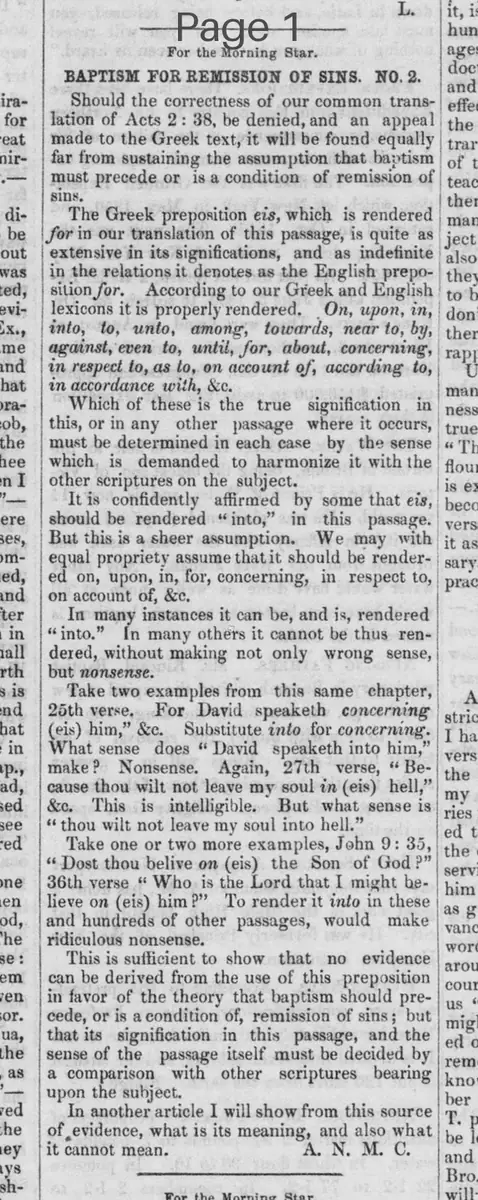
BAPTISM FOR REMISSION OF SINS. NO. 2.
Should the correctness of our common translation of Acts 2:38, be denied, and an appeal made to the Greek text, it will be found equally far from sustaining the assumption that baptism must precede or is a condition of remission of sins.
The Greek preposition eis, which is rendered for in our translation of this passage, is quite as extensive in its significations, and as indefinite in the relations it denotes as the English preposition for. According to our Greek and English lexicons it is properly rendered. On, upon, in, into, to, unto, among, towards, near to, by, against, even to, until, for, about, concerning, in respect to, as to, on account of, according to, in accordance with, &c.
Which of these is the true signification in this, or in any other passage where it occurs, must be determined in each case by the sense which is demanded to harmonize it with the other scriptures on the subject.
It is confidently affirmed by some that eis, should be rendered "into," in this passage. But this is a sheer assumption. We may with equal propriety assume that it should be rendered on, upon, in, for, concerning, in respect to, on account of, &c.
In many instances it can be, and is, rendered "into." In many others it cannot be thus rendered, without making not only wrong sense, but nonsense.
Take two examples from this same chapter 25th verse. For David speaketh concerning (eis) him," &c. Substitute into for concerning. What sense does "David speaketh into him." make? Nonsense. Again, 27th verse, "Because thou wilt not leave my soul in (eis) hell," &c. This is intelligible. But what sense is "thou wilt not leave my soul into hell."
Take one or two more examples, John 9:35. "Dost thou believe on (eis) the Son of God ?" 36th verse "Who is the Lord that I might believe on (eis) him?" To render it into in these and hundreds of other passages, would make ridiculous nonsense.
This is sufficient to show that no evidence can be derived from the use of this preposition in favor of the theory that baptism should precede, or is a condition of, remission of sins; but that its signification in this passage, and the sense of the passage itself must be decided by a comparison with other scriptures bearing upon the subject.
In another article I will show from this source of evidence, what is its meaning, and also what it cannot mean.
A. N. M. C.
BAPTISM FOR REMISSION OF SINS. NO. 2.
Should the correctness of our common translation of Acts 2:38, be denied, and an appeal made to the Greek text, it will be found equally far from sustaining the assumption that baptism must precede or is a condition of remission of sins.
The Greek preposition eis, which is rendered for in our translation of this passage, is quite as extensive in its significations, and as indefinite in the relations it denotes as the English preposition for. According to our Greek and English lexicons it is properly rendered. On, upon, in, into, to, unto, among, towards, near to, by, against, even to, until, for, about, concerning, in respect to, as to, on account of, according to, in accordance with, &c.
Which of these is the true signification in this, or in any other passage where it occurs, must be determined in each case by the sense which is demanded to harmonize it with the other scriptures on the subject.
It is confidently affirmed by some that eis, should be rendered "into," in this passage. But this is a sheer assumption. We may with equal propriety assume that it should be rendered on, upon, in, for, concerning, in respect to, on account of, &c.
In many instances it can be, and is, rendered "into." In many others it cannot be thus rendered, without making not only wrong sense, but nonsense.
Take two examples from this same chapter 25th verse. For David speaketh concerning (eis) him," &c. Substitute into for concerning. What sense does "David speaketh into him." make? Nonsense. Again, 27th verse, "Because thou wilt not leave my soul in (eis) hell," &c. This is intelligible. But what sense is "thou wilt not leave my soul into hell."
Take one or two more examples, John 9:35. "Dost thou believe on (eis) the Son of God ?" 36th verse "Who is the Lord that I might believe on (eis) him?" To render it into in these and hundreds of other passages, would make ridiculous nonsense.
This is sufficient to show that no evidence can be derived from the use of this preposition in favor of the theory that baptism should precede, or is a condition of, remission of sins; but that its signification in this passage, and the sense of the passage itself must be decided by a comparison with other scriptures bearing upon the subject.
In another article I will show from this source of evidence, what is its meaning, and also what it cannot mean.
A. N. M. C.
What sub-type of article is it?
Religious
Informative
Philosophical
What themes does it cover?
Religion
What keywords are associated?
Baptism
Remission Of Sins
Acts 2:38
Greek Preposition Eis
Biblical Translation
Theology
What entities or persons were involved?
A. N. M. C.
Morning Star
Letter to Editor Details
Author
A. N. M. C.
Recipient
Morning Star
Main Argument
the greek preposition 'eis' in acts 2:38 does not support the idea that baptism precedes or conditions remission of sins; its meaning varies and must be interpreted in harmony with other scriptures.
Notable Details
References Greek Lexicons For Meanings Of 'Eis'
Examples From Acts 2:25, 27 And John 9:35 36 To Illustrate Improper Rendering As 'Into'