Thank you for visiting SNEWPapers!
Sign up free
Story
October 17, 1843
Richmond Daily Whig
Richmond, Virginia
What is this article about?
Satirical commentary on Democratic Party (Loco Focos) infighting over presidential candidates like Van Buren, Cass, Calhoun, Buchanan, and Johnson, accusing leaders of self-interest and fraud while urging unity to avoid recriminations.
Clipping
OCR Quality
98%
Excellent
Full Text
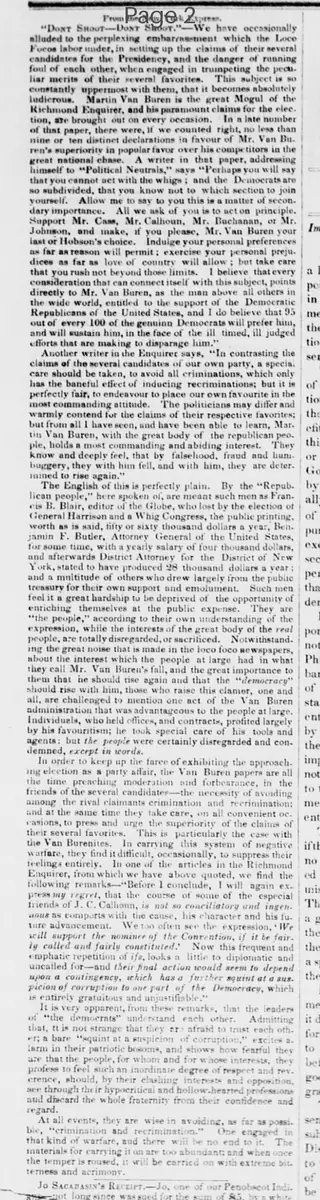
"Don't Shoot—Don't Shoot." We have occasionally alluded to the perplexing embarrassment which the Loco Focos labor under, in setting up the claims of their several candidates for the Presidency, and the danger of running foul of each other, when engaged in trumpeting the peculiar merits of their several favorites. This subject is so constantly uppermost with them, that it becomes absolutely ludicrous. Martin Van Buren is the great Mogul of the Richmond Enquirer, and his paramount claims for the election, are brought out on every occasion. In a late number of that paper, there were, if we counted right, no less than nine or ten distinct declarations in favour of Mr. Van Buren's superiority in popular favor over his competitors in the great national chase. A writer in that paper, addressing himself to "Political Neutrals," says "Perhaps you will say that you cannot act with the whigs: and the Democrats are so subdivided, that you know not to which section to join yourself. Allow me to say to you this is a matter of secondary importance. All we ask of you is to act on principle. Support Mr. Cass. Mr. Calhoun, Mr. Buchanan, or Mr. Johnson, and make, if you please, Mr. Van Buren your last or Hobson's choice. Indulge your personal preferences as far as reason will permit; exercise your personal prejudices as far as love of country will allow; but take care that you rush not beyond those limits. I believe that every consideration that can connect itself with this subject, points directly to Mr. Van Buren, as the man above all others in the wide world, entitled to the support of the Democratic Republicans of the United States, and I do believe that 95 out of every 100 of the genuine Democrats will prefer him, and will sustain him, in the face of the ill timed, ill judged efforts that are making to disparage him."
Another writer in the Enquirer says, "In contrasting the claims of the several candidates of our own party, a special care should be taken, to avoid all criminations, which only has the baneful effect of inducing recriminations; but it is perfectly fair, to endeavour to place our own favourite in the most commanding attitude. The politicians may differ and warmly contend for the claims of their respective favorites; but from all I have seen, and have been able to learn, Martin Van Buren, with the great body of the republican people, holds a most commanding and abiding interest. They know and deeply feel, that by falsehood, fraud and humbuggery, they with him fell, and with him, they are determined to rise again."
The English of this is perfectly plain. By the "Republican people," here spoken of, are meant such men as Francis B. Blair, editor of the Globe, who lost by the election of General Harrison and a Whig Congress, the public printing, worth as is said, fifty or sixty thousand dollars a year, Benjamin F. Butler, Attorney General of the United States, for some time, with a yearly salary of four thousand dollars, and afterwards District Attorney for the District of New York, stated to have produced 28 thousand dollars a year: and a multitude of others who drew largely from the public treasury for their own support and emolument. Such men feel it a great hardship to be deprived of the opportunity of enriching themselves at the public expense. They are the people," according to their own understanding of the expression, while the interests of the great body of the real people, are totally disregarded, or sacrificed. Notwithstanding the great noise that is made in the loco foco newspapers, about the interest which the people at large had in what they call Mr. Van Buren's fall, and the great importance to them that he should rise again and that the "democracy" should rise with him, those who raise this clamor, one and all, are challenged to mention one act of the Van Buren administration that was advantageous to the people at large. Individuals, who held offices, and contracts, profited largely by his favoritism; he took special care of his tools and agents: but the people were certainly disregarded and condemned, except in words.
In order to keep up the farce of exhibiting the approaching election as a party affair, the Van Buren papers are all the time preaching moderation and forbearance, in the friends of the several candidates—the necessity of avoiding among the rival claimants crimination and recrimination: and at the same time they take care, on all convenient occasions, to press and urge the superiority of the claims of their several favorites. This is particularly the case with the Van Burenites. In carrying this system of negative warfare, they find it difficult, occasionally, to suppress their feelings entirely. In one of the articles in the Richmond Enquirer, from which we have above quoted, we find the following remarks—"Before I conclude, I will again express my regret, that the course of some of the especial friends of J. C. Calhoun, is not so conciliatory and ingenuous as comports with the cause, his character and his future advancement. We too often see the expression, 'We still support the nominee of the Convention, if it be fairly called and fairly constituted:' Now this frequent and emphatic repetition of ifs, looks a little too diplomatic and uncalled for—and their final action would seem to depend upon a contingency, which has a further squint at a suspicion of corruption to one part of the Democracy, which is entirely gratuitous and unjustifiable."
It is very apparent, from these remarks, that the leaders of "the democrats" understand each other. Admitting that, it is not strange that they are afraid to trust each other; a bare "squint at a suspicion of corruption," excites alarm in their patriotic bosoms, and shows how fearful they are that the people, for whom and for whose interests, they profess to feel such an inordinate degree of respect and reverence, should, by their clashing interests and opposition, see through their hypocritical and hollow-hearted professions and discard the whole fraternity from their confidence and regard.
At all events, they are wise in avoiding, as far as possible, "crimination and recrimination." Once engaged in that kind of warfare, and there will be no end to it. The materials for carrying it on are too abundant; and when once the temper is roused, it will be carried on with extreme bitterness and acrimony.
Another writer in the Enquirer says, "In contrasting the claims of the several candidates of our own party, a special care should be taken, to avoid all criminations, which only has the baneful effect of inducing recriminations; but it is perfectly fair, to endeavour to place our own favourite in the most commanding attitude. The politicians may differ and warmly contend for the claims of their respective favorites; but from all I have seen, and have been able to learn, Martin Van Buren, with the great body of the republican people, holds a most commanding and abiding interest. They know and deeply feel, that by falsehood, fraud and humbuggery, they with him fell, and with him, they are determined to rise again."
The English of this is perfectly plain. By the "Republican people," here spoken of, are meant such men as Francis B. Blair, editor of the Globe, who lost by the election of General Harrison and a Whig Congress, the public printing, worth as is said, fifty or sixty thousand dollars a year, Benjamin F. Butler, Attorney General of the United States, for some time, with a yearly salary of four thousand dollars, and afterwards District Attorney for the District of New York, stated to have produced 28 thousand dollars a year: and a multitude of others who drew largely from the public treasury for their own support and emolument. Such men feel it a great hardship to be deprived of the opportunity of enriching themselves at the public expense. They are the people," according to their own understanding of the expression, while the interests of the great body of the real people, are totally disregarded, or sacrificed. Notwithstanding the great noise that is made in the loco foco newspapers, about the interest which the people at large had in what they call Mr. Van Buren's fall, and the great importance to them that he should rise again and that the "democracy" should rise with him, those who raise this clamor, one and all, are challenged to mention one act of the Van Buren administration that was advantageous to the people at large. Individuals, who held offices, and contracts, profited largely by his favoritism; he took special care of his tools and agents: but the people were certainly disregarded and condemned, except in words.
In order to keep up the farce of exhibiting the approaching election as a party affair, the Van Buren papers are all the time preaching moderation and forbearance, in the friends of the several candidates—the necessity of avoiding among the rival claimants crimination and recrimination: and at the same time they take care, on all convenient occasions, to press and urge the superiority of the claims of their several favorites. This is particularly the case with the Van Burenites. In carrying this system of negative warfare, they find it difficult, occasionally, to suppress their feelings entirely. In one of the articles in the Richmond Enquirer, from which we have above quoted, we find the following remarks—"Before I conclude, I will again express my regret, that the course of some of the especial friends of J. C. Calhoun, is not so conciliatory and ingenuous as comports with the cause, his character and his future advancement. We too often see the expression, 'We still support the nominee of the Convention, if it be fairly called and fairly constituted:' Now this frequent and emphatic repetition of ifs, looks a little too diplomatic and uncalled for—and their final action would seem to depend upon a contingency, which has a further squint at a suspicion of corruption to one part of the Democracy, which is entirely gratuitous and unjustifiable."
It is very apparent, from these remarks, that the leaders of "the democrats" understand each other. Admitting that, it is not strange that they are afraid to trust each other; a bare "squint at a suspicion of corruption," excites alarm in their patriotic bosoms, and shows how fearful they are that the people, for whom and for whose interests, they profess to feel such an inordinate degree of respect and reverence, should, by their clashing interests and opposition, see through their hypocritical and hollow-hearted professions and discard the whole fraternity from their confidence and regard.
At all events, they are wise in avoiding, as far as possible, "crimination and recrimination." Once engaged in that kind of warfare, and there will be no end to it. The materials for carrying it on are too abundant; and when once the temper is roused, it will be carried on with extreme bitterness and acrimony.
What sub-type of article is it?
Historical Event
Deception Fraud
What themes does it cover?
Deception
Fortune Reversal
Social Manners
What keywords are associated?
Loco Foco
Van Buren
Presidential Candidates
Party Infighting
Political Fraud
Democratic Division
Election Claims
What entities or persons were involved?
Martin Van Buren
Mr. Cass
Mr. Calhoun
Mr. Buchanan
Mr. Johnson
Francis B. Blair
Benjamin F. Butler
General Harrison
J. C. Calhoun
Where did it happen?
United States
Story Details
Key Persons
Martin Van Buren
Mr. Cass
Mr. Calhoun
Mr. Buchanan
Mr. Johnson
Francis B. Blair
Benjamin F. Butler
General Harrison
J. C. Calhoun
Location
United States
Story Details
Whig commentary mocks Democratic (Loco Foco) divisions over presidential candidates, promoting Van Buren while urging unity to avoid infighting; accuses party leaders of self-serving interests in regaining offices lost after Harrison's election, ignoring public benefit.