Thank you for visiting SNEWPapers!
Sign up free
Story
May 24, 1848
Rutland County Herald
Rutland, Rutland County, Vermont
What is this article about?
Biographical sketch of General Philip Schuyler, highlighting his sacrifices, leadership, virtues, and contributions to the American Revolution, including manumitting his slaves.
Clipping
OCR Quality
85%
Good
Full Text
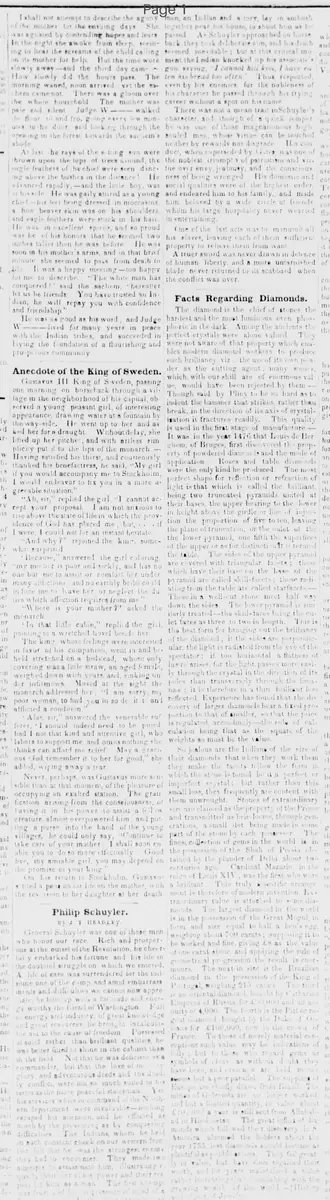
Philip Schuyler.
By J. T. HEADLEY
General Schuyler was one of those men who honor our race. Rich and prosperous at the outset of the Revolution, he cheerfully embarked his fortune and his life in the doubtful struggle on which we entered.
A life of ease was surrendered for the toilsome one of the camp and amid embarrassments and difficulties we cannot now appreciate he bore up with a fortitude and cheerfulness worthy the friend of Washington. Full of energy, and industry, of great knowledge and great resources he brought invaluable aid to the cause of freedom. Possessed of solid rather than brilliant qualities he was better fitted to shine in the cabinet than in the field. Not that he was deficient as a commander, but that the love of arms and adventures and the din of conflict were not so much suited to his taste as the more peaceful statesmanship. His labors in the civil department were invaluable - nothing escaped his attention and he effected as much by preventing as by conquering difficulties. The Indians whom he held in constant check, feared him more than any other general they had to encounter.
They made it a point to hate him.
He was the strongest enemy they had to encounter.
There was not a mean trait in Schuyler's character, and though of a quick temper he was one of those magnanimous high souled men, whose virtue can be touched neither by rewards nor disgrace. In conduct, when superseded by Gates was one of the noblest triumphs of patriotism and virtue over envy, jealousy, and the consciousness of being wronged. His domestic and social qualities were of the highest order and endeared him to his family, and made him beloved by a wide circle of friends whom his large hospitality never wearied in entertaining.
One of the last acts was to manumit all his slaves, leaving each of them sufficient property to relieve them from want.
A truer sword was never drawn in defense of human liberty, and a more untarnished blade never returned to its scabbard when the conflict was over.
By J. T. HEADLEY
General Schuyler was one of those men who honor our race. Rich and prosperous at the outset of the Revolution, he cheerfully embarked his fortune and his life in the doubtful struggle on which we entered.
A life of ease was surrendered for the toilsome one of the camp and amid embarrassments and difficulties we cannot now appreciate he bore up with a fortitude and cheerfulness worthy the friend of Washington. Full of energy, and industry, of great knowledge and great resources he brought invaluable aid to the cause of freedom. Possessed of solid rather than brilliant qualities he was better fitted to shine in the cabinet than in the field. Not that he was deficient as a commander, but that the love of arms and adventures and the din of conflict were not so much suited to his taste as the more peaceful statesmanship. His labors in the civil department were invaluable - nothing escaped his attention and he effected as much by preventing as by conquering difficulties. The Indians whom he held in constant check, feared him more than any other general they had to encounter.
They made it a point to hate him.
He was the strongest enemy they had to encounter.
There was not a mean trait in Schuyler's character, and though of a quick temper he was one of those magnanimous high souled men, whose virtue can be touched neither by rewards nor disgrace. In conduct, when superseded by Gates was one of the noblest triumphs of patriotism and virtue over envy, jealousy, and the consciousness of being wronged. His domestic and social qualities were of the highest order and endeared him to his family, and made him beloved by a wide circle of friends whom his large hospitality never wearied in entertaining.
One of the last acts was to manumit all his slaves, leaving each of them sufficient property to relieve them from want.
A truer sword was never drawn in defense of human liberty, and a more untarnished blade never returned to its scabbard when the conflict was over.
What sub-type of article is it?
Biography
Historical Event
Heroic Act
What themes does it cover?
Bravery Heroism
Moral Virtue
Justice
What keywords are associated?
Philip Schuyler
American Revolution
General
Patriotism
Manumission
Leadership
Virtue
What entities or persons were involved?
Philip Schuyler
Washington
Gates
Story Details
Key Persons
Philip Schuyler
Washington
Gates
Event Date
American Revolution
Story Details
Philip Schuyler sacrificed his wealth and comfort for the Revolution, served as a capable general and statesman, managed Indians effectively, showed noble conduct when replaced by Gates, and freed his slaves in his final act.