Thank you for visiting SNEWPapers!
Sign up free
Gazette Of The United States, & Philadelphia Daily Advertiser
Philadelphia, Philadelphia County, Pennsylvania
What is this article about?
A letter from the N.Y. Daily Gazette warns that the French Revolution's atrocities will lead to anarchy or despotism in France upon peace. It quotes a Paris-published book detailing horrors like mass guillotinings and massacres by revolutionaries. Criticizes Paul Barras for roles in bloodshed and his ties to US ex-minister James Monroe, accused of Jacobin sympathies harming US interests.
Clipping
OCR Quality
Full Text
Messrs. M'Lean & Lang,
Gentlemen,
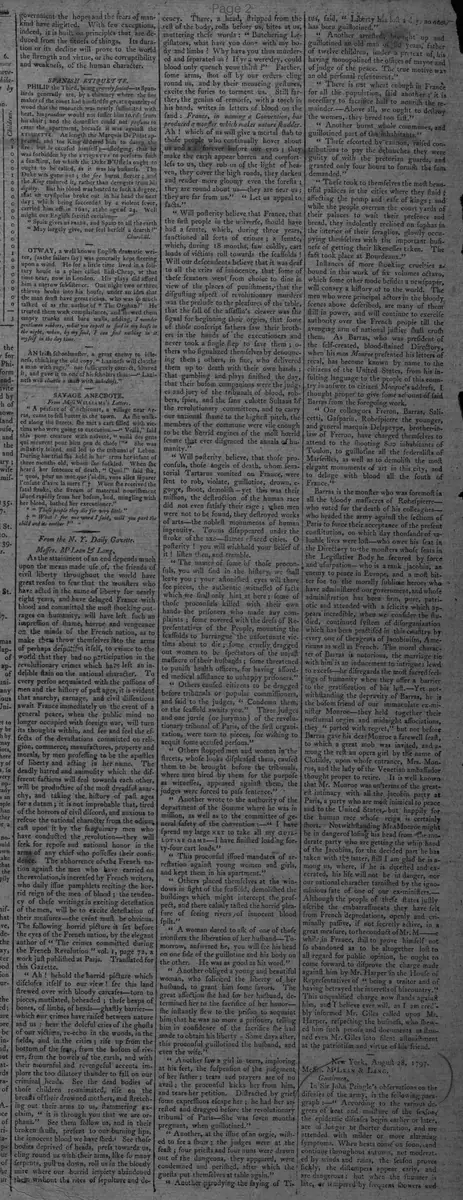
As the attainment of an end depends much upon the means made use of, the friends of civil liberty throughout the world have great reason to fear that the monsters who have acted in the name of liberty for nearly eight years, and have deluged France with blood and committed the most shocking outrages on humanity, will have left such an impression of shame, horror and vengeance on the minds of the French nation, as to make them throw themselves into the arms of perhaps despotism itself, to evince to the world that they had no participation in the revolutionary crimes which have left an indelible stain on the national character. To every person acquainted with the passions of men and the history of past ages, it is evident that anarchy, carnage, and civil dissensions await France immediately on the event of a general peace, when the public mind no longer occupied with foreign war, will turn its thoughts within, and see and feel the effects of the devastations committed on religion, commerce, manufactures, property and morals, by men professing to be the apostles of liberty and acting in her name. The deadly hatred and animosity which the different factions will feel towards each other, will be productive of the most dreadful anarchy, and taking the history of past ages for a datum; it is not improbable that, tired of the horrors of civil discord, and anxious to rescue the national character from the odium cast upon it by the sanguinary men who have conducted the revolution—they will seek for repose and national honor in the arms of any chief who possesses their confidence. The abhorrence of the French nation against the men who have carried on the revolution, is increased by French writers, who daily issue pamphlets reciting the horrid reign of the men of blood; the tendency of these writings in exciting detestation of the men, will be to excite detestation of their measures—the event must be obvious.
The following horrid picture is set before the eyes of the French nation, by the elegant author of "The crimes committed during the French Revolution," vol. I, page 72, a work just published at Paris. Translated for this Gazette.
"Ah! behold the horrid picture which discloses itself to our view! See this land strewed over with bloody carcasses—torn to pieces, mutilated, beheaded; these heaps of bones, of limbs, of heads—ghastly barrier which our crimes have raised between nature and us: hear the doleful cries of the ghosts of our victims, re-echo in the woods, in the fields, and in the cities; rise up from the bottom of the seas, from the bosom of rivers, from the bowels of the earth, and with their mournful and revengeful accents implore the too dilatory thunder to fall on our criminal heads. See the dead bodies of those children re-animated, rise on the breasts of their drowned mothers, and stretching out their arms to us, stammering exclaim, "it is through you that we are orphans." See them follow us, and in their broken skulls, present to our burning lips, the innocent blood we have shed. See those bodies deprived of heads, press towards us, cling round us with their arms, like so many serpents, pull us down, roll us in the bloody mire where our horrid impiety abandoned them without the rites of sepulture and decency. There, a head, stripped from the rest of the body, rolls before us, bites at us, muttering these words: "Butchering Legislators, what have you done with my body and limbs? Why have you thus murdered and separated us? If you were dry, could blood only quench your thirst?" Farther, some arms, shot off by our orders cling round us, and by their menacing gestures, excite the furies to torment us. Still farther, the genius of remorse, with a torch in his hand, writes in letters of blood on the sand: France, in naming a Convention, has produced a monster which makes nature shudder. Ah'! which of us will give a mortal stab to those people who continually hover about us and are forever before our eyes; they make the earth appear barren and comfortless to us, they rob us of the light of heaven, they cover the high roads, they darken and render more gloomy even the forests; they are round about us—they are near us; they are far from us." "Let us appeal to facts."
"Will posterity believe that France, that the first people in the universe, should have had a senate, which, during three years, sanctioned all sorts of crimes; a senate, which, during 18 months, saw coldly, cart loads of victims roll towards the scaffolds! Will our descendants believe that it was deaf to all the cries of innocence, that some of these senators went from choice to dine in view of the places of punishment, that the disgusting aspect of revolutionary murders was the prelude to the pleasures of the table. that the fall of the assassin's cleaver was the signal for beginning their orgies, that some of those conscript fathers saw their brothers in the hands of the executioners and never took a single step to save them; Others who signalized themselves by denouncing them; others, in fine, who delivered them up to death with their own hands; that gambling and plays finished the day, that their boon companions were the judges and jury of the tribunals of blood, robbers, spies, and the sans culotte Sultans of the revolutionary committees, and to carry our national shame to the highest pitch, the members of the commune were vile enough to be the horrid engines of the most horrid senate that ever disgraced the annals of humanity."
"Will posterity believe, that those proconsuls, those angels of death, whom editorial Tartarus vomited on France, were sent to rob, violate, guillotine, drown, gorge, shoot, demolish—yet this was their mission, the destruction of the human race did not even satisfy their rage; when men were not to be found, they destroyed works of arts the noblest monuments of human ingenuity. Towns disappeared under the stroke of the axe—flames effaced cities. O posterity! you will withhold your belief of it! listen then, and tremble.
"The names of some of those proconsuls, you will find in the history we shall leave you; your astonished eyes will there see pieces, the authentic witness of facts which we shall only hint at here; some of those proconsuls killed with their own hands the prisoners who made any complaints; some covered with the dress of Representatives of the People, mounting the scaffolds to harangue the unfortunate victims about to die; some cruelly, dragged out women to be spectators of the unjust massacre of their husbands; some threatened to punish health officers, for having afforded medical assistance to unhappy prisoners."
"Others caused citizens to be dragged before tribunals or popular commissioners, and said to the judges, "Condemn them, or the scaffold awaits you." Three judges and one jurie (or juryman) of the revolutionary tribunal of Paris, of the first organization, were torn to pieces, for wishing to acquit some accused persons."
Others stopped men and women in the streets, whose looks displeased them, caused them to be brought before the tribunals, where men hired by them for the purpose as witnesses, appeared against them, the judges were forced to pass sentence."
"Another wrote to the authority of the department of the Somme where he was in mission, as well as to the committee of general safety of the convention:—"I have spread my large Net to take all my GUILLOTINE GAME—I have finished loading forty-four cart loads."
"This proconsul issued mandates of arrestation against young women and girls, and kept them in his apartment."
"Others placed themselves at the windows in sight of the scaffold, demolished the buildings which might intercept the prospect, and there calmly tasted the horrid pleasure of seeing rivers of innocent blood spilt."
"A woman dared to ask of one of those monsters the liberation of her husband—To-morrow, answered he, you will see his head on one side of the guillotine and his body on the other. He was as good as his word."
"Another obliged a young and beautiful woman, who solicited the liberty of her husband, to grant him some favors. The great affection she had for her husband, determined her to the sacrifice of her honor— he instantly flew to the prison to acquaint him that he was no more a prisoner, telling him in confidence of the sacrifice she had made to obtain his liberty—Some days after, this proconsul guillotined the husband, and even the wife."
"Another saw a girl in tears, imploring at his feet, the suspension of the judgment of her father; tears and prayers are of no avail; the proconsul kicks her from him, and tears her petition. Distracted by grief some expressions escape her; he had her arrested and dragged before the revolutionary tribunal of Paris—She was eight months pregnant, when guillotined."
"Another, at the issue of an orgie, wished to see a show; the judges were at the feast; four priests and four nuns were drawn out of the dungeons, they appeared, were condemned and perished, after which the guests put themselves at table again."
"Another parodying the saying of Titus, said, "Liberty has lost a day, no one has been guillotined."
"Another arrested, brought up and guillotined an old man of 80 years, father of twelve children, under a pretext of his having monopolized the offices of mayor and of judge of the peace. The true motive was an old personal resentment."
"There is not wheat enough in France for all the population, said another; it is necessary to sacrifice half to nourish the remainder. -Above all, we ought to destroy the women, they breed too fast."
"Another burnt whole communes, and guillotined part of the inhabitants."
"These escorted by cannon, raised contributions to pay the debauches they were guilty of with the pretorian guards, and granted only four hours to furnish the sum demanded."
-"These took to themselves the most beautiful palaces in the cities where they stayed: affecting the pomp and ease of kings; and while the people overrun the court yards of their palaces to wait their presence and bread, they indolently reclined on sofas in the interior of their seraglios, glowly occupying themselves with the important business of getting their likenesses taken. The fact took place at Bourdeaux."
Instances of more shocking cruelties abound in this work of six volumes octavo, which some other mode besides a newspaper, will convey a history of to the world. The men who were principal actors in the bloody scenes above described, are many of them still in power, and will continue to exercise authority over the French people till the avenging arm of national justice shall crush them. As Barras, who was president of the self-created, blood-stained Directory, when his man Monroe presented his letters of recall, has become known by name to the citizens of the United States, from his insulting language to the people of this country in answer to citizen Monroe's address, I thought proper to give some account of said Barras from the foregoing work.
"Our colleagues Freron, Barras, Salicetti, Gasparin, Robespierre the younger, and general marquis De Laplace, brother-in-law of Freron, have charged themselves to attend to the shooting 800 inhabitants of Toulon, to guillotine all the federalists of Marseilles, as well as to demolish the most elegant monuments of art in this city, and to deluge with blood all the south of France."
Barras is the monster who was foremost in all the bloody massacres of Robespierre— who voted for the death of his colleagues— who headed the army against the sections of Paris to force their acceptance of the present constitution, on which day thousands of valuable lives were lost—who owes his seat in the Directory to the monsters whose seats in the Legislative Body he secured by force and usurpation—who is a rank jacobin, an enemy to peace in Europe, and a most bitter foe to the morally sublime heroes who have administered our government, and whose administration has been firm, pure, patriotic and attended with a felicity which appears incredible, when we consider the studied, continued system of disorganization which has been practiced in this country by every one of the agents of Jacobinism, Americans as well as French. The moral character of Barras is notorious, the marriage tie with him is an inducement to intrigue: lewd to excess—he disregards the most sacred feelings of humanity when they offer a barrier to the gratification of his lust.—Yet notwithstanding the depravity of Barras, he is the boon friend of our immaculate ex-minister Monroe—they held together their nocturnal orgies and midnight associations, they "parted with regret," but not before Barras gave his dear Monroe a farewell feast, to which a great mob was invited, and among the rest—an opera girl by the name of Clotilde, upon whose entrance, Mrs. Monroe, and the lady of the Venetian ambassador thought proper to retire. It is well known that Mr. Monroe was on terms of the greatest intimacy with all the jacobin party at Paris, a party who are most inimical to peace and to the United States, but happily for the human race whose reign is certainly short. Notwithstanding Mr. Monroe might be in danger of losing his head from the moderate party who are getting the whip hand of the Jacobins, for the decided part he has taken with the latter, till I am glad he is a-mong us, where, if he is detested and execrated, his life will not be in danger, nor our national character tarnished by the ignominious fate of one of our ex-ministers.— Although the people of these states justly ascribe the embarrassments they have felt from French depredations, openly and criminally passive, if not secretly active, in a great measure, to the conduct of Mr. M—e while in France, till to prove himself not so abandoned as to be altogether lost to all regard for public opinion, he ought to come forward to disprove the charge made against him by Mr. Harper in the House of Representatives of "being a traitor and of having betrayed the interests of his country." This unqualified charge now stands against him, and I believe ever will, as I am credibly informed Mr. Giles called upon Mr. Harper, respecting the business, who shewed him such proofs and documents as stunned even Mr. Giles into silent astonishment at the patriotism and virtue of his friend.
What sub-type of article is it?
What keywords are associated?
What entities or persons were involved?
Where did it happen?
Foreign News Details
Primary Location
France
Key Persons
Outcome
deluged france with blood; shooting 800 inhabitants of toulon; guillotining federalists of marseilles; thousands of lives lost in paris; mass guillotinings, drownings, shootings, burnings of communes; destruction of monuments and cities.
Event Details
Letter predicts anarchy or despotism in France after peace due to revolutionary atrocities by Jacobins over nearly eight years. Quotes book 'The crimes committed during the French Revolution' describing graphic horrors: mutilated bodies, ghostly victims, senate sanctioning crimes, proconsuls' massacres, guillotinings, rapes, and cruelties. Details Barras's role in massacres at Toulon and Marseilles, his depravity, and close ties to US ex-minister Monroe, accused of Jacobin sympathies and betraying US interests.