Thank you for visiting SNEWPapers!
Sign up free
New Hampshire Statesman And State Journal
Concord, Merrimack County, New Hampshire
What is this article about?
Summary of proceedings in the 24th Congress, First Session, from April 4 to April 9, 1836, covering Senate and House debates, bill passages including Arkansas statehood, navy appropriations, New York fire relief, and inquiries into treasury practices.
Clipping
OCR Quality
Full Text
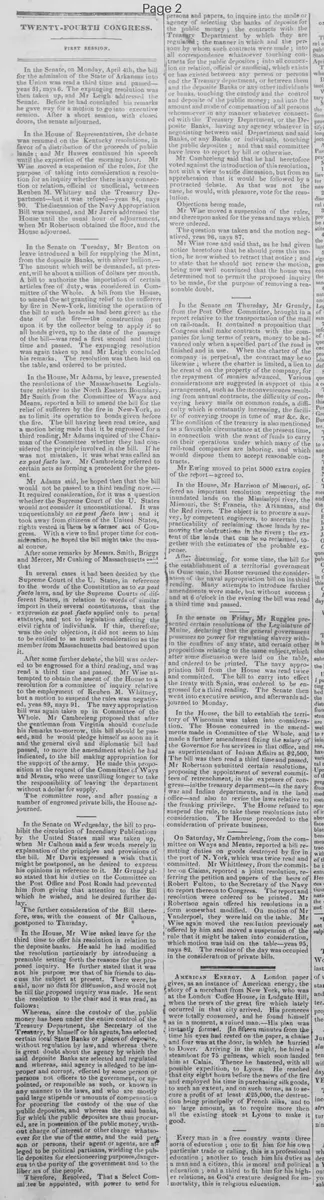
First Session.
In the Senate, on Monday, April 4th, the bill for the admission of the State of Arkansas into the Union was read a third time and passed—yeas 91, nays 6. The expunging resolution was then taken up, and Mr Leigh addressed the Senate. Before he had concluded his remarks he gave way for a motion to go into executive session. After a short session, with closed doors, the senate adjourned.
In the House of Representatives, the debate was resumed on the Kentucky resolutions, in favor of a distribution of the proceeds of public lands; and Mr Hawes continued his speech until the expiration of the morning hour. Mr Wise moved a suspension of the rules, for the purpose of taking into consideration a resolution for an inquiry whether there is any connection or relation, official or unofficial, between Reuben M. Whitney and the Treasury Department—but it was refused—yeas 84, nays 90. The discussion of the Navy Appropriation Bill was resumed, and Mr Jarvis addressed the House until the usual hour of adjournment, when Mr Robertson obtained the floor, and the House adjourned.
In the Senate on Tuesday, Mr Benton on leave introduced a bill for supplying the Mint, from the opposite Banks, with silver bullion. The amount which will be demanded, at present, will be about a million of dollars per month. A bill to authorize the importation of certain articles free of duty, was considered in Committee of the Whole. A bill from the House, to amend the act granting relief to the sufferers by fire in New-York, limiting the operation of the bill to such bonds as had been given at the date of the fire—the construction put upon it by the collector being to apply it to all bonds given, up to the date of the passage of the bill—was read a first, second and third time and passed. The expunging resolution was again taken up and Mr Leigh concluded his remarks. The resolution was then laid on the table, and ordered to be printed.
In the House, Mr Adams, by leave, presented the resolutions of the Massachusetts Legislature relative to the North Eastern Boundary. Mr Smith from the Committee of Ways and Means, reported a bill to amend the bill for the relief of sufferers by the fire in New-York, so as to limit its operation to bonds given before the fire. The bill having been read twice, and a motion being made that it be engrossed for a third reading, Mr Adams inquired of the Chairman of the Committee whether they had considered the principle involved in the bill. If he was not mistaken, it was what was called an ex post facto law. Mr Cambreleng referred to certain acts as forming a precedent for the present. Mr Adams said he hoped then that the bill would not be passed to a third reading now. It required consideration, for it was a question whether the Supreme Court of the U. States would not consider it unconstitutional. It was unquestionably an ex post facto law; and it took away from citizens of the United States, rights vested in them by a former act of Congress. With a view to find proper time for consideration, he hoped the bill might take the usual course.
After some remarks by Messrs. Smith, Briggs and Mercer, Mr Cushing of Massachusetts said that in several cases it had been decided by the Supreme Court of the U. States, in reference to the words of the Constitution as to ex post facto laws, and by the Supreme Courts of different States, in relation to words of similar import in their several constitutions, that the expression ex post facto applied only to penal statutes, and not to legislation affecting the civil rights of individuals. If this, therefore, was the only objection, it did not seem to him to be entitled to as much consideration as the member from Massachusetts had bestowed upon it.
After some further debate, the bill was ordered to be engrossed for a third reading, and was read a third time and passed. Mr Wise attempted to obtain the assent of the House to a resolution for a committee of inquiry relative to the employment of Reuben M. Whitney, but a motion to suspend the rules was negatived, yeas 89, nays 91. The navy appropriation bill was again taken up in Committee of the Whole. Mr Cambreleng proposed that after the gentleman from Virginia should conclude his remarks to-morrow, this bill should be passed, and he would pledge himself as soon as it and the general civil and diplomatic bill had passed, to move the amendment which he had indicated, to the bill making appropriation for the support of the army. He made this proposition at the request of the Committee of Ways and Means, who were unwilling longer to take the responsibility of leaving the department without a dollar for supply.
The committee rose, and after passing a number of engrossed private bills, the House adjourned.
In the Senate on Wednesday, the bill to prohibit the circulation of Incendiary Publications by the United States mail was taken up, when Mr Calhoun said a few words merely in explanation of the principles and provisions of the bill. Mr Davis expressed a wish that it might be postponed, as he desired to express his opinions in reference to it. Mr Grundy also stated that his duties on the Committee on the Post Office and Post Roads had prevented him from giving that attention to the Bill which he wished, and he desired further delay.
The further consideration of the Bill therefore, was, with the consent of Mr Calhoun, postponed to Thursday.
In the House, Mr Wise asked leave for the third time to offer his resolution in relation to the deposite banks. He said he had modified the resolution particularly by introducing a preamble setting forth the reasons for the proposed inquiry. He further stated that it was not his purpose nor that of his friends to discuss the subject at present. There were, he said, now no data for discussion, and would not be till the proposed inquiry was made. He sent the resolution to the chair and it was read, as follows:
Whereas, since the custody of the public money has been under the entire control of the Treasury Department, the Secretary of the Treasury, by himself or his agents, has selected certain local State Banks or places of deposite, without regulation by law, and whereas there is great doubt about the agency by which the said deposite Banks are selected and regulated and whereas, said agency is alledged to be improper and corrupt, effected by some person or persons not officers to the government, or appointed, or responsible as such, or known in any manner to the laws, and who are mostly paid large stipends or amounts of compensation for procuring the custody of the use of the public deposites, and whereas the said banks, for which the public deposites are thus procured, are in possession of the public money, without charge of interest or other charge whatever for the use of the same, and the said person or persons, their agent or agents, are alledged to be political partisans, wielding the public deposites for electioneering purposes,dangerous to the purity of the government and to the liberties of the people.
Therefore, Resolved, That a Select Committee be appointed, with power to send for persons and papers, to inquire into the mode or agency of selecting the banks of deposite for the public money; the contracts with the Treasury Department by which they are regulated; the manner in which and the persons by whom such contracts were made; into all correspondence whatsoever touching contracts for the public deposites; into all connection or relation, official or unofficial, which exists or has existed between any person or persons and the Treasury department, or between them and the deposite Banks or any other individuals or banks, touching the custody and the control and deposite of the public money; and into the amount and mode of compensation of all persons whomsoever in any manner whatever connected with the Treasury Department, or the Depostie Banks, having any agency whatever in negotiating between said Department and said Banks, or any Banks or individuals, touching the public deposites; and that said committee have leave to report by bill or otherwise.
Mr Cambreleng said that he had heretofore voted against the introduction of this resolution, not with a view to stifle discussion, but from an apprehension that it would be followed by a protracted debate. As that was not the case, he would, with pleasure, vote for the resolution.
Objections being made, Mr Wise moved a suspension of the rules. and thereupon asked for the yeas and nays which were ordered.
The question was taken and the motion negatived, yeas 96, nays 87.
Mr Wise rose and said that, as he had given notice heretofore that he should press this motion, he now wished to retract that notice; and to state that he should not renew the motion. being now well convinced that the house was determined not to permit the proposed inquiry to be made, for the purpose of removing a reasonable doubt.
In the Senate on Thursday, Mr Grundy, from the Post Office Committee, brought in a report relative to the transportation of the mail on rail-roads. It contained a proposition that Congress shall make contracts with the companies for long terms of years, money to be advanced only when a specified part of the road is finished and in use. When the charter of the company is perpetual, the contract may be so likewise; where the charter is limited, a lien to be created on the property of the company, for the repayment of monies advanced. Various considerations are suggested in support of this arrangement, such as the inconveniences resulting from annual contracts, the difficulty of conveying heavy mails on common roads, a difficulty which is constantly increasing, the facility of conveying troops in time of war &c. &c. The condition of the treasury is also mentioned as a favorable circumstance at the present time, in connection with the want of funds to carry on their operations under which many of the rail-road companies are laboring, and which would dispose them to accept reasonable contracts.
Mr Ewing moved to print 5000 extra copies of the report—agreed to.
In the House, Mr Harrison of Missouri, offered an important resolution respecting the inundated lands on the Mississippi river, the Missouri, the St Francis, the Arkansas, and the Red rivers. The object is to procure a survey, by competent engineers, to ascertain the practicability of reclaiming those lands by removing the obstructions in the rivers; the extent of the lands that can be so reclaimed, together with the estimates of the probable expense.
After discussing, for some time, the bill for the establishment of a territorial government in Wisconsin, the House resumed the consideration of the naval appropriation bill on its third reading. Many attempts to introduce farther amendments were made, but without success; and at 6 o'clock in the evening the bill was read a third time and passed.
In the senate on Friday, Mr Ruggles presented certain resolutions of the Legislature of Maine, declaring that the general government possesses no power for regulating slavery within the confines of any state, and certain other propositions relating to the same subject,which after some discussion were laid on the table, and ordered to be printed. The navy appropriation bill from the House was read twice and committed. The bill to carry into effect the treaty with Spain, was ordered to be engrossed for a third reading. The Senate then went into executive session, and afterwards adjourned to Monday.
In the House, the bill to establish the territory of Wisconsin was taken into consideration. The House concurred in the amendments made in Committee of the Whole. and made a further amendment fixing the salary of the Governor for his services in that office, and as superintendant of Indian Affairs at $2,500. The bill was then read a third time and passed.
Mr Robertson submitted certain resolutions, proposing the appointment of several committees of retrenchment, in the expenses of congress—in the treasury department—in the navy war and Indian departments, and in the land office—and also to revise the laws relative to the franking privilege. The House refused to suspend the rule, to take these resolutions into consideration. The House proceeded to the consideration of private business.
On Saturday, Mr Cambreleng, from the committee on Ways and Means, reported a bill remitting duties on goods destroyed by fire in the port of N. York, which was twice read and committed. Mr Whittlesey, from the committee on Claims, reported a joint resolution, referring the petition and papers of the heirs of Robert Fulton, to the Secretary of the Navy to report thereon to Congress. The report and resolution were ordered to be printed. Mr Robertson again offered his resolutions in a form somewhat modified. On motion of Mr Vanderpoel, they were laid on the table. Mr Wise again moved the resolution previously offered by him and moved a suspension of the rule that it might be taken into consideration, which motion was laid on the table—yeas 95. nays 82. The residue of the day was occupied in the consideration of private bills.
What sub-type of article is it?
What keywords are associated?
What entities or persons were involved?
Where did it happen?
Story Details
Key Persons
Location
United States Congress
Event Date
April 4th To April 9th, 1836
Story Details
Daily proceedings in the Senate and House include passage of Arkansas statehood bill, debates on expunging resolution, New York fire relief amendments, navy appropriations, inquiries into Treasury connections with Reuben M. Whitney and deposit banks, mail transportation on railroads, Wisconsin territory establishment, and various resolutions and reports.