Thank you for visiting SNEWPapers!
Sign up free
Phenix Gazette
Alexandria, Virginia
What is this article about?
The Tennessee Legislature nominated General Andrew Jackson as a candidate for U.S. President at the next election, passing with only one dissenting vote from Lewis Reneau, who protested on constitutional grounds and unwillingness to pledge support years in advance.
Clipping
OCR Quality
Full Text
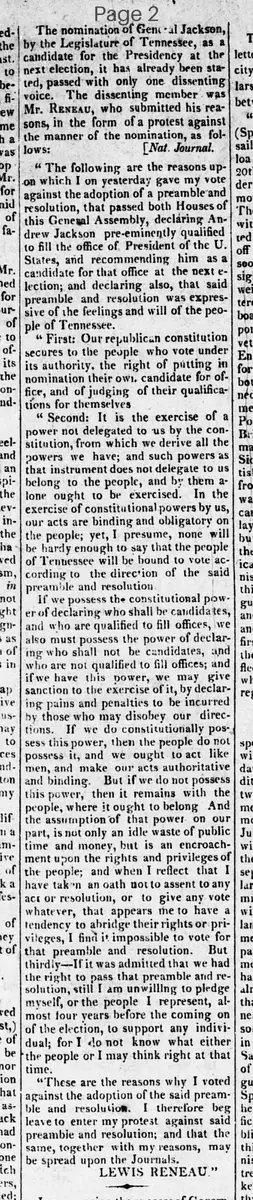
[Nat. Journal.]
"The following are the reasons upon which I on yesterday gave my vote against the adoption of a preamble and resolution, that passed both Houses of this General Assembly, declaring Andrew Jackson pre-eminently qualified to fill the office of President of the U. States, and recommending him as a candidate for that office at the next election; and declaring also, that said preamble and resolution was expressive of the feelings and will of the people of Tennessee.
First: Our republican constitution secures to the people who vote under its authority, the right of putting in nomination their own candidate for office, and of judging of their qualifications for themselves.
Second: It is the exercise of a power not delegated to us by the constitution, from which we derive all the powers we have; and such powers as that instrument does not delegate to us belong to the people, and by them alone ought to be exercised. In the exercise of constitutional powers by us, our acts are binding and obligatory on the people; yet, I presume, none will be hardy enough to say that the people of Tennessee will be bound to vote according to the direction of the said preamble and resolution.
If we possess the constitutional power of declaring who shall be candidates, and who are qualified to fill offices, we also must possess the power of declaring who shall not be candidates, and who are not qualified to fill offices; and if we have this power, we may give sanction to the exercise of it, by declaring pains and penalties to be incurred by those who may disobey our directions. If we do constitutionally possess this power, then the people do not possess it, and we ought to act like men, and make our acts authoritative and binding. But if we do not possess this power, then it remains with the people, where it ought to belong. And the assumption of that power on our part, is not only an idle waste of public time and money, but is an encroachment upon the rights and privileges of the people; and when I reflect that I have taken an oath not to assent to any act or resolution, or to give any vote whatever, that appears to me to have a tendency to abridge their rights or privileges, I find it impossible to vote for that preamble and resolution. But thirdly—If it was admitted that we had the right to pass that preamble and resolution, still I am unwilling to pledge myself, or the people I represent, almost four years before the coming on of the election, to support any individual; for I do not know what either the people or I may think right at that time.
These are the reasons why I voted against the adoption of the said preamble and resolution. I therefore beg leave to enter my protest against said preamble and resolution; and that the same, together with my reasons, may be spread upon the Journals.
LEWIS RENEAU."
What sub-type of article is it?
What keywords are associated?
What entities or persons were involved?
Where did it happen?
Domestic News Details
Primary Location
Tennessee
Key Persons
Outcome
passed with only one dissenting voice
Event Details
The Legislature of Tennessee nominated General Jackson as a candidate for the Presidency at the next election via a preamble and resolution declaring him qualified and expressive of the people's will. Lewis Reneau dissented and protested, citing constitutional issues, lack of delegated power, and unwillingness to pledge support four years early.