Thank you for visiting SNEWPapers!
Sign up free
Literary
June 14, 1908
The Morning Astorian
Astoria, Clatsop County, Oregon
What is this article about?
Broker Alfred Southerland hires detective Edgar Dunton to recover $50,000 in stolen securities from his safe. Suspecting secretary Reginald Varney, Dunton traces a sold bond to New York and encounters Southerland's daughter Mildred, who has fled home and possesses the remaining securities.
Clipping
OCR Quality
95%
Excellent
Full Text
Some Ducats and a Daughter.
By
HOWARD FIELDING.
Copyright, 1907, by C. W. Hooke.
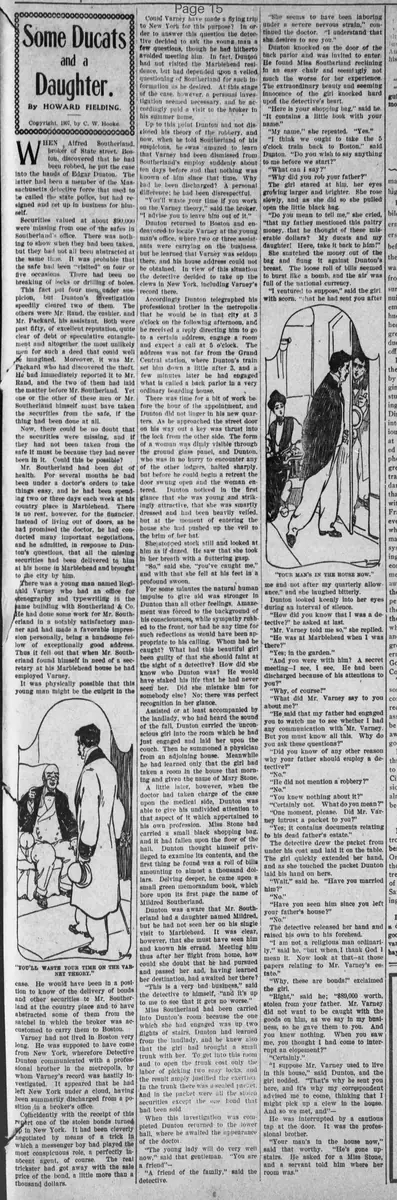
When Alfred Southerland, broker of State street, Boston, discovered that he had been robbed, he put the case into the hands of Edgar Dunton. The latter had been a member of the Massachusetts detective force that used to be called the state police, but had resigned and set up in business for himself.
Securities valued at about $50,000 were missing from one of the safes in Southerland's office. There was nothing to show when they had been taken, but they had not all been abstracted at the same time. It was probable that the safe had been "visited" on four or five occasions. There had been no breaking of locks or drilling of holes. This fact put four men under suspicion, but Dunton's investigation speedily cleared two of them. The others were Mr. Rand, the cashier, and Mr. Packard, his assistant. Both were past fifty, of excellent reputation, quite clear of debt or speculative entanglement and altogether the most unlikely men for such a deed that could well be imagined. Moreover, it was Mr. Packard who had discovered the theft. He had immediately reported it to Mr. Rand, and the two of them had laid the matter before Mr. Southerland. Yet one or the other of these men or Mr. Southerland himself must have taken the securities from the safe, if the thing had been done at all.
Now, there could be no doubt that the securities were missing, and if they had not been taken from the safe it must be because they had never been in it. Could this be possible? Mr. Southerland had been out of health. For several months he had been under a doctor's orders to take things easy, and he had been spending two or three days each week at his country place in Marblehead. There is no rest, however, for the financier. Instead of living out of doors, as he had promised the doctor, he had conducted many important negotiations, and he admitted, in response to Dunton's questions, that all the missing securities had been delivered to him at his hotel in Marblehead and brought to the city by him.
There was a young man named Reginald Varney who had an office for stenography and typewriting in the same building with Southerland & Co. He had done some work for Mr. Southerland in a notably satisfactory manner and had made a favorable impression personally, being a handsome fellow of exceptionally good address. Thus it fell out that when Mr. Southerland found himself in need of a secretary at his Marblehead house he had employed Varney.
It was physically possible that this young man might be the culprit in the case. He would have been in a position to know of the delivery of bonds and other securities to Mr. Southerland at the country place and to have abstracted some of them from the satchel in which the broker was accustomed to carry them to Boston. Varney had not lived in Boston very long. He was supposed to have come from New York, wherefore Detective Dunton communicated with a professional brother in the metropolis, by whom Varney's record was hastily investigated. It appeared that he had left New York under a cloud, having been summarily discharged from a position in a broker's office.
Coincidentally with the receipt of this report one of the stolen bonds turned up in New York. It had been cleverly negotiated by means of a trick in which a messenger boy had played the most conspicuous role, a perfectly innocent agent, of course. The real trickster had got away with the sale price of the bond, a little more than a thousand dollars.
Could Varney have made a flying trip to New York for this purpose? In order to answer this question the detective decided to ask the young man a few questions, though he had hitherto avoided meeting him. In fact, Dunton had not visited the Marblehead residence, but had depended upon a veiled questioning of Southerland for such information as he desired. At this stage of the case, however, a personal investigation seemed necessary, and he accordingly paid a visit to the broker in his summer home.
Up to this point Dunton had not disclosed his theory of the robbery, and now, when he told Southerland of his suspicions, he was amazed to learn that Varney had been dismissed from Southerland's employ suddenly about ten days before and that nothing was known of him since that time. Why had he been discharged? A personal difference; he had been disrespectful.
"You'll waste your time if you work on the Varney theory," said the broker. "I advise you to leave him out of it."
Dunton returned to Boston and endeavored to locate Varney at the young man's office, where two or three assistants were carrying on the business, but he learned that Varney was seldom there, and his house address could not be obtained. In view of this situation the detective decided to take up the clues in New York, including Varney's record there.
Accordingly Dunton telegraphed his professional brother in the metropolis that he would be in that city at 4 o'clock on the following afternoon, and he received a reply directing him to go to a certain address, engage a room and expect a call at 5 o'clock. The address was not far from the Grand Central station, where Dunton's train set him down a little after 3, and a few minutes later he had engaged what is called a back parlor in a very ordinary boarding house.
There was time for a bit of work before the hour of the appointment, and Dunton did not linger in his new quarters. As he approached the street door on his way out a key was thrust into the lock from the other side. The form of a woman was dimly visible through the ground glass panel, and Dunton, who was in no hurry to encounter any of the other lodgers, halted sharply, but before he could begin a retreat the door swung open and the woman entered. Dunton noticed in the first glance that she was young and strikingly attractive, that she was smartly dressed and had been heavily veiled, but at the moment of entering the house she had pushed up the veil to the brim of her hat.
She stopped stock still and looked at him as if dazed. He saw that she took in her breath with a fluttering gasp.
"So," said she, "you've caught me," and with that she fell at his feet in a profound swoon.
For some minutes the natural human impulse to give aid was stronger in Dunton than all other feelings. Amazement was forced to the background of his consciousness, while sympathy rushed to the front, nor had he any time for such reflections as would have been appropriate to his calling. Whom had he caught? What had this beautiful girl been guilty of that she should faint at the sight of a detective? How did she know who Dunton was? He would have staked his life that he had never seen her. Did she mistake him for somebody else? No; there was perfect recognition in her glance.
Assisted or at least accompanied by the landlady, who had heard the sound of the fall, Dunton carried the unconscious girl into the room which he had just engaged and laid her upon the couch. Then he summoned a physician from an adjoining house. Meanwhile he had learned only that the girl had taken a room in the house that morning and given the name of Mary Stone. A little later, however, when the doctor had taken charge of the case upon the medical side, Dunton was able to give his undivided attention to that aspect of it which appertained to his own profession. Miss Stone had carried a small black shopping bag, and it had fallen upon the floor of the hall. Dunton thought himself privileged to examine its contents, and the first thing he found was a roll of bills amounting to almost a thousand dollars. Delving deeper, he came upon a small green memorandum book, which bore upon its first page the name of Mildred Southerland.
Dunton was aware that Mr. Southerland had a daughter named Mildred, but he had not seen her on his single visit to Marblehead. It was clear, however, that she must have seen him and known his errand. Meeting him thus after her flight from home, how could she doubt that he had pursued and passed her and, having learned her destination, had awaited her there?
"This is a very bad business," said the detective to himself, "and it's up to me to see that it gets no worse."
Miss Southerland had been carried into Dunton's room because the one which she had engaged was up two flights of stairs, Dunton had learned from the landlady, and he knew also that the girl had brought a small trunk with her. To get into this room and to open the trunk cost only the labor of picking two easy locks, and the result amply justified the exertion. In the trunk there was a sealed packet, and in the packet were all the stolen securities except the one bond that had been sold.
When this investigation was completed Dunton returned to the lower hall, where he awaited the appearance of the doctor.
"The young lady will do very well now," said that gentleman. "You are a friend?"
"A friend of the family," said the detective.
By
HOWARD FIELDING.
Copyright, 1907, by C. W. Hooke.
When Alfred Southerland, broker of State street, Boston, discovered that he had been robbed, he put the case into the hands of Edgar Dunton. The latter had been a member of the Massachusetts detective force that used to be called the state police, but had resigned and set up in business for himself.
Securities valued at about $50,000 were missing from one of the safes in Southerland's office. There was nothing to show when they had been taken, but they had not all been abstracted at the same time. It was probable that the safe had been "visited" on four or five occasions. There had been no breaking of locks or drilling of holes. This fact put four men under suspicion, but Dunton's investigation speedily cleared two of them. The others were Mr. Rand, the cashier, and Mr. Packard, his assistant. Both were past fifty, of excellent reputation, quite clear of debt or speculative entanglement and altogether the most unlikely men for such a deed that could well be imagined. Moreover, it was Mr. Packard who had discovered the theft. He had immediately reported it to Mr. Rand, and the two of them had laid the matter before Mr. Southerland. Yet one or the other of these men or Mr. Southerland himself must have taken the securities from the safe, if the thing had been done at all.
Now, there could be no doubt that the securities were missing, and if they had not been taken from the safe it must be because they had never been in it. Could this be possible? Mr. Southerland had been out of health. For several months he had been under a doctor's orders to take things easy, and he had been spending two or three days each week at his country place in Marblehead. There is no rest, however, for the financier. Instead of living out of doors, as he had promised the doctor, he had conducted many important negotiations, and he admitted, in response to Dunton's questions, that all the missing securities had been delivered to him at his hotel in Marblehead and brought to the city by him.
There was a young man named Reginald Varney who had an office for stenography and typewriting in the same building with Southerland & Co. He had done some work for Mr. Southerland in a notably satisfactory manner and had made a favorable impression personally, being a handsome fellow of exceptionally good address. Thus it fell out that when Mr. Southerland found himself in need of a secretary at his Marblehead house he had employed Varney.
It was physically possible that this young man might be the culprit in the case. He would have been in a position to know of the delivery of bonds and other securities to Mr. Southerland at the country place and to have abstracted some of them from the satchel in which the broker was accustomed to carry them to Boston. Varney had not lived in Boston very long. He was supposed to have come from New York, wherefore Detective Dunton communicated with a professional brother in the metropolis, by whom Varney's record was hastily investigated. It appeared that he had left New York under a cloud, having been summarily discharged from a position in a broker's office.
Coincidentally with the receipt of this report one of the stolen bonds turned up in New York. It had been cleverly negotiated by means of a trick in which a messenger boy had played the most conspicuous role, a perfectly innocent agent, of course. The real trickster had got away with the sale price of the bond, a little more than a thousand dollars.
Could Varney have made a flying trip to New York for this purpose? In order to answer this question the detective decided to ask the young man a few questions, though he had hitherto avoided meeting him. In fact, Dunton had not visited the Marblehead residence, but had depended upon a veiled questioning of Southerland for such information as he desired. At this stage of the case, however, a personal investigation seemed necessary, and he accordingly paid a visit to the broker in his summer home.
Up to this point Dunton had not disclosed his theory of the robbery, and now, when he told Southerland of his suspicions, he was amazed to learn that Varney had been dismissed from Southerland's employ suddenly about ten days before and that nothing was known of him since that time. Why had he been discharged? A personal difference; he had been disrespectful.
"You'll waste your time if you work on the Varney theory," said the broker. "I advise you to leave him out of it."
Dunton returned to Boston and endeavored to locate Varney at the young man's office, where two or three assistants were carrying on the business, but he learned that Varney was seldom there, and his house address could not be obtained. In view of this situation the detective decided to take up the clues in New York, including Varney's record there.
Accordingly Dunton telegraphed his professional brother in the metropolis that he would be in that city at 4 o'clock on the following afternoon, and he received a reply directing him to go to a certain address, engage a room and expect a call at 5 o'clock. The address was not far from the Grand Central station, where Dunton's train set him down a little after 3, and a few minutes later he had engaged what is called a back parlor in a very ordinary boarding house.
There was time for a bit of work before the hour of the appointment, and Dunton did not linger in his new quarters. As he approached the street door on his way out a key was thrust into the lock from the other side. The form of a woman was dimly visible through the ground glass panel, and Dunton, who was in no hurry to encounter any of the other lodgers, halted sharply, but before he could begin a retreat the door swung open and the woman entered. Dunton noticed in the first glance that she was young and strikingly attractive, that she was smartly dressed and had been heavily veiled, but at the moment of entering the house she had pushed up the veil to the brim of her hat.
She stopped stock still and looked at him as if dazed. He saw that she took in her breath with a fluttering gasp.
"So," said she, "you've caught me," and with that she fell at his feet in a profound swoon.
For some minutes the natural human impulse to give aid was stronger in Dunton than all other feelings. Amazement was forced to the background of his consciousness, while sympathy rushed to the front, nor had he any time for such reflections as would have been appropriate to his calling. Whom had he caught? What had this beautiful girl been guilty of that she should faint at the sight of a detective? How did she know who Dunton was? He would have staked his life that he had never seen her. Did she mistake him for somebody else? No; there was perfect recognition in her glance.
Assisted or at least accompanied by the landlady, who had heard the sound of the fall, Dunton carried the unconscious girl into the room which he had just engaged and laid her upon the couch. Then he summoned a physician from an adjoining house. Meanwhile he had learned only that the girl had taken a room in the house that morning and given the name of Mary Stone. A little later, however, when the doctor had taken charge of the case upon the medical side, Dunton was able to give his undivided attention to that aspect of it which appertained to his own profession. Miss Stone had carried a small black shopping bag, and it had fallen upon the floor of the hall. Dunton thought himself privileged to examine its contents, and the first thing he found was a roll of bills amounting to almost a thousand dollars. Delving deeper, he came upon a small green memorandum book, which bore upon its first page the name of Mildred Southerland.
Dunton was aware that Mr. Southerland had a daughter named Mildred, but he had not seen her on his single visit to Marblehead. It was clear, however, that she must have seen him and known his errand. Meeting him thus after her flight from home, how could she doubt that he had pursued and passed her and, having learned her destination, had awaited her there?
"This is a very bad business," said the detective to himself, "and it's up to me to see that it gets no worse."
Miss Southerland had been carried into Dunton's room because the one which she had engaged was up two flights of stairs, Dunton had learned from the landlady, and he knew also that the girl had brought a small trunk with her. To get into this room and to open the trunk cost only the labor of picking two easy locks, and the result amply justified the exertion. In the trunk there was a sealed packet, and in the packet were all the stolen securities except the one bond that had been sold.
When this investigation was completed Dunton returned to the lower hall, where he awaited the appearance of the doctor.
"The young lady will do very well now," said that gentleman. "You are a friend?"
"A friend of the family," said the detective.
What sub-type of article is it?
Prose Fiction
What themes does it cover?
Commerce Trade
Moral Virtue
What keywords are associated?
Detective Story
Stolen Securities
Family Involvement
Financial Theft
Mystery Resolution
What entities or persons were involved?
By Howard Fielding.
Literary Details
Title
Some Ducats And A Daughter.
Author
By Howard Fielding.