Thank you for visiting SNEWPapers!
Sign up free
The New Hampshire Gazette
Portsmouth, Rockingham County, New Hampshire
What is this article about?
John Adams, in a letter from Quincy dated January 9, 1808, critiques the British King's Proclamation of October 22, 1807, for authorizing impressment of seamen from American merchant ships. He argues it violates laws of nations, natural rights, and U.S. sovereignty, justifying U.S. embargo or war response.
Merged-components note: Continuation of the 'IMPORTANT Political Retrospect' by John Adams across pages 1 and 2, maintaining coherent topic on British impressment and foreign policy.
Clippings
1 of 2
OCR Quality
Full Text
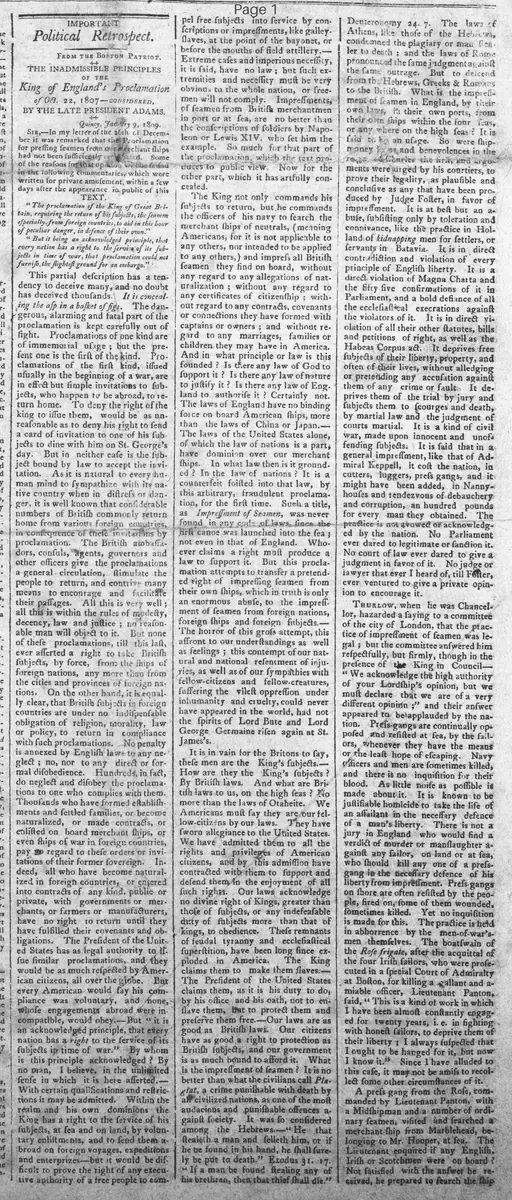
Political Retrospect.
From the Boston Patriot.
THE INADMISSIBLE PRINCIPLES
OF THE
King of England's Proclamation
of Oct. 22, 1807—CONSIDERED,
BY THE LATE PRESIDENT ADAMS.
"Quincy, January 9, 1808."
SIR,—In my letter of the 25th of December it was remarked that the Proclamation for pressing seamen from any merchant ships had not been sufficiently read. Some of the reasons for that opinion will be found in the following commentaries, which were written for private amusement, within a few days after the appearance in public of this
TEXT.
"The proclamation of the King of Great Britain, requiring the return of his subjects, the seamen especially, from foreign countries, to aid in this hour of peculiar danger, in defence of their own."
"But it being an acknowledged principle, that every nation has a right to the service of its sub- jects in time of war, that proclamation could not furnish the slightest ground for an embargo."
This partial description has a tendency to deceive many, and no doubt has deceived thousands. It is concealing the asp in a basket of figs. The dangerous, alarming and fatal part of the proclamation is kept carefully out of sight. Proclamations of one kind are of immemorial usage; but the present one is the first of the kind. Proclamations of the first kind, issued usually in the beginning of a war, are in effect but simple invitations to sub- jects, who happen to be abroad, to return home. To deny the right of the king to issue them, would be as unreasonable as to deny his right to send a card of invitation to one of his sub- jects to dine with him on St. George's day. But in neither case is the sub- ject bound by law to accept the invitation. As it is natural to every human mind to sympathize with its native country when in distress or danger, it is well known that considerable numbers of British commonly return home from various foreign countries, in consequence of these invitations by proclamation. The British ambassadors, consuls, agents, governors and other officers give the proclamations a general circulation, stimulate the people to return, and contrive many means to encourage and facilitate their passages. All this is very well; all this is within the rules of modesty, decency, law and justice; no reasonable man will object to it. But none of these proclamations, till this last, ever asserted a right to take British subjects, by force, from the ships of foreign nations, any more than from the cities and provinces of foreign nations. On the other hand, it is equally clear, that British sub- jects in foreign countries are under no indispensable obligation of religion, morality, law or policy, to return in compliance with such proclamations. No penalty is annexed by English laws to any neglect; no, nor to any direct or formal disobedience. Hundreds, in fact, do neglect and disobey the proclamations to one who complies with them. Thousands who have formed establishments and settled families, or become naturalized, or made contracts, or enlisted on board merchant ships, or even ships of war in foreign countries, pay no regard to these orders or invitations of their former sovereign. Indeed, all who have become natural- ized in foreign countries, or entered into contracts of any kind, public or private, with governments or mer- chants, or farmers or manufacturers, have no right to return until they have fulfilled their covenants and ob- ligations. The President of the United States has as legal authority to issue similar proclamations, and they would be as much respected by American citizens, all over the globe. But every American would say his compliance was voluntary, and none, whose engagements abroad were incompatible, would obey.—But "it is an acknowledged principle, that every nation has a right to the service of its subjects in time of war." By whom is this principle acknowledged? By no man, I believe, in the unlimited sense in which it is here asserted.— With certain qualifications and restrictions it may be admitted. Within the realm and his own dominions the King has a right to the service of his subjects, at sea and on land, by voluntary enlistments, and to send them abroad on foreign voyages, expeditions and enterprizes—but it would be difficult to prove the right of any executive authority of a free people to com- pel free subjects into service by con- scriptions or impressments, like galley slaves, at the point of the bayonet, or before the mouths of field artillery.— Extreme cases and imperious necessity, it is said, have no law: but such extremities and necessity must be very obvious to the whole nation, or free- men will not comply. Impressments of seamen from British merchantmen in port or at sea, are no better than the conscriptions of soldiers by Napoleon or Louis XIV. who set him the example. So much for that part of the proclamation, which the text produces to public view. Now for the other part, which it has artfully concealed.
The King not only commands his subjects to return, but he commands the officers of his navy to search the merchant Ships of neutrals, (meaning Americans, for it is not applicable to any others, nor intended to be applied to any others) and impress all British seamen they find on board, without any regard to any allegations of naturalization; without any regard to any certificates of citizenship; without regard to any contracts, covenants or connections they have formed with captains or Owners; and without regard to any marriages, families or children they may have in America.
And in what principle or law is this founded? Is there any law of God to support it? Is there any law of nature to justify it? Is there any law of England to authorize it? Certainly not. The laws of England have no binding force on board American ships, more than the laws of China or Japan.— The laws of the United States alone, of which the law of nations is a part; have dominion over our merchant ships. In what law then is it grounded? In the law of nations? It is a counterfeit foisted into that law, by this arbitrary, fraudulent proclamation, for the first time. Such a title, as Impressment of Seamen, was never found in any code of laws, since the first canoe was launched into the sea; not even in that of England. Whoever claims a right must produce a law to support it. But this proclamation attempts to transfer a pretended right of impressing seamen from their own ships, which in truth is only an enormous abuse, to the impressment of seamen from foreign nations, foreign ships and foreign subjects.— The horror of this gross attempt, this affront to our understandings as well as feelings; this contempt of our natural and national resentment of injuries, as well as of our sympathies with fellow-citizens and fellow-creatures, suffering the vilest oppression under inhumanity and cruelty, could never have appeared in the world, had not the spirits of Lord Bute and Lord George Germaine risen again at St. James's.
It is in vain for the Britons to say, these men are the King's subjects.— How are they the King's subjects? By British laws. And what are British laws to us, on the high seas? No more than the laws of Otaheite. We Americans must say they are our fellow-citizens by our laws. They have sworn allegiance to the United States. We have admitted them to all the rights and privileges of American citizens, and by this admission have contracted with them to support and defend them in the enjoyment of all such rights. Our laws acknowledge no divine right of Kings, greater than those of subjects, or any indefeasible duty of subjects more than that of kings, to obedience. These remnants of feudal tyranny and ecclesiastical superstition, have been long since exploded in America. The King claims them to make them slaves.— The President of the United States claims them, as it is his duty to do, by his office and his oath, not to enslave them, but to protect them and preserve them free.—Our laws are as good as British laws. Our citizens have as good a right to protection as British subjects, and our government is as much bound to afford it. What is the impressment of seamen? It is no better than what the civilians call Plagiat, a crime punishable with death by all civilized nations, as one of the most audacious and punishable offences against society. It was so considered among the Hebrews. "He that stealeth a man and selleth him, or if he be found in his hand, he shall surely be put to death." Exodus 21. 17. "If a man be found stealing any of his brethren, then that thief shall die." Deuteronomy 24. 7. The laws of Athens, like those of the Hebrews, condemned the plagiary or man stealer to death; and the laws of Rome pronounced the same judgment against the same outrage. But to descend from the Hebrews, Greeks & Romans to the British. What is the impressment of seamen in England, by their own laws, in their own ports, from their own ships within the four seas, or any where on the high seas? It is said to be an usage. So were ship-money, taxes and benevolences in the reign of Charles the first, and argu- ments were urged by his courtiers, to prove their legality, as plausible and conclusive as any that have been produced by Judge Foster, in favor of impressment. It is at best but an abuse, subsisting only by toleration and connivance, like the practice in Holland of kidnapping men for settlers, or servants in Batavia. It is in direct contradiction and violation of every principle of English liberty. It is a direct violation of Magna Charta and the fifty-six confirmations of it in Parliament, and a bold defiance of all the ecclesiastical execrations against the violators of it. It is in direct violation of all their other statutes, bills and petitions of right, as well as the Habeas Corpus act. It deprives free subjects of their liberty, property, and often of their lives, without alleging or pretending any accusation against them of any crime or fault. It deprives them of the trial by jury and subjects them to scourges and death, by martial law and the judgment of courts martial. It is a kind of civil war, made upon innocent and unoffending subjects: It is said that in a general impressment, like that of Admiral Keppel, it cost the nation, in cutters, luggers, press gangs, and it might have been added, in Nanny- houses and rendezvous of debauchery and corruption, an hundred pounds for every man they obtained. The practice is not avowed or acknowledged by the nation. No Parliament ever dared to legitimate or sanction it. No court of law ever dared to give a judgment in favor of it. No judge or lawyer that ever I heard of, till Foster, ever ventured to give a private opinion to encourage it. Thurlow, when he was Chancellor, hazarded a saying to a committee of the city of London, that the practice of impressment of seamen was legal; but the committee answered him respectfully, but firmly, though in the presence of the King in Council "We acknowledge the high authority of your Lordship's opinion, but we must declare that we are of a very different opinion;" and their answer appeared to be applauded by the nation. Press-gangs are continually opposed and resisted at sea, by the sailors, whenever they have the means or the least hope of escaping. Navy officers and men are sometimes killed, and there is no inquisition for their blood. As little noise as possible is made about it. It is known to be justifiable homicide to take the life of an assailant in the necessary defence of a man's liberty. There is not a jury in England who would find a verdict of murder or manslaughter against any sailor, on land or at sea, who should kill any one of a press- gang in the necessary defence of his liberty from impressment. Press-gangs on shore are often resisted by the people, fired on, some of them wounded, sometimes killed. Yet no inquisition is made for this. The practice is held in abhorrence by the men-of-war's- men themselves. The boatswain of the Roe frigate, after the acquittal of the four Irish sailors, who were prosecuted in a special Court of Admiralty at Boston, for killing a gallant and amiable officer, Lieutenant Panton, said, "This is a kind of work in which I have been almost constantly engaged for twenty years, i. e. in fighting with honest sailors, to deprive them of their liberty; I always suspected that I ought to be hanged for it, but now I know it." Since I have alluded to this case, it may not be amiss to recollect some other circumstances of it. A press-gang from the Roe, commanded by Lieutenant Panton, with a Midshipman and a number of ordinary seamen, visited and searched a merchant-ship from Marblehead, belonging to Mr. Hooper, at sea. The Lieutenant enquired if any English, Irish or Scotchmen were on board? Not satisfied with the answer he received, he prepared to search the ship
from stem to stern. At last he found four Irishmen retired and concealed in the forepeak.--With words and pistols he immediately laid siege to the enclosure and summoned the men to surrender. Corbett, who had the cool intrepidity of a Nelson, reasoned, remonstrated and laid down the law with the precision of a Mansfield.-- "I know who you are. You are the Lieutenant of a man of war, come with a press-gang to deprive me of my liberty. You have no right to impress me. I have retreated from you as far as I can; I can go no farther. I and my companions are determined to stand upon our defence. Stand off." The sailors within and without employed their usual language to each other, and a Midshipman, in the confusion, fired a pistol into the forepeak and broke an arm of one of the four. Corbett, who stood at the entrance, was engaged in a contest of menaces and defiances with the Lieutenant.-- He repeated what he had before said, and marking a line with a harpoon in the salt, with which the ship was loaded, said, "You are determined to deprive me of my liberty, and I am determined to defend it. If you step over that line, I shall consider it as a proof that you are determined to impress me, and by the eternal God of Heaven, you are a dead man." "Aye, my lad," said the Lieutenant, "I have seen many a brave fellow, before now." Taking his snuff-box out of his pocket, and taking a pinch of snuff, he very deliberately stepped over the line and attempted to seize Corbett. The latter, drawing back his arm, and driving his harpoon with all his force, cut off the carotid artery and jugular vein, and laid the Lieut. dead at his feet.-- The Rose sent a reinforcement to the press-gang; broke down the bulk-head, and seized the four Irishmen, and brought them to trial for piracy and murder. The Court consisted of Governor Bernard, Governor Wentworth, Chief Justice Hutchinson, Judge Auchmuty, Commodore Hood himself, who then commanded all the ships of war on the station, now a peer of the British Empire, and twelve or fifteen others. Counsellors of Mass. chusetts, New-Hampshire and Rhode-Island. After the trial, the President. Governor Bernard, pronounced the judgment of the Court, that the action of the prisoners was justifiable homicide, and in this opinion the whole Court was unanimous. The sailor who was wounded in the arm, brought an action against the Midshipman, and Commodore Hood himself interposed and made compensation to the Sailor, to his satisfaction, after which the action was withdrawn.-Such was the impressment of seamen, as it stood, by law, before our revolution. The author of my text, then, carries his courtly compliance to the English government, farther than the Governors Bernard and Hutchinson, and even than Lord Hood carried it, when we were a part of the British empire. He thinks, that, as every nation has a right to the service of its subjects, in time of war, the proclamation of the King of Great Britain, commanding his naval officers to practise such impressments, on board, not the vessels of his own subjects, but, of the United States, a foreign nation, could not furnish the slightest ground for an Embargo! It is not necessary for me to say, that any thing could furnish a sufficient ground for an embargo, for any long time; this, I leave to the responsibility of our President, Senators and Representatives in Congress. But, I say, with confidence, that it furnished a sufficient ground for a declaration of war. Not the murder of Pierce, nor all the murders, on board the Chesapeake, nor all the other injuries and insults, we have received from Foreign nations, atrocious as they have been, can be of such dangerous, lasting and pernicious consequence to this country, as this proclamation, if we have servility enough to submit to it. What would the author of my text have advised? Would he counsel the President to stipulate, in a treaty with Great Britain, that his navy officers should forever hereafter have a right to visit all American Merchant ships, and impress from them all English, Scotch and Irish Seamen? Will he be so good as to explain the distinction between ships of war and merchant ships." Are not merchant ships under the jurisdiction and entitled to the protection of the laws of their country upon the high seas, as much as ships of war. Is not a merchant ship as much the territory of the United States, as a Ship of war -Would the author of my text advise the President and Congress to acquiesce, in silence. it to be executed forever hereafter? under this proclamation, and permit Would not such a tame and silent acquiescence, as effectually yield the point, and establish the practice, if not the law, as an express stipulation in a Solemn treaty? If the United States had as powerful a navy as Great Britain, and Great Britain as feeble a farce at sea, as ours, would he advise the President, either to concede the principle, by treaty, or acquiesce in it, in silence? Does the circumstance of great power or great weakness make any alteration in the principle or the right? Should the Capt. or crew of an American merchantman, resist a British press-gang on the high seas, and in defence of their liberty, kill the commander, and all under him, and then make their escape, and after returning to Salem, be prosecuted, would the writer of my text, as a judge or a juror, give his judgment for finding them guilty of murder or piracy? Although the Embargo was made the watchword, in our late elections, the votes, in our greatest nurseries of seamen, for example, in Sa. lem, in Marblehead, in Barnstable. Sandwich and other places on Cape Cod, in Nantucket and the Vineyard and other places, seemed to shew, that our seamen preferred to be embargoed, rather than go to sea to be impressed. No doubt, it will be said, that we have nothing to do with the question in England, concerning the legality or illegality of impressments. This. as long as they confine the law and the practice to their own country, to their own ships, and their own sea- men, is readily acknowledged. We shall leave them to justify their own usage, whether it is a mere abuse, or a legitimate custom, to their own consciences, to their own sense of equity, humanity or policy. But when they arrogate a right, and presume in fact to transfer their usurpation to foreign nations, or rather to Americans, whom they presume to distinguish from all other foreign nations, it becomes the interest, the right, and the indispensable duty of our Government to enquire into the nefarious nature of it in England, in order to expose the greater turpitude of it when tran- sferred to us, as well as to oppose and resist it to the utmost of their power, and it is equally the duty of the peo- ple to support their government in such opposition to the last extremity. Permit me now to enquire, what will be the effects of an established law and practice of British impress. ments of seamen, from American ships, upon the commerce, the navigation and the peace of the United States, and, above all, upon the hearts and minds of our seamen. In considering those innumerable dangers, from winds and seas, rocks and shoals, to which all ships are ex- posed, in their voyages, the owner and master must sit it down together, in order to determine the number of sea- men necessary for the voyage. They must calculate the chances of impressment, and engage a supernumerary list of sailors, that they may be able to spare as many, as the British lieu- tenant shall please to take, and have enough left, to secure the safety of the ship and cargo : and, above all. the lives of the master and crew.-- They know not how many British ships of war they may meet, nor how many sailors the conscience of each lieutenant may allow him to impress. For the lieutenant is to be judge, ju- ry, sheriff and gaoler, to every sea- man in American vessels. He is to try many important questions of law and of fact. Whether the sailor is a native of America; whether he has been lawfully naturalized in America. Whether he is an Englishman, Scotch- man or Irishman. Whether he emigra- ted to America before the revolution, or since? Indeed, no evidence is to be admitted, of any naturalization by our laws, in any of the states, since the revo- lution, if before. In truth, the doctrine of the inherent and indefeasible duty of allegiance is asserted, so perempto- rily, in the proclamation, that the lieutenant may think it his duty to impress every man, who was born in the British dominions. It may be the opinion of this learned judge, that the connection between the king and sub- ject is so sacred and divine. that alle- giance cannot be dissolved by any treaty the king has made, or even by any act of parliament. And this pious sentiment may subject us all to impressment at once.-This, however, en passant. The lieutenant is to order the cap- tain of the merchantman to lay before him a list of his crew; he is then to command the crew to be ordered or summoned, or mustered -to pass in re- view before him. A tribunal ought to be erected. The lieutenant is to be the judge, possessed of greater au- thority than the Chief Justice of any of our States, or even than the Chief Justice of the United States. The midshipman is to be clerk, and the boatwain sheriff or marshal. And who are these lieutenants? Common- ly very young gentlemen, the youn- ger sons of wealthy families, who have procured their commissions to give them an honorable living, instead of putting them apprentices to trade, merchandize, law, physic or divinity; their education, their experience, their manners, their principles, are so well known, that I shall say nothing of them. Lord Keppel said, that he knew the maxim of British seamen to be, "to do no right & receive no wrong." The principles of the officers, I be- lieve to be somewhat better; but in this, they all seem to agree, officers and men, and their present ministry seem to be of the same opinion, that the world was made for the British nation and that all nature and nations were created for the dignity and om- nipotence of the British navy. It is impossible to figure to our- selves, in imagination, this solemn tri- bunal and venerable judge, without smiling, till the humiliation of our country comes into our thoughts and interrupts the sense of ridicule by the tears of grief or vengeance. "High on a splendid seat, which far out shone "Henley's gilt tub, or Flecknoe's srib throne." The Lieutenant examines the coun- tenance, the gait and air of every seaman. Like the sage of old, com- mands him to speak, "that he may know him." He pronounces his ac- cent and dialect to be that of the Scotch, Irish, West Country, York- shire, Welsh, Jersey, Guernsey, Al- derney, or Sark. Many native A- mericans are the descendants of emi- grants from all these countries, and retain a tincture of the language and pronunciation of their fathers and grandfathers. These will be decided to be the king's subjects. Many will be found to be emigrants, or the de- scendants of emigrants, from Germa- ny, Holland, Sweden, France, Spain, Portugal or Italy. These will be ad- judged by the Lieutenant to be na- tive Americans.
What sub-type of article is it?
What keywords are associated?
What entities or persons were involved?
Editorial Details
Primary Topic
Critique Of British Impressment Of Seamen From American Ships
Stance / Tone
Strongly Oppositional To British Proclamation, Defending American Sovereignty
Key Figures
Key Arguments