Thank you for visiting SNEWPapers!
Sign up free
The Massachusetts Spy, Or, Thomas's Boston Journal
Boston, Suffolk County, Massachusetts
What is this article about?
A letter to the Massachusetts Spy publishes a copy of Gen. Brattle's 1774 correspondence with Gov. Gage on militia activities in Concord and Medford, including powder removal, followed by Brattle's public defense of his compliance with orders and suggestion to disband militia officers.
Merged-components note: Merging the published copy of Gen. Brattle's letter to Gage and his subsequent public response to the same events, as they form a coherent set of related communications on the military and political tensions.
Clipping
OCR Quality
Full Text
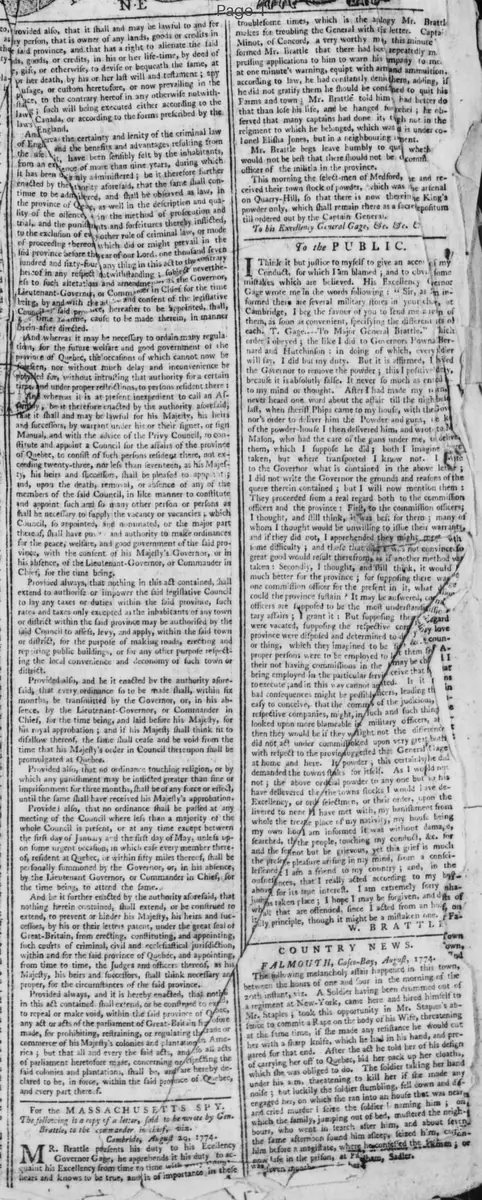
The following is a copy of a letter, said to be written by Gen. Brattle, to the commander in chief, viz.
Cambridge, August 29, 1774.
MR. Brattle presents his duty to his Excellency Governor Gage, he apprehends it his duty to acquaint his Excellency from time to time with what he hears and knows to be true, and is of importance in these troublesome times, which is the apology Mr. Brattle makes for troubling the General with this letter. Captain Minot, of Concord, a very worthy man, this minute informed Mr. Brattle that there had been repeatedly made pressing applications to him to march his company to me at one minute's warning, equipt with arms and ammunition, according to law, he had constantly denied them, adding, if he did not gratify them he should be confined to quit his farms and town: Mr. Brattle told him he had better do that than lose his life, and be hanged for his pains; he observed that many captains had done it, though not in the regiment to which he belonged, which was the 4th under colonel Elisha Jones, but in a neighbouring regiment. Mr. Brattle begs leave humbly to query whether it would not be best that there should not be one commissioned officer of the militia in the province. This morning the select-men of Medford, &c. and received their town stock of powder, which was at the arsenal on Quarry-Hill, so that there is now there the king's powder only, which shall remain there as a sacred depositum till ordered out by the Captain General.
To his Excellency General Gage, &c. &c.
To the PUBLIC.
I think it but justice to myself to give an account of my conduct, for which I am blamed; and to obviate some mistakes which are believed. His Excellency Governor Gage wrote me in the words following: "Sir, as I am informed there are several military stores in your charge, at Cambridge, I beg the favour of you to send me a return of them, as soon as convenient, specifying the different sorts of each. T. Gage.—To Major General Brattle." Which order I obeyed; the like I did to Governors Pownal, Bernard and Hutchinson: in doing of which, every soldier will say, I did but my duty. But it is affirmed, I advised the Governor to remove the powder; this I positively deny, because it is absolutely false. It never so much as entered into my mind or thought. "After I had made my return, I never heard one word about the affair till the night before last, when sheriff Phips came to my house, with the Governor's order to deliver him the powder and guns, the key of the powder-house I then delivered him, and wrote to Mr. Mason, who had the care of the guns under me, to deliver them, which I suppose he did; both I imagine were taken, but where transported I know not." I wrote to the Governor what is contained in the above letter; I did not write the Governor the grounds and reasons of the query therein contained; but I will now mention them: They proceeded from a real regard both to the commission officers and the province: First, to the commission officers; I thought, and still think, it was best for them; many of whom I thought would be unwilling to issue their warrants, and if they did not, I apprehended they might meet with some difficulty; and those that did, I was not convinced any great good would result therefrom, as if another method was taken: Secondly, I thought, and still think, it would be much better for the province; for supposing there was one commission officer for the present in it, what damage could the province sustain? It may be answered, commission officers are supposed to be the most understanding military men; I grant it: But supposing they were vacated, supposing the respective captains of the companies in the province were disposed and determined to do or attempt any thing, which they imagined to be for the good of the province, &c. if proper persons were to be employed to execute them, their not having commissions in the militia would be no objection to their being employed in the particular service. I may be charged with inconsistency in suggesting the disarming the militia, and yet approving of their being employed: Is it not easy to conceive, that the companies, might, in such and such things, be led by the judicious, and looked upon more blameable in the military officers, than they would be if they had not the difference with respect to the proving suggested that General Gage did not act under commission, joked upon very great both at home and here. It is powder; this certainly he did demand the town's stock for itself. As I would not have delivered the town's stocks I would not; the above official powder to any one but to his Excellency, or order from the selectmen or their order, upon the whole the treasure place of my nativity, my house being delivered to none I have met with, my banishment from the country cannot but be grievous, yet this grief is much lessened, oufnei for its true interest. I am extremely sorry nhat nees, that I really acted according to my best judgment. I am a friend to my country; and, in the judgs taken clace hope may be forgiven and dts of whall that are offended, since I acted from an honest, though it might be a mistaken one. Fa-
W. BRATTLE
What sub-type of article is it?
What themes does it cover?
What keywords are associated?
What entities or persons were involved?
Letter to Editor Details
Author
W. Brattle
Recipient
To The Public
Main Argument
gen. brattle reports militia resistance in concord and powder retrieval in medford to gov. gage, suggesting disbanding militia officers; he defends his compliance with orders to return and deliver military stores, denying any advice to remove powder and expressing loyalty to the province.
Notable Details