Thank you for visiting SNEWPapers!
Sign up free
Story
February 24, 1933
The Harlem News
Harlem, Blaine County, Montana
What is this article about?
A local weather observer in Great Falls, Montana, explains that the chinook wind originates in Montana's mountains, gaining warmth from compression as it descends to the plains, not from California. Similar foehn winds occur in the Alps. The true chinook is named after Chinook Indians near the Columbia River.
Clipping
OCR Quality
92%
Excellent
Full Text
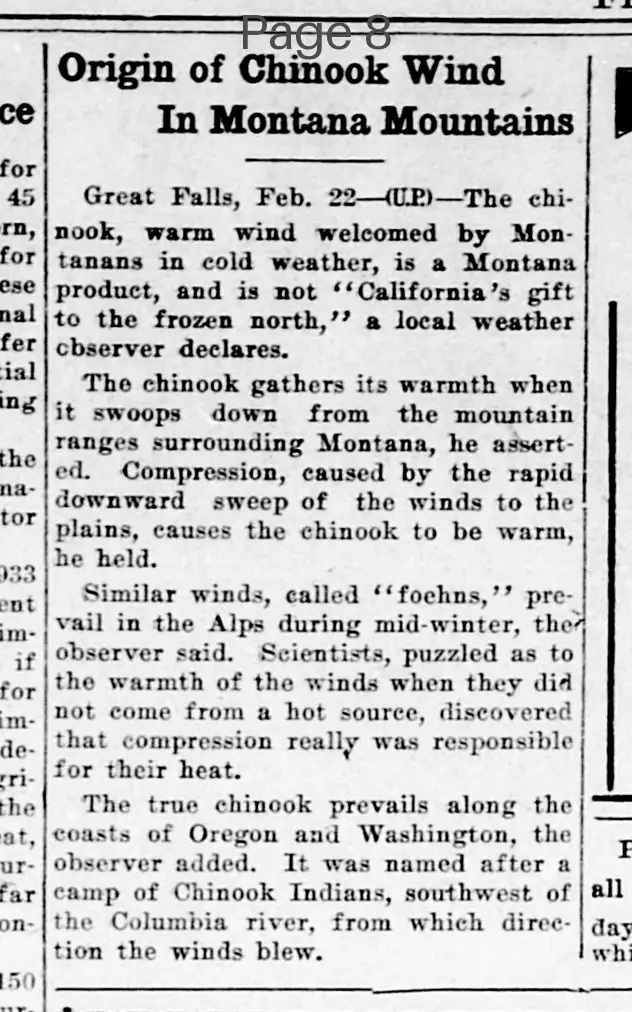
Origin of Chinook Wind In Montana Mountains
Great Falls, Feb. 22 (U.P)-The chinook, warm wind welcomed by Montanans in cold weather, is a Montana product, and is not 'California's gift to the frozen north," a local weather observer declares. The chinook gathers its warmth when it swoops down from the mountain ranges surrounding Montana, he asserted. Compression, caused by the rapid downward sweep of the winds to the plains, causes the chinook to be warm, he held. Similar winds, called "foehns," prevail in the Alps during mid-winter, the observer said. Scientists, puzzled as to the warmth of the winds when they did not come from a hot source, discovered that compression really was responsible for their heat. The true chinook prevails along the coasts of Oregon and Washington, the observer added. It was named after a camp of Chinook Indians, southwest of the Columbia river, from which direction the winds blew.
Great Falls, Feb. 22 (U.P)-The chinook, warm wind welcomed by Montanans in cold weather, is a Montana product, and is not 'California's gift to the frozen north," a local weather observer declares. The chinook gathers its warmth when it swoops down from the mountain ranges surrounding Montana, he asserted. Compression, caused by the rapid downward sweep of the winds to the plains, causes the chinook to be warm, he held. Similar winds, called "foehns," prevail in the Alps during mid-winter, the observer said. Scientists, puzzled as to the warmth of the winds when they did not come from a hot source, discovered that compression really was responsible for their heat. The true chinook prevails along the coasts of Oregon and Washington, the observer added. It was named after a camp of Chinook Indians, southwest of the Columbia river, from which direction the winds blew.
What sub-type of article is it?
Curiosity
What themes does it cover?
Nature
What keywords are associated?
Chinook Wind
Montana
Weather Phenomenon
Compression Heat
Foehn Winds
Chinook Indians
Where did it happen?
Montana Mountains, Great Falls; Coasts Of Oregon And Washington; Alps
Story Details
Location
Montana Mountains, Great Falls; Coasts Of Oregon And Washington; Alps
Story Details
Local weather observer declares chinook wind is a Montana product, warming via compression descending from mountains, not from California; similar to Alpine foehns; true chinook named after Chinook Indians near Columbia River.