Thank you for visiting SNEWPapers!
Sign up free
The Hillsborough Recorder
Hillsboro, Orange County, North Carolina
What is this article about?
The Cane Creek Agricultural Society committee in Orange County, NC, urges farmers to improve husbandry practices to restore soil fertility and increase productivity. They invite communications on agricultural experiments suited to local conditions. Amid crop failures, they recommend taxing grain distillation nearly to prohibition to curb vice and conserve grain, dated August 25, 1821.
Merged-components note: The short poem 'Rural Economy' serves as an epigraph introducing the agricultural editorial; the following two components continue the same article on agricultural improvement by the Cane Creek Society, with sequential reading order and adjacent spatial positioning.
Clipping
OCR Quality
Full Text
"And sour rich soil,
Exuberant, nature's better blessings pour
O'er every land."
For the Hillsborough Recorder.
TO AGRICULTURALISTS.
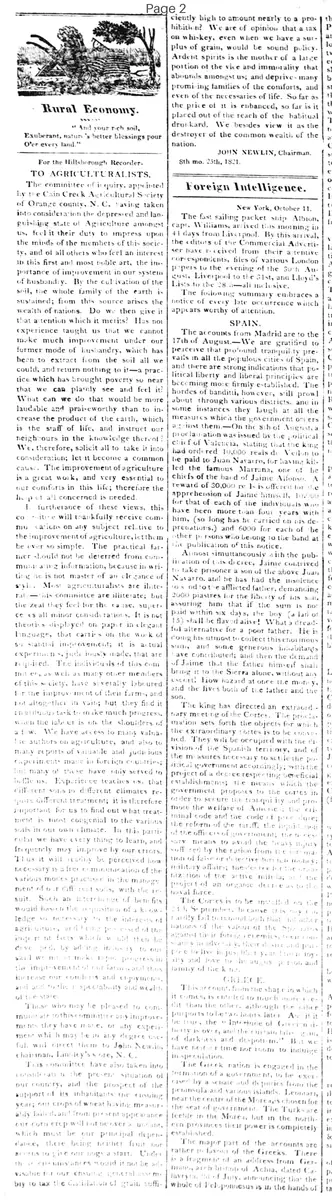
The committee of inquiry, appointed by the Cane Creek Agricultural Society of Orange county, N. C. having taken into consideration the depressed and languishing state of Agriculture amongst us, feel it their duty to impress upon the minds of the members of this society, and of all others who feel an interest in this first and most noble art, the importance of improvement in our system of husbandry. By the cultivation of the soil, the whole family of the earth is sustained; from this source arises the wealth of nations. Do we then give it that attention which it merits? Has not experience taught us that we cannot make much improvement under our former mode of husbandry, which has been to extract from the soil all we could, and return nothing to it—a practice which has brought poverty so near that we can plainly see and feel it: What can we do that would be more laudable and praiseworthy than to increase the product of the earth, which is the staff of life, and instruct our neighbours in the knowledge thereof? We, therefore, solicit all to take it into consideration; let it become a common cause. The improvement of agriculture is a great work, and very essential to our comforts in this life; therefore the help of all concerned is needed.
In furtherance of these views, this committee will thankfully receive communications on any subject relative to the improvement of agriculture, let them be ever so simple. The practical farmer should not be deterred from communicating information, because in writing he is not master of an elegance of style. Most agriculturalists are illiterate; our committee are illiterate; but the zeal they feel for the cause, supersedes all minor considerations. It is not theories displayed on paper in elegant language, that carries on the work of substantial improvement; it is actual experiments, judiciously made, that are required. The individuals of this committee, as well as many other members of this society, have severally laboured in the improvement of their farms, and not altogether in vain; but they find it arduous to make much progress, when the labour is on the shoulders of a few. We have access to many valuable authors on agriculture, and also to many reports of valuable and judicious experiments made in foreign countries: but many of these have only served to bewilder us. Experience teaches us, that different soils in different climates require different treatment; it is therefore important for us to find out what treatment is most congenial to the various soils in our own climate. In this particular we have every thing to learn, and frequently may improve by our errors. Thus it will soon be perceived how necessary is a free communication of the various modes practised in the management of our different soils, with the result. Such an interchange of benefits would hasten the acquisition of a knowledge so necessary to the interests of agriculture, and tend to the important facts which would then be developed, by adding industry to our skill we might make rapid progress in the improvement of our farms and the increase our comforts and enjoyments, and add to the respectability and wealth of the state.
Those who may be pleased to communicate to this committee any improvements they have made, or any experiments which may be in any degree useful, will address them to John Newlin, chairman, Linsley's store, N. C.
This committee have also taken into consideration the present situation of our country, and the prospect of the support of its inhabitants the ensuing year; our crops of wheat having measurably failed, and from present appearance our corn crop will not be even adequate, which must be our principal dependence, there being neither flour nor bacon to spare our legislature. Under these circumstances, would it not be advisable for our citizens generally as well as the assembly, to tax the distillation of grain sufficiently high to amount nearly to a prohibition? We are of opinion that a tax on whiskey, even when we have a surplus of grain, would be sound policy. Ardent spirits is the mother of a large portion of the vice and immorality that abounds amongst us; and deprives many promising families of the comforts, and even of the necessaries of life. So far as the price of it is enhanced, so far is it placed out of the reach of the habitual drunkard. Besides, we view it as the destroyer of the common wealth of the nation.
JOHN NEWLIN, Chairman.
8th mo. 25th, 1821.
What sub-type of article is it?
What keywords are associated?
What entities or persons were involved?
Editorial Details
Primary Topic
Improvement Of Agriculture And Taxation Of Distillation
Stance / Tone
Urging Collective Action For Agricultural Reform And Support For Whiskey Prohibition Via Taxation
Key Figures
Key Arguments