Thank you for visiting SNEWPapers!
Sign up free
Literary
January 2, 1902
Montour American
Danville, Montour County, Pennsylvania
What is this article about?
Bob Emmons, a cheerful detective, appears distracted while playing solitaire but cleverly exposes Mr. Young's theft of a valuable business contract and blackmail attempt, vindicating the innocent Miss Mariner in the process.
Clipping
OCR Quality
98%
Excellent
Full Text
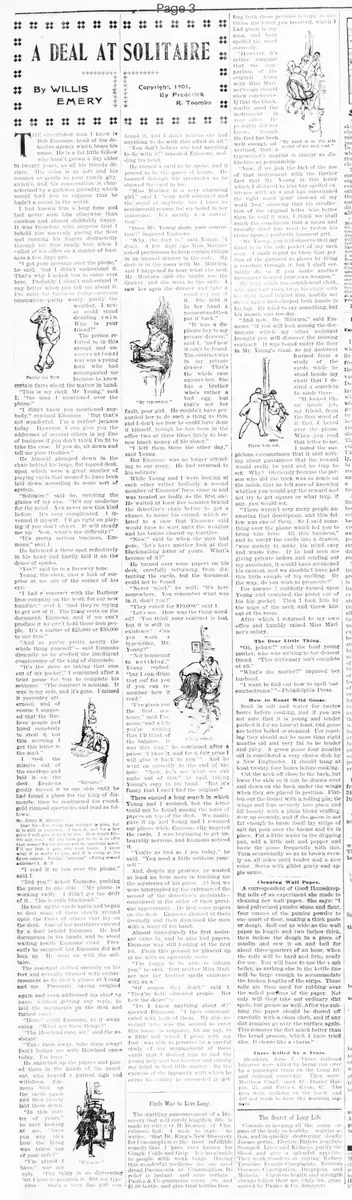
A DEAL AT SOLITAIRE
By WILLIS EMERY
Copyright, 1901, By Frederick R. Toomb.
THE cheerfulest man I know is Bob Emmons, head of the detective agency which bears his name. He is a fat little fellow who hasn't grown a day older in twenty years, as all his friends declare. His voice is as soft and his manner as gentle as your family physician's, and his conversation is characterized by a guileless garrulity which would lead you to suppose that he hadn't a secret in the world.
I had known him a long time and had never seen him otherwise than careless and almost childishly happy. It was therefore with surprise that I beheld him unevenly pacing the floor and running his fingers distractedly through his thin sandy hair when I called at his office on a matter of business a few days ago.
"I got your message over the phone," he said. "but I didn't understand it. That's why I asked you to come over here. Probably I shan't understand it any better when you tell me about it. I'm unfit for business today—nervous prostration—partly worry, partly the weather. I never could stand drizzling rain.
"Who is your friend?"
The person referred to in this abrupt and unconventional way was a young man who had accompanied me because he knew certain facts about the matter in hand.
"This is my clerk, Mr. Young," said I; "the man I mentioned over the phone."
"I didn't know you mentioned anybody," rejoined Emmons. "But that's not wonderful. I'm a perfect jackass today. However, I can give you the addresses of several others in my line of business if you don't think I'm fit to take the case. If you do, sit down and tell me your troubles."
He himself plumped down in the chair behind his large, flat-topped desk, upon which were a great number of playing cards that seemed to have been laid down according to some sort of system.
"Solitaire," said he, catching the glance of my eye. "It's my medicine for the mind. You never saw this kind before. It's very complicated. I invented it myself. I'll go right on playing if you don't object. It will steady me up. Now, what's the difficulty?"
"It's pretty serious business, Emmons," said I.
He balanced a three spot reflectively in his hand and finally laid it on the deuce of spades.
"Yes?" said he in a faraway tone.
Young, the clerk, cast a look of surprise at me out of the corner of his eye.
"I had a contract with the Barbour Iron company on the work for our new building," said I, "and they're trying to get out of it. The thing rests on the document, Emmons, and if we can't produce it we can't hold those iron people. It's a matter of $25,000 or $30,000 to our firm."
"And as you're pretty nearly the whole thing yourself"—said Emmons dreamily as he studied the intelligent countenance of the king of diamonds—
"It's the same as taking that sum out of my pocket," I continued after a brief pause for him to complete his sentence. "The contract is missing. It was in my safe, and it's gone. I missed it yesterday afternoon, and of course I supposed that the Barbour people had hired somebody to steal it, but this morning I got this letter in the mail."
I took the missive out of the envelope and laid it on the desk. Emmons gently moved it to one side until he had found a place for the king of diamonds; then he readjusted his round, gold-rimmed spectacles and read as follows:
Mr. Henry R. Minturn
Dear Sir—You think that contract is gone, but it is still in existence. I have it, and for a fair price I will give it back to you. How would $10,000 suit you? All you have got to do is to offer that reward for its return and no questions asked. I'll see that it gets into your hands. I know what it is worth to you, and it is cheap at the figure named. Publish "personal" offering reward addressed I M N
"I read it to you over the phone," said I.
"Did you?" asked Emmons, pushing the paper to one side. "My phone is working badly. I didn't get the drift of it. This is rank blackmail!"
He took up the cards again and began to deal some of them slowly around upon the faces of others that lay on the desk. One of his assistants entered by a door behind Emmons. He had documents in his hands, and he stood waiting beside Emmons' chair. Presently he coughed, but Emmons did not look up. He went on with the solitaire.
The assistant shifted uneasily on his feet and actually blushed with embarrassment as he shot a glance at Young and me. Presently, having coughed again and even addressed his chief by name without getting any reply, he laid the documents on the desk and turned away.
"Here!" cried Emmons, as if awakening. "What are these things?"
"The Howland case, sir," said the assistant.
"Take them away, take them away! Don't bother me with Howland cases today. I'm busy."
He snatched up the papers and placed them in the hands of the assistant, who heaved a patient sigh and withdrew.
Emmons took up the cards again and then slowly laid them down.
"In this matter of yours," he said, looking at me, "have you any idea how the thing was taken out of your safe?"
"I'm afraid I have," was my reply.
"The thing is so distressing that I hate to mention it. But my typewriter— She's a very fine girl—"
found it, and I don't believe she had anything to do with this affair at all."
"You don't believe she had anything to do with it!" repeated Emmons, nodding his head.
He turned a card as he spoke, and it proved to be the queen of hearts. He beamed through his spectacles as he showed the card to me.
"Miss Mariner is a very charming girl," said I, "very well educated and the equal of anybody, but I have no sentimental reason for my belief in her innocence. It's merely a—a conviction."
"Does Mr. Young share your conviction?" inquired Emmons.
"Why, the fact is," said Young, "I don't. A few days ago Miss Mariner asked permission to keep certain things in an unused drawer in the safe. My desk is in the room with Mr. Minturn, and I happened to hear what she said. Mr. Minturn said she might use the drawer, and she went to the safe. I saw her open the drawer and take a small key out of it. She held it in her hand a moment and then put it back."
"It was a duplicate key to my private drawer," said I, "and now it can't be found. The contract was in my private drawer. That's the whole case against her. She has a brother who's rather a bad egg, but that's not her fault, poor girl. He couldn't have persuaded her to do such a thing as this, and I don't see how he could have done it himself, though he has been in the office two or three times lately to borrow lunch money of his sister."
"I left them there the other day," said Young.
But Emmons was no longer attending to our story. He had returned to his solitaire.
While Young and I were looking at each other rather foolishly a second member of Emmons' force came in and was treated as badly as the first one. He waited at least five minutes behind the detective's chair before he got a chance to name his errand, which related to a case that Emmons said would have to wait until the weather and his brains cleared up together.
"Now," said he when the man had gone, "let's have another look at that blackmailing letter of yours. What's become of it?"
He turned over some papers on his desk, carefully refraining from disturbing the cards, but the document could not be found.
"Never mind," he said; "it's here somewhere. You remember what was in it, don't you?"
"They asked for $10,000," said I.
"Let's see. How was the thing worded? 'You think your contract is lost, but it is still in existence.' Can you work a typewriter, Mr. Young?"
"Not to amount to anything," Young replied.
"but I can drum that out for you if you can remember how it read."
"I've given you the first sentence," said Emmons, "and while you're writing that I'll think of the balance. It was this way," he continued after a pause: "I have it, and for a fair price I will give it back to you." And he went on correctly to the end of the note. "Now, let's see—what we can make out of this," he said, taking Young's copy in his hand. "But it's funny that I can't find the original."
There ensued a long search in which Young and I assisted, but the letter could not be found among the mass of papers on top of the desk. We finally gave it up, and Young and I resumed our places while Emmons idly fingered the cards. I was beginning to get unbearably nervous, and Emmons noticed it.
"You're as bad as I am today," he said. "You need a little solitaire yourself."
And, despite my protests, he wasted at least an hour more in teaching me the mysteries of his game. At last we were interrupted by the entrance of the second of the detective's assistants—considered in the order of their previous appearances. He laid some papers on the desk. Emmons glanced at them dreamily and then dismissed the man with a wave of his hand. Almost immediately the first assistant came in, and he also had papers. Emmons was still looking at the first lot. From this perusal he glanced up at me with an agreeable smile.
"I'm happy to be able to inform you," he said, "that neither Miss Mariner nor her brother spells existence with an 'a.'"
"Of course they don't," said I. "They're both educated people. But how the deuce—"
"Do I know anything about it?" queried Emmons. "I have communicated with both of them. My able assistant who was the second to enter this room—in response, let me say, to a little bell which I press with my foot—was able to perceive by a careful study of my arrangement of these cards that I desired him to find the young lady and her brother and satisfy my mind in that little matter. By the exercise of the ingenuity with which he earns his salary he succeeded in getting both those persons to copy at dictation the letter you received, which I had given to my man, and both spelled the word correctly.
"However, it's rather singular that the comparison of the original letter with Miss Mariner's copy should show conclusively that the blackmailer used the instrument in your office. He probably did not know, though the fact has been well enough advertised, that a typewriter's imprint is almost as distinctive as penmanship.
"Now, if we join the fact of the use of that instrument with the further fact that Mr. Young in this letter which I dictated to him has spelled ex. istence with an 'a' and has substituted the right word 'gone' instead of my word 'lost,' showing that his recollection of the original letter was better than he said it was, I think we shall reach the conclusion that a mean and rascally thief has tried to fasten his crime upon a perfectly innocent girl.
Mr. Young, you will observe that my hand is in the side pocket of my sack coat. I shall regret to blow that portion of the garment to pieces by firing a revolver through it, but I shall certainly do so if you make another movement toward your own weapon."
My very much too confidential clerk, who had half risen from his chair with his right hand behind him, hastily sat down again and clasped both hands in his lap. He tried to say something, but his mouth was too dry.
"And now, Mr. Minturn," said Emmons, "if you will look among the documents which my other assistant brought you will discover the missing contract. It was found under the floor in Mr. Young's room, as my assistant learned from a study of the cards while he stood beside my chair that I desired a search to be made there.
"It looked like an inside job, my friend, from the first word of it that I heard over the phone. When you read that letter to me I noted the suspicious circumstance that it said nothing about guarantees that the reward would really be paid and no trap be set. Why? Obviously because the person who did the trick was so much on the inside that he felt sure of knowing whether you would pay the reward and not try to get square or what trap, if any, you would set.
"There weren't very many people answering that description, and this fellow was one of them. So I said something over the phone which led you to bring him here. All this business," and he swept the cards into a drawer, "was merely to make his mind easy and waste time. If he had seen me giving private orders and sending out my assistants, it would have awakened his caution, and we shouldn't have had this little sample of his spelling. By the way, do you wish to prosecute?"
For answer I suddenly turned upon Young and snatched the pistol out of his hip pocket. Then I took him by the nape of the neck and threw him out of the room.
After which I returned to my own office and humbly raised Miss Mariner's salary.
By WILLIS EMERY
Copyright, 1901, By Frederick R. Toomb.
THE cheerfulest man I know is Bob Emmons, head of the detective agency which bears his name. He is a fat little fellow who hasn't grown a day older in twenty years, as all his friends declare. His voice is as soft and his manner as gentle as your family physician's, and his conversation is characterized by a guileless garrulity which would lead you to suppose that he hadn't a secret in the world.
I had known him a long time and had never seen him otherwise than careless and almost childishly happy. It was therefore with surprise that I beheld him unevenly pacing the floor and running his fingers distractedly through his thin sandy hair when I called at his office on a matter of business a few days ago.
"I got your message over the phone," he said. "but I didn't understand it. That's why I asked you to come over here. Probably I shan't understand it any better when you tell me about it. I'm unfit for business today—nervous prostration—partly worry, partly the weather. I never could stand drizzling rain.
"Who is your friend?"
The person referred to in this abrupt and unconventional way was a young man who had accompanied me because he knew certain facts about the matter in hand.
"This is my clerk, Mr. Young," said I; "the man I mentioned over the phone."
"I didn't know you mentioned anybody," rejoined Emmons. "But that's not wonderful. I'm a perfect jackass today. However, I can give you the addresses of several others in my line of business if you don't think I'm fit to take the case. If you do, sit down and tell me your troubles."
He himself plumped down in the chair behind his large, flat-topped desk, upon which were a great number of playing cards that seemed to have been laid down according to some sort of system.
"Solitaire," said he, catching the glance of my eye. "It's my medicine for the mind. You never saw this kind before. It's very complicated. I invented it myself. I'll go right on playing if you don't object. It will steady me up. Now, what's the difficulty?"
"It's pretty serious business, Emmons," said I.
He balanced a three spot reflectively in his hand and finally laid it on the deuce of spades.
"Yes?" said he in a faraway tone.
Young, the clerk, cast a look of surprise at me out of the corner of his eye.
"I had a contract with the Barbour Iron company on the work for our new building," said I, "and they're trying to get out of it. The thing rests on the document, Emmons, and if we can't produce it we can't hold those iron people. It's a matter of $25,000 or $30,000 to our firm."
"And as you're pretty nearly the whole thing yourself"—said Emmons dreamily as he studied the intelligent countenance of the king of diamonds—
"It's the same as taking that sum out of my pocket," I continued after a brief pause for him to complete his sentence. "The contract is missing. It was in my safe, and it's gone. I missed it yesterday afternoon, and of course I supposed that the Barbour people had hired somebody to steal it, but this morning I got this letter in the mail."
I took the missive out of the envelope and laid it on the desk. Emmons gently moved it to one side until he had found a place for the king of diamonds; then he readjusted his round, gold-rimmed spectacles and read as follows:
Mr. Henry R. Minturn
Dear Sir—You think that contract is gone, but it is still in existence. I have it, and for a fair price I will give it back to you. How would $10,000 suit you? All you have got to do is to offer that reward for its return and no questions asked. I'll see that it gets into your hands. I know what it is worth to you, and it is cheap at the figure named. Publish "personal" offering reward addressed I M N
"I read it to you over the phone," said I.
"Did you?" asked Emmons, pushing the paper to one side. "My phone is working badly. I didn't get the drift of it. This is rank blackmail!"
He took up the cards again and began to deal some of them slowly around upon the faces of others that lay on the desk. One of his assistants entered by a door behind Emmons. He had documents in his hands, and he stood waiting beside Emmons' chair. Presently he coughed, but Emmons did not look up. He went on with the solitaire.
The assistant shifted uneasily on his feet and actually blushed with embarrassment as he shot a glance at Young and me. Presently, having coughed again and even addressed his chief by name without getting any reply, he laid the documents on the desk and turned away.
"Here!" cried Emmons, as if awakening. "What are these things?"
"The Howland case, sir," said the assistant.
"Take them away, take them away! Don't bother me with Howland cases today. I'm busy."
He snatched up the papers and placed them in the hands of the assistant, who heaved a patient sigh and withdrew.
Emmons took up the cards again and then slowly laid them down.
"In this matter of yours," he said, looking at me, "have you any idea how the thing was taken out of your safe?"
"I'm afraid I have," was my reply.
"The thing is so distressing that I hate to mention it. But my typewriter— She's a very fine girl—"
found it, and I don't believe she had anything to do with this affair at all."
"You don't believe she had anything to do with it!" repeated Emmons, nodding his head.
He turned a card as he spoke, and it proved to be the queen of hearts. He beamed through his spectacles as he showed the card to me.
"Miss Mariner is a very charming girl," said I, "very well educated and the equal of anybody, but I have no sentimental reason for my belief in her innocence. It's merely a—a conviction."
"Does Mr. Young share your conviction?" inquired Emmons.
"Why, the fact is," said Young, "I don't. A few days ago Miss Mariner asked permission to keep certain things in an unused drawer in the safe. My desk is in the room with Mr. Minturn, and I happened to hear what she said. Mr. Minturn said she might use the drawer, and she went to the safe. I saw her open the drawer and take a small key out of it. She held it in her hand a moment and then put it back."
"It was a duplicate key to my private drawer," said I, "and now it can't be found. The contract was in my private drawer. That's the whole case against her. She has a brother who's rather a bad egg, but that's not her fault, poor girl. He couldn't have persuaded her to do such a thing as this, and I don't see how he could have done it himself, though he has been in the office two or three times lately to borrow lunch money of his sister."
"I left them there the other day," said Young.
But Emmons was no longer attending to our story. He had returned to his solitaire.
While Young and I were looking at each other rather foolishly a second member of Emmons' force came in and was treated as badly as the first one. He waited at least five minutes behind the detective's chair before he got a chance to name his errand, which related to a case that Emmons said would have to wait until the weather and his brains cleared up together.
"Now," said he when the man had gone, "let's have another look at that blackmailing letter of yours. What's become of it?"
He turned over some papers on his desk, carefully refraining from disturbing the cards, but the document could not be found.
"Never mind," he said; "it's here somewhere. You remember what was in it, don't you?"
"They asked for $10,000," said I.
"Let's see. How was the thing worded? 'You think your contract is lost, but it is still in existence.' Can you work a typewriter, Mr. Young?"
"Not to amount to anything," Young replied.
"but I can drum that out for you if you can remember how it read."
"I've given you the first sentence," said Emmons, "and while you're writing that I'll think of the balance. It was this way," he continued after a pause: "I have it, and for a fair price I will give it back to you." And he went on correctly to the end of the note. "Now, let's see—what we can make out of this," he said, taking Young's copy in his hand. "But it's funny that I can't find the original."
There ensued a long search in which Young and I assisted, but the letter could not be found among the mass of papers on top of the desk. We finally gave it up, and Young and I resumed our places while Emmons idly fingered the cards. I was beginning to get unbearably nervous, and Emmons noticed it.
"You're as bad as I am today," he said. "You need a little solitaire yourself."
And, despite my protests, he wasted at least an hour more in teaching me the mysteries of his game. At last we were interrupted by the entrance of the second of the detective's assistants—considered in the order of their previous appearances. He laid some papers on the desk. Emmons glanced at them dreamily and then dismissed the man with a wave of his hand. Almost immediately the first assistant came in, and he also had papers. Emmons was still looking at the first lot. From this perusal he glanced up at me with an agreeable smile.
"I'm happy to be able to inform you," he said, "that neither Miss Mariner nor her brother spells existence with an 'a.'"
"Of course they don't," said I. "They're both educated people. But how the deuce—"
"Do I know anything about it?" queried Emmons. "I have communicated with both of them. My able assistant who was the second to enter this room—in response, let me say, to a little bell which I press with my foot—was able to perceive by a careful study of my arrangement of these cards that I desired him to find the young lady and her brother and satisfy my mind in that little matter. By the exercise of the ingenuity with which he earns his salary he succeeded in getting both those persons to copy at dictation the letter you received, which I had given to my man, and both spelled the word correctly.
"However, it's rather singular that the comparison of the original letter with Miss Mariner's copy should show conclusively that the blackmailer used the instrument in your office. He probably did not know, though the fact has been well enough advertised, that a typewriter's imprint is almost as distinctive as penmanship.
"Now, if we join the fact of the use of that instrument with the further fact that Mr. Young in this letter which I dictated to him has spelled ex. istence with an 'a' and has substituted the right word 'gone' instead of my word 'lost,' showing that his recollection of the original letter was better than he said it was, I think we shall reach the conclusion that a mean and rascally thief has tried to fasten his crime upon a perfectly innocent girl.
Mr. Young, you will observe that my hand is in the side pocket of my sack coat. I shall regret to blow that portion of the garment to pieces by firing a revolver through it, but I shall certainly do so if you make another movement toward your own weapon."
My very much too confidential clerk, who had half risen from his chair with his right hand behind him, hastily sat down again and clasped both hands in his lap. He tried to say something, but his mouth was too dry.
"And now, Mr. Minturn," said Emmons, "if you will look among the documents which my other assistant brought you will discover the missing contract. It was found under the floor in Mr. Young's room, as my assistant learned from a study of the cards while he stood beside my chair that I desired a search to be made there.
"It looked like an inside job, my friend, from the first word of it that I heard over the phone. When you read that letter to me I noted the suspicious circumstance that it said nothing about guarantees that the reward would really be paid and no trap be set. Why? Obviously because the person who did the trick was so much on the inside that he felt sure of knowing whether you would pay the reward and not try to get square or what trap, if any, you would set.
"There weren't very many people answering that description, and this fellow was one of them. So I said something over the phone which led you to bring him here. All this business," and he swept the cards into a drawer, "was merely to make his mind easy and waste time. If he had seen me giving private orders and sending out my assistants, it would have awakened his caution, and we shouldn't have had this little sample of his spelling. By the way, do you wish to prosecute?"
For answer I suddenly turned upon Young and snatched the pistol out of his hip pocket. Then I took him by the nape of the neck and threw him out of the room.
After which I returned to my own office and humbly raised Miss Mariner's salary.
What sub-type of article is it?
Prose Fiction
What themes does it cover?
Moral Virtue
What keywords are associated?
Detective Story
Blackmail
Contract Theft
Solitaire Ruse
Innocence Vindicated
What entities or persons were involved?
By Willis Emery
Literary Details
Title
A Deal At Solitaire
Author
By Willis Emery
Key Lines
"I'm Happy To Be Able To Inform You," He Said, "That Neither Miss Mariner Nor Her Brother Spells Existence With An 'A.'"
"Now, If We Join The Fact Of The Use Of That Instrument With The Further Fact That Mr. Young In This Letter Which I Dictated To Him Has Spelled Existence With An 'A' And Has Substituted The Right Word 'Gone' Instead Of My Word 'Lost,' Showing That His Recollection Of The Original Letter Was Better Than He Said It Was, I Think We Shall Reach The Conclusion That A Mean And Rascally Thief Has Tried To Fasten His Crime Upon A Perfectly Innocent Girl."
"It Looked Like An Inside Job, My Friend, From The First Word Of It That I Heard Over The Phone."