Thank you for visiting SNEWPapers!
Sign up free
Kentucky Gazette
Lexington, Fayette County, Kentucky
What is this article about?
Report on the successful defense of Fort Stephenson at Lower Sandusky against a British and Indian attack in early August 1813. Major Croghan refused evacuation, repelled the assault with hidden artillery, inflicting heavy enemy losses while suffering minimal casualties. Additional notes on regional military developments.
Clipping
OCR Quality
Full Text
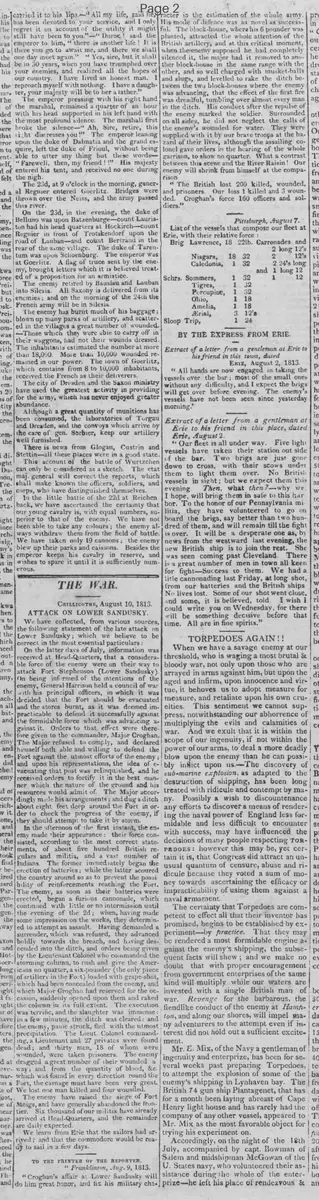
ATTACK ON LOWER SANDUSKY.
We have collected, from various sources, the following statement of the late attack on Lower Sandusky; which we believe to be correct in the most essential particulars:
On the latter days of July, information was received at Head-Quarters, that a considerable force of the enemy were on their way to attack Fort Stephenson (Lower Sandusky). On being informed of the intentions of the enemy, General Harrison held a council of war with his principal officers, in which it was decided that the Fort should be evacuated and the stores burnt, as it was deemed impracticable to defend it successfully against the formidable force which was advancing against it. Orders to that effect were therefore given to the commander, Major Croghan.
The Major refused to comply, and declared himself both able and willing to defend the Fort against the utmost efforts of the enemy; and upon his representations, the idea of evacuating that post was relinquished, and he received orders to fortify it in the best manner which the nature of the ground and his resources would admit of. The Major accordingly made his arrangements; and dug a ditch about eight feet deep around the Fort in order to check the progress of the enemy, if they should attempt to take it by storm.
In the afternoon of the first instant, the enemy made their appearance: their force consisted, according to the most correct statements, of about five hundred British regulars and militia, and a vast number of Indians. The former immediately began the erection of batteries; while the latter scoured the country around so as to prevent the possibility of reinforcements reaching the Fort.
The enemy, as soon as their batteries were erected, began a furious cannonade, which continued with little or no intermission until the evening of the 2d; when, having made some impression on the works, they determined to attempt an assault. Having demanded a surrender, which was refused, they advanced boldly towards the breach, and having descended into the ditch, and orders being given by the Lieutenant Colonel who commanded the storming column, to rush and give the Americans no quarter, a six-pounder (the only piece of artillery in the Fort) loaded with grape-shot, which had been concealed from the enemy, and which Major Croghan had reserved for the occasion, suddenly opened upon them and raked the column in its full extent. The execution was terrific, and the slaughter was immense: in a few minutes, the ditch was cleared: and the enemy, panic struck, fled with the utmost precipitation. The Lieut Colonel commanding, a Lieutenant and 27 privates were found dead; and thirty men, 18 of whom were wounded, were taken prisoners. The enemy dragged a great number of their wounded away: and from the quantity of blood, &c. which was found in every direction round the Fort, the carnage must have been very great.
We lost one man killed and four wounded.
The enemy have raised the siege of Fort Meigs, and have generally abandoned the frontier. Six thousand of our militia have already arrived at Head-Quarters, and the remainder are daily expected.
We learn from Erie that the sailors had arrived: and that the commodore would be ready to sail in a few days.
TO THE PRINTER OF THE REPORTER.
"Franklinton, Aug. 9, 1813.
"Croghan's affair at Lower Sandusky will do him great honor, and fix his military character in the estimation of the whole army. His mode of defence was as novel as successful. The block-house, where his 6 pounder was planted, attracted the whole attention of the British artillery, and at this critical moment, when the enemy supposed he had completely silenced it, the major had it removed to another block-house in the same range with the other, and so well charged with musket-balls and slugs, and levelled to rake the ditch between the two block-houses where the enemy was advancing, that the effect of the first fire was dreadful, tumbling over almost every man in the ditch. His conduct after the repulse of the enemy marked the soldier. Surrounded on all sides, he did not neglect the calls of the enemy's wounded for water. They were supplied with it by our brave troops at the hazard of their lives although the assailing colonel gave orders in the hearing of the whole garrison, to show no quarter. What a contrast between this scene and the River Raisin! Our enemy will shrink from himself at the comparison.
"The British lost 200 killed, wounded, and prisoners. Our loss 1 killed and 3 wounded. Croghan's force 160 officers and soldiers."
What sub-type of article is it?
What keywords are associated?
What entities or persons were involved?
Where did it happen?
Domestic News Details
Primary Location
Lower Sandusky
Event Date
August 1 2, 1813
Key Persons
Outcome
american: 1 killed, 4 wounded. enemy: lieutenant colonel, lieutenant, 27 privates dead; 30 prisoners (18 wounded); estimated heavy losses including many wounded dragged away. siege raised, enemy abandoned frontier.
Event Details
British and Indian forces attacked Fort Stephenson. Major Croghan refused evacuation orders, fortified the fort, and repelled the assault with a concealed six-pounder cannon, causing massive enemy casualties and retreat. Additional militia reinforcements arrived, and naval preparations noted at Erie.