Thank you for visiting SNEWPapers!
Sign up free
Letter to Editor
March 15, 1839
The Liberator
Boston, Suffolk County, Massachusetts
What is this article about?
In Andover, MA, Feb 1839, an eyewitness letter to Garrison describes anti-colonization lectures by Mr. Stanton that swayed audiences toward abolition, followed by Rev. Binney's poorly attended pro-colonization response lecture, adjourned due to lack of interest from the abolitionist congregation.
Clipping
OCR Quality
98%
Excellent
Full Text
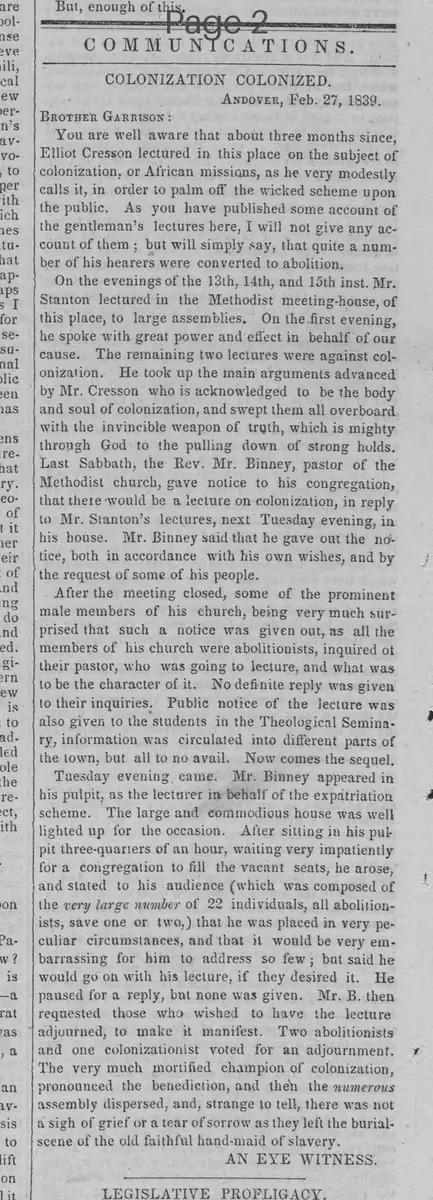
COMMUNICATIONS.
COLONIZATION COLONIZED.
ANDOVER, Feb. 27, 1839.
BROTHER GARRISON:
You are well aware that about three months since, Elliot Cresson lectured in this place on the subject of colonization, or African missions, as he very modestly calls it, in order to palm off the wicked scheme upon the public. As you have published some account of the gentleman's lectures here, I will not give any account of them; but will simply say, that quite a number of his hearers were converted to abolition.
On the evenings of the 13th, 14th, and 15th inst. Mr. Stanton lectured in the Methodist meeting-house, of this place, to large assemblies. On the first evening, he spoke with great power and effect in behalf of our cause. The remaining two lectures were against colonization. He took up the main arguments advanced by Mr. Cresson who is acknowledged to be the body and soul of colonization, and swept them all overboard with the invincible weapon of truth, which is mighty through God to the pulling down of strong holds.
Last Sabbath, the Rev. Mr. Binney, pastor of the Methodist church, gave notice to his congregation, that there would be a lecture on colonization, in reply to Mr. Stanton's lectures, next Tuesday evening, in his house. Mr. Binney said that he gave out the notice, both in accordance with his own wishes, and by the request of some of his people.
After the meeting closed, some of the prominent male members of his church, being very much surprised that such a notice was given out, as all the members of his church were abolitionists, inquired of their pastor, who was going to lecture, and what was to be the character of it. No definite reply was given to their inquiries. Public notice of the lecture was also given to the students in the Theological Seminary, information was circulated into different parts of the town, but all to no avail. Now comes the sequel.
Tuesday evening came. Mr. Binney appeared in his pulpit, as the lecturer in behalf of the expatriation scheme. The large and commodious house was well lighted up for the occasion. After sitting in his pulpit three-quarters of an hour, waiting very impatiently for a congregation to fill the vacant seats, he arose, and stated to his audience (which was composed of the very large number of 22 individuals, all abolitionists, save one or two,) that he was placed in very peculiar circumstances, and that it would be very embarrassing for him to address so few; but said he would go on with his lecture, if they desired it. He paused for a reply, but none was given. Mr. B. then requested those who wished to have the lecture adjourned, to make it manifest. Two abolitionists and one colonizationist voted for an adjournment.
The very much mortified champion of colonization, pronounced the benediction, and then the numerous assembly dispersed, and, strange to tell, there was not a sigh of grief or a tear of sorrow as they left the burial scene of the old faithful hand-maid of slavery.
AN EYE WITNESS.
COLONIZATION COLONIZED.
ANDOVER, Feb. 27, 1839.
BROTHER GARRISON:
You are well aware that about three months since, Elliot Cresson lectured in this place on the subject of colonization, or African missions, as he very modestly calls it, in order to palm off the wicked scheme upon the public. As you have published some account of the gentleman's lectures here, I will not give any account of them; but will simply say, that quite a number of his hearers were converted to abolition.
On the evenings of the 13th, 14th, and 15th inst. Mr. Stanton lectured in the Methodist meeting-house, of this place, to large assemblies. On the first evening, he spoke with great power and effect in behalf of our cause. The remaining two lectures were against colonization. He took up the main arguments advanced by Mr. Cresson who is acknowledged to be the body and soul of colonization, and swept them all overboard with the invincible weapon of truth, which is mighty through God to the pulling down of strong holds.
Last Sabbath, the Rev. Mr. Binney, pastor of the Methodist church, gave notice to his congregation, that there would be a lecture on colonization, in reply to Mr. Stanton's lectures, next Tuesday evening, in his house. Mr. Binney said that he gave out the notice, both in accordance with his own wishes, and by the request of some of his people.
After the meeting closed, some of the prominent male members of his church, being very much surprised that such a notice was given out, as all the members of his church were abolitionists, inquired of their pastor, who was going to lecture, and what was to be the character of it. No definite reply was given to their inquiries. Public notice of the lecture was also given to the students in the Theological Seminary, information was circulated into different parts of the town, but all to no avail. Now comes the sequel.
Tuesday evening came. Mr. Binney appeared in his pulpit, as the lecturer in behalf of the expatriation scheme. The large and commodious house was well lighted up for the occasion. After sitting in his pulpit three-quarters of an hour, waiting very impatiently for a congregation to fill the vacant seats, he arose, and stated to his audience (which was composed of the very large number of 22 individuals, all abolitionists, save one or two,) that he was placed in very peculiar circumstances, and that it would be very embarrassing for him to address so few; but said he would go on with his lecture, if they desired it. He paused for a reply, but none was given. Mr. B. then requested those who wished to have the lecture adjourned, to make it manifest. Two abolitionists and one colonizationist voted for an adjournment.
The very much mortified champion of colonization, pronounced the benediction, and then the numerous assembly dispersed, and, strange to tell, there was not a sigh of grief or a tear of sorrow as they left the burial scene of the old faithful hand-maid of slavery.
AN EYE WITNESS.
What sub-type of article is it?
Persuasive
Informative
Political
What themes does it cover?
Slavery Abolition
Politics
What keywords are associated?
Colonization
Abolition
Andover
Lecture
Stanton
Cresson
Binney
Methodist Church
What entities or persons were involved?
An Eye Witness.
Brother Garrison
Letter to Editor Details
Author
An Eye Witness.
Recipient
Brother Garrison
Main Argument
reports on successful anti-colonization lectures by mr. stanton that converted listeners to abolitionism, and the subsequent failure of rev. mr. binney's pro-colonization lecture, which drew only 22 mostly abolitionist attendees and was adjourned.
Notable Details
Elliot Cresson Lectured On Colonization Three Months Prior
Mr. Stanton Lectured Against Colonization On Feb 13 15, 1839
Rev. Mr. Binney's Lecture On Feb 19, 1839, Adjourned After Three Quarters Hour With Only 22 Attendees
All Church Members Were Abolitionists