Thank you for visiting SNEWPapers!
Sign up free
Story
October 23, 1844
The Rhode Islander
Newport, Newport County, Rhode Island
What is this article about?
During a thunderstorm in Baltimore on Tuesday, superintendents of Morse's Magnetic Telegraph removed batteries to avoid lightning damage, but the wires then operated via lightning flashes, proving atmospheric and battery electricity are identical in effect.
Clipping
OCR Quality
98%
Excellent
Full Text
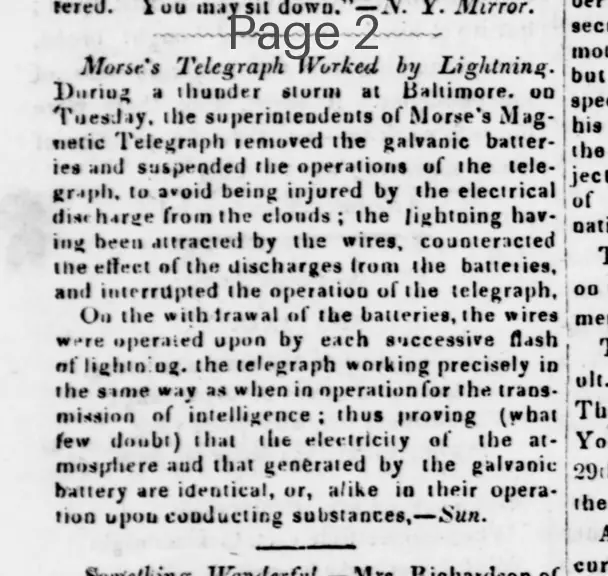
Morse's Telegraph Worked by Lightning.
During a thunder storm at Baltimore, on Tuesday, the superintendents of Morse's Magnetic Telegraph removed the galvanic batteries and suspended the operations of the telegraph, to avoid being injured by the electrical discharge from the clouds; the lightning having been attracted by the wires, counteracted the effect of the discharges from the batteries, and interrupted the operation of the telegraph. On the withdrawal of the batteries, the wires were operated upon by each successive flash of lightning, the telegraph working precisely in the same way as when in operation for the transmission of intelligence; thus proving (what few doubt) that the electricity of the atmosphere and that generated by the galvanic battery are identical, or, alike in their operation upon conducting substances.—Sun.
During a thunder storm at Baltimore, on Tuesday, the superintendents of Morse's Magnetic Telegraph removed the galvanic batteries and suspended the operations of the telegraph, to avoid being injured by the electrical discharge from the clouds; the lightning having been attracted by the wires, counteracted the effect of the discharges from the batteries, and interrupted the operation of the telegraph. On the withdrawal of the batteries, the wires were operated upon by each successive flash of lightning, the telegraph working precisely in the same way as when in operation for the transmission of intelligence; thus proving (what few doubt) that the electricity of the atmosphere and that generated by the galvanic battery are identical, or, alike in their operation upon conducting substances.—Sun.
What sub-type of article is it?
Curiosity
Extraordinary Event
Historical Event
What themes does it cover?
Nature
Triumph
What keywords are associated?
Morse Telegraph
Lightning Operation
Baltimore Thunderstorm
Electricity Identity
Galvanic Battery
What entities or persons were involved?
Morse
Superintendents
Where did it happen?
Baltimore
Story Details
Key Persons
Morse
Superintendents
Location
Baltimore
Event Date
On Tuesday
Story Details
During a thunderstorm, superintendents removed batteries from Morse's telegraph to avoid lightning damage; instead, lightning operated the wires like the batteries, proving atmospheric electricity identical to galvanic in effect on conductors.