Thank you for visiting SNEWPapers!
Sign up free
Burlington Free Press
Burlington, Chittenden County, Vermont
What is this article about?
Henry Clay, the eminent statesman, was baptized into the Protestant Episcopal Church at his home in Ashland, Kentucky, on June 22, 1847, along with his daughter-in-law and her four children, by Rev. Edward F. Berkley. The private ceremony reflected his deepening faith amid retirement from public life.
Clipping
OCR Quality
Full Text
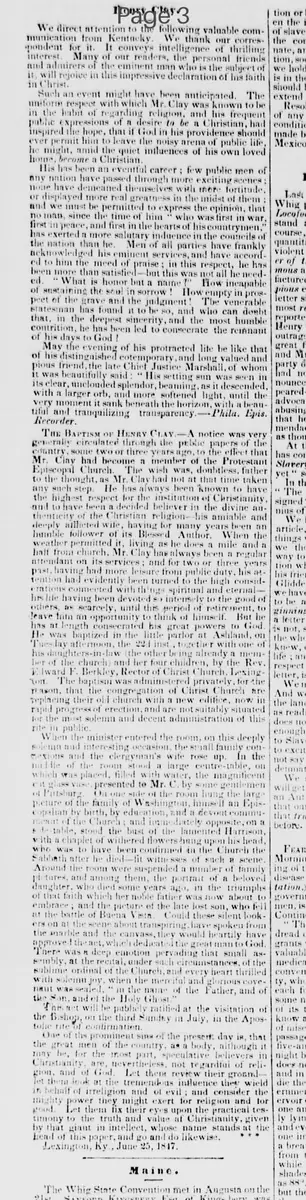
Such an event might have been anticipated. The profound respect with which Mr. Clay was known to be in the habit of regarding religion, and his frequent public expressions of a desire to be a Christian, had inspired the hope, that if God in his providence should ever permit him to leave the noisy arena of public life, he might, amid the quiet influences of his own loved home, become a Christian.
His has been an eventful career; few public men of any nation have passed through more exciting scenes: none have demeaned themselves with more fortitude, or displayed more real greatness in the midst of them: and we must be permitted to express the opinion, that no man, since the time of him "who was first in war, first in peace, and first in the hearts of his countrymen," has exerted a more salutary influence in the councils of the nation than he. Men of all parties have frankly acknowledged his eminent services, and have accorded to him the meed of praise; in this respect, he has been more than satisfied—but this was not all he needed. "What is honor but a name?" How incapable of sustaining the soul in sorrow! How empty in prospect of the grave and the judgment! The venerable statesman has found it to be so, and who can doubt that, in the deepest sincerity, and the most humble contrition, he has been led to consecrate the remnant of his days to God?
May the evening of his protracted life be like that of his distinguished contemporary, and long valued and pious friend, the late Chief Justice Marshall, of whom it was beautifully said: "His setting sun was seen in its clear, unclouded splendor, beaming, as it descended, with a larger orb, and more softened light, until the very moment it sank beneath the horizon, with a beautiful and tranquilizing transparency.—Phila. Epis. Recorder."
The Baptism of Henry Clay.—A notice was very generally circulated through the public papers of the country, some two or three years ago, to the effect that Mr. Clay had become a member of the Protestant Episcopal Church. The wish was, doubtless, father to the thought, as Mr. Clay had not at that time taken any such step. He has always been known to have the highest respect for the institution of Christianity, and to have been a decided believer in the divine authenticity of the Christian religion—his amiable and deeply afflicted wife, having for many years been a humble follower of its Blessed Author. When the weather permitted it, living as he does a mile and a half from church, Mr. Clay has always been a regular attendant on its services; and for two or three years past, having had more leisure from public duty, his attention had evidently been turned to the high considerations connected with things spiritual and eternal—his life having been devoted so intensely to the good of others, as scarcely, until this period of retirement, to leave him an opportunity to think of himself. But he has at length consecrated his great powers to God. He was baptized in the little parlor at Ashland, on Tuesday afternoon, the 22d inst., together with one of his daughters-in-law (the other being already a member of the church) and her four children, by the Rev. Edward F. Berkley, Rector of Christ Church, Lexington. The baptism was administered privately, for the reason that the congregation of Christ Church are replacing their old church with a new edifice, now in rapid progress of erection, and are not suitably situated for the most solemn and decent administration of this rite in public.
When the minister entered the room, on this deeply solemn and interesting occasion, the small family connections and the clergyman's wife rose up. In the centre of the room stood a large centre-table, on which was placed, filled with water, the magnificent cut glass vase presented to Mr. C. by some gentlemen of Pittsburgh. On one side of the room hung the large picture of the family of Washington, himself an Episcopalian by birth, by education, and a devout communicant of the Church: and immediately opposite, on a table, stood the bust of the lamented Harrison, with a chaplet of withered flowers hanging upon his head, who was to have been confirmed in the Church the Sabbath after he died—fit witnesses of such a scene. Around the room were suspended a number of family pictures, and among them, the portrait of a beloved daughter, who died some years ago, in the triumphs of that faith which her noble father was now about to embrace, and the picture of the late lost son, who fell at the battle of Buena Vista. Could these silent lookers-on at the scene about transpiring, have spoken from the marble and the canvass, they would heartily have approved the act, which dedicated the great man to God.
There was a deep emotion pervading that small assembly, at the recital, under such circumstances, of the sublime ordinal of the Church, and every heart thrilled with solemn joy, when the merciful and glorious covenant was sealed. "In the name of the Father, and of the Son, and of the Holy Ghost." This act will be publicly ratified at the visitation of the Bishop, on the third Sunday in July, in the Apostolic rite of confirmation.
One of the prominent sins of the present day is, that the great men of the country, as a body, although it may be, for the most part, speculative believers in Christianity, are, nevertheless, not regardful of religion, and of God. Let them review their ground—Let them look at the tremendous influence they wield in behalf of irreligion and of evil; and consider the mighty power they might exert for religion and for good. "Let them fix their eyes upon the practical testimony to the truth and value of Christianity, given by that giant in intellect, whose name stands at the head of this paper, and go and do likewise."
Lexington, Ky., June 25, 1847.
What sub-type of article is it?
What keywords are associated?
What entities or persons were involved?
Where did it happen?
Domestic News Details
Primary Location
Ashland, Near Lexington, Ky.
Event Date
Tuesday Afternoon, The 22d Inst. (June 22, 1847)
Key Persons
Outcome
baptism administered privately; to be confirmed publicly in july.
Event Details
Henry Clay was baptized in the parlor at Ashland by Rev. Edward F. Berkley, along with one daughter-in-law and her four children. The ceremony used a cut glass vase for water and occurred privately due to church construction.