Thank you for visiting SNEWPapers!
Sign up free
Literary
November 5, 1825
Edwardsville Spectator
Edwardsville, Madison County, Illinois
What is this article about?
In this excerpt from 'The Foresters,' six-year-old Lucy ventures alone to a neighbor's farm but fails to return, prompting a desperate night-long search by her family and community amid fears of death or abduction. Her clothes are found with blood spots, but hope persists, and she is joyfully reunited with her parents.
Clipping
OCR Quality
95%
Excellent
Full Text
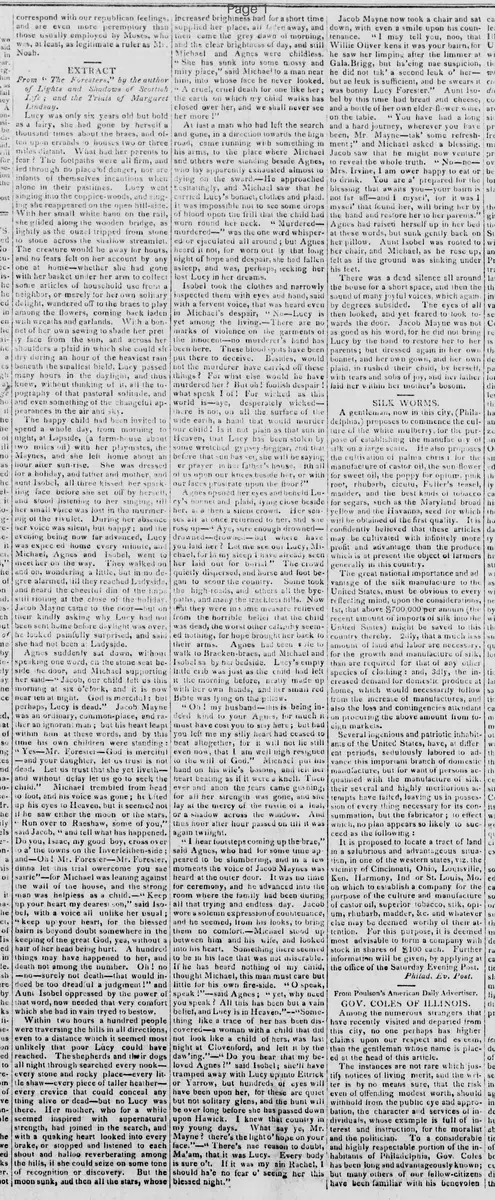
EXTRACT
From "The Foresters," by the author of Lights and Shadows of Scottish Life; and the Trials of Margaret Lindsay.
Lucy was only six years old but bold as a fairy, she had gone by herself a thousand times about the braes, and often upon errands to houses two or three miles distant. What had her parents to fear? The footpaths were all firm, and led through no place of danger, nor are infants of themselves incautious when alone in their pastimes. Lucy went singing into the coppice-woods, and singing she reappeared on the open hill-side. With her small white hand on the rail, she glided along the wooden bridge, as lightly as the ouzel tripped from stone to stone across the shallow streamlet. The creature would be away for hours, and no fears felt on her account by any one at home—whether she had gone with her basket under her arm to collect some articles of household use from a neighbor, or merely for her own solitary delight, wandered off to the braes to play among the flowers, coming back laden with wreaths and garlands. With a bonnet of her own sewing to shade her pretty face from the sun, and across her shoulders a plaid in which she could sit dry during an hour of the heaviest rain beneath the smallest bield, Lucy passed many hours in the daylight, and thus knew, without thinking of it, all the topography of that pastoral solitude, and even something of the changeable appearances in the air and sky.
The happy child had been invited to spend a whole day, from morning to night, at Ladyside, (a farm-house about two miles off) with her playmates, the Maynes, and she left home about an hour after sun-rise. She was dressed for a holiday, and father and mother, and aunt Isabel, all three kissed her sparkling face before she set off by herself, and stood listening to her singing, till her small voice was lost in the murmuring of the rivulet. During her absence her voice was silent, but happy; and the evening being now far advanced, Lucy was expected home every minute, and Michael, Agnes and Isobel, went to meet her on the way. They walked on and on, wondering a little, but in no degree alarmed, till they reached Ladyside, and heard the cheerful din of the lamps still rioting at the close of the holiday. Jacob Mayne came to the door—but on their kindly asking why Lucy had not been sent home before daylight was over, he looked painfully surprised, and said she had not been at Ladyside.
Agnes suddenly sat down, without speaking one word, on the stone seat beside the door, and Michael supporting her said—"Jacob, our child left us this morning at six o'clock, and it is now near ten at night. God is merciful: but perhaps, Lucy is dead." Jacob Mayne was an ordinary, common-place, and rather an ignorant man; but his heart leapt within him at these words, and by this time his own children were standing: "Yes—Mr. Forrester—God is merciful—and your daughter, let us trust is not dead. Let us trust that she yet liveth—and without delay let us go to seek the child." Michael trembled from head to foot, and his voice was gone; he lifted up his eyes to Heaven, but it seemed not if he saw either the moon or the stars. "Run over to Raeshaw, some of you," said Jacob, "and tell what has happened. Do you, Isaac, my good boy, cross over o'er a' the towns on the Inverleithen-side; and—Oh! Mr. Forrester—Mr. Forester, dinna let this trial overcome you sae sair"—for Michael was leaning against the wall of the house, and the strong man was helpless as a child.—"Keep up your heart my dearest con," said Isobel, with a voice all unlike her usual; "keep up your heart, for the blessed bairn is beyond doubt somewhere in the keeping of the great God, yea, without a hair of her head being hurt. A hundred things may have happened to her, and death not among the number. Oh! no—no—surely not death—that would indeed be too dreadful a judgment!" and Aunt Isobel oppressed by the power of that word, now needed that very comfort which she had in vain tried to bestow.
Within two hours a hundred people were traversing the hills in all directions, even to a distance which it seemed most unlikely that poor Lucy could have reached. The shepherds and their dogs all night through searched every nook—every stone and rocky place—every little shaw—every piece of taller heather—every crevice that could conceal any thing alive or dead—but no Lucy was there. Her mother, who for a while seemed inspired with supernatural strength, had joined in the search, and with a quaking heart looked into every brake, or stopped and listened to each shout and halloo reverberating among the hills, if she could seize on some tone of recognition or discovery. But the moon sunk, and then all the stars, whose increased brightness had for a short time supplied her place, all faded away, and then came the grey dawn of morning, and the clear brightness of day, and still Michael and Agnes were childless.
"She has sunk into some mossy and miry place," said Michael to a man near him, into whose face he never looked. "A cruel, cruel death for one like her; the earth on which my child walks has closed over her, and we shall never see her more!"
At last a man who had left the search and gone, in a direction towards the high road, came running with something in his arms, to the place where Michael and others were standing beside Agnes, who lay apparently exhausted almost to dying on the sward.—He approached hesitatingly, and Michael saw that he carried Lucy's bonnet, clothes and plaid. It was impossible not to see some drops of blood upon the frill that the child had worn round her neck. "Murdered—murdered—" was the one word whispered or ejaculated all around; but Agnes heard it not, for worn out by that long night of hope and despair, she had fallen asleep, and was, perhaps, seeking her lost Lucy in her dreams.
Isobel took the clothes and narrowly inspected them with eyes and hand, said with a fervent voice, that was heard even in Michael's despair, "No—Lucy is yet among the living.—There are no marks of violence on the garments of the innocent—no murderer's hand has been here. These blood spots have been put there to deceive. Besides, would not the murderer have carried off these things? For what else would he have murdered her? But oh! foolish despair! what speak I of! For wicked as this world is—aye, desperately wicked—there is not, on all the surface of the wide earth, a hand that would murder our child! Is it not plain as that sun in Heaven, that Lucy has been stolen by some wretched gipsy-beggar, and that before that sun has set, she will be saying her prayer in her father's house, with all of us upon our knees beside her, or with our faces prostrate upon the floor?"
Agnes opened her eyes and beheld Lucy's bonnet and plaid, lying close beside her, as in a silent crowd. Her senses all at once returned to her, and she rose up—"Aye, sure enough drowned—drowned—drowned—but where have you laid her? Let me see our Lucy, Michael, for in my sleep I have already seen her laid out for burial!" The crowd quietly dispersed, and horse and foot began to scour the country. Some took the high-roads, and others all the bye-paths, and many the trackless hills. Now that they were in some measure relieved from the horrible belief that the child was dead, the worst other calamity seemed nothing, for hope brought her back to their arms. Agnes had been got to walk to Bracken-braes, and Michael and Isobel sat by her bedside. Lucy's empty little crib was just as the child had left it the morning before, neatly made up with her own hands, and her small red Bible was lying on the pillow.
"Oh! my husband—this is being indeed kind to your Agnes, for much it must have cost you to stay here; but had you left me my silly heart had ceased to beat altogether, for it will not lie still even now, that I am well nigh resigned to the will of God." Michael put his hand on his wife's bosom, and felt her heart beating as if it were a knell. Then ever and anon the tears came gushing, for all her strength was gone, and she lay at the mercy of the rustle of a leaf, or a shadow across the window. And thus hour after hour passed on until it was again twilight.
"I hear footsteps coming up the brae," said Agnes, who had for some time appeared to be slumbering, and in a few moments the voice of Jacob Mayne was heard at the outer door. It was no time for ceremony, and he advanced into the room where the family had been during all that trying and endless day. Jacob wore a solemn expression of countenance, and he seemed, from his looks, to bring them no comfort.—Michael stood up between him and his wife, and looked into his heart. Something there seemed to be in his face that was not miserable. If he has heard nothing of my child, thought Michael, this man must care but little for his own fire-side. "O speak, speak!"—said Agnes; "yet, why need you speak? All this has been but a vain belief, and Lucy is in Heaven,"—"Something like a trace of her has been discovered—a woman with a child that did not look like a child of hers, was last night at Clovenford, and left it by the dawning." "Do you hear that my beloved Agnes?" said Isobel; she'll have tramped away with Lucy up into Ettrick or Yarrow, but hundreds of eyes will have been upon her, for these are quiet but not solitary glens, and the hunt will be over long before she has passed down upon Hawick. I knew that country in my young days. What say ye, Mr. Mayne? there's the light o' hope on your face." "There's nae reason to doubt, Ma'am, that it was Lucy. Every body is sure o't. If it was my ain Rachel, I should ha'e no fear o' seeing her this blessed night."
Jacob Mayne now took a chair and sat down, with even a smile upon his countenance. "I may tell you, noo, that Willie Oliver kens it was your bairn, for he saw her limping after the limmer at Gala-Brigg, but ha'eing nae suspicion, he did not tak' a second leuk o' her—but ae leuk is sufficient, and he swears it was bonny Lucy Forester." Aunt Isabel by this time had bread and cheese, and a bottle of her own elder-flower wine, on the table. "You have had a long and a hard journey, wherever you have been, Mr. Mayne—tak' some refreshment;" and Michael asked a blessing. Jacob saw that he might now venture to reveal the whole truth. "No—no—Mrs. Irvine, I am ower happy to eat or to drink. You are a' prepared for the blessing that awaits you—your bairn is not far aff—and I mysel', for it was I mysel' that found her, will bring her by the hand and restore her to her parents."
Agnes had raised herself up in her bed at these words, but sunk gently back on her pillow. Aunt Isobel was rooted to her chair, and Michael, as he rose up, felt as if the ground was sinking under his feet.
There was a dead silence all around the house for a short space, and then the sound of many joyful voices, which again by degrees subsided. The eyes of all then looked, and yet feared to look towards the door. Jacob Mayne was not as good as his word, for he did not bring Lucy by the hand to restore her to her parents; but dressed again in her own bonnet, and her own gown, and her own plaid, in rushed their child, by herself, with tears and sobs of joy, and her father laid her within her mother's bosom.
From "The Foresters," by the author of Lights and Shadows of Scottish Life; and the Trials of Margaret Lindsay.
Lucy was only six years old but bold as a fairy, she had gone by herself a thousand times about the braes, and often upon errands to houses two or three miles distant. What had her parents to fear? The footpaths were all firm, and led through no place of danger, nor are infants of themselves incautious when alone in their pastimes. Lucy went singing into the coppice-woods, and singing she reappeared on the open hill-side. With her small white hand on the rail, she glided along the wooden bridge, as lightly as the ouzel tripped from stone to stone across the shallow streamlet. The creature would be away for hours, and no fears felt on her account by any one at home—whether she had gone with her basket under her arm to collect some articles of household use from a neighbor, or merely for her own solitary delight, wandered off to the braes to play among the flowers, coming back laden with wreaths and garlands. With a bonnet of her own sewing to shade her pretty face from the sun, and across her shoulders a plaid in which she could sit dry during an hour of the heaviest rain beneath the smallest bield, Lucy passed many hours in the daylight, and thus knew, without thinking of it, all the topography of that pastoral solitude, and even something of the changeable appearances in the air and sky.
The happy child had been invited to spend a whole day, from morning to night, at Ladyside, (a farm-house about two miles off) with her playmates, the Maynes, and she left home about an hour after sun-rise. She was dressed for a holiday, and father and mother, and aunt Isabel, all three kissed her sparkling face before she set off by herself, and stood listening to her singing, till her small voice was lost in the murmuring of the rivulet. During her absence her voice was silent, but happy; and the evening being now far advanced, Lucy was expected home every minute, and Michael, Agnes and Isobel, went to meet her on the way. They walked on and on, wondering a little, but in no degree alarmed, till they reached Ladyside, and heard the cheerful din of the lamps still rioting at the close of the holiday. Jacob Mayne came to the door—but on their kindly asking why Lucy had not been sent home before daylight was over, he looked painfully surprised, and said she had not been at Ladyside.
Agnes suddenly sat down, without speaking one word, on the stone seat beside the door, and Michael supporting her said—"Jacob, our child left us this morning at six o'clock, and it is now near ten at night. God is merciful: but perhaps, Lucy is dead." Jacob Mayne was an ordinary, common-place, and rather an ignorant man; but his heart leapt within him at these words, and by this time his own children were standing: "Yes—Mr. Forrester—God is merciful—and your daughter, let us trust is not dead. Let us trust that she yet liveth—and without delay let us go to seek the child." Michael trembled from head to foot, and his voice was gone; he lifted up his eyes to Heaven, but it seemed not if he saw either the moon or the stars. "Run over to Raeshaw, some of you," said Jacob, "and tell what has happened. Do you, Isaac, my good boy, cross over o'er a' the towns on the Inverleithen-side; and—Oh! Mr. Forrester—Mr. Forester, dinna let this trial overcome you sae sair"—for Michael was leaning against the wall of the house, and the strong man was helpless as a child.—"Keep up your heart my dearest con," said Isobel, with a voice all unlike her usual; "keep up your heart, for the blessed bairn is beyond doubt somewhere in the keeping of the great God, yea, without a hair of her head being hurt. A hundred things may have happened to her, and death not among the number. Oh! no—no—surely not death—that would indeed be too dreadful a judgment!" and Aunt Isobel oppressed by the power of that word, now needed that very comfort which she had in vain tried to bestow.
Within two hours a hundred people were traversing the hills in all directions, even to a distance which it seemed most unlikely that poor Lucy could have reached. The shepherds and their dogs all night through searched every nook—every stone and rocky place—every little shaw—every piece of taller heather—every crevice that could conceal any thing alive or dead—but no Lucy was there. Her mother, who for a while seemed inspired with supernatural strength, had joined in the search, and with a quaking heart looked into every brake, or stopped and listened to each shout and halloo reverberating among the hills, if she could seize on some tone of recognition or discovery. But the moon sunk, and then all the stars, whose increased brightness had for a short time supplied her place, all faded away, and then came the grey dawn of morning, and the clear brightness of day, and still Michael and Agnes were childless.
"She has sunk into some mossy and miry place," said Michael to a man near him, into whose face he never looked. "A cruel, cruel death for one like her; the earth on which my child walks has closed over her, and we shall never see her more!"
At last a man who had left the search and gone, in a direction towards the high road, came running with something in his arms, to the place where Michael and others were standing beside Agnes, who lay apparently exhausted almost to dying on the sward.—He approached hesitatingly, and Michael saw that he carried Lucy's bonnet, clothes and plaid. It was impossible not to see some drops of blood upon the frill that the child had worn round her neck. "Murdered—murdered—" was the one word whispered or ejaculated all around; but Agnes heard it not, for worn out by that long night of hope and despair, she had fallen asleep, and was, perhaps, seeking her lost Lucy in her dreams.
Isobel took the clothes and narrowly inspected them with eyes and hand, said with a fervent voice, that was heard even in Michael's despair, "No—Lucy is yet among the living.—There are no marks of violence on the garments of the innocent—no murderer's hand has been here. These blood spots have been put there to deceive. Besides, would not the murderer have carried off these things? For what else would he have murdered her? But oh! foolish despair! what speak I of! For wicked as this world is—aye, desperately wicked—there is not, on all the surface of the wide earth, a hand that would murder our child! Is it not plain as that sun in Heaven, that Lucy has been stolen by some wretched gipsy-beggar, and that before that sun has set, she will be saying her prayer in her father's house, with all of us upon our knees beside her, or with our faces prostrate upon the floor?"
Agnes opened her eyes and beheld Lucy's bonnet and plaid, lying close beside her, as in a silent crowd. Her senses all at once returned to her, and she rose up—"Aye, sure enough drowned—drowned—drowned—but where have you laid her? Let me see our Lucy, Michael, for in my sleep I have already seen her laid out for burial!" The crowd quietly dispersed, and horse and foot began to scour the country. Some took the high-roads, and others all the bye-paths, and many the trackless hills. Now that they were in some measure relieved from the horrible belief that the child was dead, the worst other calamity seemed nothing, for hope brought her back to their arms. Agnes had been got to walk to Bracken-braes, and Michael and Isobel sat by her bedside. Lucy's empty little crib was just as the child had left it the morning before, neatly made up with her own hands, and her small red Bible was lying on the pillow.
"Oh! my husband—this is being indeed kind to your Agnes, for much it must have cost you to stay here; but had you left me my silly heart had ceased to beat altogether, for it will not lie still even now, that I am well nigh resigned to the will of God." Michael put his hand on his wife's bosom, and felt her heart beating as if it were a knell. Then ever and anon the tears came gushing, for all her strength was gone, and she lay at the mercy of the rustle of a leaf, or a shadow across the window. And thus hour after hour passed on until it was again twilight.
"I hear footsteps coming up the brae," said Agnes, who had for some time appeared to be slumbering, and in a few moments the voice of Jacob Mayne was heard at the outer door. It was no time for ceremony, and he advanced into the room where the family had been during all that trying and endless day. Jacob wore a solemn expression of countenance, and he seemed, from his looks, to bring them no comfort.—Michael stood up between him and his wife, and looked into his heart. Something there seemed to be in his face that was not miserable. If he has heard nothing of my child, thought Michael, this man must care but little for his own fire-side. "O speak, speak!"—said Agnes; "yet, why need you speak? All this has been but a vain belief, and Lucy is in Heaven,"—"Something like a trace of her has been discovered—a woman with a child that did not look like a child of hers, was last night at Clovenford, and left it by the dawning." "Do you hear that my beloved Agnes?" said Isobel; she'll have tramped away with Lucy up into Ettrick or Yarrow, but hundreds of eyes will have been upon her, for these are quiet but not solitary glens, and the hunt will be over long before she has passed down upon Hawick. I knew that country in my young days. What say ye, Mr. Mayne? there's the light o' hope on your face." "There's nae reason to doubt, Ma'am, that it was Lucy. Every body is sure o't. If it was my ain Rachel, I should ha'e no fear o' seeing her this blessed night."
Jacob Mayne now took a chair and sat down, with even a smile upon his countenance. "I may tell you, noo, that Willie Oliver kens it was your bairn, for he saw her limping after the limmer at Gala-Brigg, but ha'eing nae suspicion, he did not tak' a second leuk o' her—but ae leuk is sufficient, and he swears it was bonny Lucy Forester." Aunt Isabel by this time had bread and cheese, and a bottle of her own elder-flower wine, on the table. "You have had a long and a hard journey, wherever you have been, Mr. Mayne—tak' some refreshment;" and Michael asked a blessing. Jacob saw that he might now venture to reveal the whole truth. "No—no—Mrs. Irvine, I am ower happy to eat or to drink. You are a' prepared for the blessing that awaits you—your bairn is not far aff—and I mysel', for it was I mysel' that found her, will bring her by the hand and restore her to her parents."
Agnes had raised herself up in her bed at these words, but sunk gently back on her pillow. Aunt Isobel was rooted to her chair, and Michael, as he rose up, felt as if the ground was sinking under his feet.
There was a dead silence all around the house for a short space, and then the sound of many joyful voices, which again by degrees subsided. The eyes of all then looked, and yet feared to look towards the door. Jacob Mayne was not as good as his word, for he did not bring Lucy by the hand to restore her to her parents; but dressed again in her own bonnet, and her own gown, and her own plaid, in rushed their child, by herself, with tears and sobs of joy, and her father laid her within her mother's bosom.
What sub-type of article is it?
Prose Fiction
What themes does it cover?
Death Mortality
Religious
What keywords are associated?
Child Disappearance
Family Search
Scottish Rural Life
Faith And Hope
Joyful Reunion
What entities or persons were involved?
By The Author Of Lights And Shadows Of Scottish Life; And The Trials Of Margaret Lindsay.
Literary Details
Title
The Foresters
Author
By The Author Of Lights And Shadows Of Scottish Life; And The Trials Of Margaret Lindsay.
Form / Style
Narrative Prose
Key Lines
"God Is Merciful: But Perhaps, Lucy Is Dead."
"No—Lucy Is Yet Among The Living.—There Are No Marks Of Violence On The Garments Of The Innocent—No Murderer's Hand Has Been Here."
"Keep Up Your Heart, For The Blessed Bairn Is Beyond Doubt Somewhere In The Keeping Of The Great God, Yea, Without A Hair Of Her Head Being Hurt."
In Rushed Their Child, By Herself, With Tears And Sobs Of Joy, And Her Father Laid Her Within Her Mother's Bosom.