Thank you for visiting SNEWPapers!
Sign up free
The National Intelligencer And Washington Advertiser
Washington, District Of Columbia
What is this article about?
Debate in the US House of Representatives on June 22-23, 1812, over a bill amending the non-intercourse act. Speakers including Mr. Randolph, Mr. Jackson, Mr. Ross, and Mr. Gold argue against admitting armed ships of France and Britain into US ports without concessions, stressing impartiality, consistency, and awaiting presidential judgment on negotiations.
Merged-components note: This is a continuation of the congressional debate on foreign relations, explicitly marked as '(Continued)' on page 1 and picking up seamlessly on page 2, ending with '(To be continued.)'. Merging into a single story component.
Clippings
1 of 2
OCR Quality
Full Text
HOUSE OF REPRESENTATIVES.
DEBATE ON FOREIGN RELATIONS
(Continued.)
JUNE 22.
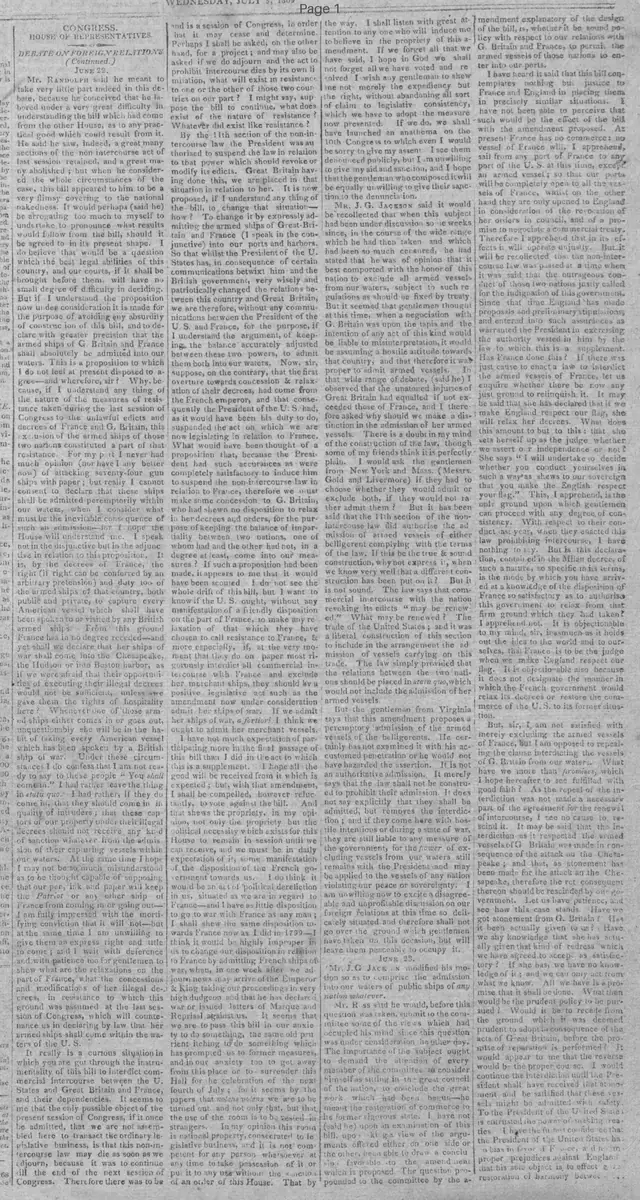
Mr. Randolph said he meant to take very little part indeed in this debate, because he conceived that he labored under a very great difficulty in understanding the bill which had come from the other House, as to any practical good which could result from it. He said he saw, indeed, a great many sections of the non intercourse act of last session retained, and a great many abolished; but when he considered the whole circumstances of the case, this bill appeared to him to be a very flimsy covering to the national nakedness. It would perhaps (said he) be arrogating too much to myself to undertake to pronounce what results would follow from the bill, should it be agreed to in its present shape. I do believe that would be a question which the best legal abilities of this country, and our courts, if it shall be brought before them, will have no small degree of difficulty in deciding. But if I understand the proposition now under consideration it is made for the purpose of avoiding any absurdity of construction of this bill, and to declare with greater precision that the armed ships of G. Britain and France shall absolutely be admitted into our waters. This is a proposition to which I do not feel at present disposed to agree—and wherefore, sir? Why, because, if I understand any thing of the nature of the measures of resistance taken during the last session of Congress to the unlawful edicts and decrees of France and G. Britain, this exclusion of the armed ships of those two nations constituted a part of that resistance. For my part I never had much opinion (nor have I any better now) of attacking seventy-four gun ships with paper; but really I cannot consent to declare that these ships shall be admitted peremptorily within our waters, when I consider what must be the inevitable consequence of such an admission—for I hope the House will understand me. I speak not in the disjunctive but in the adjunctive in relation to this proposition. It is, by the decrees of France, the right (if right can be conferred by an arbitrary pretension) and duty too of the armed ships of that country, both public and private, to capture every American vessel which shall have been spoken to or visited by any British armed ships. From this ground France has in no degree receded—and yet shall we declare that her ships of war shall come into the Chesapeake, the Hudson or into Boston harbor, as if we were afraid that their opportunities of executing their illegal decrees would not be sufficient, unless we gave them the rights of hospitality here? Whenever one of those armed ships either comes in or goes out, unquestionably she will be in the habit of taking every American vessel which has been spoken by a British ship of war. Under these circumstances I do confess that I am not ready to say to these people "You shall come in." I had rather leave the thing in statu quo. I had rather, if they do come in, that they should come in in quality of intruders; that these captors of our property under their illegal decrees should not receive any kind of sanction whatever from the admission of their capturing vessels within our waters. At the same time I hope I may not be so much misunderstood as to be thought capable of supposing that our pen, ink and paper will keep the Patriot or any other ship of France from coming in or going out—I am fully impressed with the mortifying conviction that it will not—but at the same time I am unwilling to give them an express right and title to come; and I wait with deference and with patience too for gentlemen to shew what are the relaxations on the part of France, what the concessions and modifications of her illegal decrees, in resistance to which this ground was assumed at the last session of Congress, which will countenance us in declaring by law that her armed ships shall come within the waters of the U. S.
It really is a curious situation in which you are got through the instrumentality of this bill to interdict commercial intercourse between the U. States and Great Britain and France, and their dependencies. It seems to me that the only possible object of the present session of Congress, if it once be admitted, that we are not assembled here to transact the ordinary legislative business, is that this non-intercourse law may die as soon as we adjourn, because it was to continue till the end of the next session of Congress. Therefore there was to be and is a session of Congress, in order that it may cease and determine. Perhaps I shall be asked, on the other hand, for a project; and may also be asked if we do adjourn and the act to prohibit intercourse dies by its own limitation, what will exist in resistance to one or the other of those two countries on our part? I might say, suppose the bill to continue, what does exist of the nature of resistance? Whatever did exist like resistance? By the 11th section of the non-intercourse law the President was authorised to suspend the law in relation to that power which should revoke or modify its edicts. Great Britain having done this, we are placed in that situation in relation to her. It is now proposed, if I understand any thing of the bill, to change that situation—how? To change it by expressly admitting the armed ships of Great-Britain and France (I speak in the conjunctive) into our ports and harbors. So that whilst the President of the U. States has, in consequence of certain communications betwixt him and the British government, very wisely and patriotically changed the relations between this country and Great Britain, we are therefore, without any communications between the President of the U S. and France, for the purpose, if I understand the argument, of keeping the balance accurately adjusted between these two powers, to admit them both into our waters. Now, sir, suppose, on the contrary, that the first overture towards concession & relaxation of their decrees, had come from the French emperor, and that consequently the President of the U. S. had, as it would have been his duty to do, suspended the act on which we are now legislating in relation to France. What would have been thought of a proposition that, because the President had such assurances as were completely satisfactory to induce him to suspend the non-intercourse law in relation to France, therefore we must make some concession to G. Britain, who had shewn no disposition to relax in her decrees and orders, for the purpose of keeping the balance of impartiality between two nations, one of whom had and the other had not, in a degree at least, come into our measures? If such a proposition had been made, it appears to me that it would have been scouted I do not see the whole drift of this bill, but I want to know if the U. S. ought, without any manifestation of a friendly disposition on the part of France, to make any relaxation of that which they have chosen to call resistance to France, & more especially, if, at the very moment that they do on paper most rigorously interdict all commercial intercourse with France and exclude her merchant ships, they should by a positive legislative act such as the amendment now under consideration admit her ships of war. If we admit her ships of war, a fortiori I think we ought to admit her merchant vessels. I have not much expectation of participating more in the final passage of this bill than I did in the act to which this is a supplement. I hope all the good will be received from it which is expected; but, with that amendment, I shall be compelled, however reluctantly, to vote against the bill. And that shews the propriety, in my opinion, not only the propriety but the political necessity which exists for this House to remain in session until we can receive, and we must be in daily expectation of it, some manifestation of the disposition of the French government towards us. I do think it would be an act of political dereliction in us, situated as we are in regard to France—and I have as little disposition to go to war with France as any man; I shall shew the same disposition towards France now as I did in 1799—I think it would be highly improper in us to change our disposition in relation to France by admitting French ships of war, when, in one week after we adjourn news may arrive of the Emperor & King taking our proceedings in very high dudgeon and that he has declared war or issued letters of marque and reprisal against us. It seems that we are to pass this bill in our anxiety to do something, the same old prudent itching to do something which has prompted us to former measures, and in our anxiety too to get away from this place or to surrender this Hall for the celebration of the next fourth of July; for it seems by the papers that nolens volens we are to be turned out. and not only that, but that the use of the room is to be vested in strangers. In my opinion this room is national property, consecrated to legislative business, and it is not competent for any person whatsoever at any time to take possession of it or put it to any use without the sanction of an order of this House. That by the way. I shall listen with great attention to any one who will induce me to believe in the propriety of this amendment. If we forget all that we have said, I hope in God we shall not forget all we have voted and resolved I wish any gentleman to shew me not merely the expediency but the right, without abandoning all sort of claim to legislative consistency, which we have to adopt the measure now presented. If we do, we shall have launched an anathema on the 10th Congress to which even I would be sorry to give my assent I see them denounced publicly, but I am unwilling to give my aid and sanction, and I hope that the gentleman who composed it will be equally unwilling to give their sanction to the denunciation.
Mr. J. G. Jackson said it would be recollected that when this subject had been under discussion some weeks since, in the course of the wide range which he had then taken and which had been so much censured, he had stated that he was of opinion that it best comported with the honor of this nation to exclude all armed vessels from our waters, subject to such regulations as should be fixed by treaty But it seemed that gentlemen thought at this time, when a negociation with G. Britain was upon the tapis and the intention of any act of this kind would be liable to misinterpretation, it would be assuming a hostile attitude towards that country, and that therefore it was proper to admit armed vessels. In that wide range of debate, (said he) I observed that the unatoned injuries of Great Britain had equalled if not exceeded those of France, and I therefore asked why should we make a distinction in the admission of her armed vessels. There is a doubt in my mind of the construction of the law, though some of my friends think it is perfectly plain. I would ask the gentlemen from New York and Mass. (Messrs. Gold and Livermore) if they had to choose whether they would admit or exclude both, if they would not rather admit them? But it has been said that the 11th section of the non-intercourse law did authorise the admission of armed vessels of either belligerent complying with the terms of the law. If this be the true & sound construction, why not express it, when we know very well that a different construction has been put on it? But it is not sound. The law says that commercial intercourse with the nation revoking its edicts "may be renewed." What may be renewed? The trade of the United States: and it was a liberal construction of this section to include in the arrangement the admission of vessels carrying on this trade. The law simply provided that the relations between the two nations should be placed in statu quo, which would not include the admission of her armed vessels.
But the gentleman from Virginia says that this amendment proposes a peremptory admission of the armed vessels of the belligerents. He certainly has not examined it with his accustomed penetration or he would not have hazarded the assertion. It is not an authoritative admission. It merely says that the law shall not be construed to prohibit their admission. It does not say explicitly that they shall be admitted, but removes the interdiction; and if they come here with hostile intentions or during a state of war, they are still liable to any measure of the government, for the power of excluding vessels from our waters still remains with the President and may be applied to the vessels of any nation violating our peace or sovereignty. I am unwilling now to excite a disagreeable and unprofitable discussion on our foreign relations at this time so delicately situated and therefore shall not go over the ground which gentlemen have taken on this occasion, but will leave them peaceably to occupy it.
JUNE 23.
Mr. J. G. Jackson modified his motion so as to comprise the admission into our waters of public ships of any nation whatever.
Mr. Ross said he would, before this question was taken, submit to the committee some of the views which had occupied his mind since this question was under consideration the other day. The importance of the subject ought to demand the attention of every member of the committee to consider himself as sitting in the great council of the nation, to conclude the great work which had been begun—he meant the restoration of commerce to its former vigorous state. I have not (said he) upon an examination of this bill, upon a view of the arguments offered either on one side or the other, been able to draw a conclusion favorable to the amendment which is proposed. The question propounded to the committee by the amendment explanatory of the design of the bill, is, whether it be sound policy with respect to our relations with G. Britain and France, to permit the armed vessels of those nations to enter into our ports. I have heard it said that this bill contemplates nothing but justice to France and England in placing them in precisely similar situations. I have not been able to perceive that such would be the effect of the bill with the amendment proposed. At present France has no commerce: no vessel of France will, I apprehend, sail from any port of France to any port of the U. S. at this time, except an armed vessel; so that our ports will be completely open to all the vessels of France, whilst on the other hand they are only opened to England in consideration of the revocation of her orders in council, and of a promise to negotiate a commercial treaty. Therefore I apprehend that in its effects it will operate unjustly. But it will be recollected that the non-intercourse law was passed at a time when it was said that the outrageous conduct of those two nations justly called for the indignation of this government. Since that time England has made proposals and preliminary stipulations, and entered into such assurances as warranted the President in exercising the authority vested in him by the law to which this is a supplement. Has France done this? If there was just cause to enact a law to interdict the armed vessels of France, let us enquire whether there be now any just ground to relinquish it. It may be said that she has declared that if we make England respect our flag, she will relax her decrees. What does this amount to but to this: that she sets herself up as the judge whether we assert our independence or not? She says "I will undertake to decide whether you conduct yourselves in such a way as shews to our sovereign that you make the English respect your flag." This, I apprehend, is the only ground upon which gentlemen can proceed with any degree of consistency. With respect to their conduct last year, when they enacted this law prohibiting intercourse, I have nothing to say. But is this declaration, contained in the Milan decree, of such a nature, so specific in its terms, is the mode by which you have arrived at a knowledge of the disposition of France so satisfactory as to authorise this government to relax from that firm ground which they had taken? I apprehend not. It is objectionable to my mind, sir, inasmuch as it holds out the idea to the world and to ourselves, that France is to be the judge when we make England respect our flag. It is objectionable also because it does not designate the manner in which the French government would relax its decrees or restore the commerce of the U. S. to its former situation.
But, sir, I am not satisfied with merely excluding the armed vessels of France, but I am opposed to repealing the clause interdicting the vessels of G. Britain from our waters. What have we more than promises, which I hope hereafter to see fulfilled with good faith? As the repeal of the interdiction was not made a necessary part of the agreement for the renewal of intercourse, I see no cause to rescind it. It may be said that the interdiction as it respected the armed vessels of G. Britain was made in consequence of the attack on the Chesapeake; and that, as atonement has been made for the attack on the Chesapeake, therefore the act consequent thereon should be rescinded by our government. Let us have patience, and see how this case stands. Have we got atonement from G. Britain? Has it been actually given to us? Have we any knowledge that she has actually given that kind of redress which we have agreed to accept as satisfactory? If she has, we have no knowledge of it; and we can only act from what we know. All we have is a promise that it shall be done. What then would be the prudent policy to be pursued? Would it be to recede from the ground which it was deemed prudent to adopt in consequence of the acts of Great Britain, before the promise of reparation is performed? It would appear to me that the reverse would be the proper course. I would continue the interdiction until the President shall have received that atonement and be satisfied that these vessels might be admitted with safety. To the President of the United States is entrusted the power of making treaties I have the fullest confidence that the President of the United States has no bias in favor of France, and no improper prejudices against England that his sole object is to effect a restoration of harmony between us.
two countries. Having this opinion, I would leave every thing with him to conduct on this occasion, and do no more than enable him, in the different stages of negotiation, to rescind what shall interfere with it, as he shall think right; and, therefore, would authorize him to admit the armed vessels of either nation, as he was before authorized to renew intercourse. This would leave the state of things as we found it, without having altered in any manner the laws in relation to the two belligerent nations, as they stood at the end of the last session. Would not this be sound policy? If we were to admit the armed vessels of France, we might furnish Great Britain with reasons for flying from her promises and breaking stipulations. Is there any immediate necessity that we should admit the armed vessels of both nations? The President alone, who is immediately concerned and interested, who knows all the different turns and changes of the negotiations, can best tell at what time it will be proper to do this act. Is there any necessity that the Legislature should do it whilst sitting? Would it not be better to trust it into the hands of him who is to conduct the negotiation, that he may wield it as a shield during the negotiation? Certainly. I therefore submit it to the committee whether it be proper to admit the armed vessels of France in our present situation? Whether it would not be abandoning that impartial conduct which was manifested to the world in the act to which this is a supplement? Being impartial, why should you give up your impartial conduct? England has come to some terms; France to none. We have nothing from which we can say that France has not at this moment a declaration of war in force against us. We should make a ridiculous appearance, if we should repeal the interdiction before the rising of the Legislature, and before we arrive at home should hear of a declaration of war from France. Therefore I can see no reason for relinquishing that ground assumed last winter with regard to France, nor in regard to England, further than the President shall think proper. I am therefore opposed to the amendment, and am of opinion that the first and second sections of the act to which this is a supplement should be re-enacted, that a clause should be added to this bill authorizing the President by his proclamation, whenever the state of affairs would justify it, to permit the armed vessels of the belligerents to enter our waters. If I had any favorable feelings or disposition to England rather than to France, I should be disposed to adopt the amendment, because the vessels of the former are so much superior, that if the vessels of the latter should attempt to enter our waters, they will fall a sacrifice, and, therefore, though in terms the law would appear to be favorable to France, it would be giving an advantage to Great Britain so far forth as it will give her an opportunity to destroy the French vessels attempting to enter our waters. I have given the committee my views of the subject. I have thought of it with considerable attention, and cannot bring my mind to bear so as to think it proper to adopt the amendment proposed or to recede from the interdiction already in existence, without committing my character for impartiality or consistency and good policy. Mr. Gold moved to strike out the words "any nation whatsoever," and insert G. B. so as to admit the armed vessels of Great Britain only into our waters. If this were agreed to, he should be willing to continue the exclusion as to France, giving the President's power to suspend it, when in his opinion it may be expedient. Whilst on, he said he would make some remarks in reply to observations in support of this amendment. It has been asked (said he) with some emphasis, what has France done to exclude her from our waters? I comprehend sir, the bearing of the question, and am to understand, that France has not trespassed in our waters, as was the case of England in the attack upon the Chesapeake. But does, sir, the honorable member suppose that a forfeiture of the rights of hospitality can be incurred only by an injury within the straits, the marine leagues. The admission of armed vessels within our harbors appertains to the frame of hospitality, and the causes which will justify an exclusion are many and various; they are not confined to this or that part of the theatre of national intercourse. Suppose a nation, while under the obligation of a treaty of amity, denies you the rights of hospitality in her own harbors. Suppose she makes prize of any unfortunate wrecked vessel on her coasts, (inasmuch be coming barbarians only) and arresting your merchantmen in her ports upon the faith of treaty; makes prisoners of your seamen, and drives them like beasts from the sea-board into the interior, and there incarcerates them--and suppose she fills up the measure of her injustice by turning your vessels upon the high sea.--will you receive such a nation with open arms and welcome her to the rights of hospitality? France, in a manner that is thus offended, and America is about to receive her to her embrace; and greet her with all the rights of hospitality. But, "in justification. it is said that the object of our government has been to restore, and preserve equality with the great belligerents." "For this the non-intercourse was made common to both nations; and the provision ceasing, as to the public vessels of Eng. land, ought to be discontinued as to France." Strange equality? Such impartiality !. I do greatly fear, sir, that notwithstanding these professions of impartiality, our public councils will be exposed to well founded imputations of not holding the balance even between those nations. While sir. I have been constrained to say, that France, pursuing an unyielding course of injustice towards this country, is not entitled to the same treatment as Great Britain ; I stand free, if I know my own heart, from all impressions of favor or prejudice in relation to the belligerents. It is enough for me that a foreign nation does my country injustice, "Trois Rutulusve" is to me indifferent. Mr. WHITMAN quoted the journal of the proceedings of the last session in relation to an amendment for issuing letters of marque and reprisal against both belligerents, offered by Mr. J. G. Jackson. He said he also found, by the yeas and nays, that the gentleman from Virginia was then in favor of excluding the armed vessels of France. He wished to know what had induced the gentleman now to change that opinion? (To be continued.)
What sub-type of article is it?
What themes does it cover?
What keywords are associated?
What entities or persons were involved?
Where did it happen?
Story Details
Key Persons
Location
House Of Representatives
Event Date
June 22 And June 23
Story Details
Members of the House debate a bill amending the non-intercourse act, arguing over admitting armed ships of Great Britain and France into US waters. Speakers oppose the amendment to maintain resistance, impartiality, and consistency, preferring to leave decisions to the President pending negotiations and concessions from France.