Thank you for visiting SNEWPapers!
Sign up free
Letter to Editor
August 21, 1802
The National Intelligencer And Washington Advertiser
Washington, District Of Columbia
What is this article about?
This letter warns Americans against admiring Napoleon Bonaparte's usurpation, arguing it erodes republican values and invites domestic tyranny from ambitious leaders who scorn liberty and favor monarchy. It critiques those in power who elevate despots while denouncing Jacobins.
Clipping
OCR Quality
92%
Excellent
Full Text
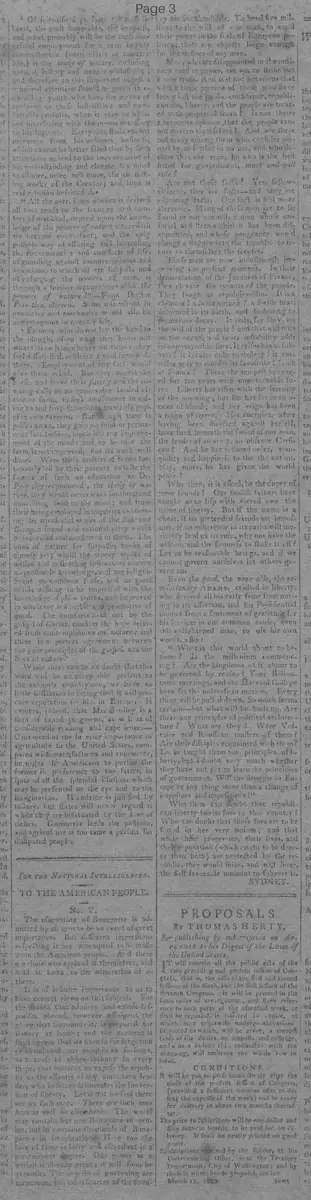
FOR THE NATIONAL INTELLIGENCER.
TO THE AMERICAN PEOPLE.
No. V.
The usurpation of Bonaparte is admitted by all men to be an event of great importance. But different impressions respecting it are attempted to be made upon the American people. And there are those who applaud it themselves, and hold it forth to the admiration of others.
It is of infinite importance to us to have correct views on this subject. For the nation that admires and exults despotism abroad, however effulgent the glory that surrounds it, is prepared for it even at home; and the moment it shall appear that we have so far forgotten or abandoned our republican feelings, as to cease to abhor tyranny in every shape, that moment we expose the republic to the assaults of any ambitious leader, who in secret deliberates the subversion of liberty. Let it not be said there are no such men. There are such men here as well as elsewhere. The world may contain but one Bonaparte in genius, but it contains thousands of Bonapartes in imagination! The love of fame is lofty and ardent in a pre-eminent degree. Our power as a nation is already great; it will soon be gigantic. The objects of governing are numerous, and the resources of the country are inexhaustible. To bend five millions to the will of one man, to wield their power in the scale of European politics; these are objects large enough for the desires of any man.
Men, who are disappointed in the ordinary road to power, are apt to strike out a new tract. And is it not notorious that with a large portion of those who have lately lost the public confidence, republicanism, liberty, and the people are treated with perpetual scorn? Is not theirs a favourite opinion that the people cannot govern themselves? And are there not many among them who consider monarchy as settled in nature, and who declare that one man, he who is the best fitted for government, must and will rule?
Are not these facts? Yes, fellow-citizens, they are facts—and they are alarming facts. One fact is still more alarming. Many of the men are to be found in our councils: men whose unsocial and stern ambition has been disappointed, and whose vengeance would plunge a dagger into the republic to ensure to themselves the sceptre.
These men are now industriously improving the present moment. In their denunciation of the Jacobins of France, they elevate the tyrants of the people. They laugh at republicanism. It is a chimera! a lusus naturae! a feeble brat, deformed in its birth, and hastening to premature decay. It rests, say they, on the will of the people! and that will rests on the ocean, and to its instability adds its ungovernable fury. It rises but to subvert! it creates only to destroy! it carries only to murder its favourite! Look at France! There the tempest has raged for ten years with ungovernable fury. Liberty has risen with the serenity of the morning; but she has set in an ocean of blood; and her reign has been a reign of terror. Her energies, after having been directed against herself, have sunk beneath the word of one man, the leader of an army, an obscure Corsican! And he has restored order, tranquility and happiness to the nation. Nay, more, he has given the world peace!
Why then, it is asked, be the dupes of mere sounds? Our foolish fathers have taught us to lisp with sacred awe the name of liberty. But if the name is a cheat, if its pretended friends are impostors, if an adherence in its paths will inevitably lead us to ruin, why not have the wisdom and the firmness to shake it off? Let us be reasonable beings, and if we cannot govern ourselves let others govern us.
Even the sage, the venerable, the renowned Adams, cradled in liberty, who derived all his early fame from uniting in its assertion, and his Presidential honors from a sentiment of gratitude for his services in our common cause, even this enlightened man, to use his own words, asks:
"What is this world about to become? Is the millennium commencing? Are the kingdoms of it about to be governed by reason? Your Boston-town meetings, and our Harvard College have set the universe in motion. Every thing will be pulled down. So much seems certain—but what will be built up. Are there any principles of political architecture? What are they? Were Voltaire and Rousseau masters of them? Are their disciples acquainted with them? Locke taught them the principles of liberty, but I doubt very much whether they have not yet to learn the principles of government. Will the struggle in Europe be any thing more than a change of impostors and impositions?"
Who then can doubt that republican liberty has its foes in this country? Who can doubt that those foes are to be found in her very bosom; and that while their properties, their lives, and their reputation (which ought to be dearer than both) are protected by the republic, they would seize, and will seize the first favourable moment to subvert it.
SYDNEY.
TO THE AMERICAN PEOPLE.
No. V.
The usurpation of Bonaparte is admitted by all men to be an event of great importance. But different impressions respecting it are attempted to be made upon the American people. And there are those who applaud it themselves, and hold it forth to the admiration of others.
It is of infinite importance to us to have correct views on this subject. For the nation that admires and exults despotism abroad, however effulgent the glory that surrounds it, is prepared for it even at home; and the moment it shall appear that we have so far forgotten or abandoned our republican feelings, as to cease to abhor tyranny in every shape, that moment we expose the republic to the assaults of any ambitious leader, who in secret deliberates the subversion of liberty. Let it not be said there are no such men. There are such men here as well as elsewhere. The world may contain but one Bonaparte in genius, but it contains thousands of Bonapartes in imagination! The love of fame is lofty and ardent in a pre-eminent degree. Our power as a nation is already great; it will soon be gigantic. The objects of governing are numerous, and the resources of the country are inexhaustible. To bend five millions to the will of one man, to wield their power in the scale of European politics; these are objects large enough for the desires of any man.
Men, who are disappointed in the ordinary road to power, are apt to strike out a new tract. And is it not notorious that with a large portion of those who have lately lost the public confidence, republicanism, liberty, and the people are treated with perpetual scorn? Is not theirs a favourite opinion that the people cannot govern themselves? And are there not many among them who consider monarchy as settled in nature, and who declare that one man, he who is the best fitted for government, must and will rule?
Are not these facts? Yes, fellow-citizens, they are facts—and they are alarming facts. One fact is still more alarming. Many of the men are to be found in our councils: men whose unsocial and stern ambition has been disappointed, and whose vengeance would plunge a dagger into the republic to ensure to themselves the sceptre.
These men are now industriously improving the present moment. In their denunciation of the Jacobins of France, they elevate the tyrants of the people. They laugh at republicanism. It is a chimera! a lusus naturae! a feeble brat, deformed in its birth, and hastening to premature decay. It rests, say they, on the will of the people! and that will rests on the ocean, and to its instability adds its ungovernable fury. It rises but to subvert! it creates only to destroy! it carries only to murder its favourite! Look at France! There the tempest has raged for ten years with ungovernable fury. Liberty has risen with the serenity of the morning; but she has set in an ocean of blood; and her reign has been a reign of terror. Her energies, after having been directed against herself, have sunk beneath the word of one man, the leader of an army, an obscure Corsican! And he has restored order, tranquility and happiness to the nation. Nay, more, he has given the world peace!
Why then, it is asked, be the dupes of mere sounds? Our foolish fathers have taught us to lisp with sacred awe the name of liberty. But if the name is a cheat, if its pretended friends are impostors, if an adherence in its paths will inevitably lead us to ruin, why not have the wisdom and the firmness to shake it off? Let us be reasonable beings, and if we cannot govern ourselves let others govern us.
Even the sage, the venerable, the renowned Adams, cradled in liberty, who derived all his early fame from uniting in its assertion, and his Presidential honors from a sentiment of gratitude for his services in our common cause, even this enlightened man, to use his own words, asks:
"What is this world about to become? Is the millennium commencing? Are the kingdoms of it about to be governed by reason? Your Boston-town meetings, and our Harvard College have set the universe in motion. Every thing will be pulled down. So much seems certain—but what will be built up. Are there any principles of political architecture? What are they? Were Voltaire and Rousseau masters of them? Are their disciples acquainted with them? Locke taught them the principles of liberty, but I doubt very much whether they have not yet to learn the principles of government. Will the struggle in Europe be any thing more than a change of impostors and impositions?"
Who then can doubt that republican liberty has its foes in this country? Who can doubt that those foes are to be found in her very bosom; and that while their properties, their lives, and their reputation (which ought to be dearer than both) are protected by the republic, they would seize, and will seize the first favourable moment to subvert it.
SYDNEY.
What sub-type of article is it?
Persuasive
Political
Provocative
What themes does it cover?
Politics
Constitutional Rights
Morality
What keywords are associated?
Bonaparte Usurpation
Republican Liberty
American Tyranny
Political Ambition
French Revolution
John Adams Quote
What entities or persons were involved?
Sydney
To The American People
Letter to Editor Details
Author
Sydney
Recipient
To The American People
Main Argument
admiring bonaparte's despotism abroad prepares americans for tyranny at home, exposing the republic to subversion by ambitious leaders who scorn republicanism and favor monarchy.
Notable Details
Quotes John Adams On Principles Of Government And Liberty
References To Jacobins, Voltaire, Rousseau, Locke
Critique Of Those In Councils Plotting Against The Republic