Thank you for visiting SNEWPapers!
Sign up free
Editorial
December 20, 1925
The Daily Worker
Chicago, Cook County, Illinois
What is this article about?
C. E. Ruthenberg, General Secretary of the Workers (Communist) Party, urges unification to end internal factional struggles and redirect party energies toward mass work among workers and farmers, highlighting favorable economic conditions and trade union activities.
Clipping
OCR Quality
97%
Excellent
Full Text
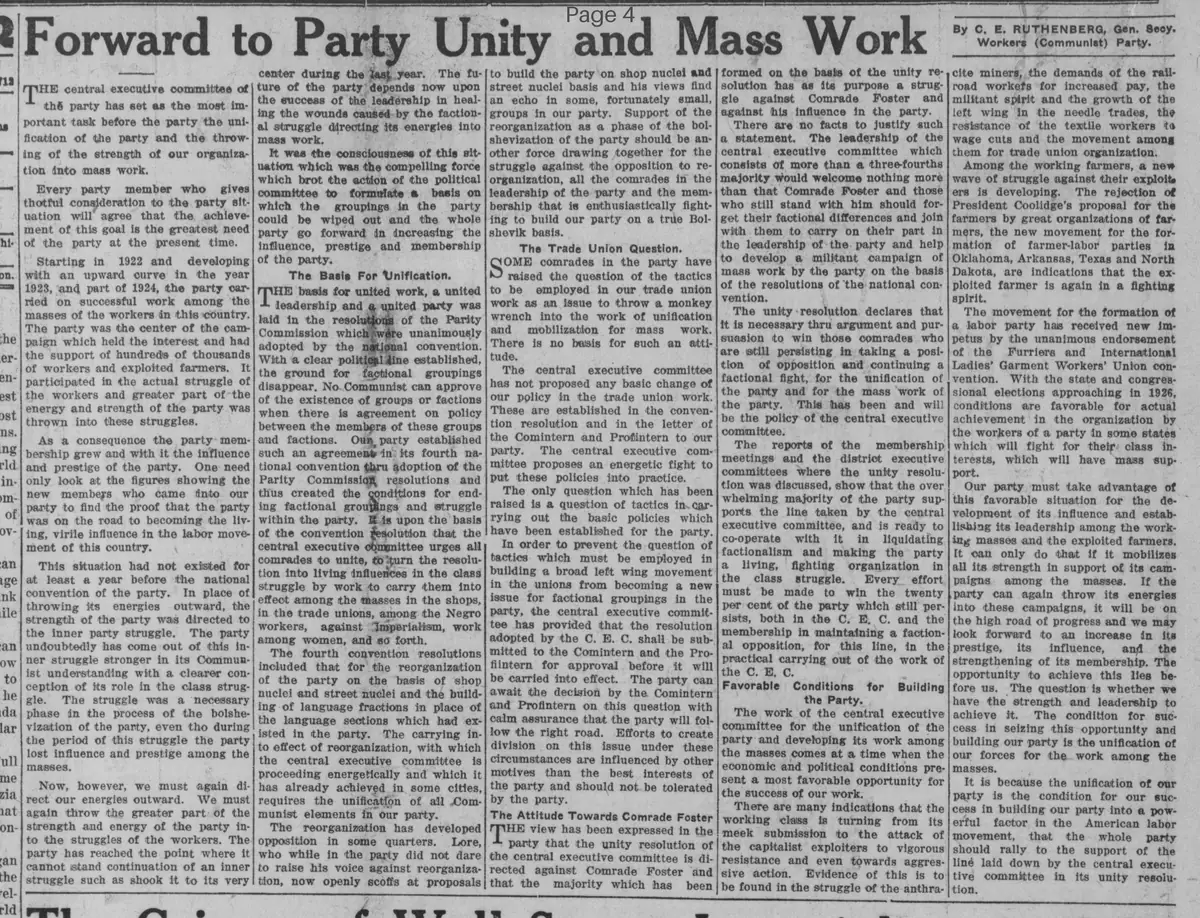
By C. E. RUTHENBERG, Gen. Secy. Workers (Communist) Party.
The central executive committee of the party has set as the most important task before the party the unification of the party and the throwing of the strength of our organization into mass work.
Every party member who gives thoughtful consideration to the party situation will agree that the achievement of this goal is the greatest need of the party at the present time.
Starting in 1922 and developing with an upward curve in the year 1923 and part of 1924, the party carried on successful work among the masses of the workers in this country. The party was the center of the campaign which held the interest and had the support of hundreds of thousands of workers and exploited farmers. It participated in the actual struggle of the workers and greater part of the energy and strength of the party was thrown into these struggles.
As a consequence the party membership grew and with it the influence and prestige of the party. One need only look at the figures showing the new members who came into our party to find the proof that the party was on the road to becoming the living, virile influence in the labor movement of this country.
This situation had not existed for at least a year before the national convention of the party. In place of throwing its energies outward, the strength of the party was directed to the inner party struggle. The party undoubtedly has come out of this inner struggle stronger in its Communist understanding with a clearer conception of its role in the class struggle. The struggle was a necessary phase in the process of the bolshevization of the party, even tho during the period of this struggle the party lost influence and prestige among the masses.
Now, however, we must again direct our energies outward. We must again throw the greater part of the strength and energy of the party into the struggles of the workers. The party has reached the point where it cannot stand continuation of an inner struggle such as shook it to its very center during the last year. The future of the party depends now upon the success of the leadership in healing the wounds caused by the factional struggle directing its energies into mass work.
It was the consciousness of this situation which was the compelling force which brot the action of the political committee to formulate a basis on which the groupings in the party could be wiped out and the whole party go forward in increasing the influence, prestige and membership of the party.
The Basis For Unification.
The basis for united work, a united leadership and a united party was laid in the resolutions of the Parity Commission which were unanimously adopted by the national convention.
With a clear political line established, the ground for factional groupings disappear. No Communist can approve of the existence of groups or factions when there is agreement on policy between the members of these groups and factions. Our party established such an agreement in its fourth national convention thru adoption of the Parity Commission resolutions and thus created the conditions for ending factional groupings and struggle within the party. It is upon the basis of the convention resolution that the central executive committee urges all comrades to unite, to turn the resolution into living influences in the class struggle by work to carry them into effect among the masses in the shops, in the trade unions, among the Negro workers, against Imperialism, work among women, and so forth.
The fourth convention resolutions included that for the reorganization of the party on the basis of shop nuclei and street nuclei and the building of language fractions in place of the language sections which had existed in the party. The carrying into effect of reorganization, with which the central executive committee is proceeding energetically and which it has already achieved in some cities, requires the unification of all Communist elements in our party.
The reorganization has developed opposition in some quarters. Lore, who while in the party did not dare to raise his voice against reorganization, now openly scoffs at proposals to build the party on shop nuclei and street nuclei basis and his views find an echo in some, fortunately small, groups in our party. Support of the reorganization as a phase of the bolshevization of the party should be another force drawing together for the struggle against the opposition to reorganization, all the comrades in the leadership of the party and the membership that is enthusiastically fighting to build our party on a true Bolshevik basis.
The Trade Union Question.
Some comrades in the party have raised the question of the tactics to be employed in our trade union work as an issue to throw a monkey wrench into the work of unification and mobilization for mass work.
There is no basis for such an attitude.
The central executive committee has not proposed any basic change of our policy in the trade union work. These are established in the convention resolution and in the letter of the Comintern and Profintern to our party. The central executive committee proposes an energetic fight to put these policies into practice.
The only question which has been raised is a question of tactics in carrying out the basic policies which have been established for the party.
In order to prevent the question of tactics which must be employed in building a broad left wing movement in the unions from becoming a new issue for factional groupings in the party, the central executive committee has provided that the resolution adopted by the C. E. C. shall be submitted to the Comintern and the Profintern for approval before it will be carried into effect. The party can await the decision by the Comintern and Profintern on this question with calm assurance that the party will follow the right road. Efforts to create division on this issue under these circumstances are influenced by other motives than the best interests of the party and should not be tolerated by the party.
The Attitude Towards Comrade Foster
The view has been expressed in the party that the unity resolution of the central executive committee is directed against Comrade Foster and that the majority which has been formed on the basis of the unity resolution has as its purpose a struggle against Comrade Foster and against his influence in the party.
There are no facts to justify such a statement. The leadership of the central executive committee which consists of more than a three-fourths majority would welcome nothing more than that Comrade Foster and those who still stand with him should forget their factional differences and join with them to carry on their part in the leadership of the party and help to develop a militant campaign of mass work by the party on the basis of the resolutions of the national convention.
The unity resolution declares that it is necessary thru argument and persuasion to win those comrades who are still persisting in taking a position of opposition and continuing a factional fight, for the unification of the party and for the mass work of the party. This has been and will be the policy of the central executive committee.
The reports of the membership meetings and the district executive committees where the unity resolution was discussed, show that the overwhelming majority of the party supports the line taken by the central executive committee, and is ready to co-operate with it in liquidating factionalism and making the party a living, fighting organization in the class struggle. Every effort must be made to win the twenty per cent of the party which still persists, both in the C. E. C. and the membership in maintaining a factional opposition, for this line, in the practical carrying out of the work of the C. E. C.
Favorable Conditions for Building the Party.
The work of the central executive committee for the unification of the party and developing its work among the masses comes at a time when the economic and political conditions present a most favorable opportunity for the success of our work.
There are many indications that the working class is turning from its meek submission to the attack of the capitalist exploiters to vigorous resistance and even towards aggressive action. Evidence of this is to be found in the struggle of the anthracite miners, the demands of the railroad workers for increased pay, the militant spirit and the growth of the left wing in the needle trades, the resistance of the textile workers to wage cuts and the movement among them for trade union organization.
Among the working farmers, a new wave of struggle against their exploiters is developing. The rejection of President Coolidge's proposal for the farmers by great organizations of farmers, the new movement for the formation of farmer-labor parties in Oklahoma, Arkansas, Texas and North Dakota, are indications that the exploited farmer is again in a fighting spirit.
The movement for the formation of a labor party has received new impetus by the unanimous endorsement of the Furriers and International Ladies' Garment Workers' Union convention. With the state and congressional elections approaching in 1926, conditions are favorable for actual achievement in the organization by the workers of a party in some states which will fight for their class interests, which will have mass support.
Our party must take advantage of this favorable situation for the development of its influence and establishing its leadership among the working masses and the exploited farmers. It can only do that if it mobilizes all its strength in support of its campaigns among the masses. If the party can again throw its energies into these campaigns, it will be on the high road of progress and we may look forward to an increase in its prestige, its influence, and the strengthening of its membership. The opportunity to achieve this lies before us. The question is whether we have the strength and leadership to achieve it. The condition for success in seizing this opportunity and building our party is the unification of our forces for the work among the masses.
It is because the unification of our party is the condition for our success in building our party into a powerful factor in the American labor movement, that the whole party should rally to the support of the line laid down by the central executive committee in its unity resolution.
The central executive committee of the party has set as the most important task before the party the unification of the party and the throwing of the strength of our organization into mass work.
Every party member who gives thoughtful consideration to the party situation will agree that the achievement of this goal is the greatest need of the party at the present time.
Starting in 1922 and developing with an upward curve in the year 1923 and part of 1924, the party carried on successful work among the masses of the workers in this country. The party was the center of the campaign which held the interest and had the support of hundreds of thousands of workers and exploited farmers. It participated in the actual struggle of the workers and greater part of the energy and strength of the party was thrown into these struggles.
As a consequence the party membership grew and with it the influence and prestige of the party. One need only look at the figures showing the new members who came into our party to find the proof that the party was on the road to becoming the living, virile influence in the labor movement of this country.
This situation had not existed for at least a year before the national convention of the party. In place of throwing its energies outward, the strength of the party was directed to the inner party struggle. The party undoubtedly has come out of this inner struggle stronger in its Communist understanding with a clearer conception of its role in the class struggle. The struggle was a necessary phase in the process of the bolshevization of the party, even tho during the period of this struggle the party lost influence and prestige among the masses.
Now, however, we must again direct our energies outward. We must again throw the greater part of the strength and energy of the party into the struggles of the workers. The party has reached the point where it cannot stand continuation of an inner struggle such as shook it to its very center during the last year. The future of the party depends now upon the success of the leadership in healing the wounds caused by the factional struggle directing its energies into mass work.
It was the consciousness of this situation which was the compelling force which brot the action of the political committee to formulate a basis on which the groupings in the party could be wiped out and the whole party go forward in increasing the influence, prestige and membership of the party.
The Basis For Unification.
The basis for united work, a united leadership and a united party was laid in the resolutions of the Parity Commission which were unanimously adopted by the national convention.
With a clear political line established, the ground for factional groupings disappear. No Communist can approve of the existence of groups or factions when there is agreement on policy between the members of these groups and factions. Our party established such an agreement in its fourth national convention thru adoption of the Parity Commission resolutions and thus created the conditions for ending factional groupings and struggle within the party. It is upon the basis of the convention resolution that the central executive committee urges all comrades to unite, to turn the resolution into living influences in the class struggle by work to carry them into effect among the masses in the shops, in the trade unions, among the Negro workers, against Imperialism, work among women, and so forth.
The fourth convention resolutions included that for the reorganization of the party on the basis of shop nuclei and street nuclei and the building of language fractions in place of the language sections which had existed in the party. The carrying into effect of reorganization, with which the central executive committee is proceeding energetically and which it has already achieved in some cities, requires the unification of all Communist elements in our party.
The reorganization has developed opposition in some quarters. Lore, who while in the party did not dare to raise his voice against reorganization, now openly scoffs at proposals to build the party on shop nuclei and street nuclei basis and his views find an echo in some, fortunately small, groups in our party. Support of the reorganization as a phase of the bolshevization of the party should be another force drawing together for the struggle against the opposition to reorganization, all the comrades in the leadership of the party and the membership that is enthusiastically fighting to build our party on a true Bolshevik basis.
The Trade Union Question.
Some comrades in the party have raised the question of the tactics to be employed in our trade union work as an issue to throw a monkey wrench into the work of unification and mobilization for mass work.
There is no basis for such an attitude.
The central executive committee has not proposed any basic change of our policy in the trade union work. These are established in the convention resolution and in the letter of the Comintern and Profintern to our party. The central executive committee proposes an energetic fight to put these policies into practice.
The only question which has been raised is a question of tactics in carrying out the basic policies which have been established for the party.
In order to prevent the question of tactics which must be employed in building a broad left wing movement in the unions from becoming a new issue for factional groupings in the party, the central executive committee has provided that the resolution adopted by the C. E. C. shall be submitted to the Comintern and the Profintern for approval before it will be carried into effect. The party can await the decision by the Comintern and Profintern on this question with calm assurance that the party will follow the right road. Efforts to create division on this issue under these circumstances are influenced by other motives than the best interests of the party and should not be tolerated by the party.
The Attitude Towards Comrade Foster
The view has been expressed in the party that the unity resolution of the central executive committee is directed against Comrade Foster and that the majority which has been formed on the basis of the unity resolution has as its purpose a struggle against Comrade Foster and against his influence in the party.
There are no facts to justify such a statement. The leadership of the central executive committee which consists of more than a three-fourths majority would welcome nothing more than that Comrade Foster and those who still stand with him should forget their factional differences and join with them to carry on their part in the leadership of the party and help to develop a militant campaign of mass work by the party on the basis of the resolutions of the national convention.
The unity resolution declares that it is necessary thru argument and persuasion to win those comrades who are still persisting in taking a position of opposition and continuing a factional fight, for the unification of the party and for the mass work of the party. This has been and will be the policy of the central executive committee.
The reports of the membership meetings and the district executive committees where the unity resolution was discussed, show that the overwhelming majority of the party supports the line taken by the central executive committee, and is ready to co-operate with it in liquidating factionalism and making the party a living, fighting organization in the class struggle. Every effort must be made to win the twenty per cent of the party which still persists, both in the C. E. C. and the membership in maintaining a factional opposition, for this line, in the practical carrying out of the work of the C. E. C.
Favorable Conditions for Building the Party.
The work of the central executive committee for the unification of the party and developing its work among the masses comes at a time when the economic and political conditions present a most favorable opportunity for the success of our work.
There are many indications that the working class is turning from its meek submission to the attack of the capitalist exploiters to vigorous resistance and even towards aggressive action. Evidence of this is to be found in the struggle of the anthracite miners, the demands of the railroad workers for increased pay, the militant spirit and the growth of the left wing in the needle trades, the resistance of the textile workers to wage cuts and the movement among them for trade union organization.
Among the working farmers, a new wave of struggle against their exploiters is developing. The rejection of President Coolidge's proposal for the farmers by great organizations of farmers, the new movement for the formation of farmer-labor parties in Oklahoma, Arkansas, Texas and North Dakota, are indications that the exploited farmer is again in a fighting spirit.
The movement for the formation of a labor party has received new impetus by the unanimous endorsement of the Furriers and International Ladies' Garment Workers' Union convention. With the state and congressional elections approaching in 1926, conditions are favorable for actual achievement in the organization by the workers of a party in some states which will fight for their class interests, which will have mass support.
Our party must take advantage of this favorable situation for the development of its influence and establishing its leadership among the working masses and the exploited farmers. It can only do that if it mobilizes all its strength in support of its campaigns among the masses. If the party can again throw its energies into these campaigns, it will be on the high road of progress and we may look forward to an increase in its prestige, its influence, and the strengthening of its membership. The opportunity to achieve this lies before us. The question is whether we have the strength and leadership to achieve it. The condition for success in seizing this opportunity and building our party is the unification of our forces for the work among the masses.
It is because the unification of our party is the condition for our success in building our party into a powerful factor in the American labor movement, that the whole party should rally to the support of the line laid down by the central executive committee in its unity resolution.
What sub-type of article is it?
Partisan Politics
Labor
What keywords are associated?
Party Unification
Factionalism
Mass Work
Trade Unions
Bolshevization
Communist Party
Labor Struggles
Farmer Labor Parties
What entities or persons were involved?
C. E. Ruthenberg
Central Executive Committee
Comrade Foster
Parity Commission
Comintern
Profintern
Lore
Editorial Details
Primary Topic
Unification Of The Workers (Communist) Party And Redirection To Mass Work
Stance / Tone
Urging Unification And Outward Focus On Worker Struggles
Key Figures
C. E. Ruthenberg
Central Executive Committee
Comrade Foster
Parity Commission
Comintern
Profintern
Lore
Key Arguments
Unification Is Essential To End Inner Factional Struggles
Redirect Party Energies To Mass Work Among Workers And Farmers
Party Grew Influential Through Mass Engagement In 1922 1924
Convention Resolutions Provide Basis For Unity
Reorganization On Shop And Street Nuclei Requires Unified Support
No Change In Trade Union Policy, Only Tactical Questions
Welcome Foster's Participation In Unified Leadership
Favorable Conditions In Labor Struggles And Farmer Movements