Thank you for visiting SNEWPapers!
Sign up free
Literary
February 19, 1845
Morning Star
Limerick, York County, Maine
What is this article about?
Theological essay defending the Trinitarian doctrine of Christ's divinity against Unitarian, Arian, and Sabellian views, using scriptural evidence on names, attributes, works, and worship to argue Christ is fully God and man.
Clipping
OCR Quality
95%
Excellent
Full Text
DOCTRINAL.
For the Morning Star.
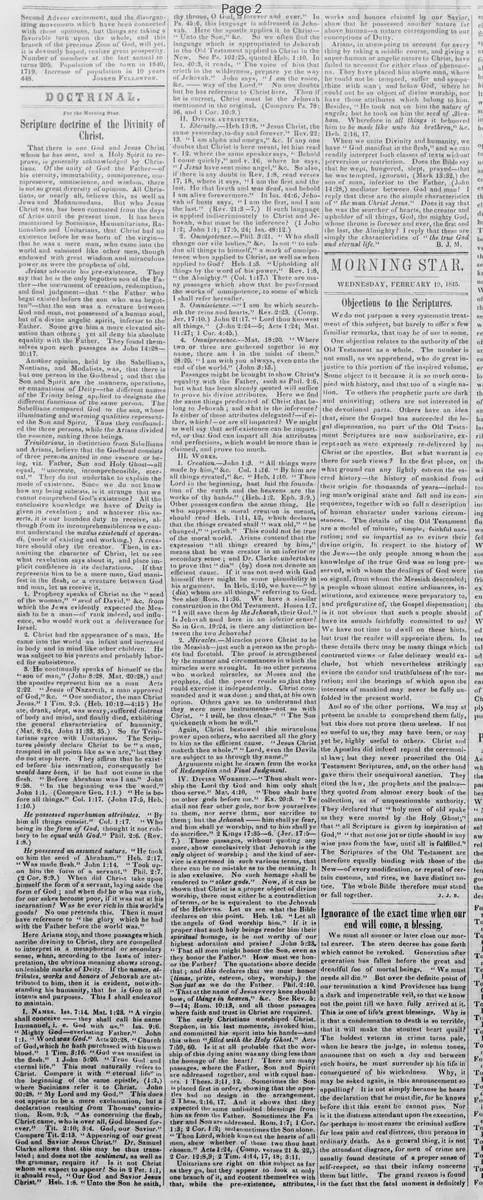
Scripture doctrine of the Divinity of Christ.
That there is one God and Jesus Christ whom he has sent, and a Holy Spirit to reprove, is generally acknowledged by Christians. Of the unity of God the Father-of his eternity, immutability, omnipotence, omnipresence, omniscience, and wisdom, there is not so great diversity of opinion. All Christians, or nearly all, believe this, as well as Jews and Mohammedans. But who Jesus Christ was, has been contested from the days of Arius until the present time. It has been maintained by Socinians, Humanitarians, Rationalists and Unitarians, that Christ had no existence before he was born of the virgin—that he was a mere man, who came into the world and subsisted like other men, though endowed with great wisdom and miraculous power as were the prophets of old.
Arians advocate his pre-existence. They say that he is the only begotten son of the Father-the instrument of creation, redemption, and final judgment-that "the Father who begat existed before the son who was begotten"-that the son was a creature between God and man, not possessed of a human soul, but of a divine angelic spirit, inferior to the Father. Some give him a more elevated situation than others; yet all deny his absolute equality with the Father. They found themselves upon such passages as John 14:28-20:17.
Another opinion, held by the Sabellians, Noetians, and Modalists, was, that there is but one person in the Godhead; and that the Son and Spirit are the manners, operations, or emanations of Deity--the different names of the Trinity being applied to designate the different functions of the same person. The Sabellians compared God to the sun, whose illuminating and warming qualities represented the Son and Spirit. Thus they confounded the three persons, while the Arians divided the essence, making three beings.
Trinitarians, in distinction from Sabellians and Arians, believe that the Godhead consists of three persons united in one essence or being, viz. Father, Son and Holy Ghost-all equal, "uncreate, incomprehensible, eternal." They do not undertake to explain the mode of existence. Since we do not know how any being subsists, is it strange that we cannot comprehend God's existence? All the conclusive knowledge we have of Deity is given in revelation; and whatever this asserts, it is our bounden duty to receive, although from its incomprehensibleness we cannot understand the modus existendi et operandi, (mode of existing and working.) A creature should obey the creator. Then, in examining the character of Christ, let us see what revelation says about it, and place implicit confidence in its declarations. If that represents him to be a mere man, God manifest in the flesh, or a creature between God and man, let us receive it.
1. Prophecy speaks of Christ as the "seed of the woman," "seed of David," &c. from which the Jews evidently expected the Messiah to be a man-of rank indeed, and influence, who would work out a deliverance for Israel.
2. Christ had the appearance of a man. He came into the world an infant and increased in body and in mind like other children. He was subject to his parents and probably labored for subsistence.
3. He continually speaks of himself as the "son of man," (John 8:28, Mat. 20:28.) and the apostles represent him as a man Acts 2:22. "Jesus of Nazareth, a man approved of God,"&c. "One mediator, the man Christ Jesus." 1 Tim. 2:5. (Heb. 10:12-4:15) He ate, drank, slept, was weary, suffered distress of body and mind, and finally died, exhibiting the general characteristics of humanity. (Mat. 8:24, John 11:33. 35.) So far Trinitarians agree with Unitarians. The Scriptures plainly declare Christ to be "a man, tempted in all points like as we are,"but they do not stop here. They affirm that he existed before his incarnation, consequently he would have been, if he had not come in the flesh. "Before Abraham was I am." John 8:58. "In the beginning was the word." John 1:1. (Compare Gen. 1:1.) "He is before all things." Col. 1:17. (John 17:5, Heb. 1:10.)
He possessed superhuman attributes. "By him all things consist." Col. 1:17. "Who being in the form of God, thought it not robbery to be equal with God." Phil. 2:6. (Rev. 1:8.)
He possessed an assumed nature. "He took on him the seed of Abraham." Heb. 2:17. "Was made flesh." John 1:14. "Took upon him the form of a servant." Phil. 2:7. (2 Cor. 8:9.) When did Christ take upon himself the form of a servant, laying aside the form of God; and when did he who was rich, for our sakes become poor, if it was not at his incarnation? Was he ever rich in this world's goods? No one pretends this. Then it must have reference to "the glory which he had with the Father before the world was."
Here Arians stop, and those passages which ascribe divinity to Christ, they are compelled to interpret in a metaphorical or secondary sense, when, according to the laws of interpretation, the obvious meaning shows strong, undeniable marks of Deity. If the names, attributes, works and honors of Jehovah are attributed to him, then it is evident, notwithstanding his humanity, that he is God to all intents and purposes. This I shall endeavor to maintain.
I. NAMES. Isa. 7:14. Mat. 1:23. "A virgin shall conceive --they shall call his name Immanuel, i. e. God with us." Isa. 9:6. "Mighty God-everlasting Father." John 1:1. "Word was God." Acts 20:28. "Church of God,which he hath purchased with his own blood." 1 Tim. 3:16. "God was manifest in the flesh." 1 John 5:20. "True God and eternal life." This most naturally refers to Christ. Compare it with "eternal life" in the beginning of the same epistle, (1:2,) where Socinians refer it to Christ. John 20:28. "My Lord and my God." This does not appear to be a mere exclamation, but a declaration resulting from Thomas' conviction. Rom. 9:5. "As concerning the flesh, Christ came, who is over all, God blessed forever." Tit. 2:13; 3:4. God, our Savior." Compare Tit. 2:13. "Appearing of our great God and Savior Jesus Christ." Dr. Samuel Clarke allows that this may be thus translated: and does not the sentiment, as well as the grammar, require it? Is it not Christ whom we expect to appear? So in 2 Pet. 1:1. it should read, "Our God and Savior Jesus Christ." Heb. 1:8. "Unto the Son he saith, thy throne, O God, is forever and ever." In Ps. 45:6, this language is addressed to Jehovah. Here the apostle applies it to Christ- "Unto the Son," &c. So we often find the language which is appropriated to Jehovah in the Old Testament applied to Christ in the New. See Ps. 102:25, quoted Heb. 1:10. In Isa. 40:3, it reads, "The voice of him that crieth in the wilderness, prepare ye the way of Jehovah." John says, "I am the voice, &c. - way of the Lord." No one doubts but he has reference to Christ here. Then if he is correct, Christ must be the Jehovah mentioned in the original. (Compare Ps. 78:56, and 1 Cor. 10:9.)
II. Divine ATTRIBUTES.
1. Eternity.-Heb.13:8. "Jesus Christ, the same yesterday,to-day and forever." Rev.22:13. "I am alpha and omega," &c. If any one doubts that Christ is here meant, let him read v. 12. where the same speaker says, "Behold I come quickly," and v. 16, where he says, "I Jesus have sent mine angel," &c. So also if there is any doubt in Rev. 1:8, read verses 17. 18, where it says, "I am the first and the last. He that liveth and was dead, and behold I am alive forevermore." In Isa. 44:6, Jehovah of hosts says, "I am the first, and I am the last." (Rev. 21:5-7.) If such language is applied indiscriminately to Christ and Jehovah, what must be the inference? (1 John 1:2; John 1:1; 17:5, 24; Isa. 48:12.)
2. Omnipotence.-Phil. 3:21. "Who shall change our vile bodies," &c. Is not "to subdue all things to himself," a mark of omnipotence when applied to Christ, as well as when applied to God? Heb. 1:3. "Upholding all things by the word of his power." Rev. 1:8. "the Almighty," (Col. 1:17.) There are many passages which show that he performed the works of omnipotence, to some of which I shall refer hereafter.
3. Omniscience.-"I am he which searcheth the reins and hearts." Rev. 2:23. (Comp. Jer. 17:10.) John 21:17. "Lord thou knowest all things." (John 2:24-5; Acts 1:24: Mat 11:27; 1 Cor. 4:5.)
4. Omnipresence.--Mat. 18:20. "Where two or three are gathered together in my name, there am I in the midst of them." 28:20. "I am with you always, even unto the end of the world." (John 8:13.)
Passages might be brought to show Christ's equality with the Father, such as Phil. 2:6, but what has been already quoted will suffice to prove his divine attributes. Here we find the same things predicated of Christ that belong to Jehovah; and what is the inference? Is either of these attributes delegated?-if either, which?-or are all imparted? We might as well say that self-existence can be imparted, or that God can impart all his attributes and perfections, which would be more than is claimed, and prove too much.
III. Works.
1. Creation-John 1:3. "All things were made by him," &c. Col. 1:16. "By him are all things created,"&c. "Heb. 1:10." Thou Lord in the beginning. hast laid the foundation of the earth and the heavens are the works of thy hands." (Heb. 1:2. Eph. 3:9.) Other passages confirm the same thing. He who supposes a moral creation is meant, should read Heb. 1:11, 12, which declares that the things created shall "wax old," "be changed," "perish." This could not be true of the moral world. Arians contend that the expression "all things created by him," means that he was creator in an inferior or secondary sense; and Dr. Clarke undertakes to prove that "dia" (by) does not denote an efficient cause. If it was not used with God himself there might be some plausibility in his argument. In Heb. 2:10, we have-."by (dia) whom are all things," referring to God See also Rom. 11:36. We have a similar construction in the Old Testament. Hosea 1:7. "I will save them by the Jehovah, their God." Is Jehovah used here in an inferior sense? So in Gen. 19:24, is there any distinction between the two Jehovahs?
2. Miracles.-Miracles prove Christ to be the Messiah-just such a person as the prophets had foretold. The proof is strengthened by the manner and circumstances in which the miracles were wrought. In no other persons who worked miracles, as Moses and the prophets, did the power reside so that they could exercise it independently. Christ commanded and it was done; and that, at his own option. Others gave us to understand that they were mere instruments-not so with Christ, "I will, be thou clean." "The Son quickeneth whom he will."
Again, Christ bestowed this miraculous power upon others, who ascribed all the glory to him as the efficient cause. "Jesus Christ maketh thee whole." "Lord, even the Devils are subject to us through thy name."
Arguments might be drawn from the works of Redemption and Final Judgment.
IV. Divine Worship,-"Thou shalt worship the Lord thy God and him only shalt thou serve." Mat. 4:10, "Thou shalt have no other gods before me." Ex. 20:3. "Ye shall not fear other gods, nor bow yourselves to them, nor serve them, nor sacrifice to them; but the Jehovah -- him shall ye fear, and him shall ye worship, and to him shall ye do sacrifice." 2 Kings 17:35-6.(Jer. 17:5-7.) These passages, without quoting any more, show conclusively that Jehovah is the only object of worship; and the kind of service is expressed in such various terms, that there can be no mistake as to the meaning. It is also exclusive. No such homage shall be rendered to "other gods." Now, if it can be shown that Christ is a proper object of divine worship, there must either be a contradiction of terms, or he is equivalent to the Jehovah of the Hebrews. Let us see what the Bible declares on this point. Heb. 1:6. "Let all the angels of God worship him," If it is proper that such holy beings render him their spiritual homage, is he not worthy of our highest adoration and praise? John 5:23. "That all men might honor the Son, even as they honor the Father." How must we honor the Father? The quotations above decide that; and this declares that we must honor (love, prize, esteem, obey, worship,) the Son just as we do the Father. Phil. 2:10. "That at the name of Jesus every knee should bow, of things in heaven," &c. See Rev. 5:9--14; Rom. 10:13, and all those passages where faith and trust in Christ are required.
The early Christians worshiped Christ. Stephen, in his last moments, invoked him, and committed his spirit into his hands-and this when "filled with the Holy Ghost." Acts 7:59, 60. Is it at all probable that the worship of this dying saint was any thing less than the homage of the heart? There are many passages, where the Father, Son and Spirit are addressed together, and with equal honors. 1 Thess. 3:11. 12. Sometimes the Son is placed first in order, showing that the apostles had no design in the arrangement. 2 Thess. 2:16, 17. And it shows that they expected the same unlimited blessings from him as from the Father. Sometimes the Father and Son are addressed. Rom. 1:7; 1 Cor. 1:8; 2 Cor. 1:2; and sometimes the Son alone. "Thou Lord, which knowest the hearts of all men, shew whether of these two thou hast chosen." Acts 1:24, (Comp. verses 21 & 22,) 2 Cor. 12:8,9; 2 Tim. 4:14, 17, 18; 3:11.
Unitarians are right on this subject as far as they go, but they appear to look at only one branch of it, and content themselves with that, while the pre-existence, attributes, works and honors claimed by our Savior, show that he possessed another nature far above human-a nature corresponding to our conceptions of Deity.
Arians, in attempting to account for every thing by taking a middle course, and giving a super-human or angelic nature to Christ, have failed to account for either class of phenomena. They have placed him above man, where he could not be tempted, suffer and sympathize with man; and below God, where he could not be an object of divine worship, nor have those attributes which belong to him.
Besides, "He took not on him the nature of angels; but he took on him the seed of Abraham. Wherefore in all things it behooved him to be made like unto his brethren," &c. Heb. 2:16, 17.
When we unite Divinity and humanity, we have "God manifest in the flesh," and we can readily interpret both classes of texts without perversion or restriction. Does the Bible say that he wept, hungered, slept, prayed-that he was tempted, ignorant.(Mark 13:32,) the son of man, inferior to the Father, (John 14:28,) mediator between God and man? I reply that these are the simple characteristics of "the man Christ Jesus." Does it say that he was the searcher of hearts, the creator and upholder of all things, God, the mighty God, whose throne is forever and ever, the first and the last, the Almighty? I reply that these are simply the characteristics of "the true God and eternal life."
B. J. M.
For the Morning Star.
Scripture doctrine of the Divinity of Christ.
That there is one God and Jesus Christ whom he has sent, and a Holy Spirit to reprove, is generally acknowledged by Christians. Of the unity of God the Father-of his eternity, immutability, omnipotence, omnipresence, omniscience, and wisdom, there is not so great diversity of opinion. All Christians, or nearly all, believe this, as well as Jews and Mohammedans. But who Jesus Christ was, has been contested from the days of Arius until the present time. It has been maintained by Socinians, Humanitarians, Rationalists and Unitarians, that Christ had no existence before he was born of the virgin—that he was a mere man, who came into the world and subsisted like other men, though endowed with great wisdom and miraculous power as were the prophets of old.
Arians advocate his pre-existence. They say that he is the only begotten son of the Father-the instrument of creation, redemption, and final judgment-that "the Father who begat existed before the son who was begotten"-that the son was a creature between God and man, not possessed of a human soul, but of a divine angelic spirit, inferior to the Father. Some give him a more elevated situation than others; yet all deny his absolute equality with the Father. They found themselves upon such passages as John 14:28-20:17.
Another opinion, held by the Sabellians, Noetians, and Modalists, was, that there is but one person in the Godhead; and that the Son and Spirit are the manners, operations, or emanations of Deity--the different names of the Trinity being applied to designate the different functions of the same person. The Sabellians compared God to the sun, whose illuminating and warming qualities represented the Son and Spirit. Thus they confounded the three persons, while the Arians divided the essence, making three beings.
Trinitarians, in distinction from Sabellians and Arians, believe that the Godhead consists of three persons united in one essence or being, viz. Father, Son and Holy Ghost-all equal, "uncreate, incomprehensible, eternal." They do not undertake to explain the mode of existence. Since we do not know how any being subsists, is it strange that we cannot comprehend God's existence? All the conclusive knowledge we have of Deity is given in revelation; and whatever this asserts, it is our bounden duty to receive, although from its incomprehensibleness we cannot understand the modus existendi et operandi, (mode of existing and working.) A creature should obey the creator. Then, in examining the character of Christ, let us see what revelation says about it, and place implicit confidence in its declarations. If that represents him to be a mere man, God manifest in the flesh, or a creature between God and man, let us receive it.
1. Prophecy speaks of Christ as the "seed of the woman," "seed of David," &c. from which the Jews evidently expected the Messiah to be a man-of rank indeed, and influence, who would work out a deliverance for Israel.
2. Christ had the appearance of a man. He came into the world an infant and increased in body and in mind like other children. He was subject to his parents and probably labored for subsistence.
3. He continually speaks of himself as the "son of man," (John 8:28, Mat. 20:28.) and the apostles represent him as a man Acts 2:22. "Jesus of Nazareth, a man approved of God,"&c. "One mediator, the man Christ Jesus." 1 Tim. 2:5. (Heb. 10:12-4:15) He ate, drank, slept, was weary, suffered distress of body and mind, and finally died, exhibiting the general characteristics of humanity. (Mat. 8:24, John 11:33. 35.) So far Trinitarians agree with Unitarians. The Scriptures plainly declare Christ to be "a man, tempted in all points like as we are,"but they do not stop here. They affirm that he existed before his incarnation, consequently he would have been, if he had not come in the flesh. "Before Abraham was I am." John 8:58. "In the beginning was the word." John 1:1. (Compare Gen. 1:1.) "He is before all things." Col. 1:17. (John 17:5, Heb. 1:10.)
He possessed superhuman attributes. "By him all things consist." Col. 1:17. "Who being in the form of God, thought it not robbery to be equal with God." Phil. 2:6. (Rev. 1:8.)
He possessed an assumed nature. "He took on him the seed of Abraham." Heb. 2:17. "Was made flesh." John 1:14. "Took upon him the form of a servant." Phil. 2:7. (2 Cor. 8:9.) When did Christ take upon himself the form of a servant, laying aside the form of God; and when did he who was rich, for our sakes become poor, if it was not at his incarnation? Was he ever rich in this world's goods? No one pretends this. Then it must have reference to "the glory which he had with the Father before the world was."
Here Arians stop, and those passages which ascribe divinity to Christ, they are compelled to interpret in a metaphorical or secondary sense, when, according to the laws of interpretation, the obvious meaning shows strong, undeniable marks of Deity. If the names, attributes, works and honors of Jehovah are attributed to him, then it is evident, notwithstanding his humanity, that he is God to all intents and purposes. This I shall endeavor to maintain.
I. NAMES. Isa. 7:14. Mat. 1:23. "A virgin shall conceive --they shall call his name Immanuel, i. e. God with us." Isa. 9:6. "Mighty God-everlasting Father." John 1:1. "Word was God." Acts 20:28. "Church of God,which he hath purchased with his own blood." 1 Tim. 3:16. "God was manifest in the flesh." 1 John 5:20. "True God and eternal life." This most naturally refers to Christ. Compare it with "eternal life" in the beginning of the same epistle, (1:2,) where Socinians refer it to Christ. John 20:28. "My Lord and my God." This does not appear to be a mere exclamation, but a declaration resulting from Thomas' conviction. Rom. 9:5. "As concerning the flesh, Christ came, who is over all, God blessed forever." Tit. 2:13; 3:4. God, our Savior." Compare Tit. 2:13. "Appearing of our great God and Savior Jesus Christ." Dr. Samuel Clarke allows that this may be thus translated: and does not the sentiment, as well as the grammar, require it? Is it not Christ whom we expect to appear? So in 2 Pet. 1:1. it should read, "Our God and Savior Jesus Christ." Heb. 1:8. "Unto the Son he saith, thy throne, O God, is forever and ever." In Ps. 45:6, this language is addressed to Jehovah. Here the apostle applies it to Christ- "Unto the Son," &c. So we often find the language which is appropriated to Jehovah in the Old Testament applied to Christ in the New. See Ps. 102:25, quoted Heb. 1:10. In Isa. 40:3, it reads, "The voice of him that crieth in the wilderness, prepare ye the way of Jehovah." John says, "I am the voice, &c. - way of the Lord." No one doubts but he has reference to Christ here. Then if he is correct, Christ must be the Jehovah mentioned in the original. (Compare Ps. 78:56, and 1 Cor. 10:9.)
II. Divine ATTRIBUTES.
1. Eternity.-Heb.13:8. "Jesus Christ, the same yesterday,to-day and forever." Rev.22:13. "I am alpha and omega," &c. If any one doubts that Christ is here meant, let him read v. 12. where the same speaker says, "Behold I come quickly," and v. 16, where he says, "I Jesus have sent mine angel," &c. So also if there is any doubt in Rev. 1:8, read verses 17. 18, where it says, "I am the first and the last. He that liveth and was dead, and behold I am alive forevermore." In Isa. 44:6, Jehovah of hosts says, "I am the first, and I am the last." (Rev. 21:5-7.) If such language is applied indiscriminately to Christ and Jehovah, what must be the inference? (1 John 1:2; John 1:1; 17:5, 24; Isa. 48:12.)
2. Omnipotence.-Phil. 3:21. "Who shall change our vile bodies," &c. Is not "to subdue all things to himself," a mark of omnipotence when applied to Christ, as well as when applied to God? Heb. 1:3. "Upholding all things by the word of his power." Rev. 1:8. "the Almighty," (Col. 1:17.) There are many passages which show that he performed the works of omnipotence, to some of which I shall refer hereafter.
3. Omniscience.-"I am he which searcheth the reins and hearts." Rev. 2:23. (Comp. Jer. 17:10.) John 21:17. "Lord thou knowest all things." (John 2:24-5; Acts 1:24: Mat 11:27; 1 Cor. 4:5.)
4. Omnipresence.--Mat. 18:20. "Where two or three are gathered together in my name, there am I in the midst of them." 28:20. "I am with you always, even unto the end of the world." (John 8:13.)
Passages might be brought to show Christ's equality with the Father, such as Phil. 2:6, but what has been already quoted will suffice to prove his divine attributes. Here we find the same things predicated of Christ that belong to Jehovah; and what is the inference? Is either of these attributes delegated?-if either, which?-or are all imparted? We might as well say that self-existence can be imparted, or that God can impart all his attributes and perfections, which would be more than is claimed, and prove too much.
III. Works.
1. Creation-John 1:3. "All things were made by him," &c. Col. 1:16. "By him are all things created,"&c. "Heb. 1:10." Thou Lord in the beginning. hast laid the foundation of the earth and the heavens are the works of thy hands." (Heb. 1:2. Eph. 3:9.) Other passages confirm the same thing. He who supposes a moral creation is meant, should read Heb. 1:11, 12, which declares that the things created shall "wax old," "be changed," "perish." This could not be true of the moral world. Arians contend that the expression "all things created by him," means that he was creator in an inferior or secondary sense; and Dr. Clarke undertakes to prove that "dia" (by) does not denote an efficient cause. If it was not used with God himself there might be some plausibility in his argument. In Heb. 2:10, we have-."by (dia) whom are all things," referring to God See also Rom. 11:36. We have a similar construction in the Old Testament. Hosea 1:7. "I will save them by the Jehovah, their God." Is Jehovah used here in an inferior sense? So in Gen. 19:24, is there any distinction between the two Jehovahs?
2. Miracles.-Miracles prove Christ to be the Messiah-just such a person as the prophets had foretold. The proof is strengthened by the manner and circumstances in which the miracles were wrought. In no other persons who worked miracles, as Moses and the prophets, did the power reside so that they could exercise it independently. Christ commanded and it was done; and that, at his own option. Others gave us to understand that they were mere instruments-not so with Christ, "I will, be thou clean." "The Son quickeneth whom he will."
Again, Christ bestowed this miraculous power upon others, who ascribed all the glory to him as the efficient cause. "Jesus Christ maketh thee whole." "Lord, even the Devils are subject to us through thy name."
Arguments might be drawn from the works of Redemption and Final Judgment.
IV. Divine Worship,-"Thou shalt worship the Lord thy God and him only shalt thou serve." Mat. 4:10, "Thou shalt have no other gods before me." Ex. 20:3. "Ye shall not fear other gods, nor bow yourselves to them, nor serve them, nor sacrifice to them; but the Jehovah -- him shall ye fear, and him shall ye worship, and to him shall ye do sacrifice." 2 Kings 17:35-6.(Jer. 17:5-7.) These passages, without quoting any more, show conclusively that Jehovah is the only object of worship; and the kind of service is expressed in such various terms, that there can be no mistake as to the meaning. It is also exclusive. No such homage shall be rendered to "other gods." Now, if it can be shown that Christ is a proper object of divine worship, there must either be a contradiction of terms, or he is equivalent to the Jehovah of the Hebrews. Let us see what the Bible declares on this point. Heb. 1:6. "Let all the angels of God worship him," If it is proper that such holy beings render him their spiritual homage, is he not worthy of our highest adoration and praise? John 5:23. "That all men might honor the Son, even as they honor the Father." How must we honor the Father? The quotations above decide that; and this declares that we must honor (love, prize, esteem, obey, worship,) the Son just as we do the Father. Phil. 2:10. "That at the name of Jesus every knee should bow, of things in heaven," &c. See Rev. 5:9--14; Rom. 10:13, and all those passages where faith and trust in Christ are required.
The early Christians worshiped Christ. Stephen, in his last moments, invoked him, and committed his spirit into his hands-and this when "filled with the Holy Ghost." Acts 7:59, 60. Is it at all probable that the worship of this dying saint was any thing less than the homage of the heart? There are many passages, where the Father, Son and Spirit are addressed together, and with equal honors. 1 Thess. 3:11. 12. Sometimes the Son is placed first in order, showing that the apostles had no design in the arrangement. 2 Thess. 2:16, 17. And it shows that they expected the same unlimited blessings from him as from the Father. Sometimes the Father and Son are addressed. Rom. 1:7; 1 Cor. 1:8; 2 Cor. 1:2; and sometimes the Son alone. "Thou Lord, which knowest the hearts of all men, shew whether of these two thou hast chosen." Acts 1:24, (Comp. verses 21 & 22,) 2 Cor. 12:8,9; 2 Tim. 4:14, 17, 18; 3:11.
Unitarians are right on this subject as far as they go, but they appear to look at only one branch of it, and content themselves with that, while the pre-existence, attributes, works and honors claimed by our Savior, show that he possessed another nature far above human-a nature corresponding to our conceptions of Deity.
Arians, in attempting to account for every thing by taking a middle course, and giving a super-human or angelic nature to Christ, have failed to account for either class of phenomena. They have placed him above man, where he could not be tempted, suffer and sympathize with man; and below God, where he could not be an object of divine worship, nor have those attributes which belong to him.
Besides, "He took not on him the nature of angels; but he took on him the seed of Abraham. Wherefore in all things it behooved him to be made like unto his brethren," &c. Heb. 2:16, 17.
When we unite Divinity and humanity, we have "God manifest in the flesh," and we can readily interpret both classes of texts without perversion or restriction. Does the Bible say that he wept, hungered, slept, prayed-that he was tempted, ignorant.(Mark 13:32,) the son of man, inferior to the Father, (John 14:28,) mediator between God and man? I reply that these are the simple characteristics of "the man Christ Jesus." Does it say that he was the searcher of hearts, the creator and upholder of all things, God, the mighty God, whose throne is forever and ever, the first and the last, the Almighty? I reply that these are simply the characteristics of "the true God and eternal life."
B. J. M.
What sub-type of article is it?
Essay
What themes does it cover?
Religious
What keywords are associated?
Divinity Of Christ
Trinitarianism
Arianism
Unitarianism
Scriptural Proof
Divine Attributes
Christian Doctrine
What entities or persons were involved?
B. J. M.
Literary Details
Title
Scripture Doctrine Of The Divinity Of Christ
Author
B. J. M.
Subject
Doctrinal Argument On The Divinity Of Christ From Scripture
Key Lines
"Word Was God." John 1:1.
"God Was Manifest In The Flesh." 1 Tim. 3:16.
"Jesus Christ, The Same Yesterday, To Day And Forever." Heb. 13:8.
"All Things Were Made By Him." John 1:3.
"Let All The Angels Of God Worship Him." Heb. 1:6.