Thank you for visiting SNEWPapers!
Sign up free
Editorial
February 19, 1768
The New Hampshire Gazette And Historical Chronicle
Portsmouth, Greenland, Rockingham County, New Hampshire
What is this article about?
In Letter IV, the Farmer denies Parliament's right to impose any taxes on the colonies without consent, equating the Townshend duties to the Stamp Act. He cites English constitutional history, Magna Carta, and New York Congress resolves to argue all such impositions violate colonial liberties.
Clipping
OCR Quality
98%
Excellent
Full Text
From The Pennsylvania Chronicle,
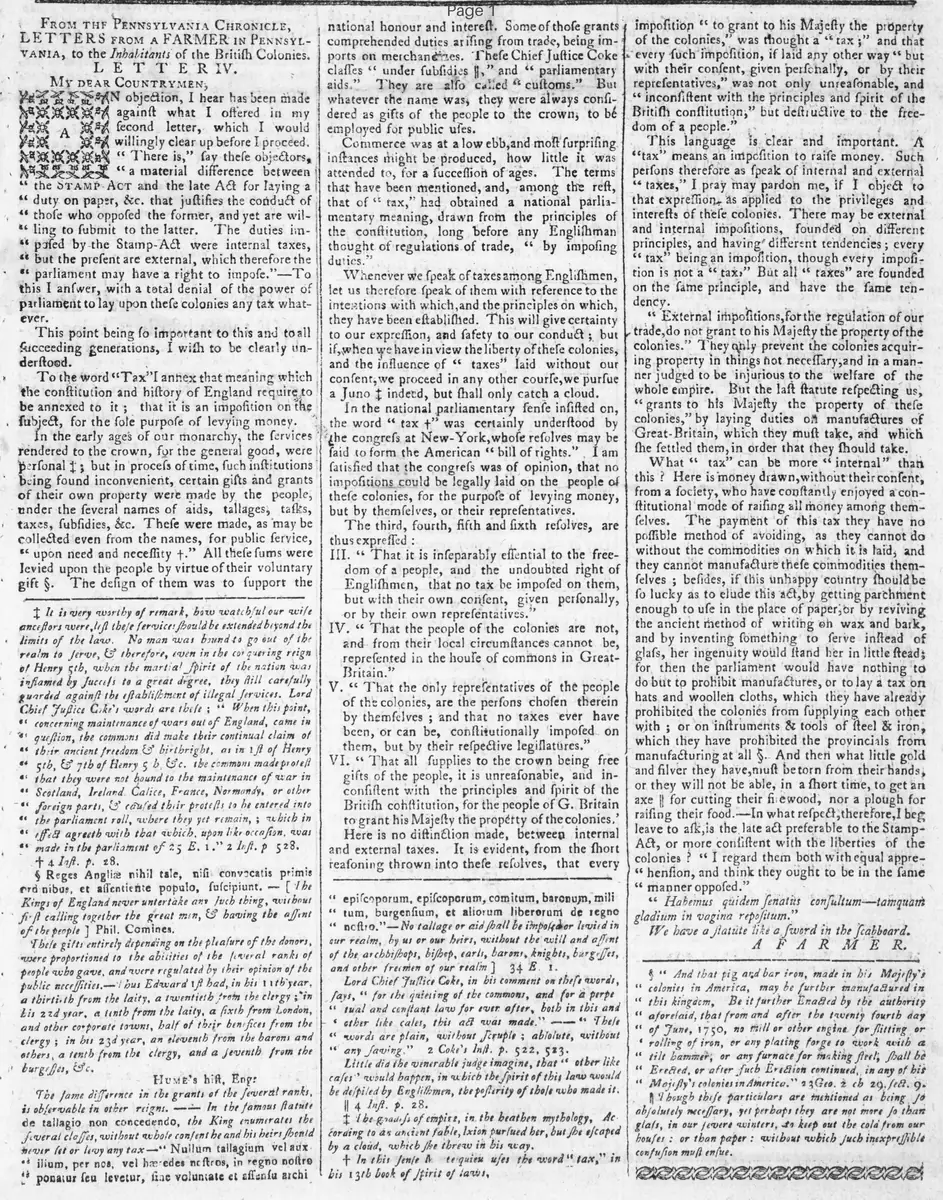
LETTERS FROM A FARMER IN PENNSYLVANIA, to the Inhabitants of the British Colonies.
LETTER IV.
My Dear Countrymen,
Various objections, I hear, have been made against what I offered in my last, which I would willingly clear up before I proceed.
"There is," say the objectors, "a material difference between the Stamp-Act and the late Act for laying a duty on paper, &c. that justifies the conduct of those who opposed the former, and yet are willing to submit to the latter. The duties imposed by the Stamp-Act were internal taxes, but the present are external, which therefore the parliament may have a right to impose."—To this I answer, with a total denial of the power of parliament to lay upon these colonies any tax whatever.
This point being so important to this and to all succeeding generations, I wish to be clearly understood.
To the word "Tax" I annex that meaning which the constitution and history of England require to be annexed to it; that it is an imposition on the subject, for the sole purpose of levying money.
In the early ages of our monarchy, the services rendered to the crown, for the general good, were personal; but in process of time, such institutions being found inconvenient, certain gifts and grants of their own property were made by the people, under the several names of aids, tallages, tasks, taxes, subsidies, &c. These were made, as may be collected even from the names, for public service, upon need and necessity." All these sums were levied upon the people by virtue of their voluntary gifts. The design of them was to support the public service.
It is very worthy of remark, how watchful our wise ancestors were, lest these services should be extended beyond the limits of the law. No man was bound to go out of the realm to serve, & therefore, even in the conquering reign of Henry 5th, when the martial spirit of the nation was inflamed by successes to a great degree, they still carefully guarded against the establishment of illegal services. Lord Chief Justice Coke's words are these; "When this point, concerning maintenance of wars out of England, came in question, the commons did make their continual claim of their ancient freedom & birthright, as in 1st of Henry 4th, 6th, & 7th of Henry 5th, &c. the commons made protest that they were not bound to the maintenance of war in Scotland, Ireland, Calais, France, Normandy, or other foreign parts, caused their protests to be entered into the parliament roll, where they yet remain; which in effect agreeth with that which, upon like occasion, was made in the parliament of 35 E. I." 2 Inst. p 528.
4 Inst. p. 28.
§ Reges Angliae nihil tale, nisi convocatis primis episcoporum, episcoporum, comitum, baronum, militum, burgensium, et aliorum liberorum de regno
nationis."—No tallage or aid shall be imposed or levied in our realm, by us or our heirs, without the will and assent of the archbishops, bishops, earls, barons, knights, burgesses, and other freemen of our realm. 34 E. I.
Lord Chief Justice Coke, in his comment on these words, says, "for the pleasing of the commons, and for a perpetual and constant law for ever after, both in this and other like cases, this act was made."—"These words are plain, 'without scruple'; absolute, without any saving." 2 Coke's Inst. p. 522, 533.
Little did the venerable judge imagine, that "other like cases" would happen, in which "the Spirit of this law would be despised by Englishmen, the posterity of those who made it."
4 Inst. p. 28.
These gifts entirely depending on the pleasure of the donors, were proportioned to the abilities of the several ranks of people who gave, and were regulated by their opinion of the public necessities.—Thus Edward I. had, in his 11th year, a thirtieth from the laity, a twentieth from the clergy; "in his 22d year, a fifth from the laity, a sixth from London, and other corporate towns, half of their benefices from the clergy; in his 23d year, an eleventh from the barons and others, a tenth from the clergy, and a seventh from the burgesses, &c.
Hume's hint. Eng:
The same difference in the grants of the several ranks, is observable in other reigns.—In the famous statute de tallagio non concedendo, the King enumerates the several classes, without whose consent he and his heirs should never set or levy any tax—"Nullum tallagium vel auxilium, per nos, vel haeredes nostros, in regno nostro ponatur vel levetur, in voluntate et assensu archi
national honour and interest. Some of those grants comprehended duties arising from trade, being impositions on merchandizes. These Chief Justice Coke calls "under subsidies," and "parliamentary aids."
They are also called "customs." But whatever the name was, they were always considered as gifts of the people to the crown; to be employed for public uses.
Commerce was at a low ebb, and most surprising instances might be produced, how little it was attended to, for a succession of ages. The terms that have been mentioned, and, among the rest, that of "tax," had obtained a national parliamentary meaning, drawn from the principles of the constitution, long before any Englishman thought of regulations of trade, "by imposing duties."
Whenever we speak of taxes among Englishmen, let us therefore speak of them with reference to the intentions with which, and the principles on which, they have been established. This will give certainty to our expression, and safety to our conduct; but if, when we have in view the liberty of these colonies, and the influence of "taxes laid without our consent," we proceed in any other course, we pursue a Juno indeed, but shall only catch a cloud.
In the national parliamentary sense insisted on, the word "tax" was certainly understood by the congress at New-York, whose resolves may be said to form the American "bill of rights." I am satisfied that the congress was of opinion, that no impositions could be legally laid on the people of these colonies, for the purpose of levying money, but by themselves, or their representatives.
The third, fourth, fifth and sixth resolves, are thus expressed:
III. "That it is inseparably essential to the freedom of a people, and the undoubted right of Englishmen, that no tax be imposed on them, but with their own consent, given personally, or by their own representatives."
IV. "That the people of the colonies are not, and from their local circumstances cannot be, represented in the house of commons in Great-Britain."
V. "That the only representatives of the people of the colonies, are the persons chosen therein by themselves; and that no taxes ever have been, or can be, constitutionally imposed on them, but by their respective legislatures."
VI. "That all supplies to the crown being free gifts of the people, it is unreasonable, and inconsistent with the principles and spirit of the British constitution, for the people of G. Britain to grant to his Majesty the property of the colonies."
Here is no distinction made, between internal and external taxes. It is evident, from the short reasoning thrown into these resolves, that every imposition "to grant to his Majesty the property of the colonies," was thought a tax; and that every such imposition, if laid any other way "but with their consent, given personally, or by their representatives," was not only unreasonable, and "inconsistent with the principles and spirit of the British constitution," but destructive to the freedom of a people.
This language is clear and important. A "tax" means an imposition to raise money. Such persons therefore as speak of internal and external "taxes," I pray may pardon me, if I object to that expression, as applied to the privileges and interests of these colonies. There may be external and internal impositions, founded on different principles, and having different tendencies; every "tax" being an imposition, though every imposition is not a "tax:" But all "taxes" are founded on the same principle, and have the same tendency.
"External impositions, for the regulation of our trade, do not grant to his Majesty the property of the colonies." They only prevent the colonies acquiring property in things not necessary, and in a manner judged to be injurious to the welfare of the whole empire. But the late statute respecting us, "grants to his Majesty the property of these colonies," by laying duties on manufactures of Great-Britain, which they must take, and which she settled there, in order that they should take.
What "tax" can be more "internal" than this? Here is money drawn, without their consent, from a society, who have constantly enjoyed a constitutional mode of raising all money among themselves. The payment of this tax they have no possible method of avoiding, as they cannot do without the commodities on which it is laid, and they cannot manufacture these commodities themselves; besides, if this unhappy country should be so lucky as to elude this act, by getting parchment enough to use in the place of paper, or by reviving the ancient method of writing on wax and bark, and by inventing something to serve instead of glass, her ingenuity would stand her in little stead; for then the parliament would have nothing to do but to prohibit manufactures, or to lay a tax on hats and woollen cloths, which they have already prohibited the colonies from supplying each other with; or on instruments & tools of steel & iron; which they have prohibited the provincials from manufacturing at all §. And then what little gold and silver they have, must be torn from their hands; or they will not be able, in a short time, to get an axe for cutting their firewood, nor a plough for raising their food.—In what respect, therefore, I beg leave to ask, is the late Act preferable to the Stamp-Act, or more consistent with the liberties of the colonies? "I regard them both with equal apprehension, and think they ought to be in the same manner opposed."
"Habemus quidem senatus consultum—tamquam gladium in vagina repositum."
We have a statute like a sword in the scabbard.
FARMER.
8 "And that pig and bar iron, made in his Majesty's colonies in.
further transmanufactured in this kingdom,.
Be it further Enacted by the authority
aforesaid, that from and after the twenty fourth day of June, 1750, no slitting or other engine for slitting or rolling of iron, or any plating forge to work with a tilt hammer, or any furnace for making steel, shall be erected, or after such erection continued, in any of his Majesty's colonies in America." 23 Geo. II. ch 20, sect. 9:
A Although these particulars are mentioned as being so absolutely necessary, yet perhaps they are not more so than glass, in our severe winters, to keep out the cold from our houses; or than paper, without which such inexpressible confusion must ensue.
LETTERS FROM A FARMER IN PENNSYLVANIA, to the Inhabitants of the British Colonies.
LETTER IV.
My Dear Countrymen,
Various objections, I hear, have been made against what I offered in my last, which I would willingly clear up before I proceed.
"There is," say the objectors, "a material difference between the Stamp-Act and the late Act for laying a duty on paper, &c. that justifies the conduct of those who opposed the former, and yet are willing to submit to the latter. The duties imposed by the Stamp-Act were internal taxes, but the present are external, which therefore the parliament may have a right to impose."—To this I answer, with a total denial of the power of parliament to lay upon these colonies any tax whatever.
This point being so important to this and to all succeeding generations, I wish to be clearly understood.
To the word "Tax" I annex that meaning which the constitution and history of England require to be annexed to it; that it is an imposition on the subject, for the sole purpose of levying money.
In the early ages of our monarchy, the services rendered to the crown, for the general good, were personal; but in process of time, such institutions being found inconvenient, certain gifts and grants of their own property were made by the people, under the several names of aids, tallages, tasks, taxes, subsidies, &c. These were made, as may be collected even from the names, for public service, upon need and necessity." All these sums were levied upon the people by virtue of their voluntary gifts. The design of them was to support the public service.
It is very worthy of remark, how watchful our wise ancestors were, lest these services should be extended beyond the limits of the law. No man was bound to go out of the realm to serve, & therefore, even in the conquering reign of Henry 5th, when the martial spirit of the nation was inflamed by successes to a great degree, they still carefully guarded against the establishment of illegal services. Lord Chief Justice Coke's words are these; "When this point, concerning maintenance of wars out of England, came in question, the commons did make their continual claim of their ancient freedom & birthright, as in 1st of Henry 4th, 6th, & 7th of Henry 5th, &c. the commons made protest that they were not bound to the maintenance of war in Scotland, Ireland, Calais, France, Normandy, or other foreign parts, caused their protests to be entered into the parliament roll, where they yet remain; which in effect agreeth with that which, upon like occasion, was made in the parliament of 35 E. I." 2 Inst. p 528.
4 Inst. p. 28.
§ Reges Angliae nihil tale, nisi convocatis primis episcoporum, episcoporum, comitum, baronum, militum, burgensium, et aliorum liberorum de regno
nationis."—No tallage or aid shall be imposed or levied in our realm, by us or our heirs, without the will and assent of the archbishops, bishops, earls, barons, knights, burgesses, and other freemen of our realm. 34 E. I.
Lord Chief Justice Coke, in his comment on these words, says, "for the pleasing of the commons, and for a perpetual and constant law for ever after, both in this and other like cases, this act was made."—"These words are plain, 'without scruple'; absolute, without any saving." 2 Coke's Inst. p. 522, 533.
Little did the venerable judge imagine, that "other like cases" would happen, in which "the Spirit of this law would be despised by Englishmen, the posterity of those who made it."
4 Inst. p. 28.
These gifts entirely depending on the pleasure of the donors, were proportioned to the abilities of the several ranks of people who gave, and were regulated by their opinion of the public necessities.—Thus Edward I. had, in his 11th year, a thirtieth from the laity, a twentieth from the clergy; "in his 22d year, a fifth from the laity, a sixth from London, and other corporate towns, half of their benefices from the clergy; in his 23d year, an eleventh from the barons and others, a tenth from the clergy, and a seventh from the burgesses, &c.
Hume's hint. Eng:
The same difference in the grants of the several ranks, is observable in other reigns.—In the famous statute de tallagio non concedendo, the King enumerates the several classes, without whose consent he and his heirs should never set or levy any tax—"Nullum tallagium vel auxilium, per nos, vel haeredes nostros, in regno nostro ponatur vel levetur, in voluntate et assensu archi
national honour and interest. Some of those grants comprehended duties arising from trade, being impositions on merchandizes. These Chief Justice Coke calls "under subsidies," and "parliamentary aids."
They are also called "customs." But whatever the name was, they were always considered as gifts of the people to the crown; to be employed for public uses.
Commerce was at a low ebb, and most surprising instances might be produced, how little it was attended to, for a succession of ages. The terms that have been mentioned, and, among the rest, that of "tax," had obtained a national parliamentary meaning, drawn from the principles of the constitution, long before any Englishman thought of regulations of trade, "by imposing duties."
Whenever we speak of taxes among Englishmen, let us therefore speak of them with reference to the intentions with which, and the principles on which, they have been established. This will give certainty to our expression, and safety to our conduct; but if, when we have in view the liberty of these colonies, and the influence of "taxes laid without our consent," we proceed in any other course, we pursue a Juno indeed, but shall only catch a cloud.
In the national parliamentary sense insisted on, the word "tax" was certainly understood by the congress at New-York, whose resolves may be said to form the American "bill of rights." I am satisfied that the congress was of opinion, that no impositions could be legally laid on the people of these colonies, for the purpose of levying money, but by themselves, or their representatives.
The third, fourth, fifth and sixth resolves, are thus expressed:
III. "That it is inseparably essential to the freedom of a people, and the undoubted right of Englishmen, that no tax be imposed on them, but with their own consent, given personally, or by their own representatives."
IV. "That the people of the colonies are not, and from their local circumstances cannot be, represented in the house of commons in Great-Britain."
V. "That the only representatives of the people of the colonies, are the persons chosen therein by themselves; and that no taxes ever have been, or can be, constitutionally imposed on them, but by their respective legislatures."
VI. "That all supplies to the crown being free gifts of the people, it is unreasonable, and inconsistent with the principles and spirit of the British constitution, for the people of G. Britain to grant to his Majesty the property of the colonies."
Here is no distinction made, between internal and external taxes. It is evident, from the short reasoning thrown into these resolves, that every imposition "to grant to his Majesty the property of the colonies," was thought a tax; and that every such imposition, if laid any other way "but with their consent, given personally, or by their representatives," was not only unreasonable, and "inconsistent with the principles and spirit of the British constitution," but destructive to the freedom of a people.
This language is clear and important. A "tax" means an imposition to raise money. Such persons therefore as speak of internal and external "taxes," I pray may pardon me, if I object to that expression, as applied to the privileges and interests of these colonies. There may be external and internal impositions, founded on different principles, and having different tendencies; every "tax" being an imposition, though every imposition is not a "tax:" But all "taxes" are founded on the same principle, and have the same tendency.
"External impositions, for the regulation of our trade, do not grant to his Majesty the property of the colonies." They only prevent the colonies acquiring property in things not necessary, and in a manner judged to be injurious to the welfare of the whole empire. But the late statute respecting us, "grants to his Majesty the property of these colonies," by laying duties on manufactures of Great-Britain, which they must take, and which she settled there, in order that they should take.
What "tax" can be more "internal" than this? Here is money drawn, without their consent, from a society, who have constantly enjoyed a constitutional mode of raising all money among themselves. The payment of this tax they have no possible method of avoiding, as they cannot do without the commodities on which it is laid, and they cannot manufacture these commodities themselves; besides, if this unhappy country should be so lucky as to elude this act, by getting parchment enough to use in the place of paper, or by reviving the ancient method of writing on wax and bark, and by inventing something to serve instead of glass, her ingenuity would stand her in little stead; for then the parliament would have nothing to do but to prohibit manufactures, or to lay a tax on hats and woollen cloths, which they have already prohibited the colonies from supplying each other with; or on instruments & tools of steel & iron; which they have prohibited the provincials from manufacturing at all §. And then what little gold and silver they have, must be torn from their hands; or they will not be able, in a short time, to get an axe for cutting their firewood, nor a plough for raising their food.—In what respect, therefore, I beg leave to ask, is the late Act preferable to the Stamp-Act, or more consistent with the liberties of the colonies? "I regard them both with equal apprehension, and think they ought to be in the same manner opposed."
"Habemus quidem senatus consultum—tamquam gladium in vagina repositum."
We have a statute like a sword in the scabbard.
FARMER.
8 "And that pig and bar iron, made in his Majesty's colonies in.
further transmanufactured in this kingdom,.
Be it further Enacted by the authority
aforesaid, that from and after the twenty fourth day of June, 1750, no slitting or other engine for slitting or rolling of iron, or any plating forge to work with a tilt hammer, or any furnace for making steel, shall be erected, or after such erection continued, in any of his Majesty's colonies in America." 23 Geo. II. ch 20, sect. 9:
A Although these particulars are mentioned as being so absolutely necessary, yet perhaps they are not more so than glass, in our severe winters, to keep out the cold from our houses; or than paper, without which such inexpressible confusion must ensue.
What sub-type of article is it?
Constitutional
Taxation
What keywords are associated?
Parliamentary Taxation
Colonial Rights
No Taxation Without Representation
Stamp Act
Townshend Duties
English Constitution
New York Congress
Magna Carta
What entities or persons were involved?
Parliament
British Crown
New York Congress
Colonial Legislatures
Lord Chief Justice Coke
Editorial Details
Primary Topic
Denial Of Parliament's Right To Tax The Colonies Without Consent
Stance / Tone
Strong Opposition To Parliamentary Taxation
Key Figures
Parliament
British Crown
New York Congress
Colonial Legislatures
Lord Chief Justice Coke
Key Arguments
- parliament has no power to lay any tax on the colonies
- tax defined as imposition for levying money, requiring consent
- historical english constitution requires voluntary grants for taxes
- no distinction between internal and external taxes; both violate rights
- townshend duties equivalent to stamp act in infringing liberties
- new york congress resolves affirm no taxation without representation
- colonies cannot be represented in house of commons
- all supplies to crown are free gifts of the people
- late act grants crown property of colonies without consent
- opposition to both stamp act and townshend act equally necessary