Thank you for visiting SNEWPapers!
Sign up free
The New Hampshire Gazette And General Advertiser
Portsmouth, Rockingham County, New Hampshire
What is this article about?
Congress grants Baron Steuben a lifetime pension of $2,500 per year after previous liberal payments and a $7,000 grant in 1785, as reported in a May 30 letter from New York.
Clipping
OCR Quality
Full Text
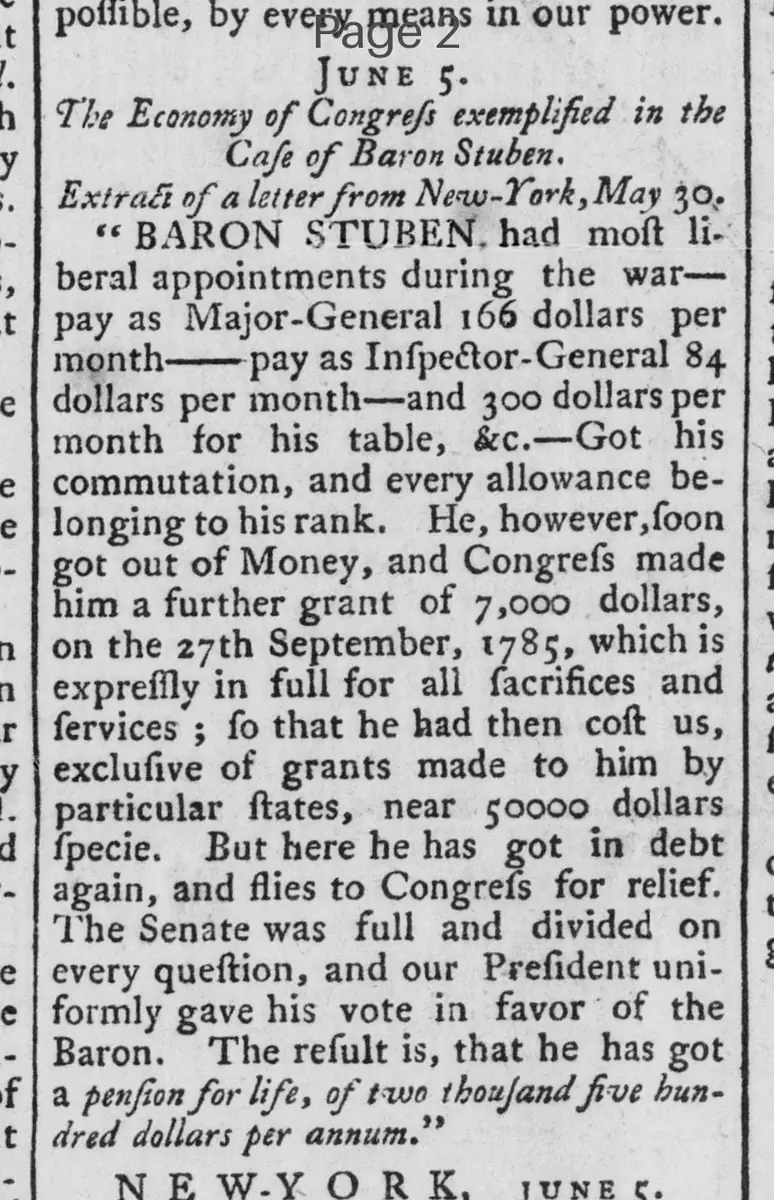
The Economy of Congress exemplified in the Case of Baron Steuben.
Extract of a letter from New-York, May 30.
"Baron Steuben had most liberal appointments during the war—pay as Major-General 166 dollars per month—pay as Inspector-General 84 dollars per month—and 300 dollars per month for his table, &c.—Got his commutation, and every allowance belonging to his rank. He, however, soon got out of money, and Congress made him a further grant of 7,000 dollars, on the 27th September, 1785, which is expressly in full for all sacrifices and services: so that he had then cost us, exclusive of grants made to him by particular states, near 50,000 dollars specie. But here he has got in debt again, and flies to Congress for relief. The Senate was full and divided on every question, and our President uniformly gave his vote in favor of the Baron. The result is, that he has got a pension for life, of two thousand five hundred dollars per annum."
What sub-type of article is it?
What keywords are associated?
What entities or persons were involved?
Where did it happen?
Domestic News Details
Primary Location
New York
Event Date
May 30
Key Persons
Outcome
granted a pension for life of two thousand five hundred dollars per annum
Event Details
Baron Steuben received liberal payments during the war including pay as Major-General of 166 dollars per month, as Inspector-General of 84 dollars per month, and 300 dollars per month for his table; he received commutation and all allowances; Congress granted him 7,000 dollars on September 27, 1785, in full for services, totaling near 50,000 dollars; he fell into debt again and sought relief; the Senate was divided but the President voted in his favor, resulting in the lifetime pension.