Thank you for visiting SNEWPapers!
Sign up free
Literary
April 6, 1860
The Bedford Gazette
Bedford, Bedford County, Pennsylvania
What is this article about?
Legend of Wilhelm and daughter Madeline, pioneers near Fort Bedford, captured by Indian chief Mukundwa after he demands her as wife. Lover Edward Shippen tracks them using cloth markers, shoots the chief, and aids in their escape from captors. They return safely; later die in Revolutionary War.
Clipping
OCR Quality
85%
Good
Full Text
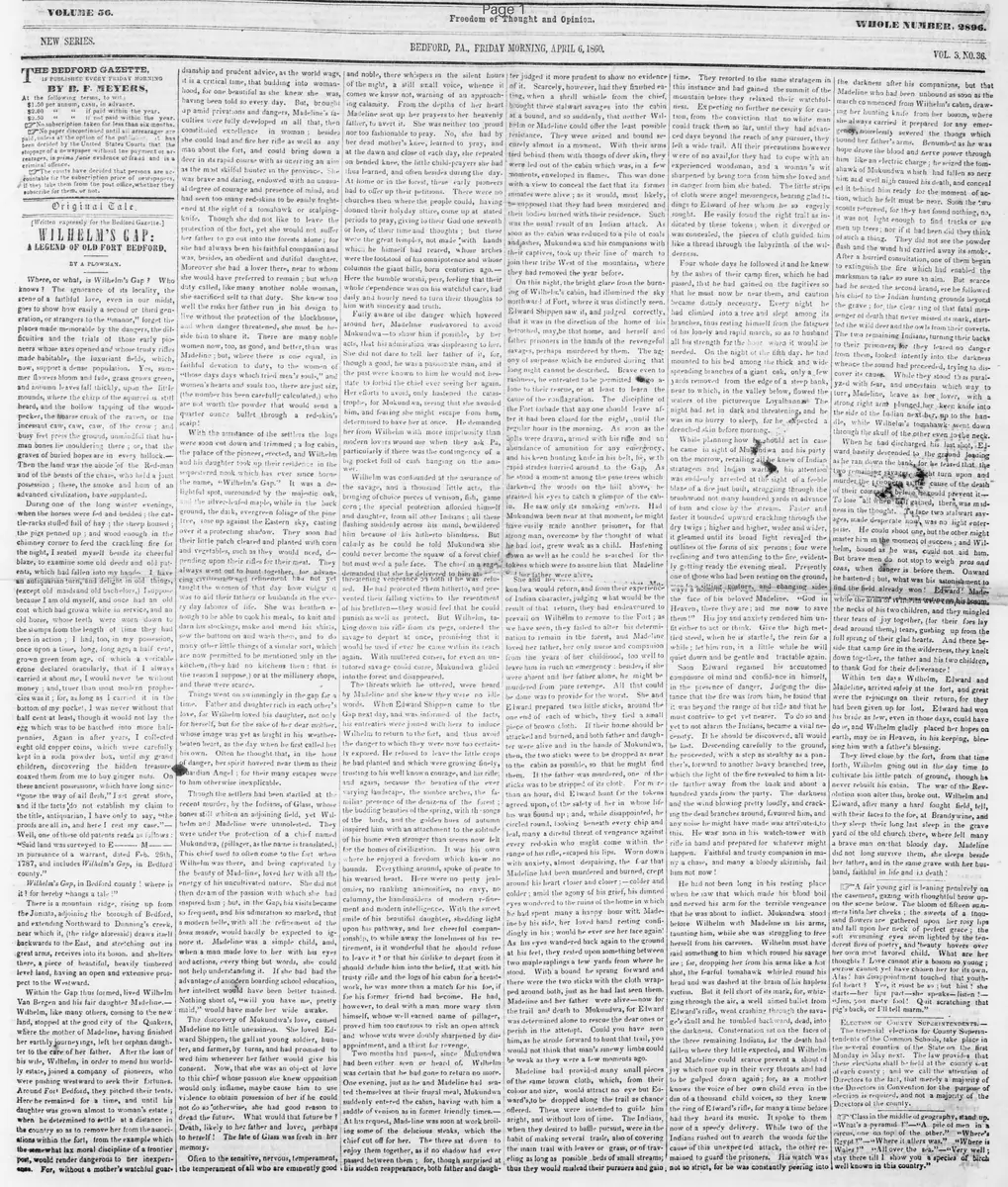
Original Tale.
(Written expressly for the Bedford Gazette.)
WILHELM'S GAP
A LEGEND OF OLD FORT BEDFORD.
BY A PLOWMAN.
Where, or what, is Wilhelm's Gap? Who knows? The ignorance of its locality, the scene of a faithful love, even in our midst, goes to show how easily a second or third generation, or strangers to the 'manor,' forget the places made memorable by the dangers, the difficulties and the trials of those early pioneers whose axes opened and whose trusty rifles made habitable, the luxuriant fields, which, now, support a dense population. Yes, summer flowers bloom and fade, grass grows green, and autumn leaves fall thickly, upon the little mounds, where the chirp of the squirrel is still heard, and the hollow tapping of the wood-pecker, the hoarse croak of the raven, or the incessant caw, caw, caw, of the crow; and busy feet press the ground, unmindful that human bones lie mouldering there; or, that the graves of buried hopes are in every hillock.
Then the land was the abode of the Red-man and of the beasts of the chase, who held a joint possession; these, the smoke and hum of an advanced civilization, have supplanted.
During one of the long winter evenings, when the horses were fed and bedded; the cattle-racks stuffed full of hay; the sheep housed; the pigs penned up; and wood enough in the chimney corner to feed the crackling fire for the night, I seated myself beside its cheerful blaze, to examine some old deeds and old patents, which had fallen into my hands. I have an antiquarian turn, and delight in old things, (except old maids and old bachelors,) I suppose because I am old myself, and once had an old coat which had grown white in service, and an old horse, whose teeth were worn down to the stumps from the length of time they had been in action; I had, too, in my possession, once upon a time, long, long ago, a half cent, grown green from age, of which a veritable crone declared oracularly, that if I always carried it about me, I would never be without money; and, truer than most modern prophecies was it; for, as long as I carried it in the bottom of my pocket, I was never without that half cent at least, though it would not lay the egg which was to be hatched into more half-pennies. Again in after years, I collected eight old copper coins, which were carefully kept in a soda powder box, until my grandchildren, discovering the hidden treasure, coaxed them from me to buy ginger nuts. On these ancient possessions, which have long since 'gone the way of all flesh,' I set great store, and if the facts do not establish my claim to the title, antiquarian, I have only to say, 'the proofs are all in, and here I rest my case.'
Well, one of these old patents reads as follows:
'Said land was surveyed to E---.- M---- in pursuance of a warrant, dated Feb. 26th, 1787, and includes Wilhelm's Gap, in Bedford county.'
Wilhelm's Gap, in Bedford county! where is it? for hereby 'hangs a tale!'
There is a mountain ridge, rising up from the Juniata, adjoining the borough of Bedford, and extending Northward to Dunning's creek, near which it, (the ridge aforesaid) draws itself backwards to the East, and stretching out its great arms, receives into its bosom, and shelters there, a piece of beautiful, heavily timbered level land, having an open and extensive prospect to the Westward.
Within the Gap thus formed, lived Wilhelm Van Bergen and his fair daughter Madeline.
Wilhelm, like many others, coming to the new land, stopped at the good city of the Quakers, where the mother of Madeline, having finished her earthly journeyings, left her orphan daughter to the care of her father. After the loss of his wife, Wilhelm, in order to mend his worldly estate, joined a company of pioneers, who were pushing westward to seek their fortunes.
Around Fort Bedford, they pitched their tents. Here he remained for a time, and until his daughter was grown almost to woman's estate; when he determined to settle at a distance in the country so as to remove her from the associations within the fort, from the example which the somewhat lax moral discipline of a frontier post, would render dangerous to her inexperience. For, without a mother's watchful guardianship and prudent advice, as the world wags, it is a critical time, that budding into womanhood, for one beautiful as she knew she was, having been told so every day. But, brought up amid privations and dangers, Madeline's faculties were fully developed in all that, then constituted excellence in woman; besides she could load and fire her rifle as well as any man about the fort, and could bring down a deer in its rapid course with as unerring an aim as the most skilful hunter in the province. She was brave and daring, endowed with an unusual degree of courage and presence of mind, and had seen too many red-skins to be easily frightened at the sight of a tomahawk or scalping-knife. Though she did not like to leave the protection of the fort, yet she would not suffer her father to go out into the forests alone; for she had always been his faithful companion and was, besides, an obedient and dutiful daughter.
Moreover she had a lover there, near to whom she would have preferred to remain; but when duly called, like many another noble woman, she sacrificed self to that duty. She knew too well the risks her father run in his design to live without the protection of the blockhouse, and when danger threatened, she must be beside him to share it. There are many noble women now, too, as good, and better, than was Madeline; but, where there is one equal, in faithful devotion to duty, to the women of 'those days which tried men's souls,' and women's hearts and souls too, there are just six, (the number has been carefully calculated,) who are not worth the powder that would send a quarter ounce bullet through a red-skin's scalp!
With the assistance of the settlers the logs were soon cut down and trimmed; a log cabin, the palace of the pioneer, erected, and Wilhelm and his daughter took up their residence in the sequestered nook which has ever since borne the name, 'Wilhelm's Gap.' It was a delightful spot, surrounded by the majestic oak, and the silver-leafed maple, while in the back ground, the dark, evergreen foliage of the pine tree, rose up against the Eastern sky, casting over it a protecting shadow. They soon had their little patch cleared and planted with corn and vegetables, such as they would need, depending upon their rifles for their meat. They always went out to hunt together, for advanced civilization and refinement had not yet taught the women of that day how vulgar it was to aid their fathers or husbands in the every day labours of life. She was heathen enough to be able to cook his meals, to knit and darn his stockings, make and mend his shirts, sew the buttons on and wash them, and to do many other little things of a similar sort, which are now permitted to be mentioned only in the kitchen, (they had no kitchens then: that is the reason I suppose.) or at the millinery shops, and these were scarce.
Things went on swimmingly in the gap for a time. Father and daughter rich in each other's love, for Wilhelm loved his daughter, not only for herself, but for the sake of her dear mother, whose image was yet as bright in his weather-beaten heart, as the day when he first called her his own. Often he thought that, in the hour of danger, her spirit hovered near them as their Guardian Angel: for their many escapes were to him otherwise inexplicable.
Though the settlers had been startled at the recent murder, by the Indians, of Glass, whose bones still whiten an adjoining field, yet Wilhelm and Madeline were unmolested. They were under the protection of a chief named Mukundwa, (pillager, as the name is translated.) This chief used to often come to the fort when Wilhelm was there, and being captivated by the beauty of Madeline, loved her with all the energy of his uncultivated nature. She did not then dream of the passion with which she had inspired him; but, in the Gap, his visits became so frequent, and his admiration so marked, that a modern belle, with all the refinement of the beau monde, would hardly be expected to ignore it. Madeline was a simple child, and, when a man made love to her with his eyes and actions, every thing but words, she could not help understanding it. If she had had the advantage of a modern boarding school education, her intellect would have been better trained. Nothing short of, 'will you have me, pretty maid,' would have made her wide awake.
The discovery of Mukundwa's love, caused Madeline no little uneasiness. She loved Edward Shippen, the gallant young soldier, hunter, and farmer, by turns, and had promised to wed him whenever her father would give his consent. Now, that she was an object of love to this chief whose passion she knew opposition would only inflame, maybe cause him to use violence to obtain possession of her if he could not do so otherwise, she had good reason to dread the future. What would that future be? Death, likely to her father and lover, perhaps to herself! The fate of Glass was fresh in her memory.
Often to the sensitive, nervous, temperament, the temperament of all who are eminently good and noble, there whispers in the silent hours of the night, a still small voice, whence it comes we know not, warning of an approaching calamity. From the depths of her heart Madeline sent up her prayers to her heavenly Father, to avert it. She was neither too proud nor too fashionable to pray. No, she had by her dead mother's knee, learned to pray, and at the dawn and close of each day, she repeated on bended knee, the little child-prayers she had thus learned, and often besides during the day.
At home or in the forest, these early pioneers had to offer up their petitions. There were no churches then where the people could, having donned their holiday attire, come up at stated periods to pray, giving to their God one seventh or less, of their time and thoughts; but these were the great temples, not made with hands which he himself had reared, whose arches were the footstool of his omnipotence and whose columns the giant hills, born centuries ago.
Here the humble worshippers, feeling that their whole dependence was on his watchful care, had daily and hourly need to turn their thoughts to him with sincerity and truth.
Fully aware of the danger which hovered around her, Madeline endeavored to avoid Mukundwa—to show him if possible, by her acts, that his admiration was displeasing to her. She did not dare to tell her father of it, for, though a good, he was a passionate man, and if the past were known to him he would not hesitate to forbid the chief ever seeing her again.
Her efforts to avoid, only hastened the catastrophe, for Mukundwa, seeing that she avoided him, and fearing she might escape from him, determined to have her at once. He demanded her from Wilhelm with more impetuosity than modern lovers would use when they ask Pa, particularly if there was the contingency of a big pocket full of cash hanging on the answer.
Wilhelm was confounded at the assurance of the savage, and a thousand little acts, the bringing of choice pieces of venison, fish, game corn; the special protection afforded himself and daughter, from all other Indians; all these flashing suddenly across his mind, bewildered him because of his hitherto blindness. But calmly as he could he told Mukundwa she could never become the squaw of a forest chief but must wed a pale face. The chief in a rage demanded that she be delivered to him at once, threatening vengeance on both if he was refused. He had protected them hitherto, and prevented their falling victims to the resentment of his brethren—they would feel that he could punish as well as protect. But Wilhelm, taking down his rifle from its pegs, ordered the savage to depart at once, promising that it would be used if ever he came within its reach again. With muttered curses, for even an untutored savage could curse, Mukundwa glided into the forest; and disappeared.
The threats which he uttered, were heard by Madeline and she knew they were no idle words. When Edward Shippen came to the Gap next day, and was informed of the facts, his entreaties were joined with hers to induce Wilhelm to return to the fort, and thus avoid the danger to which they were now too certainly exposed. He refused to leave the little crops he had planted and which were growing finely, trusting to his well known courage, and his rifle; and again, because the beauties of the ever varying landscape, the sombre arches, the familiar presence of the denizens of the forest; the budding beauties of the spring, with the songs of the birds, and the golden hues of autumn inspired him with an attachment to the solitude of his home even stronger than seems now felt for the homes of civilization. It was his own where he enjoyed a freedom which knew no bounds. Everything around, spoke of peace to his wearied heart. Here were no petty jealousies, no rankling animosities, no envy, no calumny, the handmaidens of modern refinement and modern intelligence. With the sweet smile of his beautiful daughter, shedding light upon his pathway, and her cheerful companionship, to while away the loneliness of his retirement, is it wonderful that he should refuse to leave it? or that his dislike to depart from it should delude him into the belief, that with his trusty rifle and the logs of his cabin for a breastwork, he was more than a match for his foe, if foe his former friend had become. He had, however, to deal with a man more wary than himself, whose well earned name of pillager, proved him too cautious to risk an open attack and whose wits were doubly sharpened by disappointment, and a thirst for revenge.
Two months had passed, since Mukundwa had been either seen or heard of. Wilhelm was certain that he had gone to return no more.
One evening, just as he and Madeline had seated themselves at their frugal meal, Mukundwa suddenly entered the cabin, having with him a saddle of venison as in former friendly times.
At his request, Madeline was soon at work broiling some of the delicious steaks, which the chief cut off for her. The three sat down to enjoy them together, as if no shadow had ever passed between them; for, though surprised at his sudden reappearance, both father and daughter judged it more prudent to show no evidence of it. Scarcely, however, had they finished eating, when a shrill whistle from the chief, brought three stalwart savages into the cabin at a bound, and so suddenly, that neither Wilhelm or Madeline could offer the least possible resistance. They were seized and bound securely almost in a moment. With their arms tied behind them with thongs of deer skin, they were led out of the cabin which was, in a few moments, enveloped in flames. This was done with a view to conceal the fact that its former inmates were alive; as it would, most likely, be supposed that they had been murdered and their bodies burned with their residence. Such was the usual result of an Indian attack. As soon as the cabin was reduced to a pile of coals and ashes, Mukundwa and his companions with their captives, took up their line of march to join their tribe West of the mountains, where they had removed the year before.
On this night, the bright glare from the burning of Wilhelm's cabin, had illumined the sky northward of Fort, where it was distinctly seen. Edward Shippen saw it, and judged correctly, that it was in the direction of the home of his betrothed, nay, be that home, and herself and father prisoners in the hands of the revengeful savages, perhaps murdered by them. The agony of suspense which he endured during that long night cannot be described. Brave even to rashness, he entreated to be permitted to go alone to their rescue, or at least to learn the cause of the conflagration. The discipline of the Fort forbade that any one should leave after it had been closed for the night, until the regular hour in the morning. As soon as the gates were drawn, armed with his rifle and an abundance of ammunition for any emergency, and his keen hunting knife in his belt, he, with rapid strides hurried around to the Gap. As he stood a moment among the pine trees which darkened the woods on the hill above, he strained his eyes to catch a glimpse of the cabin. He saw only its smoking embers. Had Mukundwa been near at that moment, he might have easily made another prisoner, for that strong man, overcome by the thought of what he had lost, grew weak as a child. Hastening down as well as he could he searched for the tokens which were to assure him that Madeline and her father were alive.
She and her lover had feared that Mukundwa would return, and from their experience of Indian character, judging what would be the result of that return, they had endeavored to prevail on Wilhelm to remove to the Fort; as we have seen, they failed to alter his determination to remain in the forest, and Madeline loved her father, her only nurse and companion from the years of her childhood, too well to leave him in such an emergency: besides, if she were absent and her father alone, he might be murdered from pure revenge. All that could be done was to provide for the worst. She and Edward prepared two little sticks, around the one end of each of which, they tied a small piece of brown cloth. If their home should be attacked and burned, and both father and daughter were alive and in the hands of Mukundwa, then, the two sticks were to be dropped as near to the cabin as possible, so that he might find them. If the father was murdered, one of the sticks was to be stripped of its cloth. For more than an hour, did Edward hunt for the tokens agreed upon, of the safety of her in whose life his was bound up; and, while disappointed, he circled round, looking beneath every chip and leaf, many a dreadful threat of vengeance against every red-skin who might come within the range of his rifle, escaped his lips. Worn down with anxiety, almost despairing, the fear that Madeline had been murdered and burned, crept around his heart closer and closer; colder and colder; amid the agony of his grief, his dimmed eyes wandered to the ruins of the home in which he had spent many a happy hour with Madeline by his side, her loved hand resting confidingly in his; would he ever see her face again! As his eyes wandered back again to the ground at his feet, they rested upon something between two maple saplings a few yards from where he stood. With a bound he sprang forward and there were the two sticks with the cloth wrapped around both, just as he had last seen them. Madeline and her father were alive—now for the trail and death to Mukundwa, for Edward was determined alone to rescue the dear ones or perish in the attempt. Could you have seen him, as he strode forward to hunt that trail, you would not think that man's sinewy limbs could be weak as they were a few moments ago.
Madeline had provided many small pieces of the same brown cloth, which, from their colour and size, would attract no eye but Edward's, to be dropped along the trail as chance offered. These were intended to guide him aright, and without loss of time. The Indians, when they desired to baffle pursuit, were in the habit of making several trails, also of covering the main trail with leaves or grass, or of traveling as long as possible beds of small streams; thus they would mislead their pursuers and gain time. They resorted to the same stratagem in this instance and had gained the summit of the mountain before they relaxed their watchfulness. Expecting no further necessity for caution, from the conviction that no white man could track them so far, until they had advanced days beyond the reach of any pursuer, they left a wide trail. All their precautions however were of no avail, for they had to cope with an experienced woodsman, and a woman's wit sharpened by being torn from him she loved and in danger from him she hated. The little strips of cloth were angel messengers, bearing glad tidings to Edward of her whom he so eagerly sought. He easily found the right trail as indicated by these tokens: when it diverged or was concealed, the pieces of cloth guided him like a thread through the labyrinth of the wilderness.
Four whole days he followed it and he knew by the ashes of their camp fires, which he had passed, that he had gained on the fugitives so that he must now be near them, and caution became doubly necessary. Every night he had climbed into a tree and slept among its branches, thus resting himself from the fatigues of his lonely and rapid march, so as to husband all his strength for the hour when it would be needed. On the night of the fifth day, he had mounted to his bed among the thick and wide spreading branches of a giant oak, only a few yards removed from the edge of a steep bank, near to which, in the valley below, flowed the waters of the picturesque Loyalhanna. The night had set in dark and threatening, and he was in no hurry to sleep, for he expected a drenched skin before morning.
While planning how he should act in case he came in sight of Mukundwa and his party on the morrow, recalling all he knew of Indian stratagem and Indian warfare, his attention was suddenly arrested at the sight of a feeble blaze of a fire just built, struggling through the brushwood not many hundred yards in advance of him and close by the stream. Faster and faster it bounded upward crackling through the dry twigs; higher and higher, wider and wider, it gleamed until its broad light revealed the outlines of the forms of six persons; four were reclining and two attending to the fire, evidently getting ready the evening meal. Presently one of those who had been resting on the ground, was smiling, no—stretching—and changing side—the face of his beloved Madeline. 'God in Heaven, there they are; aid me now to save them!' His joy and anxiety rendered him unfit either to act or think. Give the high-mettled steed, when he is startled, the rein for a while; let him run, in a little while he will quiet down and be gentle and tractable again.
Soon Edward regained his accustomed composure of mind and confidence in himself, in the presence of danger. Judging the distance that the fire was from him, he found that it was beyond the range of his rifle and that he must contrive to get yet nearer. To do so and yet to not alarm the Indians, became a vital necessity. If he should be discovered, all would be lost. Descending carefully to the ground, he proceeded, with a step as stealthy as a panther's, forward to another heavy branched tree, which the light of the fire revealed to him a little farther away from the bank and about a hundred yards from the party. The darkness and the wind blowing pretty loudly, and cracking the dead branches around, favoured him, and any noise he might have made was attributed to this. He was soon in his watch-tower with rifle in hand and prepared for whatever might happen. Faithful and trusty companion in many a chase, and many a bloody skirmish, fail him not now!
He had not been long in his resting place when he saw that which made his blood boil and nerved his arm for the terrible vengeance that he was about to inflict. Mukundwa stood before Wilhelm with Madeline in his arms, taunting him, while she was struggling to free herself from his caresses. Wilhelm must have said something to him which roused his savage ire: for, dropping her from his arms like a hot shot, the fearful tomahawk whirled round his head and was dashed at the brain of his hapless victim. But it fell short of its mark, for, whizzing through the air, a well aimed bullet from Edward's rifle, went crashing through the savage's skull and he tumbled backward, dead, into the darkness. Consternation sat on the faces of the three remaining Indians, for the death had fallen where they little expected, and Wilhelm and Madeline could scarce prevent a shout of joy which rose up in their very throats and had to be gulped down again; for, as a mother knows the voice of her own child even in the din of a thousand child voices, so they knew the ring of Edward's rifle, for many a time before had they heard its music. It spoke to them now of a speedy delivery. While two of the Indians rushed out to search the woods for the cause of this unexpected attack, the other remained to guard the prisoners. His watch was not so strict, for he was constantly peering into the darkness after his companions, but that Madeline who had been unbound as soon as the march commenced from Wilhelm's cabin, drawing her hunting knife from her bosom, where she always carried it prepared for any emergency, noiselessly severed the thongs which bound her father's arms. Benumbed as he was hope drove the blood and nerve power through him like an electric charge; he seized the tomahawk of Mukundwa which had fallen so near him and well nigh caused his death, and concealed it behind him ready for the moment of action, which he felt must be near. Soon the two scouts returned, for they had found nothing, no, it was not light enough to find tracks or see men up trees; nor if it had been did they think of such a thing. They did not see the powder flash and the wind had carried away its smoke. After a hurried consultation, one of them began to extinguish the fire which had enabled the marksman to take so sure an aim. But scarce had he seized the second brand, ere he followed his chief to the Indian hunting grounds beyond the grave; for, the clear ring of that fatal messenger of death that never missed its mark, startled the wild deer and the owls from their coverts.
The two remaining Indians, turning their backs to their prisoners, for they feared no danger from them, looked intently into the darkness whence the sound had proceeded, trying to discover its cause. While they stood thus paralyzed with fear, and uncertain which way to turn, Madeline, brave as her lover, with a strong right arm plunged her keen knife into the side of the Indian next her, up to the handle, while Wilhelm's tomahawk went down through the skull of the other even to the neck.
When he had discharged his last shot, Edward hastily descended to the ground loading as he ran down the bank, for he feared that the two remaining savages, might turn upon and murder the prisoners as the cause of the death of their comrades before he could prevent it. To lose all when half gained, there was madness in the thought. To face two stalwart savages, made desperate now, was no light enterprise. He could shoot one, but the other might master him in the moment of success; and Wilhelm, bound as he was, could not aid him.
But brave men do not stop to weigh pros and cons, when danger is before them. Onward he hastened; but, what was his astonishment to find the field already won! Edward! Madeline while the arms of Wilhelm were yet on his bosom the necks of his two children, and they mingled their tears of joy together, (for their foes lay dead around them,) tears, gushing up from the full spring of their glad hearts. And there beside that camp fire in the wilderness, they knelt down together, the father and his two children, to thank God for their deliverance!
Within ten days Wilhelm, Edward and Madeline, arrived safely at the fort, and great were the rejoicings on their return, for they had been given up for lost. Edward had won his bride as few, even in those days, could have done, and Wilhelm gladly placed her hopes on earth, may be in Heaven, in his keeping, blessing him with a father's blessing.
They lived close by the fort, from that time forth, Wilhelm going out in the day time to cultivate his little patch of ground, though he never rebuilt his cabin. The war of the Revolution soon after this, broke out. Wilhelm and Edward, after many a hard fought field, fell, with their faces to the foe, at Brandywine, and they sleep their long last sleep in the grave yard of the old church there, where fell many a brave man on that bloody day. Madeline did not long survive them, she sleeps beside her father, and in the same grave with her husband, faithful in life and in death!
(Written expressly for the Bedford Gazette.)
WILHELM'S GAP
A LEGEND OF OLD FORT BEDFORD.
BY A PLOWMAN.
Where, or what, is Wilhelm's Gap? Who knows? The ignorance of its locality, the scene of a faithful love, even in our midst, goes to show how easily a second or third generation, or strangers to the 'manor,' forget the places made memorable by the dangers, the difficulties and the trials of those early pioneers whose axes opened and whose trusty rifles made habitable, the luxuriant fields, which, now, support a dense population. Yes, summer flowers bloom and fade, grass grows green, and autumn leaves fall thickly, upon the little mounds, where the chirp of the squirrel is still heard, and the hollow tapping of the wood-pecker, the hoarse croak of the raven, or the incessant caw, caw, caw, of the crow; and busy feet press the ground, unmindful that human bones lie mouldering there; or, that the graves of buried hopes are in every hillock.
Then the land was the abode of the Red-man and of the beasts of the chase, who held a joint possession; these, the smoke and hum of an advanced civilization, have supplanted.
During one of the long winter evenings, when the horses were fed and bedded; the cattle-racks stuffed full of hay; the sheep housed; the pigs penned up; and wood enough in the chimney corner to feed the crackling fire for the night, I seated myself beside its cheerful blaze, to examine some old deeds and old patents, which had fallen into my hands. I have an antiquarian turn, and delight in old things, (except old maids and old bachelors,) I suppose because I am old myself, and once had an old coat which had grown white in service, and an old horse, whose teeth were worn down to the stumps from the length of time they had been in action; I had, too, in my possession, once upon a time, long, long ago, a half cent, grown green from age, of which a veritable crone declared oracularly, that if I always carried it about me, I would never be without money; and, truer than most modern prophecies was it; for, as long as I carried it in the bottom of my pocket, I was never without that half cent at least, though it would not lay the egg which was to be hatched into more half-pennies. Again in after years, I collected eight old copper coins, which were carefully kept in a soda powder box, until my grandchildren, discovering the hidden treasure, coaxed them from me to buy ginger nuts. On these ancient possessions, which have long since 'gone the way of all flesh,' I set great store, and if the facts do not establish my claim to the title, antiquarian, I have only to say, 'the proofs are all in, and here I rest my case.'
Well, one of these old patents reads as follows:
'Said land was surveyed to E---.- M---- in pursuance of a warrant, dated Feb. 26th, 1787, and includes Wilhelm's Gap, in Bedford county.'
Wilhelm's Gap, in Bedford county! where is it? for hereby 'hangs a tale!'
There is a mountain ridge, rising up from the Juniata, adjoining the borough of Bedford, and extending Northward to Dunning's creek, near which it, (the ridge aforesaid) draws itself backwards to the East, and stretching out its great arms, receives into its bosom, and shelters there, a piece of beautiful, heavily timbered level land, having an open and extensive prospect to the Westward.
Within the Gap thus formed, lived Wilhelm Van Bergen and his fair daughter Madeline.
Wilhelm, like many others, coming to the new land, stopped at the good city of the Quakers, where the mother of Madeline, having finished her earthly journeyings, left her orphan daughter to the care of her father. After the loss of his wife, Wilhelm, in order to mend his worldly estate, joined a company of pioneers, who were pushing westward to seek their fortunes.
Around Fort Bedford, they pitched their tents. Here he remained for a time, and until his daughter was grown almost to woman's estate; when he determined to settle at a distance in the country so as to remove her from the associations within the fort, from the example which the somewhat lax moral discipline of a frontier post, would render dangerous to her inexperience. For, without a mother's watchful guardianship and prudent advice, as the world wags, it is a critical time, that budding into womanhood, for one beautiful as she knew she was, having been told so every day. But, brought up amid privations and dangers, Madeline's faculties were fully developed in all that, then constituted excellence in woman; besides she could load and fire her rifle as well as any man about the fort, and could bring down a deer in its rapid course with as unerring an aim as the most skilful hunter in the province. She was brave and daring, endowed with an unusual degree of courage and presence of mind, and had seen too many red-skins to be easily frightened at the sight of a tomahawk or scalping-knife. Though she did not like to leave the protection of the fort, yet she would not suffer her father to go out into the forests alone; for she had always been his faithful companion and was, besides, an obedient and dutiful daughter.
Moreover she had a lover there, near to whom she would have preferred to remain; but when duly called, like many another noble woman, she sacrificed self to that duty. She knew too well the risks her father run in his design to live without the protection of the blockhouse, and when danger threatened, she must be beside him to share it. There are many noble women now, too, as good, and better, than was Madeline; but, where there is one equal, in faithful devotion to duty, to the women of 'those days which tried men's souls,' and women's hearts and souls too, there are just six, (the number has been carefully calculated,) who are not worth the powder that would send a quarter ounce bullet through a red-skin's scalp!
With the assistance of the settlers the logs were soon cut down and trimmed; a log cabin, the palace of the pioneer, erected, and Wilhelm and his daughter took up their residence in the sequestered nook which has ever since borne the name, 'Wilhelm's Gap.' It was a delightful spot, surrounded by the majestic oak, and the silver-leafed maple, while in the back ground, the dark, evergreen foliage of the pine tree, rose up against the Eastern sky, casting over it a protecting shadow. They soon had their little patch cleared and planted with corn and vegetables, such as they would need, depending upon their rifles for their meat. They always went out to hunt together, for advanced civilization and refinement had not yet taught the women of that day how vulgar it was to aid their fathers or husbands in the every day labours of life. She was heathen enough to be able to cook his meals, to knit and darn his stockings, make and mend his shirts, sew the buttons on and wash them, and to do many other little things of a similar sort, which are now permitted to be mentioned only in the kitchen, (they had no kitchens then: that is the reason I suppose.) or at the millinery shops, and these were scarce.
Things went on swimmingly in the gap for a time. Father and daughter rich in each other's love, for Wilhelm loved his daughter, not only for herself, but for the sake of her dear mother, whose image was yet as bright in his weather-beaten heart, as the day when he first called her his own. Often he thought that, in the hour of danger, her spirit hovered near them as their Guardian Angel: for their many escapes were to him otherwise inexplicable.
Though the settlers had been startled at the recent murder, by the Indians, of Glass, whose bones still whiten an adjoining field, yet Wilhelm and Madeline were unmolested. They were under the protection of a chief named Mukundwa, (pillager, as the name is translated.) This chief used to often come to the fort when Wilhelm was there, and being captivated by the beauty of Madeline, loved her with all the energy of his uncultivated nature. She did not then dream of the passion with which she had inspired him; but, in the Gap, his visits became so frequent, and his admiration so marked, that a modern belle, with all the refinement of the beau monde, would hardly be expected to ignore it. Madeline was a simple child, and, when a man made love to her with his eyes and actions, every thing but words, she could not help understanding it. If she had had the advantage of a modern boarding school education, her intellect would have been better trained. Nothing short of, 'will you have me, pretty maid,' would have made her wide awake.
The discovery of Mukundwa's love, caused Madeline no little uneasiness. She loved Edward Shippen, the gallant young soldier, hunter, and farmer, by turns, and had promised to wed him whenever her father would give his consent. Now, that she was an object of love to this chief whose passion she knew opposition would only inflame, maybe cause him to use violence to obtain possession of her if he could not do so otherwise, she had good reason to dread the future. What would that future be? Death, likely to her father and lover, perhaps to herself! The fate of Glass was fresh in her memory.
Often to the sensitive, nervous, temperament, the temperament of all who are eminently good and noble, there whispers in the silent hours of the night, a still small voice, whence it comes we know not, warning of an approaching calamity. From the depths of her heart Madeline sent up her prayers to her heavenly Father, to avert it. She was neither too proud nor too fashionable to pray. No, she had by her dead mother's knee, learned to pray, and at the dawn and close of each day, she repeated on bended knee, the little child-prayers she had thus learned, and often besides during the day.
At home or in the forest, these early pioneers had to offer up their petitions. There were no churches then where the people could, having donned their holiday attire, come up at stated periods to pray, giving to their God one seventh or less, of their time and thoughts; but these were the great temples, not made with hands which he himself had reared, whose arches were the footstool of his omnipotence and whose columns the giant hills, born centuries ago.
Here the humble worshippers, feeling that their whole dependence was on his watchful care, had daily and hourly need to turn their thoughts to him with sincerity and truth.
Fully aware of the danger which hovered around her, Madeline endeavored to avoid Mukundwa—to show him if possible, by her acts, that his admiration was displeasing to her. She did not dare to tell her father of it, for, though a good, he was a passionate man, and if the past were known to him he would not hesitate to forbid the chief ever seeing her again.
Her efforts to avoid, only hastened the catastrophe, for Mukundwa, seeing that she avoided him, and fearing she might escape from him, determined to have her at once. He demanded her from Wilhelm with more impetuosity than modern lovers would use when they ask Pa, particularly if there was the contingency of a big pocket full of cash hanging on the answer.
Wilhelm was confounded at the assurance of the savage, and a thousand little acts, the bringing of choice pieces of venison, fish, game corn; the special protection afforded himself and daughter, from all other Indians; all these flashing suddenly across his mind, bewildered him because of his hitherto blindness. But calmly as he could he told Mukundwa she could never become the squaw of a forest chief but must wed a pale face. The chief in a rage demanded that she be delivered to him at once, threatening vengeance on both if he was refused. He had protected them hitherto, and prevented their falling victims to the resentment of his brethren—they would feel that he could punish as well as protect. But Wilhelm, taking down his rifle from its pegs, ordered the savage to depart at once, promising that it would be used if ever he came within its reach again. With muttered curses, for even an untutored savage could curse, Mukundwa glided into the forest; and disappeared.
The threats which he uttered, were heard by Madeline and she knew they were no idle words. When Edward Shippen came to the Gap next day, and was informed of the facts, his entreaties were joined with hers to induce Wilhelm to return to the fort, and thus avoid the danger to which they were now too certainly exposed. He refused to leave the little crops he had planted and which were growing finely, trusting to his well known courage, and his rifle; and again, because the beauties of the ever varying landscape, the sombre arches, the familiar presence of the denizens of the forest; the budding beauties of the spring, with the songs of the birds, and the golden hues of autumn inspired him with an attachment to the solitude of his home even stronger than seems now felt for the homes of civilization. It was his own where he enjoyed a freedom which knew no bounds. Everything around, spoke of peace to his wearied heart. Here were no petty jealousies, no rankling animosities, no envy, no calumny, the handmaidens of modern refinement and modern intelligence. With the sweet smile of his beautiful daughter, shedding light upon his pathway, and her cheerful companionship, to while away the loneliness of his retirement, is it wonderful that he should refuse to leave it? or that his dislike to depart from it should delude him into the belief, that with his trusty rifle and the logs of his cabin for a breastwork, he was more than a match for his foe, if foe his former friend had become. He had, however, to deal with a man more wary than himself, whose well earned name of pillager, proved him too cautious to risk an open attack and whose wits were doubly sharpened by disappointment, and a thirst for revenge.
Two months had passed, since Mukundwa had been either seen or heard of. Wilhelm was certain that he had gone to return no more.
One evening, just as he and Madeline had seated themselves at their frugal meal, Mukundwa suddenly entered the cabin, having with him a saddle of venison as in former friendly times.
At his request, Madeline was soon at work broiling some of the delicious steaks, which the chief cut off for her. The three sat down to enjoy them together, as if no shadow had ever passed between them; for, though surprised at his sudden reappearance, both father and daughter judged it more prudent to show no evidence of it. Scarcely, however, had they finished eating, when a shrill whistle from the chief, brought three stalwart savages into the cabin at a bound, and so suddenly, that neither Wilhelm or Madeline could offer the least possible resistance. They were seized and bound securely almost in a moment. With their arms tied behind them with thongs of deer skin, they were led out of the cabin which was, in a few moments, enveloped in flames. This was done with a view to conceal the fact that its former inmates were alive; as it would, most likely, be supposed that they had been murdered and their bodies burned with their residence. Such was the usual result of an Indian attack. As soon as the cabin was reduced to a pile of coals and ashes, Mukundwa and his companions with their captives, took up their line of march to join their tribe West of the mountains, where they had removed the year before.
On this night, the bright glare from the burning of Wilhelm's cabin, had illumined the sky northward of Fort, where it was distinctly seen. Edward Shippen saw it, and judged correctly, that it was in the direction of the home of his betrothed, nay, be that home, and herself and father prisoners in the hands of the revengeful savages, perhaps murdered by them. The agony of suspense which he endured during that long night cannot be described. Brave even to rashness, he entreated to be permitted to go alone to their rescue, or at least to learn the cause of the conflagration. The discipline of the Fort forbade that any one should leave after it had been closed for the night, until the regular hour in the morning. As soon as the gates were drawn, armed with his rifle and an abundance of ammunition for any emergency, and his keen hunting knife in his belt, he, with rapid strides hurried around to the Gap. As he stood a moment among the pine trees which darkened the woods on the hill above, he strained his eyes to catch a glimpse of the cabin. He saw only its smoking embers. Had Mukundwa been near at that moment, he might have easily made another prisoner, for that strong man, overcome by the thought of what he had lost, grew weak as a child. Hastening down as well as he could he searched for the tokens which were to assure him that Madeline and her father were alive.
She and her lover had feared that Mukundwa would return, and from their experience of Indian character, judging what would be the result of that return, they had endeavored to prevail on Wilhelm to remove to the Fort; as we have seen, they failed to alter his determination to remain in the forest, and Madeline loved her father, her only nurse and companion from the years of her childhood, too well to leave him in such an emergency: besides, if she were absent and her father alone, he might be murdered from pure revenge. All that could be done was to provide for the worst. She and Edward prepared two little sticks, around the one end of each of which, they tied a small piece of brown cloth. If their home should be attacked and burned, and both father and daughter were alive and in the hands of Mukundwa, then, the two sticks were to be dropped as near to the cabin as possible, so that he might find them. If the father was murdered, one of the sticks was to be stripped of its cloth. For more than an hour, did Edward hunt for the tokens agreed upon, of the safety of her in whose life his was bound up; and, while disappointed, he circled round, looking beneath every chip and leaf, many a dreadful threat of vengeance against every red-skin who might come within the range of his rifle, escaped his lips. Worn down with anxiety, almost despairing, the fear that Madeline had been murdered and burned, crept around his heart closer and closer; colder and colder; amid the agony of his grief, his dimmed eyes wandered to the ruins of the home in which he had spent many a happy hour with Madeline by his side, her loved hand resting confidingly in his; would he ever see her face again! As his eyes wandered back again to the ground at his feet, they rested upon something between two maple saplings a few yards from where he stood. With a bound he sprang forward and there were the two sticks with the cloth wrapped around both, just as he had last seen them. Madeline and her father were alive—now for the trail and death to Mukundwa, for Edward was determined alone to rescue the dear ones or perish in the attempt. Could you have seen him, as he strode forward to hunt that trail, you would not think that man's sinewy limbs could be weak as they were a few moments ago.
Madeline had provided many small pieces of the same brown cloth, which, from their colour and size, would attract no eye but Edward's, to be dropped along the trail as chance offered. These were intended to guide him aright, and without loss of time. The Indians, when they desired to baffle pursuit, were in the habit of making several trails, also of covering the main trail with leaves or grass, or of traveling as long as possible beds of small streams; thus they would mislead their pursuers and gain time. They resorted to the same stratagem in this instance and had gained the summit of the mountain before they relaxed their watchfulness. Expecting no further necessity for caution, from the conviction that no white man could track them so far, until they had advanced days beyond the reach of any pursuer, they left a wide trail. All their precautions however were of no avail, for they had to cope with an experienced woodsman, and a woman's wit sharpened by being torn from him she loved and in danger from him she hated. The little strips of cloth were angel messengers, bearing glad tidings to Edward of her whom he so eagerly sought. He easily found the right trail as indicated by these tokens: when it diverged or was concealed, the pieces of cloth guided him like a thread through the labyrinth of the wilderness.
Four whole days he followed it and he knew by the ashes of their camp fires, which he had passed, that he had gained on the fugitives so that he must now be near them, and caution became doubly necessary. Every night he had climbed into a tree and slept among its branches, thus resting himself from the fatigues of his lonely and rapid march, so as to husband all his strength for the hour when it would be needed. On the night of the fifth day, he had mounted to his bed among the thick and wide spreading branches of a giant oak, only a few yards removed from the edge of a steep bank, near to which, in the valley below, flowed the waters of the picturesque Loyalhanna. The night had set in dark and threatening, and he was in no hurry to sleep, for he expected a drenched skin before morning.
While planning how he should act in case he came in sight of Mukundwa and his party on the morrow, recalling all he knew of Indian stratagem and Indian warfare, his attention was suddenly arrested at the sight of a feeble blaze of a fire just built, struggling through the brushwood not many hundred yards in advance of him and close by the stream. Faster and faster it bounded upward crackling through the dry twigs; higher and higher, wider and wider, it gleamed until its broad light revealed the outlines of the forms of six persons; four were reclining and two attending to the fire, evidently getting ready the evening meal. Presently one of those who had been resting on the ground, was smiling, no—stretching—and changing side—the face of his beloved Madeline. 'God in Heaven, there they are; aid me now to save them!' His joy and anxiety rendered him unfit either to act or think. Give the high-mettled steed, when he is startled, the rein for a while; let him run, in a little while he will quiet down and be gentle and tractable again.
Soon Edward regained his accustomed composure of mind and confidence in himself, in the presence of danger. Judging the distance that the fire was from him, he found that it was beyond the range of his rifle and that he must contrive to get yet nearer. To do so and yet to not alarm the Indians, became a vital necessity. If he should be discovered, all would be lost. Descending carefully to the ground, he proceeded, with a step as stealthy as a panther's, forward to another heavy branched tree, which the light of the fire revealed to him a little farther away from the bank and about a hundred yards from the party. The darkness and the wind blowing pretty loudly, and cracking the dead branches around, favoured him, and any noise he might have made was attributed to this. He was soon in his watch-tower with rifle in hand and prepared for whatever might happen. Faithful and trusty companion in many a chase, and many a bloody skirmish, fail him not now!
He had not been long in his resting place when he saw that which made his blood boil and nerved his arm for the terrible vengeance that he was about to inflict. Mukundwa stood before Wilhelm with Madeline in his arms, taunting him, while she was struggling to free herself from his caresses. Wilhelm must have said something to him which roused his savage ire: for, dropping her from his arms like a hot shot, the fearful tomahawk whirled round his head and was dashed at the brain of his hapless victim. But it fell short of its mark, for, whizzing through the air, a well aimed bullet from Edward's rifle, went crashing through the savage's skull and he tumbled backward, dead, into the darkness. Consternation sat on the faces of the three remaining Indians, for the death had fallen where they little expected, and Wilhelm and Madeline could scarce prevent a shout of joy which rose up in their very throats and had to be gulped down again; for, as a mother knows the voice of her own child even in the din of a thousand child voices, so they knew the ring of Edward's rifle, for many a time before had they heard its music. It spoke to them now of a speedy delivery. While two of the Indians rushed out to search the woods for the cause of this unexpected attack, the other remained to guard the prisoners. His watch was not so strict, for he was constantly peering into the darkness after his companions, but that Madeline who had been unbound as soon as the march commenced from Wilhelm's cabin, drawing her hunting knife from her bosom, where she always carried it prepared for any emergency, noiselessly severed the thongs which bound her father's arms. Benumbed as he was hope drove the blood and nerve power through him like an electric charge; he seized the tomahawk of Mukundwa which had fallen so near him and well nigh caused his death, and concealed it behind him ready for the moment of action, which he felt must be near. Soon the two scouts returned, for they had found nothing, no, it was not light enough to find tracks or see men up trees; nor if it had been did they think of such a thing. They did not see the powder flash and the wind had carried away its smoke. After a hurried consultation, one of them began to extinguish the fire which had enabled the marksman to take so sure an aim. But scarce had he seized the second brand, ere he followed his chief to the Indian hunting grounds beyond the grave; for, the clear ring of that fatal messenger of death that never missed its mark, startled the wild deer and the owls from their coverts.
The two remaining Indians, turning their backs to their prisoners, for they feared no danger from them, looked intently into the darkness whence the sound had proceeded, trying to discover its cause. While they stood thus paralyzed with fear, and uncertain which way to turn, Madeline, brave as her lover, with a strong right arm plunged her keen knife into the side of the Indian next her, up to the handle, while Wilhelm's tomahawk went down through the skull of the other even to the neck.
When he had discharged his last shot, Edward hastily descended to the ground loading as he ran down the bank, for he feared that the two remaining savages, might turn upon and murder the prisoners as the cause of the death of their comrades before he could prevent it. To lose all when half gained, there was madness in the thought. To face two stalwart savages, made desperate now, was no light enterprise. He could shoot one, but the other might master him in the moment of success; and Wilhelm, bound as he was, could not aid him.
But brave men do not stop to weigh pros and cons, when danger is before them. Onward he hastened; but, what was his astonishment to find the field already won! Edward! Madeline while the arms of Wilhelm were yet on his bosom the necks of his two children, and they mingled their tears of joy together, (for their foes lay dead around them,) tears, gushing up from the full spring of their glad hearts. And there beside that camp fire in the wilderness, they knelt down together, the father and his two children, to thank God for their deliverance!
Within ten days Wilhelm, Edward and Madeline, arrived safely at the fort, and great were the rejoicings on their return, for they had been given up for lost. Edward had won his bride as few, even in those days, could have done, and Wilhelm gladly placed her hopes on earth, may be in Heaven, in his keeping, blessing him with a father's blessing.
They lived close by the fort, from that time forth, Wilhelm going out in the day time to cultivate his little patch of ground, though he never rebuilt his cabin. The war of the Revolution soon after this, broke out. Wilhelm and Edward, after many a hard fought field, fell, with their faces to the foe, at Brandywine, and they sleep their long last sleep in the grave yard of the old church there, where fell many a brave man on that bloody day. Madeline did not long survive them, she sleeps beside her father, and in the same grave with her husband, faithful in life and in death!
What sub-type of article is it?
Prose Fiction
What themes does it cover?
Love Romance
War Peace
Moral Virtue
What keywords are associated?
Pioneer Legend
Indian Captivity
Rescue Narrative
Fort Bedford
Wilhelm's Gap
Mukundwa
Edward Shippen
Madeline
Revolutionary War
What entities or persons were involved?
By A Plowman
Literary Details
Title
Wilhelm's Gap A Legend Of Old Fort Bedford
Author
By A Plowman
Subject
A Legend Of Old Fort Bedford
Key Lines
'God In Heaven, There They Are; Aid Me Now To Save Them!'
And There Beside That Camp Fire In The Wilderness, They Knelt Down Together, The Father And His Two Children, To Thank God For Their Deliverance!
Madeline Did Not Long Survive Them, She Sleeps Beside Her Father, And In The Same Grave With Her Husband, Faithful In Life And In Death!