Thank you for visiting SNEWPapers!
Sign up free
Norfolk Gazette And Publick Ledger
Norfolk, Virginia
What is this article about?
U.S. House of Representatives proceedings in December 1810: members seated, petitions on land grants, buoys, and Louisiana governance presented; bill for free document transport passed; Rev. Jesse Lee elected chaplain. Treasury Secretary Gallatin's report detailed 1810 revenue, expenditures, debt reduction, and 1811 estimates, with recommendations for loans and trade enforcement.
Clipping
OCR Quality
Full Text
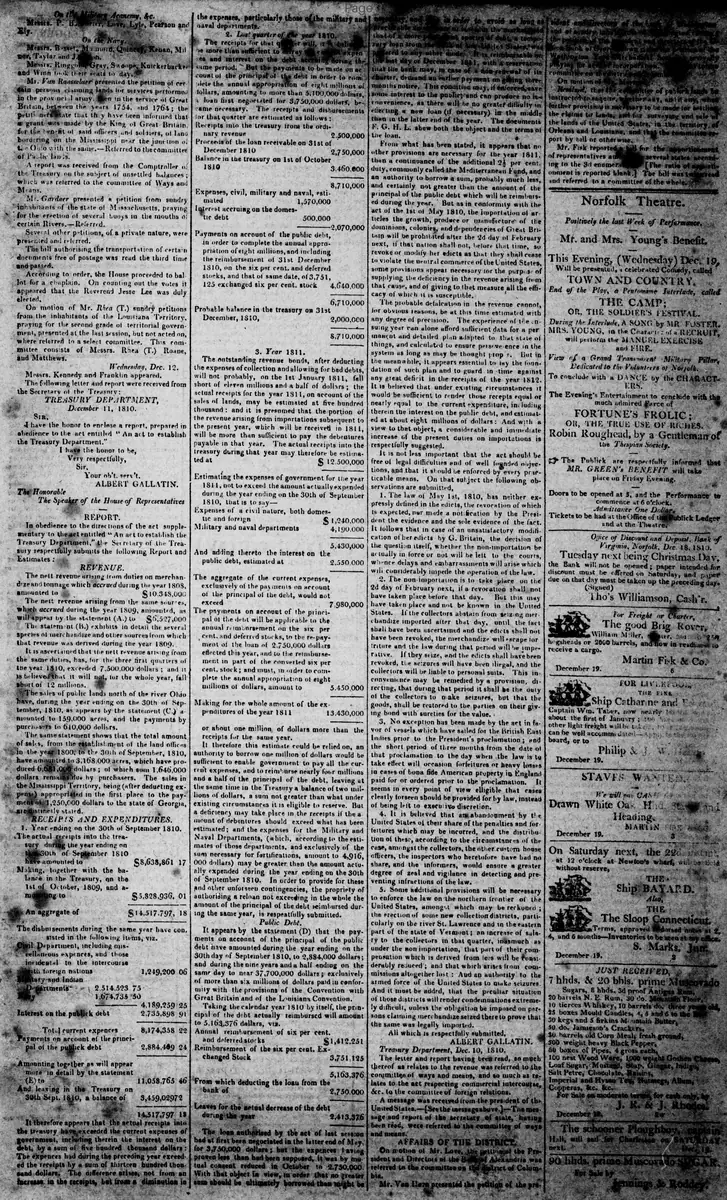
Mr. Van Rensselaer presented the petition of certain persons claiming lands for services performed in the provincial army then in the service of Great Britain, between the years 1754 and 1763; the petitioners state that they have been informed that a grant was made by the King of Great Britain for the benefit of said officers and soldiers, of land bordering on the Mississippi near the junction of the Ohio with the same. Referred to the committee of public lands.
A report was received from the Comptroller of the Treasury on the subject of unsettled balances; which was referred to the committee of Ways and Means.
Mr. Gardner presented a petition from sundry inhabitants of the state of Massachusetts, praying for the erection of several buoys in the mouths of certain rivers. Referred.
Several other petitions, of a private nature, were presented and referred.
The bill authorizing the transportation of certain documents free of postage was read the third time and passed.
According to order, the House proceeded to ballot for a chaplain. On counting out the votes it appeared that the Reverend Jesse Lee was duly elected.
On motion of Mr. Rhea (T.) sundry petitions from the inhabitants of the Louisiana Territory praying for the second grade of territorial government, presented at the last session, but not acted on, were referred to a select committee. This committee consists of Messrs. Rhea (T.) Roane, and Matthews.
Wednesday, Dec. 12.
Messrs. Kennedy and Franklin appeared.
The following letter and report were received from the Secretary of the Treasury:
TREASURY DEPARTMENT.
December 11, 1810.
SIR,
I have the honor to enclose a report, prepared in obedience to the act entitled "An act to establish the Treasury Department."
I have the honor to be,
Very respectfully,
Sir,
Your ob't. serv't.
ALBERT GALLATIN.
The Honorable
The Speaker of the House of Representatives
REPORT.
(In obedience to the directions of the act supplementary to the act entitled "An act to establish the Treasury Department," the Secretary of the Treasury respectfully submits the following Report and Estimates:)
REVENUE.
The net revenue arising from duties on merchandise and tonnage which accrued during the year 1809, amounted to $10,348,000.
The net revenue arising from the same sources, which accrued during the year 1810, amounted, as will appear by the statement (A.) to $6,527,000.
The statement (B.) exhibits in detail the several species of merchandise and other sources from which that revenue was derived during the year 1809.
It is ascertained that the net revenue arising from the same duties, has, for the three first quarters of the year 1810, exceeded 7,500,000 dollars; and it is believed that it will not, for the whole year, fall short of 12 millions.
The sales of public lands north of the river Ohio have, during the year ending on the 30th of September, 1810, as appears by the statement (C.) amounted to 159,000 acres, and the payments by purchasers to $610,000.
The same statement shows that the total amount of sales, from the establishment of the land offices in the year 1800, to the 30th of September, 1810, have amounted to 3,168,000 acres, which have produced $6,681,000; of which sum $1,646,000 dollars remains due by purchasers. The sales in the Mississippi Territory, being (after deducting expense) appropriated in the first place to the payment of $1,250,000 dollars to the state of Georgia, are distinctly stated.
RECEIPTS AND EXPENDITURES.
1. Year ending on the 30th of September 1810.
The actual receipts into the treasury during the year ending on the 30th of September 1810 have amounted to $8,638,861 17.
Making, together with the balance in the Treasury, on the 1st of October, 1809, amount to $5,828,936. 01.
An aggregate of $14,517,797. 18.
The disbursements during the same year have consisted in the following items, viz.
Civil Department, including miscellaneous expenses, and those incidental to the intercourse with foreign nations $1,249,200 06.
Military and Indian Departments $2,514,523 75.
Naval Department $1,674,735 50.
Total $4,189,259 25.
Interest on the public debt $2,735,898 91.
Total current expenses $8,174,358 22.
Payments on account of the principal of the public debt $2,884,409 24.
Amounting together as will appear more in detail by the statement (E) to $11,058,765 46.
And leaving in the Treasury on 30th Sept. 1810, a balance of $3,459,029 72.
$14,517,797 18.
It therefore appears that the actual receipts into the treasury have exceeded the current expenses of government, including therein the interest on the debt, by a sum of five hundred thousand dollars.
The expenses had during the preceding year exceeded the receipts by a sum of thirteen hundred thousand dollars. The difference arises, not from an increase in the receipts but from a diminution in the expenses, particularly those of the military and naval department.
2. Last quarter of the year 1810.
The receipts for that quarter will, it is believed, be more than sufficient to defray the expenses and interest on the debt accruing during the same period. But the payments to be made on account of the principal of the debt in order to complete the annual appropriation of eight millions of dollars, amounting to more than $5,100,000 dollars, a loan first negotiated for $3,750,000 dollars, became necessary. The receipts and disbursements for that quarter are estimated as follows:
Receipts into the treasury from the ordinary revenue $2,500,000.
Proceeds of the loan receivable on 31st of December 1810 $2,750,000.
Balance in the treasury on 1st of October 1810 $3,460,000.
$8,710,000.
Expenses, civil, military and naval, estimated $1,570,000.
Interest accruing on the domestic debt $500,000.
$2,070,000.
Payments on account of the public debt, in order to complete the annual appropriation of eight millions, and including the reimbursement of 31st December 1810, on the six per cent. and deferred stocks, and that of same date, of $3,751,125 exchanged six per cent. stock $4,640,000.
$6,710,000.
Probable balance in the treasury on 31st December, 1810, $2,000,000.
$8,710,000.
3. Year 1811.
The outstanding revenue bonds, after deducting the expenses of collection and allowing for bad debts, will not probably, on the 1st January 1811, fall short of eleven millions and a half of dollars; the actual receipts for the year 1811, on account of the sales of lands, may be estimated at five hundred thousand: and it is presumed that the portion of the revenue arising from importations subsequent to the present year, which will be received in 1811, will be more than sufficient to pay the debentures payable in that year. The actual receipts into the treasury during that year may therefore be estimated at $12,500,000.
Estimating the expenses of government for the year 1811, not to exceed the amount actually expended during the year ending on the 30th of September 1810, that is to say--
Expenses of a civil nature, both domestic and foreign $1,240,000.
Military and naval departments $4,190,000.
$5,430,000.
And adding thereto the interest on the public debt, estimated at $2,550,000.
The aggregate of the current expenses, exclusively of the payments on account of the principal of the debt, would not exceed $7,980,000.
The payments on account of the principal of the debt will be applicable to the annual reimbursement on the six per cent. and deferred stocks, to the re-payment of the loan of $2,750,000 dollars effected this year, and to the reimbursement in part of the converted six per cent. stock; and must, in order to complete the annual appropriation of eight millions of dollars, amount to $5,450,000.
Making for the whole amount of the expenditures of the year 1811 $13,430,000.
or about one million of dollars more than the receipts for the same year.
It is therefore if this estimate could be relied on, an authority to borrow one million of dollars would be sufficient to enable government to pay all the current expenses, and to reimburse nearly four millions and a half of the principal of the debt, leaving at the same time in the Treasury a balance of two millions of dollars, a sum not greater than what under existing circumstances it is eligible to reserve. But a deficiency may take place in the receipts if the amount of debentures should exceed what has been estimated; and the expenses of the Military and Naval Departments, (which, according to the estimates of those departments, and exclusively of the sum necessary for fortifications, amount to 4,916,000 dollars) may be greater than the amount actually expended during the year ending on the 30th of September 1810. In order to provide for these and other unforeseen contingencies, the propriety of authorising a loan not exceeding in the whole the amount of the principal of the debt reimbursed during the same year, is respectfully submitted.
Public Debt.
It appears by the statement (D) that the payments on account of the principal of the public debt have amounted during the year ending on the 30th day of September 1810, to 2,884,000 dollars; and during the nine years and a half ending on the same day to near 37,700,000 dollars; exclusively of more than six millions of dollars paid in conformity with the provisions of the Convention with Great Britain and of the Louisiana Convention.
Taking the calendar year 1810 by itself, the principal of the debt actually reimbursed will amount to 5,163,376 dollars, viz.
Annual reimbursement of six per cent. and deferred stocks $1,412,251.
Reimbursement of the six per cent. Exchanged Stock $3,751,125.
$5,163,376.
From which deducting the loan from the bank of $2,750,000.
Leaves for the actual decrease of the debt during the year $2,413,376.
The loan authorised by the act of last session had at first been negotiated in the latter end of May for 3,750,000 dollars; but the expenses having proven less than had been supposed, it was by mutual consent reduced in October to 2,750,000.
With that object in view-- in order that no greater sum should be ultimately borrowed than might be necessary. The loan from the Bank of the United States, negotiated on the last day of December last, with these terms: the bank may, in case of non-renewal of its charter, demand an earlier payment on giving three months notice. This condition may, if enforced, save some interest to the public, and can produce no inconvenience, as there will be no greater difficulty in effecting a new loan (if necessary) in the middle than in the latter end of the year. The documents F. G. H. I. show both the object and the terms of the loan.
From what has been stated, it appears that no other provisions are necessary for the year 1811, than a continuance of the additional 2 per cent. duty, commonly called the Mediterranean Fund, and an authority to borrow a sum, probably much less, and certainly not greater than the amount of the principal of the public debt which will be reimbursed during the year. But as in conformity with the act of the 1st of May 1810, the importation of articles the growth, produce or manufacture of the dominions, colonies, and dependencies of Great Britain will be prohibited after the 2d day of February next, if that nation shall not, before that time, so revoke or modify her edicts as that they shall cease to violate the neutral commerce of the United States, some provisions appear necessary for the purpose of supplying the deficiency in the revenue arising from that cause, and of giving to that measure all the efficacy of which it is susceptible.
The probable defalcation in the revenue cannot, for obvious reasons, be at this time estimated with any degree of precision. The experience of the ensuing year can alone afford sufficient data for a permanent and detailed plan adapted to that state of things, and calculated to ensure perseverance in the system as long as may be thought proper. But in the meanwhile, it appears essential to lay the foundation of such plan and to guard in time against any great deficit in the receipts of the year 1812.
It is believed that under existing circumstances it would be sufficient to render those receipts equal, or nearly equal to the current expenditure, including therein the interest on the public debt, and estimated at about eight millions of dollars: And with a view to that object, a considerable and immediate increase of the present duties on importations is respectfully suggested.
It is not less important that the act should be free of legal difficulties and of well founded objections, and that it should be enforced by every practicable means. On that subject the following observations are submitted,
1. The law of May 1st, 1810, has neither expressly defined what are the edicts, the revocation of which is expected, nor made a notification by the President the evidence and the sole evidence of the fact.
It follows that in case of an unsatisfactory modification of her edicts by G. Britain, the decision of the question itself, whether the non-importation be actually in force or not will be left to the courts, whence delays and embarrassments will arise which will considerably impede the operation of the law.
2. The non-importation is to take place on the 2d day of February next, if a revocation shall not have taken place before that day. But this may have taken place and not be known in the United States. If the collectors abstain from seizing merchandise imported after that day, until the fact shall have been ascertained and the edicts shall not have been revoked, the merchandise will escape forfeiture and the law during that period will be inoperative. If they seize, and the edicts shall have been revoked, the seizures will have been illegal, and the collectors will be liable to personal suits. This inconvenience may be remedied by a provision, directing, that during that period it shall be the duty of the collectors to make seizures, but that the goods, shall be restored to the parties on their giving bond with sureties for the value.
3. No exception has been made by the act in favor of vessels which have sailed for the British East Indies prior to the President's proclamation; and the short period of three months from the date of that proclamation to the day when the law is to take effect will occasion forfeitures or heavy losses in cases of bona fide American property in England paid for or ordered prior to the proclamation. It seems in every point of view eligible that cases clearly foreseen should be provided for by law, instead of being left to executive discretion.
4. It is believed that an abandonment by the United States of their share of the penalties and forfeitures which may be incurred, and the distribution of these, according to the circumstances of the case, amongst the collectors, the other custom house officers, the inspectors who heretofore have had no share, and the informers, would ensure a greater degree of zeal and vigilance in detecting and preventing infractions of the law.
5. Some additional provisions will be necessary to enforce the law on the northern frontier of the United States, amongst which may be reckoned; the erection of some new collection districts, particularly on the river St. Lawrence and in the eastern part of the state of Vermont; an increase of salary to the collectors in that quarter, inasmuch as under the non importation, that part of their compensation which is derived from fees will be considerably reduced; and that which arises from commissions altogether lost: And an authority to the armed force of the United States to make seizures.
And it must be added, that the peculiar situation of those districts will render condemnations extremely difficult, unless the obligation be imposed on persons claiming merchandise seized there to prove that the same was legally imported.
All which is respectfully submitted,
ALBERT GALLATIN.
Treasury Department, Dec. 10, 1810.
The letter and report having been read, so much thereof as relates to the revenue was referred to the committee of ways and means, and so much as relates to the act respecting commercial intercourse, &c. to the committee of foreign relations.
A message was received from the president of the United States. (See the message above.) The message and report of the secretary of state having been read, were referred to the committee of ways and means.
AFFAIRS OF THE DISTRICT
On motion of Mr. Love, a memorial of the President and Directors of the Bank of Alexandria was referred to the committee on the district of Columbia.
On motion of Mr. [garbled], to instruct the committee to enquire if further provision is necessary to be made for paying the claims for lands and for surveying and selling the lands of the United States in the territory of Orleans and Louisiana and in the committee report by bill or otherwise.
Mr. Fisk reported bill for the apportionment of representatives according to the 3d enumeration. The ratio of [garbled]. The bill was [read] and referred to a committee of the whole.
What sub-type of article is it?
What keywords are associated?
What entities or persons were involved?
Where did it happen?
Domestic News Details
Primary Location
Washington
Event Date
December 11 12, 1810
Key Persons
Event Details
House members including Bassett, Taylor, Ringo, Gray, Sampson, Knickerbocker, and Winn took seats. Petitions presented on land claims for provincial army services 1754-1763, unsettled treasury balances, buoys in Massachusetts rivers, private matters, and Louisiana Territory governance; all referred to committees. Bill for free postage on certain documents passed. Rev. Jesse Lee elected chaplain. On Dec. 12, Kennedy and Franklin appeared. Gallatin's Treasury report on 1809-1810 revenue from duties ($10.3M to $12M est.), land sales, receipts ($8.6M), expenditures (civil $1.2M, military/Indian $2.5M, naval $1.7M, interest $2.7M, principal $2.9M), debt reduction ($2.4M net), 1811 estimates ($12.5M receipts vs. $13.4M expenditures), loan needs, and non-importation enforcement suggestions received and referred. Presidential message and state secretary report referred. District affairs: Bank of Alexandria memorial referred; motion on Orleans/Louisiana land claims; apportionment bill reported.