Thank you for visiting SNEWPapers!
Sign up free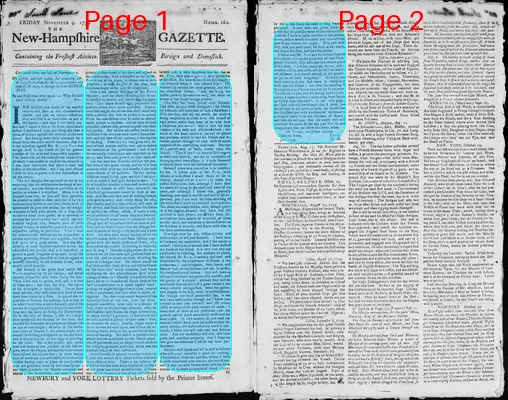
Editorial
November 9, 1759
The New Hampshire Gazette
Portsmouth, Rockingham County, New Hampshire
What is this article about?
Satirical editorial, the eighth and final reason to remove Mr. Pitt from power: his honesty, which the author ironically argues disqualifies him in an era of polished vice and moderate corruption. Signed O.M., Coleman Street, Jan. 1759.
Merged-components note: These three components form a single continuous editorial piece spanning pages 1 and 2, with sequential reading order and flowing text content.
Clippings
1 of 2
OCR Quality
95%
Excellent
Full Text
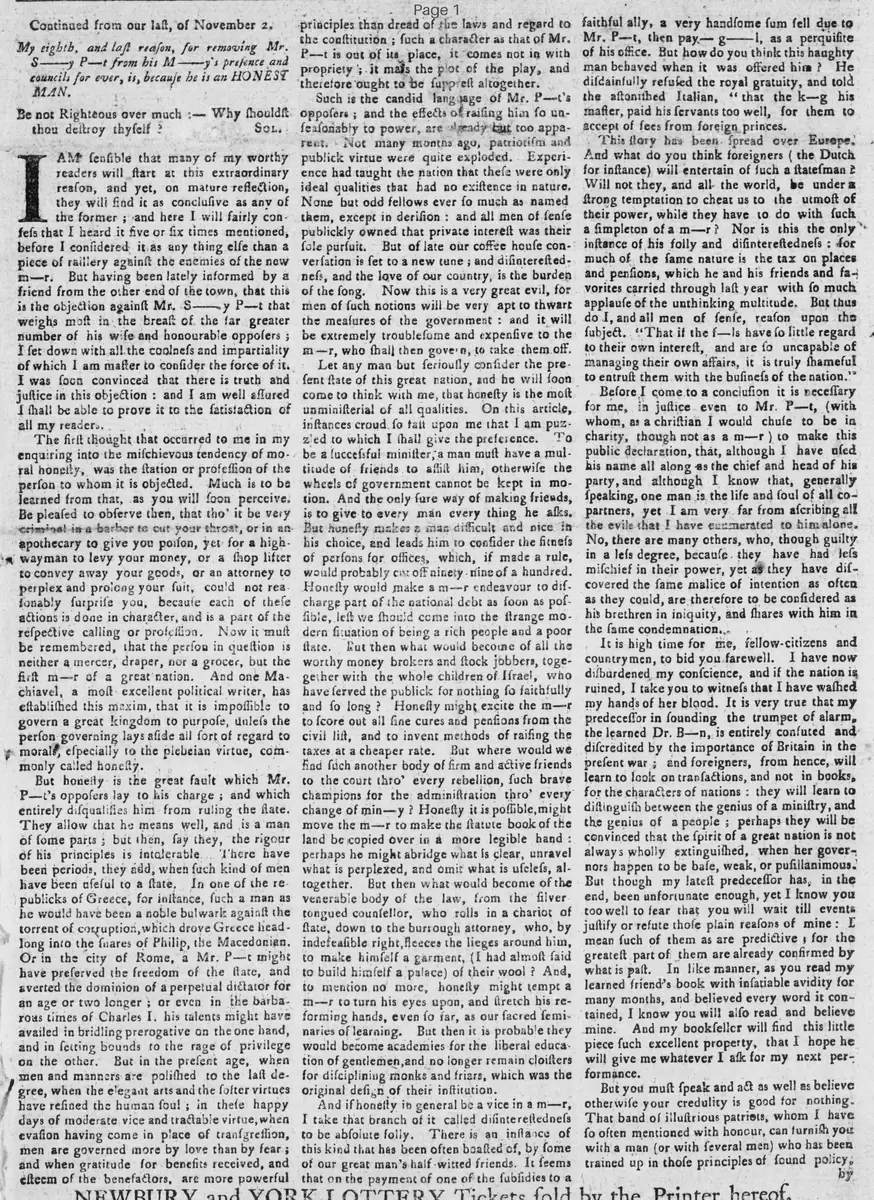
Continued from our last, of November
My eighth. and last reason, for removing Mr.
S-n-y P--t from his M--p's presence and
councils for ever, is, because he is an HONEST
MAN.
Be not Righteous over much :-- Why Shouldst
thou destroy thyself ?
SOL. :
AM sensible that many of my worthy
readers will start at this extraordinary
reason, and yet, on mature reflection,
they will find it as conclusive as any of
the former ; and here I will fairly con-
fess that I heard it five or six times mentioned.
before I considered it as any thing else than a
piece of raillery against the enemies of the new
m--r. But having been lately informed by a
friend from the other end of the town. that this
is the objection against Mr. S---- y P--t that
weighs most in the breast of. the far greater
number of his wise and honourable opposers ;
I set down with all the coolness and impartiality
of which I am master to consider the force of it.
I was soon convinced that there is truth and
justice in this objection : and I am well assured
I shall be able to prove it to the satisfaction of
all my readers.
The first thought that occurred to me in my
enquiring into the mischievous tendency of mo-
ral honesty. was the station or profession of the
person to whom it is objected. Much is to be
learned from that, .as you will soon perceive.
Be pleased to observe then, that tho' it be very
criminal in a barber to cut your throat, or in an
apothecary to give you poison, yet for a high-
wayman to levy your money, or a shop lifter
to convey away your goods, or an attorney to
perplex and prolong your suit, could not rea-
sonably surprize you, because each of these
actions is done in character, and is a part of the
respective calling or profession. Now it must
be remembered, that the person in question is
neither a mercer, draper, nor a grocer, but the
first m--r of a great nation. And one Ma-
chiavel, a most excellent political writer, has
established this maxim, that it is impossible to
govern a great kingdom to purpose, unless the
person governing lays aside all sort of regard to
morals, especially to the plebeian virtue, com-
monly called honesty.
But honesty is the great fault which Mr.
P--t's opposers lay to his charge ; and which
entirely disqualifies him from ruling the state.
They allow that he means well, and is a man
of some parts ; but then, say they. the rigour
of his principles is intolerable. There have
been periods, they add, when such kind of men
have been useful to a state. In one of the re-
publicks of Greece, for instance. such a man as
he would have been a noble bulwark against the
torrent of corruption, which drove Greece head-
long into the snares of Philip, the Macedonian.
Or in the city of Rome, a Mr. P--t might
have preserved the freedom of the state, and
averted the dominion of a perpetual dictator for
an age or two longer ; or even in the barba-
rous times of Charles I. his talents might have
availed in bridling prerogative on the one hand,
and in setting bounds to the rage of privilege
on the other. But in the present age. when
men and manners are polished to the last de-
gree, when the elegant arts and the softer virtues
have refined the human soul ; in these happy
days of moderate vice and tractable virtue, when
evasion having come in place of transgression,
men are governed more by love than by fear ;
and when gratitude for benefits received, and
esteem of the benefactors, are more powerful
principles than dread of the laws and regard to
the constitution : such a character as that of Mr.
P--t is out of its place. it comes not in with
propriety ;.it mars the plot of the play, and
therefore ought to be suppressed altogether.
Such is the candid language of Mr. P--t's
opposers ; and the effects of raising him so un-
reasonably to power, are already but too appa-
rent. Not many months ago, patriotism and
publick virtue were quite exploded. Experi-
ence had taught the nation that these were only
ideal qualities that had no existence in nature.
None but odd fellows ever so much as named
them, except in derision : and all men of sense
publickly owned that private interest was their
sole pursuit. But of late our coffee house con-
versation is set to a new tune ; and disinterested-
ness, and the love of our country. is the burden
of the song. Now this is a very great evil, for
men of such notions will be very apt to thwart
the measures of the government : and it will
be extremely troublesome and expensive to the
m-r, who shall then govern. to take them off.
Let any man but seriously consider the pre-
sent state of this great nation, and he will soon
come to think with me, that honesty is the most
unministerial of all qualities. On this article,
instances crowd so fast upon me that I am puz-
zled to which I shall give the preference. To
be a successful miniter a man must have a mul-
titude of friends. to assist him. otherwise the
wheels of government cannot be kept in mo-
tion. And the only sure way of making friends,
is to give to every man every thing he asks.
But honesty makes a man difficult and nice in
his choice. and leads him to consider the fitness
of persons for offices. which. if made a rule,
would probably cast off ninety nine of a hundred.
Honesty would make a m--r endeavour to dis-
charge part of the national debt as soon as pos-
sible. lest we should come into the strange mo-
dern situation of being a rich people and a poor
state. But then what would become of all the
worthy money brokers and stock jobbers, toge-
ther with the whole children of Israel, who
have served the publick for nothing so faithfully
and so long ? Honesty might excite the m--r
to score out all sine cures and pensions from the
civil list, and to invent methods of raising the
taxes at a cheaper rate. But where would we
find such another body of firm and active friends
to the court thro' every rebellion, such brave
champions for the administration thro' every
change of min-y ? Honesty it is possible, might
move the m--r to make the statute book of the
land be copied over in a more legible hand :
perhaps he might abridge what is clear, unravel
what is perplexed, and omit what is useless, al-
together. But then what would become of the
venerable body of the law. from the silver
tongued counsellor. who rolls in a chariot of
state, down to the burrough attorney, who, by
indefeasible right, fleeces the lieges around him,
to make himself a garment. (I had almost said
to build himself a palace) of their wool ? And,
to mention no more, honesty might tempt a
m--r to turn his eyes upon, and stretch his re-
forming hands, even so far, as our sacred emi-
naries of learning. But then it is probable they
would become academies for the liberal educa-
tion of gentlemen,and no longer remain cloisters
for disciplining monks and friars, which was the
original design of their institution.
And if honesty in general be a vice in a m--r,
I take that branch of it called disinterestedness
to be absolute folly. There is an instance of
this kind that has been often boasted of, by some
of our great man's half witted friends. It seems
that on the payment of one of the subsidies to a
by which this island has been so long happily
governed. A man who has given notorious
proof that he possesses none of the unministerial
qualities I have so justly ascribed to the present
minister, and to whose character and conduct not
one of my reasons will apply. Him you must
find, him you must exalt. For such as he, alone,
can rescue the state, and save the nation.
I know that Mr. Pitt and his friends support
their spirits with an old prophecy of one Humphrey
Oldcastle, Esq; who says in a certain place
of his book, "Let but one great, brave, disinterested,
active, man arise, and he will be received,
followed, and almost adored, as the guardian
genius of those kingdoms." Hitherto you
have acted as if you had been in conspiracy
with that old dotard; but after the warning
I have given you, I know you will do so no more.
To the minister too, and his daring band of associates,
I have directed a threatening, from better
authority than Oldcastle's, in my title page;
and lest it should be thought that I bend the
sacred text to my own purpose, my bookseller
has furnished me with a collateral evidence in
a scrap of Latin from the Solomon of Rome:
and bids me tell you, that the hopes you will
vindicate the credit of the age you live in, and
demonstrate that yet there are times, when
O virtutes certissimum exitium.
Coleman Street,
Jan. 1759.
O. M.
My eighth. and last reason, for removing Mr.
S-n-y P--t from his M--p's presence and
councils for ever, is, because he is an HONEST
MAN.
Be not Righteous over much :-- Why Shouldst
thou destroy thyself ?
SOL. :
AM sensible that many of my worthy
readers will start at this extraordinary
reason, and yet, on mature reflection,
they will find it as conclusive as any of
the former ; and here I will fairly con-
fess that I heard it five or six times mentioned.
before I considered it as any thing else than a
piece of raillery against the enemies of the new
m--r. But having been lately informed by a
friend from the other end of the town. that this
is the objection against Mr. S---- y P--t that
weighs most in the breast of. the far greater
number of his wise and honourable opposers ;
I set down with all the coolness and impartiality
of which I am master to consider the force of it.
I was soon convinced that there is truth and
justice in this objection : and I am well assured
I shall be able to prove it to the satisfaction of
all my readers.
The first thought that occurred to me in my
enquiring into the mischievous tendency of mo-
ral honesty. was the station or profession of the
person to whom it is objected. Much is to be
learned from that, .as you will soon perceive.
Be pleased to observe then, that tho' it be very
criminal in a barber to cut your throat, or in an
apothecary to give you poison, yet for a high-
wayman to levy your money, or a shop lifter
to convey away your goods, or an attorney to
perplex and prolong your suit, could not rea-
sonably surprize you, because each of these
actions is done in character, and is a part of the
respective calling or profession. Now it must
be remembered, that the person in question is
neither a mercer, draper, nor a grocer, but the
first m--r of a great nation. And one Ma-
chiavel, a most excellent political writer, has
established this maxim, that it is impossible to
govern a great kingdom to purpose, unless the
person governing lays aside all sort of regard to
morals, especially to the plebeian virtue, com-
monly called honesty.
But honesty is the great fault which Mr.
P--t's opposers lay to his charge ; and which
entirely disqualifies him from ruling the state.
They allow that he means well, and is a man
of some parts ; but then, say they. the rigour
of his principles is intolerable. There have
been periods, they add, when such kind of men
have been useful to a state. In one of the re-
publicks of Greece, for instance. such a man as
he would have been a noble bulwark against the
torrent of corruption, which drove Greece head-
long into the snares of Philip, the Macedonian.
Or in the city of Rome, a Mr. P--t might
have preserved the freedom of the state, and
averted the dominion of a perpetual dictator for
an age or two longer ; or even in the barba-
rous times of Charles I. his talents might have
availed in bridling prerogative on the one hand,
and in setting bounds to the rage of privilege
on the other. But in the present age. when
men and manners are polished to the last de-
gree, when the elegant arts and the softer virtues
have refined the human soul ; in these happy
days of moderate vice and tractable virtue, when
evasion having come in place of transgression,
men are governed more by love than by fear ;
and when gratitude for benefits received, and
esteem of the benefactors, are more powerful
principles than dread of the laws and regard to
the constitution : such a character as that of Mr.
P--t is out of its place. it comes not in with
propriety ;.it mars the plot of the play, and
therefore ought to be suppressed altogether.
Such is the candid language of Mr. P--t's
opposers ; and the effects of raising him so un-
reasonably to power, are already but too appa-
rent. Not many months ago, patriotism and
publick virtue were quite exploded. Experi-
ence had taught the nation that these were only
ideal qualities that had no existence in nature.
None but odd fellows ever so much as named
them, except in derision : and all men of sense
publickly owned that private interest was their
sole pursuit. But of late our coffee house con-
versation is set to a new tune ; and disinterested-
ness, and the love of our country. is the burden
of the song. Now this is a very great evil, for
men of such notions will be very apt to thwart
the measures of the government : and it will
be extremely troublesome and expensive to the
m-r, who shall then govern. to take them off.
Let any man but seriously consider the pre-
sent state of this great nation, and he will soon
come to think with me, that honesty is the most
unministerial of all qualities. On this article,
instances crowd so fast upon me that I am puz-
zled to which I shall give the preference. To
be a successful miniter a man must have a mul-
titude of friends. to assist him. otherwise the
wheels of government cannot be kept in mo-
tion. And the only sure way of making friends,
is to give to every man every thing he asks.
But honesty makes a man difficult and nice in
his choice. and leads him to consider the fitness
of persons for offices. which. if made a rule,
would probably cast off ninety nine of a hundred.
Honesty would make a m--r endeavour to dis-
charge part of the national debt as soon as pos-
sible. lest we should come into the strange mo-
dern situation of being a rich people and a poor
state. But then what would become of all the
worthy money brokers and stock jobbers, toge-
ther with the whole children of Israel, who
have served the publick for nothing so faithfully
and so long ? Honesty might excite the m--r
to score out all sine cures and pensions from the
civil list, and to invent methods of raising the
taxes at a cheaper rate. But where would we
find such another body of firm and active friends
to the court thro' every rebellion, such brave
champions for the administration thro' every
change of min-y ? Honesty it is possible, might
move the m--r to make the statute book of the
land be copied over in a more legible hand :
perhaps he might abridge what is clear, unravel
what is perplexed, and omit what is useless, al-
together. But then what would become of the
venerable body of the law. from the silver
tongued counsellor. who rolls in a chariot of
state, down to the burrough attorney, who, by
indefeasible right, fleeces the lieges around him,
to make himself a garment. (I had almost said
to build himself a palace) of their wool ? And,
to mention no more, honesty might tempt a
m--r to turn his eyes upon, and stretch his re-
forming hands, even so far, as our sacred emi-
naries of learning. But then it is probable they
would become academies for the liberal educa-
tion of gentlemen,and no longer remain cloisters
for disciplining monks and friars, which was the
original design of their institution.
And if honesty in general be a vice in a m--r,
I take that branch of it called disinterestedness
to be absolute folly. There is an instance of
this kind that has been often boasted of, by some
of our great man's half witted friends. It seems
that on the payment of one of the subsidies to a
by which this island has been so long happily
governed. A man who has given notorious
proof that he possesses none of the unministerial
qualities I have so justly ascribed to the present
minister, and to whose character and conduct not
one of my reasons will apply. Him you must
find, him you must exalt. For such as he, alone,
can rescue the state, and save the nation.
I know that Mr. Pitt and his friends support
their spirits with an old prophecy of one Humphrey
Oldcastle, Esq; who says in a certain place
of his book, "Let but one great, brave, disinterested,
active, man arise, and he will be received,
followed, and almost adored, as the guardian
genius of those kingdoms." Hitherto you
have acted as if you had been in conspiracy
with that old dotard; but after the warning
I have given you, I know you will do so no more.
To the minister too, and his daring band of associates,
I have directed a threatening, from better
authority than Oldcastle's, in my title page;
and lest it should be thought that I bend the
sacred text to my own purpose, my bookseller
has furnished me with a collateral evidence in
a scrap of Latin from the Solomon of Rome:
and bids me tell you, that the hopes you will
vindicate the credit of the age you live in, and
demonstrate that yet there are times, when
O virtutes certissimum exitium.
Coleman Street,
Jan. 1759.
O. M.
What sub-type of article is it?
Satire
Partisan Politics
What keywords are associated?
Political Honesty
Ministerial Vice
William Pitt
British Satire
Corruption Critique
Public Virtue
What entities or persons were involved?
Mr. S N Y P T
Mr. Pitt
His Opposers
Machiavel
Editorial Details
Primary Topic
Honesty As Disqualification For Ministry
Stance / Tone
Ironic Critique Of Political Opponents
Key Figures
Mr. S N Y P T
Mr. Pitt
His Opposers
Machiavel
Key Arguments
Honesty Is Incompatible With Governing A Great Nation Per Machiavelli
In Modern Polished Society, Honesty Disrupts The Balance Of Moderate Vice
Honesty Would Undermine Patronage, Debt Management, Pensions, Legal Complexity, And Educational Institutions
Pitt's Disinterestedness Is Folly In A Minister
Opposers Seek A Dishonest Leader To Maintain Governance