Thank you for visiting SNEWPapers!
Sign up free
Literary
April 24, 1949
Atlanta Daily World
Atlanta, Fulton County, Georgia
What is this article about?
In Chapter 28 of 'Marry for Money,' Gail's destitute father, Morrison Rogers, unexpectedly returns and pressures her for support, recounting his past abandonment of her mother and hinting at scandal. Mrs. Spencer arrives, maintains composure, and takes charge of the situation while Gail contacts her husband Brad.
Clipping
OCR Quality
96%
Excellent
Full Text
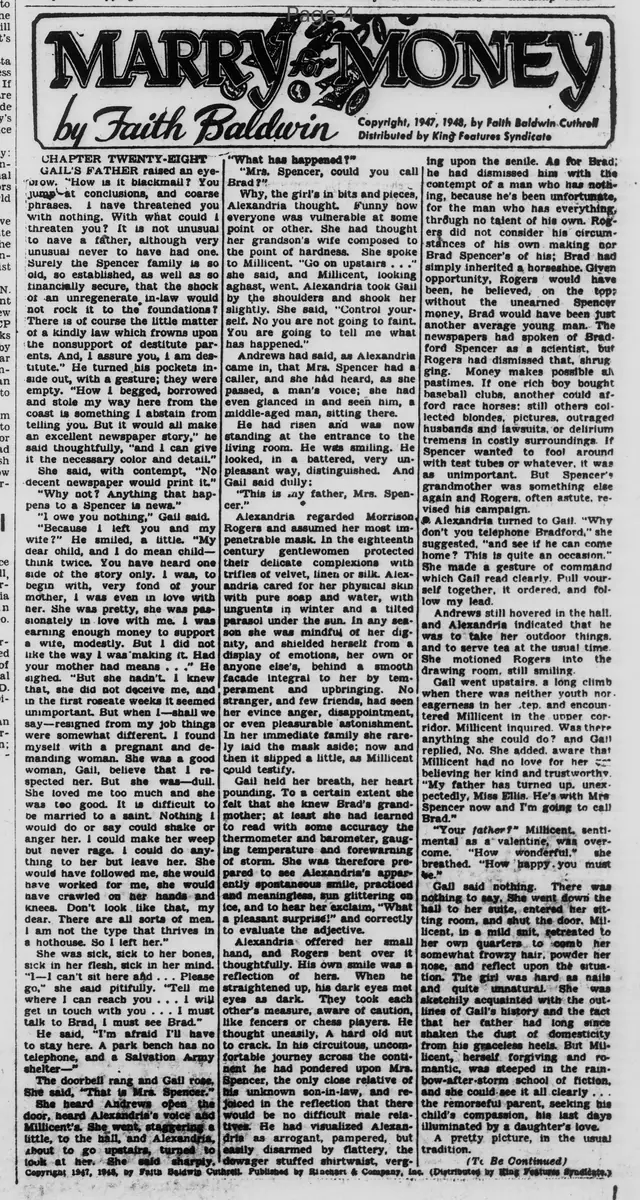
MARRY FOR MONEY
by Faith Baldwin
Copyright, 1947, 1948, by Faith Baldwin Cuthrel
Distributed by King Features Syndicate
CHAPTER TWENTY-EIGHT
GAIL'S FATHER raised an eyebrow. "How is it blackmail? You jump to conclusions, and coarse phrases. I have threatened you with nothing. With what could I threaten you? It is not unusual to have a father, although very unusual never to have had one.
Surely the Spencer family is so old, so established, as well as so financially secure, that the shock of an unregenerate in-law would not rock it to the foundations?
There is of course the little matter of a kindly law which frowns upon the nonsupport of destitute parents. And, I assure you, I am destitute." He turned his pockets inside out, with a gesture; they were empty. "How I begged, borrowed and stole my way here from the coast is something I abstain from telling you. But it would all make an excellent newspaper story," he said thoughtfully, "and I can give it the necessary color and detail."
She said, with contempt, "No decent newspaper would print it."
"Why not? Anything that happens to a Spencer is news."
"I owe you nothing," Gail said.
"Because I left you and my wife?" He smiled, a little. "My dear child, and I do mean child—think twice. You have heard one side of the story only. I was, to begin with, very fond of your mother, I was even in love with her. She was pretty, she was passionately in love with me. I was earning enough money to support a wife, modestly. But I did not like the way I was making it. Had your mother had means . . ." He sighed. "But she hadn't. I knew that, she did not deceive me, and in the first roseate weeks it seemed unimportant. But when I—shall we say—resigned from my job things were somewhat different, I found myself with a pregnant and demanding woman. She was a good woman, Gail, believe that I respected her. But she was—dull. She loved me too much and she was too good. It is difficult to be married to a saint. Nothing I would do or say could shake or anger her. I could make her weep but never rage. I could do anything to her but leave her. She would have followed me, she would have worked for me, she would have crawled on her hands and knees. Don't look like that, my dear. There are all sorts of men. I am not the type that thrives in a hothouse. So I left her."
She was sick, sick to her bones, sick in her flesh, sick in her mind.
"I— I can't sit here and... Please go," she said pitifully, "Tell me where I can reach you ... I will get in touch with you . . . I must talk to Brad, I must see Brad."
He said, "I'm afraid I'll have to stay here. A park bench has no telephone, and a Salvation Army shelter—"
The doorbell rang and Gail rose
She said, 'That is Mrs. Spencer,"
She heard Andrews open the door, heard Alexandria's voice and Millicent's. She went staggering a little, to the hall, and Alexandria, about to go upstairs, turned to look at her. She said sharply.
"What has happened?"
"Mrs. Spencer, could you call Brad?"
Why, the girl's in bits and pieces, Alexandria thought. Funny how everyone was vulnerable at some point or other. She had thought her grandson's wife composed to the point of hardness. She spoke to Millicent. "Go on upstairs . . ." she said, and Millicent, looking aghast, went. Alexandria took Gail by the shoulders and shook her slightly. She said, "Control yourself. No you are not going to faint. You are going to tell me what has happened.'
Andrews had said, as Alexandria came in, that Mrs. Spencer had a caller, and she had heard, as she passed, a man's voice; she had even glanced in and seen him, a middle-aged man, sitting there.
He had risen and was now standing at the entrance to the living room. He was smiling. He looked, in a battered, very unpleasant way, distinguished. And Gail said dully:
"This is my father, Mrs. Spencer."
Alexandria regarded Morrison Rogers and assumed her most impenetrable mask. In the eighteenth century gentlewomen protected their delicate complexions with trifles of velvet, linen or silk. Alexandria cared for her physical skin with pure soap and water, with unguents in winter and a tilted parasol under the sun. In any season she was mindful of her dignity, and shielded herself from a display of emotions, her own or anyone else's, behind a smooth facade integral to her by temperament and upbringing,
No stranger, and few friends, had seen her evince anger, disappointment, or even pleasurable astonishment. In her immediate family she rarely laid the mask aside; now and then it slipped a little, as Millicent could testify.
Gail held her breath, her heart pounding. To a certain extent she felt that she knew Brad's grandmother; at least she had learned to read with some accuracy the thermometer and barometer, gauging temperature and forewarning of storm. She was therefore prepared— to see Alexandria's apparently spontaneous smile, practiced and meaningless, sun glittering on ice, and to hear her exclaim, "What a pleasant surprise!" and correctly to evaluate the adjective.
Alexandria offered her small hand, and Rogers bent over it thoughtfully. His own smile was a reflection of hers. When he straightened up, his dark eyes met eyes as dark.
They took each other's measure, aware of caution, like fencers or chess players. He thought uneasily, A hard old nut to crack. In his circuitous, uncomfortable journey across the continent he had pondered upon Mrs. Spencer, the only close relative of his unknown son-in-law, and rejoiced in the reflection that there would be no difficult male relatives. He had visualized Alexandria as arrogant, pampered, but easily disarmed by flattery, the dowager stuffed shirtwaist, verging upon the senile. As for Brad: he had dismissed him with the contempt of a man who has nothing, because he's been unfortunate, for the man who has everything, through no talent of his own. Rogers did not consider his circumstances of his own making nor Brad Spencer's of his; Brad had simply inherited a horseshoe. Given opportunity, Rogers would have been, he believed, on top without the unearned Spencer money, Brad would have been just another average young man. The newspapers had spoken of Bradford Spencer as a scientist, but Rogers had dismissed that, shrugging. Money makes possible all pastimes. If one rich boy bought baseball clubs, another could afford race horses; still others collected blondes, pictures, outraged husbands and lawsuits, or delirium tremens in costly surroundings. If Spencer wanted to fool around with test tubes or whatever, it was as unimportant. But Spencer's grandmother was something else again and Rogers, often astute, revised his campaign.
Alexandria turned to Gail. "Why don't you telephone Bradford," she suggested, "and see if he can come home? This is quite an occasion."
She made a gesture of command which Gail read clearly. Pull yourself together, it ordered, and follow my lead.
Andrews still hovered in the hall. and Alexandria indicated that he was to take her outdoor things. and to serve tea at the usual time.
She motioned Rogers into the drawing room, still smiling.
Gail went upstairs, a long climb when there was neither youth nor eagerness in her step, and encountered Millicent in the upper corridor. Millicent inquired. Was there anything she could do? and Gail replied, No. She added, aware that Millicent had no love for her but believing her kind and trustworthy.
"My father has turned up, unexpectedly, Miss Ellis. He's with Mrs. Spencer now and I'm going to call Brad."
"Your father?" Millicent, sentimental as a valentine, was overcome.
"How wonderful," she breathed. "How happy you must be.'
Gail said nothing. There was nothing to say, She went down the hall to her suite, entered her sitting room, and shut the door. Millicent, in a mild snit, retreated to her own quarters to comb her somewhat frowzy hair, powder her nose, and reflect upon the situation. The girl was hard as nails and quite unnatural. She was sketchily acquainted with the outlines of Gail's history and the fact that her father had long since shaken the dust of domesticity from his graceless heels. But Millicent, herself forgiving and romantic, was steeped in the rainbow-after-storm school of fiction, and she could see it all clearly . . . the remorseful parent, seeking his child's compassion, his last days illuminated by a daughter's love.
A pretty picture, in the usual tradition.
(To Be Continued)
©. Distributed by King Features Syndicate.
by Faith Baldwin
Copyright, 1947, 1948, by Faith Baldwin Cuthrel
Distributed by King Features Syndicate
CHAPTER TWENTY-EIGHT
GAIL'S FATHER raised an eyebrow. "How is it blackmail? You jump to conclusions, and coarse phrases. I have threatened you with nothing. With what could I threaten you? It is not unusual to have a father, although very unusual never to have had one.
Surely the Spencer family is so old, so established, as well as so financially secure, that the shock of an unregenerate in-law would not rock it to the foundations?
There is of course the little matter of a kindly law which frowns upon the nonsupport of destitute parents. And, I assure you, I am destitute." He turned his pockets inside out, with a gesture; they were empty. "How I begged, borrowed and stole my way here from the coast is something I abstain from telling you. But it would all make an excellent newspaper story," he said thoughtfully, "and I can give it the necessary color and detail."
She said, with contempt, "No decent newspaper would print it."
"Why not? Anything that happens to a Spencer is news."
"I owe you nothing," Gail said.
"Because I left you and my wife?" He smiled, a little. "My dear child, and I do mean child—think twice. You have heard one side of the story only. I was, to begin with, very fond of your mother, I was even in love with her. She was pretty, she was passionately in love with me. I was earning enough money to support a wife, modestly. But I did not like the way I was making it. Had your mother had means . . ." He sighed. "But she hadn't. I knew that, she did not deceive me, and in the first roseate weeks it seemed unimportant. But when I—shall we say—resigned from my job things were somewhat different, I found myself with a pregnant and demanding woman. She was a good woman, Gail, believe that I respected her. But she was—dull. She loved me too much and she was too good. It is difficult to be married to a saint. Nothing I would do or say could shake or anger her. I could make her weep but never rage. I could do anything to her but leave her. She would have followed me, she would have worked for me, she would have crawled on her hands and knees. Don't look like that, my dear. There are all sorts of men. I am not the type that thrives in a hothouse. So I left her."
She was sick, sick to her bones, sick in her flesh, sick in her mind.
"I— I can't sit here and... Please go," she said pitifully, "Tell me where I can reach you ... I will get in touch with you . . . I must talk to Brad, I must see Brad."
He said, "I'm afraid I'll have to stay here. A park bench has no telephone, and a Salvation Army shelter—"
The doorbell rang and Gail rose
She said, 'That is Mrs. Spencer,"
She heard Andrews open the door, heard Alexandria's voice and Millicent's. She went staggering a little, to the hall, and Alexandria, about to go upstairs, turned to look at her. She said sharply.
"What has happened?"
"Mrs. Spencer, could you call Brad?"
Why, the girl's in bits and pieces, Alexandria thought. Funny how everyone was vulnerable at some point or other. She had thought her grandson's wife composed to the point of hardness. She spoke to Millicent. "Go on upstairs . . ." she said, and Millicent, looking aghast, went. Alexandria took Gail by the shoulders and shook her slightly. She said, "Control yourself. No you are not going to faint. You are going to tell me what has happened.'
Andrews had said, as Alexandria came in, that Mrs. Spencer had a caller, and she had heard, as she passed, a man's voice; she had even glanced in and seen him, a middle-aged man, sitting there.
He had risen and was now standing at the entrance to the living room. He was smiling. He looked, in a battered, very unpleasant way, distinguished. And Gail said dully:
"This is my father, Mrs. Spencer."
Alexandria regarded Morrison Rogers and assumed her most impenetrable mask. In the eighteenth century gentlewomen protected their delicate complexions with trifles of velvet, linen or silk. Alexandria cared for her physical skin with pure soap and water, with unguents in winter and a tilted parasol under the sun. In any season she was mindful of her dignity, and shielded herself from a display of emotions, her own or anyone else's, behind a smooth facade integral to her by temperament and upbringing,
No stranger, and few friends, had seen her evince anger, disappointment, or even pleasurable astonishment. In her immediate family she rarely laid the mask aside; now and then it slipped a little, as Millicent could testify.
Gail held her breath, her heart pounding. To a certain extent she felt that she knew Brad's grandmother; at least she had learned to read with some accuracy the thermometer and barometer, gauging temperature and forewarning of storm. She was therefore prepared— to see Alexandria's apparently spontaneous smile, practiced and meaningless, sun glittering on ice, and to hear her exclaim, "What a pleasant surprise!" and correctly to evaluate the adjective.
Alexandria offered her small hand, and Rogers bent over it thoughtfully. His own smile was a reflection of hers. When he straightened up, his dark eyes met eyes as dark.
They took each other's measure, aware of caution, like fencers or chess players. He thought uneasily, A hard old nut to crack. In his circuitous, uncomfortable journey across the continent he had pondered upon Mrs. Spencer, the only close relative of his unknown son-in-law, and rejoiced in the reflection that there would be no difficult male relatives. He had visualized Alexandria as arrogant, pampered, but easily disarmed by flattery, the dowager stuffed shirtwaist, verging upon the senile. As for Brad: he had dismissed him with the contempt of a man who has nothing, because he's been unfortunate, for the man who has everything, through no talent of his own. Rogers did not consider his circumstances of his own making nor Brad Spencer's of his; Brad had simply inherited a horseshoe. Given opportunity, Rogers would have been, he believed, on top without the unearned Spencer money, Brad would have been just another average young man. The newspapers had spoken of Bradford Spencer as a scientist, but Rogers had dismissed that, shrugging. Money makes possible all pastimes. If one rich boy bought baseball clubs, another could afford race horses; still others collected blondes, pictures, outraged husbands and lawsuits, or delirium tremens in costly surroundings. If Spencer wanted to fool around with test tubes or whatever, it was as unimportant. But Spencer's grandmother was something else again and Rogers, often astute, revised his campaign.
Alexandria turned to Gail. "Why don't you telephone Bradford," she suggested, "and see if he can come home? This is quite an occasion."
She made a gesture of command which Gail read clearly. Pull yourself together, it ordered, and follow my lead.
Andrews still hovered in the hall. and Alexandria indicated that he was to take her outdoor things. and to serve tea at the usual time.
She motioned Rogers into the drawing room, still smiling.
Gail went upstairs, a long climb when there was neither youth nor eagerness in her step, and encountered Millicent in the upper corridor. Millicent inquired. Was there anything she could do? and Gail replied, No. She added, aware that Millicent had no love for her but believing her kind and trustworthy.
"My father has turned up, unexpectedly, Miss Ellis. He's with Mrs. Spencer now and I'm going to call Brad."
"Your father?" Millicent, sentimental as a valentine, was overcome.
"How wonderful," she breathed. "How happy you must be.'
Gail said nothing. There was nothing to say, She went down the hall to her suite, entered her sitting room, and shut the door. Millicent, in a mild snit, retreated to her own quarters to comb her somewhat frowzy hair, powder her nose, and reflect upon the situation. The girl was hard as nails and quite unnatural. She was sketchily acquainted with the outlines of Gail's history and the fact that her father had long since shaken the dust of domesticity from his graceless heels. But Millicent, herself forgiving and romantic, was steeped in the rainbow-after-storm school of fiction, and she could see it all clearly . . . the remorseful parent, seeking his child's compassion, his last days illuminated by a daughter's love.
A pretty picture, in the usual tradition.
(To Be Continued)
©. Distributed by King Features Syndicate.
What sub-type of article is it?
Prose Fiction
What themes does it cover?
Social Manners
What keywords are associated?
Absent Father
Family Confrontation
Wealthy Family
Emotional Blackmail
Social Composure
Unexpected Reunion
What entities or persons were involved?
By Faith Baldwin
Literary Details
Title
Chapter Twenty Eight
Author
By Faith Baldwin
Key Lines
"How Is It Blackmail? You Jump To Conclusions, And Coarse Phrases. I Have Threatened You With Nothing."
"I Was, To Begin With, Very Fond Of Your Mother, I Was Even In Love With Her. [...] So I Left Her."
"This Is My Father, Mrs. Spencer."
"What A Pleasant Surprise!"
"Pull Yourself Together, It Ordered, And Follow My Lead."