Thank you for visiting SNEWPapers!
Sign up free
Urbana Union
Urbana, Champaign County, Ohio
What is this article about?
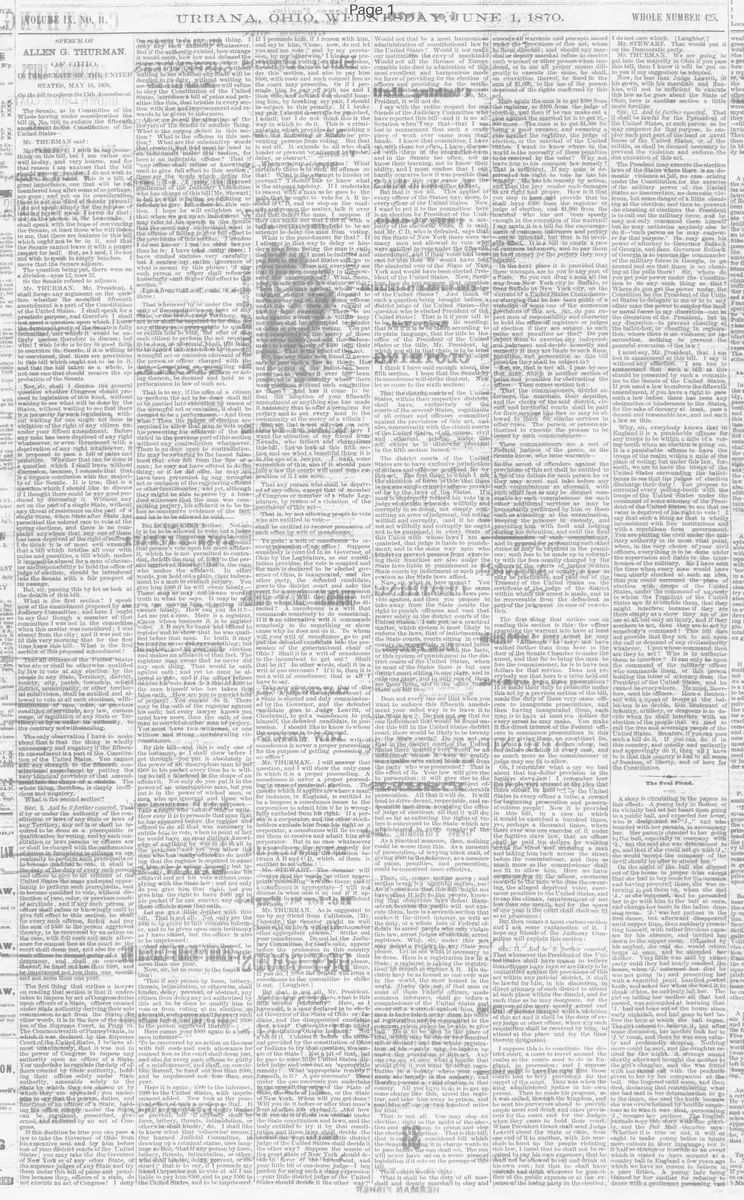
On May 16, 1870, Senator Allen G. Thurman of Ohio delivered a speech in the U.S. Senate criticizing the bill (S. No. 1310) to enforce the 15th Amendment, arguing it imposes unnecessary penalties on state officers, encourages perjury, undermines state authority, and allows military interference in elections without evidence of need.
Clipping
OCR Quality
Full Text
SPEECH OF
ALLEN G. THURMAN.
OF OHIO,
IN THE SENATE OF THE UNITED
STATES, MAY 16, 1870
On the bill to enforce the 15th Amendment.
The Senate, as in Committee of the
Whole having under consideration the
bill (S. No. 1310) to enforce the fifteenth
amendment to the Constitution of the
United States—
Mr. THURMAN said:
Mr. President: I wish to say something
on this bill, but I am rather unwell
to-day, and very hoarse, and for
that reason I am anxious that the bill
should go over; besides, I do not wish to
speak to empty seats. This is a bill of
great importance, one that will be remembered
long after some of us perhaps,
are gone; and yet on its consideration
there is not one third of Senate present.
I do not speak simply for the purpose of
hearing myself speak I never do that:
nor, as the phrase is, for buncombe. I
shall speak with the hope of convincing
the Senate, or at least those who will listen
to me, that there are features in this bill
which ought not to be in it, and that
the Senate cannot leave it with a proper
respect for itself. But, as I said, I do not
wish to speak to empty benches. I
move that the Senate adjourn.
The question being put, there were on
a division—ayes 12, noes 32.
So the Senate refused to adjourn.
Mr. THURMAN. Mr. President, I
shall forego any argument on the question
whether the so-called fifteenth
amendment is a part of the Constitution
of the United States. I shall speak for a
practical purpose, and therefore I shall
not moot a question upon which I know
the dominant party of the Senate is fully
committed, and which it would be entirely
useless therefore to discuss; but
what I wish to do is to try in good faith
to convince the Senate, if it is willing to
be convinced, that there are provisions
in this bill which ought not to be in it,
and that the bill taken as a whole, is
not one that should receive the approbation
of the Senate.
Nor, sir, shall I discuss the general
question whether Congress should proceed
to legislation of this kind, without
waiting to see what will be done by the
States, without waiting to see that there
is a necessity for such legislation, without
waiting for one single act done in
violation of the right of any citizen under
your fifteenth amendment. Before
any man has been deprived of any right
whatsoever, or even threatened with a
deprivation of any right whatsoever, it
is proposed to pass a bill of pains and
penalties. Whether that can be done is
a question which I shall leave without
discussion, because, I concede that that
is a forgone conclusion with the majority
of the Senate. It is true, that is a
question which I should like to discuss
if I thought there could be any good produced
by discussing it. Without any
act on the part of a single State, without
any threat of resistance on the part of a
single State, when State after State has
permitted the colored race to vote at the
spring elections, and there is no complaint
anywhere that any one of them
has been deprived of the right of suffrage
I do think it is of most evil example
that a bill which bristles all over with
pains and penalties, a bill which makes
it impossible almost for a man of character
and responsibility to hold the office of
judge of election, should be introduced
into the Senate with a fair prospect of
its passage.
But, sir, passing this by let us look at
the details of this bill.
What is the first section? I speak
now of the amendment proposed by the
Judiciary Committee: and here I ought
to say that though a member of that
committee I was not in the committee
when this matter was considered; I was
absent from the city: and it was not until
this very morning that for the first
time I saw this bill. What is the first
section of this proposed amendment?
That all citizens of the United States
who are or shall be otherwise qualified
by law to vote at any election by the
people in any State, Territory, district,
county, city, parish, township, school
district, municipality, or other territorial
subdivision, shall be entitled and allowed
to vote at all such elections, without
distinction of race, color, or previous
condition of servitude, any law, custom
usage, or regulation of any State or Territory,
or by or under its authority, to
the contrary notwithstanding.
The only observation I have to make
about that is that the thing is wholly
unnecessary and nugatory if the fifteenth
amendment is a part of the Constitution
of the United States. You cannot
add any strength to the fifteenth constitutional
amendment by putting the
very identical provision of that amendment
into the shape of a statute. The
whole thing, therefore, is simply innocuous
and nugatory.
What is the second section?
Sec. 2. And be it further enacted, That
if by or under the authority of the constitution
or laws of any State or laws of
any Territory, any act is or shall be required
to be done as a prerequisite or
qualification for voting, and by such constitution
or laws persons or officers are
or shall be charged with the performance
of duties in furnishing to citizens an opportunity
to perform such prerequisite or
to become qualified to vote, it shall be
the duty of every such person
and officer to give to all citizens of the
United States the same and equal opportunity
to perform such prerequisite, and
to become qualified to vote, without distinction
of race, color, or previous condition
of servitude, and if any such person or
officer shall refuse or knowingly omit to
give full effect to this section, he shall
for every such offense, forfeit and pay
the sum of $500 to the person aggrieved
thereby, to be recovered by an action on
the case, with full costs and such allowance
for counsel fees as the court shall deem just, and also for every
such offense be deemed guilty of a misdemeanor,
and shall on conviction
thereof, be fined not less than $500, and
be imprisoned not less than one month
and not more than one year.
The first thing that strikes a lawyer
on reading that section is that it undertakes
to impose by act of Congress duties
upon officers of a State, officers created
under State authority deriving their sole
commission to act from the State. In
other words, it is in the face of the decision
of the Supreme Court, in Prigg vs.
The Commonwealth of Pennsylvania, in
which it was declared by the Supreme
Court of the United States, I believe almost
unanimously, that it was not in
the power of Congress to impose any
authority upon an officer of a State
You undertake to regulate the duty of officers
created by State authority, holding
their offices solely under State
authority, amenable solely to the
State by which they are chosen or by
which they are appointed; you undertake
to say that the powers, duties, and
functions of an officer of a State, holding
his office simply under the State,
can be regulated, prescribed, governed,
and enforced by an act of Congress.
If this doctrine be true you can pass a
law to take the Governor of Ohio from
his executive seat and try him before
one of your district courts of the United
States: you may take the Governor
of New York or of any other State, or
the supreme judges of any State and try
them under this bill of pains and penalties
because they, officers of a state, do
not execute an act of Congress! I deny
the authority to do any such thing. I
deny any such authority whatsoever.
But if the authority existed, how strange
it would seem, how low and debased the
States would have become when
Congress of the United States, without
waiting to see whether any State will be
derelict in its duty, without waiting to
see whether any State officers will refuse
to obey the Constitution of the United
States, introduce a bill of pains and penalties
like this, that bristles in every section
with fine and imprisonment and rewards
to be given to informers.
Allow me to call the attention of the
lawyers of the Senate to another thing.
What is the corpus delicti in this section?
What is the offense in this section? What
are the substantive words
that create it, and that must be used in
an indictment under this section, for
here is an indictable offense? That if
"any officer shall refuse or knowingly
omit to give full effect to this section;"
these are the words which define the
crime. Now, I pray the learned
gentleman of the Judiciary Committee
who has charge of this bill [Mr. Stewart]
to tell us what is failing or omitting or
refusing to give full effect to this section.
I hope he will enlighten us, so
that when we get up an indictment we
may refer to his speech in the Senate
that the court may understand what is
the offense of failing to give full effect to
the provisions of this section. I confess
I do not know. I am an older lawyer
than he is: I have tried many cases: I
have studied statutes very carefully:
but I confess my entire ignorance of
what is meant by this phrase 'if any
such person or officer shall refuse or
knowingly omit to give full effect to this
section.'"
I pass from that and come to section
three:
That whenever by or under the authority
of the constitution or laws of any
State, or the laws of any Territory, any
act is or shall be required to be done as
any citizen as a prerequisite to qualify
or entitle him to vote, the offer of any
such citizen to perform the act required
to be done, as aforesaid, shall, if it failed
to be carried into execution by reason of
wrongful act or omission aforesaid of the
person or officer charged with the
duty of receiving or permitting such
performances, or offer to perform or acting
thereon, be deemed and held as a
performance in law of such act.
That is to say, if the offer of a citizen
to perform the act to be done shall fail
to be carried into execution by reason of
the wrongful act or omission, it shall be
deemed to be a performance. And then
what? Then the judges of election are
required to allow that man to vote upon
his presenting his affidavit of the fact
stated in the previous part of this section
without any contradiction whatsoever.
There is no door open to contradiction.
He may be swearing to the basest falsehood
that ever fell from the lips of a
man; he may not have offered to do the
thing; or if he did offer, he may not
have been prevented by any wrongful
act or omission of the registering officers
or other functionaries; and yet, although
they might be able to prove by a hundred
witnesses that the man was committing
perjury, his affidavit is to be taken
as conclusive evidence of the fact.
and he is to be allowed to vote.
But let us go a little further. Not only
is he to be allowed to vote; but a judge
of election or the person who is to count
the vote, if he do not receive and count
that person's vote upon his mere affidavit,
which he is not permitted to contradict,
forfeits the sum of $500 to the person
aggrieved thereby; that is, the man
who makes the affidavit. In other
words, you hold out a plain, clear inducement
to a man to commit perjury. You
give him $500 if he will swear falsely.
There may or may not be one word of
truth in what he says. It may be said
you can convict him of perjury if he
swears falsely. How can you do it?
Let me put a case. Here is a registrar,
a man whose business it is to register
votes. A B says he came and offered to
register and to show that he was qualified
before that man. In truth it may
be that he never did any such thing: but
he says so, and he goes to the election
and makes an affidavit of that fact. The
registrar may swear that he never did
any such thing. That would be oath
against oath; and yet he must be allowed
to vote, and if the officer refuses
receive his vote here is a fine of $500 to
the man himself who has taken this
false oath. How are you to convict him
of perjury? You cannot do it. There
may be the oath of the registrar against
his oath; but every lawyer knows you
must have more than the oath of one
man to convict another man of perjury.
You must have two witnesses, or one
witness and strong corroborating circumstances.
By this bill—and this is only one of
the instances, as I shall show before I
get through—you put it absolutely in
the power of an unscrupulous man to put
$500 in his pocket every time he is willing
to tell a falsehood in the shape of an
affidavit. Not only do you put it in the
power of an unscrupulous man, but you
men who are ignorant and those who
use ignorant men for their purposes.
Take a negro who cannot read or write.
How easy it is to persuade that man that
he has appeared before the register and
offered to do all that was necessary to
entitle him to vote, when in point of fact
he would have no clear distinct knowledge
of anything he was to do at all in
the premises; and yet you allow the
man who has really offered to do nothing
that the register is required to exact
of him, who is acting honestly but ignorantly,
the right to go and make his
affidavit and get his vote without complying
with the State law ; and not only
do you give him that right, but you
give him the right to have $500 put in
his pocket if he can convict any one of
these officials upon that oath.
Let me go a little further with this
bill. That is not all. Not only are the
$500 to be given to this common informer,
and to be given upon such testimony
as I have stated, but the officer is also
to be imprisoned;
And shall, on conviction thereof, be
fined not less than $500 and be imprisoned
not less than one month
and not more than one year.
Now, sir, let us come to the fourth
section:
That if any person by force, bribery
threats, intimidation, or otherwise, shall
hinder, delay, prevent, or obstruct, any
citizen from doing any act authorized by
this act to be done to qualify him to
vote or from voting at an election as
aforesaid, such person shall for every such
offense forfeit and pay the sum of $500
to the person aggrieved thereby—
Here comes your $500 again to a common
informer—
To be recovered by an action on the case
with full costs and such allowance for
counsel fees as the court shall deem just,
and also for every such offense be guilty
of a misdemeanor, and shall, on conviction
thereof, be fined not less than $500,
and be imprisoned not less than one
year.
Here it is again : $500 to the informer,
$500 to the United States, with imprisonment
added. Now look at the practical
effect of such a section as that. It
says if any man shall, not simply hinder
or prevent, but 'if anybody shall by
force, bribery, threats, intimidation, or
otherwise shall hinder,' &c. I shall like
to know what that 'otherwise' means?
Our learned Judicial Committee, in
drawing up a criminal statute, uses language
as this, 'that if any person by force,
bribery, threats, intimidation, or otherwise
shall hinder, delay, prevent, or obstruct;'
that is to say, if I persuade my
friend Carpenter not to vote at all I am
liable to pay him $500, and to pay $500 to
the United States, and to be imprisoned.
If I persuade him, if I reason with him.
and say to him, 'Come, now, do not let
you and me vote;' and by my persuasion,
by my 'otherwise,' I hinder or prevent
him from voting on that occasion,
forsooth, I am liable to be indicted under
this section, and also to pay him
$500, with costs and such counsel fees as
the court may prescribe. Or if I persuade
him to pair off with me and I
then vote, and in that way should humbug
him, by breaking my pair, I should
be subject to this penalty. If I broke
my pair I should deserve to be punished,
I admit; but I do not think this is the
way in which to do it. This is a criminal
statute which provides for punishing a
man for hindering or 'otherwise' preventing
persons from voting. But that
is not all. It extends to all who shall
hinder or prevent 'or attempt to hinder,
delay, or obstruct.'
What certainty of description: What
certainty there is in such an offense as
that! What is the attempt to hinder or
prevent? I should like to know what
is the attempt to delay. If I undertake
to reason with a man as he goes to the
polls, that he ought to vote for A B instead
of C D, and we stop on the roadside
and reason the matter, talk it over
and that delays the man, I suppose if
they can make out that I did it with a
bad motive that would be held to be an
attempt to delay the man from voting.
What is the punishment for that? If
I attempt in that way to delay or hinder
a man from voting the man is entitled
to $500 for it, I must be indicted and
pay $500 to the United States and go to
prison besides. Does not everybody see
that it puts men completely in the power
of the unscrupulous? What, man,
pray, is safe with such a statute as this?
There is no man against whom some
bad man cannot swear. I disposed to
make money out of him,
some offense
under this bill
Here is
a reward of
$500 for false swearing.
There is no
man against whom such a villain may
not swear that he attempted to hinder
or delay or prevent his voting. You put
men completely at
the mercy of those
who swear falsely, and add the inducement
to swear falsely of $500 into their
pockets. That is the effect of this act.
Sir, has any State ever found it necessary
to pass such a law as this? Has
not the purity of the ballot-box been
preserved as well as it ever has been
preserved in any country where there
were elections without such enormities
as these? And has it come to be
that the adoption of your fifteenth
amendment or anything else has made
it necessary thus to offer a premium for
perjury and to put every man in the
community at the mercy of a villain ?
But, sir, that is not all; let us now
come to the fifth section; and here I
want the attention of my friend from
Nevada, who fathers and champions
this bill. Let us look at this fifth section
and see what a beautiful thing it is
in the eye of a lawyer. I want some
exposition of this, and if it should pass
into a law the courts will need some exposition
of it I am sure:
That any person who shall be deprived
of any office, except that of member
of Congress or member of a State Legislature,
by reason of a violation of the
provisions of this act—
That is, by not allowing people to vote
who are entitled to vote—
shall be entitled to recover possession of
such office by writ of mandamus.
Ye gods! a writ of mandamus to recover
possession of an office! Suppose
somebody is counted in as Governor of
Ohio by the Legislature, as our constitution
provides; the vote is counted and
the man is declared to be elected governor
of Ohio, is inaugurated, and the
other party, the defeated candidate,
goes to the district court and asks the
court for a mandamus to get possession
of the office. Will the gentlemen tell
me to whom that mandamus will be directed?
A mandamus is a writ that
commands somebody to do something.
If it is an alternative writ it commands
somebody to do something or show
cause why he does not do it. To whom
will your writ of mandamus go to put
the defeated candidate into the possession
of the gubernatorial chair of
Ohio? Shall it be a writ of mandamus
to the incumbent to get out? Shall
that be it? In other words, shall it be a
writ of quo warranto? If it is, then it is
not a writ of mandamus; that is all I
have to say.
Take any other case, say that of the
judge. A judge of the supreme court of
a State is elected and duly commissioned
by the Governor, and the defeated
candidate goes to Judge Leavitt, of
Cincinnati, to get a mandamus to put
himself, the defeated candidate, in possession.
I should like to know to whom
the mandamus is to be directed.
Mr. STEWART. I ask if the writ of
mandamus is never a proper proceeding
for the purpose of getting possession of
an office?
Mr. THURMAN. I will answer that
question, and I will show the only case
in which it is a proper proceeding. A
mandamus is never a proper proceeding
in cases of contested election. The
cases to which it applies are where a man,
for instance, in England, is entitled to
be a burgess; a mandamus issues to the
corporation to admit him if he is wrongfully
excluded from his right. If a person
is a corporator, and the other stockholders
exclude him from his right as a
corporator, a mandamus will lie to compel
them to receive and admit him as a
corporator. But in no case whatsoever
is a mandamus the proper remedy for
the purpose of trying the question between
A B and C D, which of them is
entitled to an office.
Mr. STEWART. The Senator will
observe that the words "or other appropriate
proceeding" are also there; and if
a mandamus is appropriate—I will not
discuss in what case it is but if it appropriate
in any case, that is sufficient
provision.
Mr. THURMAN. As is suggested to
me by my friend from California, [Mr.
Casserly,] the Senator might as well
have said in his 'a writ of attachment or
other appropriate process.' Strike out
your mandamus. Do not let the Judiciary
Committee, for God's sake, appear
before the profession in this country
with such a provision as that in their
bill Put quo warranto in if you please,
but do not let 'mandamus' stick there.
If you do, I hope the Senate will issue a
mandamus to the committee to strike
it out. [Laughter.]
But that is not all, Mr. President.
Mandamus or quo warranto, what is this
fifth section practically? Here, as I
have said, is a man declared to be elected
Governor of the State of Ohio or Indiana,
and the disappointed candidate
does what? Contest the election under
the constitution Ohio or Indiana? Not
a bit of it. Contest it before the tribunal
provided by the constitution of Ohio
or Indiana to try that question, the senate
of the State? Not a bit of that, but
he goes to some little United States district
judge and sues out an 'appropriate
remedy!' What 'appropriate remedy!
forsooth, is it? A quo warranto? Then
under the quo warranto you undertake
to canvass all the votes of the State of
Ohio, the State of Indiana, or the State
of New York. When will you get done?
Will you do it before or after that man's
term of office has expired? And how
will you do it if there is a contest under
the State constitution and laws, and the
body entitled to try it by that constitution
and those laws shall decide the
contest one way, and your little district
Judge of the United States shall decide it
the other way? Suppose the senate of
the great State of New York should decide
in favor of the incumbent, and
your little bit of one-horse judge—I beg
pardon for using such a slang expression
—your little district Judge of the United
States should decide it the other way?
Would not that be a most harmonious
administration of constitutional law in
the United States? Would it not make
our institutions the envy of mankind?
Would not all the thrones of Europe
crumble into dust in admiration of this
most excellent and harmonious mode
we have of providing for the election of
Den
nte
ccess:
Mami..
lates
Mr.
The district courts of the United
States are to have exclusive jurisdiction
of crimes and offenses provided for by
this act. The first thing to which I ask
the attention of them is this: that there
is not one single crime or offense provided
for by the laws of the States. If a
man is improperly refused his vote by a
judge of election who acts willfully and
corruptly in so doing, not simply committing
an error of judgment, but acting
willfully and corruptly, (and if he does
not act willfully and corruptly he ought
not to be punished, in every State of
this Union with whose laws I am acquainted,
that judge is liable to punishment;
and in the same way men who
hinder or prevent persons from exercising
their franchise are also under the
State laws liable to punishment in the
State courts by indictment or such prosecution
as the State laws afford.
Now, sir, what is here meant?
You
have provided for precisely the same
Class of offenses that the State laws provide
against, and then you propose to
take away from the State courts the
right to punish offenses and vest that
power solely in the district courts of the
United States. I ask you, as a practical
matter, which system is most likely to
enforce the laws, that of indictments in
the State courts, courts sitting in every
county in every State, with grand juries
in every county familiar with the facts,
or this system of punishment in the district
courts of the United States, when
in most of the States there is but one
district court sitting in one place, and in
only one place, and in only one of them
are there three, and in the other States
there are but two.
Does not every one see that when you
want to enforce this fifteenth amendment
your safest way is to leave it to
the State law ? Do you not see that for
one indictment that would be found under
this bill in the United States district
court, there would be likely to be twenty
in the State courts? Do you not see
that in the district court of the United
States there scarcely ever would be an
indictment unless it were to gratify
some malice or to extort blackmail from
the party who was prosecuted? That is
the effect of it Your law will give rise
to persecution; it will give rise to the
levy-od
vill subject of-
ficer of election
to the most intolerable
persecution. All that it will do. It will
tend to drive decent, respectable, and responsible
men from accepting the office
of judge of elections, all that it will do;
but so far as enforcing the rights of voters
is concerned to the State which are
administered in every
county of the
State.
As a practical measure, then, nothing
could be worse than this. As a measure
of persecution, of levying black mail, of
giving $500 to the Informer, as a measure
of pains, penalties, and persecution,
could be conceived more effective.
Then, sir, comes section seven ; and
section seven is a beautiful section, too!
As it conscious that this bill might not
have effect if left to the people, knowing
that obnoxious laws defeat them-
selves, because the people will not execute
them, here is a seventh section that
makes it the direct interest, as well as
the duty, of a whole host of Federal officials
to arrest people who may violate
this law, arrest judges of election, arrest
registrars. Why, sir, under this you
may defeat a registry in any State you
please. Let us see what is necessary to
be done. Here is a registration law in a
State; a registrar is taking the registration:
he refuses to register A B. His decision
may be as honest as one ever was
in the world, the most honest in the
world. Under this act, if that man or
some of these Federal officers, made
common informers, shall go before a
commissioner of the United States and
swear out a warrant against him, that
man is to be taken away from his office
of registration and be committed to the
common prison unless he be able to give
bail. He is to be "sent to the place of
trial, which may be one or two hundred
miles distant; and the whole registration
of his county may be broken up
under the provisions of this act. Any
one can see at once what a handle that
would give if you want to defeat registration
in a county where your opponents
are largely in the majority, and
thereby prevent a valid election in that
county. All you have to do is to get up
some charge like this, arrest the registrar,
and take him away to prison, and
send him off one or two hundred miles
for trial.
That is not all. You may stop an
election; right in the midst of the election
and send them to prison and stop
the election altogether. That is this bill;
that is carefully considered bill which
the Senators having it in charge wants us
te pass before the sun shall set. The sun
will never have set on a worse piece of
legislation if it sets on the passage of this
bil
execute all warrants and precepts issued
under the provisions of this act, when
to them directed: and should any marshal
or deputy marshal refuse to receive
such warrant or other process when tendered,
or to use all proper means diligently
to execute the same, he shall,
on conviction thereof, be fined in the
sum of $1,000, to the use of the person
depived of the rights conferred by this
act.
Here again the man is to get $500 from
the registrar, or $500 from the judge of
election, and then if he can make out a
case against the marshal he is to get $1,-
000 more. The man is to get $1,500 for
being a good swearer, and swearing a
case against the registrar, the judge of
election, or the marshal of the United
States. I want to know where in the
world is the necessity of these penalties
to be received by the voter? Why not
leave him to his common law remedy?
That is sufficient. If any man is deprived
of his right to vote he has his
remedy. He has his remedy by action
and then the jury render such damages
as are right and proper. How is it that
you step in here and provide that he
shall have $500 from the registrar or
judge of election, and $1,000 from the
marshal who has not been speedy
enough in the execution of the warrant?
I say again it is a bill for the encouragement
of common informers and perjury
—not so intended, but that is its invariable
effect. It is a bill to create a race
of common informers, and to pay them
in hard money for the perjury they may
commit.
In the next place it is provided that
these warrants are to run to any part of
a State. So you can drag a man all the
way from New York city to Buffalo, or
from Buffalo to New York city, on the
warrant of a United States Commissioner
charging that he has been guilty of a
violation of some one of the numerous
provisions of this act. Sir, do you expect
men of responsibility and character
to hold the offices of registrars or judges
of election if they are subject to such
pains and penalties as that? Do you
expect them to exercise any independent
judgment and decide honestly and
correctly if they are liable to such fines,
penalties, and persecution as this bill
provides they shall be subject to?
—But, sir, that is not all. I pass by section
nine, which is another section of
pains and penalties for obstructing the
officer. Then comes section ten :
That the commissioners, district attorneys,
the marshals, their deputies,
and the clerks of the said district, circuit,
and territorial courts shall be paid
for their services like fees as may be allowed
to them for similar services in
other cases. The person or persons authorized
to execute the process to be
issued by such commissioners—
These commissioners are a sort of
Federal justices of the peace, as the
Senate know, who issue warrants—
for the arrest of offenders against the
provisions of this act shall be entitled to
a fee of ten dollars for each person he or
they may arrest and take before any
such commissioner as aforesaid, with
such other fees as may be deemed reasonable
by such commissioner for such
other additional services as may be
necessarily performed by him or them
such as attending at the examination,
keeping the prisoner in custody, and
providing him with food and lodging
during his detention, and until the final
determination of such commissioner
and in general for performing such other
duties as may be required in the premises;
such fees to be made up in conformity
with the fees usually charged by the
officers of the courts of justice within
the proper district or county, as near as
may be practicable, and paid out of the
Treasury of the United States on the
certificate of the judge of the district
within which the arrest is made, and to
be recoverable from the defendant as
part of the judgment in case of conviction.
The first thing that strikes one on
reading this section is this: the officer
executing the warrant is to have at least
ten dollars for every arrest he may
Although he may not have
walked further than from here to the
door of the Senate Chamber to make the
arrest, and that far to bring the man before
the commissioner, he is to have ten
dollars for that service. Does not everybody
see that here is a bribe held out
to officers to begin these prosecutions?
It is made their duty to prosecute under
this act by a previous section of the bill,
made the duty of these very same officers
to inaugurate prosecutions, and
then having inaugurated them, each
man is to have at least ten dollars for
every arrest he may make. You make
it the direct interest of the Federal officers
to commence prosecutions in this
way by giving them an exorbitant fee.
It is not a fee of ten dollars alone, but
ten dollars certainly in every case, and
as much more as the commissioner or
judge may see fit to allow.
Oh, I remember what a cry we had
about that ten-dollar provision in the
fugitive slave law! I remember how
the people were aroused at the idea that
there should be held out by the United
States to every officer a bribe, a reward
for beginning prosecution and persecution
of colored people! Now it is provided
in this bill, in a case in which
it would be exercised a hundred times,
yes, perhaps a thousand times, where
there ever was one exercise of it under
the fugitive slave law, that an officer
shall be paid ten dollars for walking
across the street and arresting a man
and taking him back across the street
before the commissioner, and then as
much more as the commissioner shall
see fit to allow him. Here we have
enormous fees to the officer, enormous
rewards to the man who does the swearing,
the alleged deprived voter, enormous
penalties to the United States, and
to cap the climax, imprisonment of not
less than one month, and for the space
of one year if the court shall see fit
so to pronounce !
But then comes a most curious section
and I ask some explanation of it. I
hope my friends of the Judiciary Committee
will explain this section:
Sec. 11. And be it further enacted,
That whenever the President of the United
States shall have reason to believe
that offenses have been or are likely to be
committed against the provisions of this
act within any judicial district, it shall
be lawful for him, in his discretion, to
direct the attorney of such district to attend
at such place within the district, and for
such time as he may designate, for the
purpose of the more speedy arrest and
trial of persons charged with a violation
of this act and it shall be the duty of every
Judge or other officer, when any such
requisition shall be received by him, to
attend at the place and for the time
therein designated
I suppose this is to constitute the district
court, a court to travel around the
realm as the courts used to do in England,
in procession: and I suppose
they ought to have the right that those
courts had to levy provisions for the
support of the court. That was when the
king administered justice in his own
person. Then he made his progress, as
it was called, through the kingdom, and
he sent his purveyors ahead to provide
ample meat and drink and other provisions
for the court and for the Judges
when they came to hold their court.
When President Grant shall send Judge
Leavitt about the State of Ohio, from
one end of it to another, with his marshals
to hunt up the people violating
this law, I insist that he shall not be required
to pay his own expenses; that he
shall not be allowed to eat and drink at
his own cost; but that he shall have
victuals and drink wherever he goes either
at the public expense or at the expense
of the people. I do not care which. [Laughter.]
Mr. STEWART. That would put it
on the Democratic party.
Mr. THURMAN. We are going to
get into the majority in Ohio if you pass
this bill, then I know it will be put on
to you if my suggestion be adopted.
Now, for fear that Judge Leavitt, in
his gown, with his marshals and flunkies,
will not be sufficient to execute
this law as he goes about the State of
Ohio, here is another section a little
more forcible:
Sec. 12. And be it further enacted, That
it shall be lawful for the President of
the United States, or such person as he
may empower for that purpose, to employ
such part of the land or naval
forces of the United States, or of the
militia, as shall be necessary to
prevent the violation and enforce the
due execution of this act.
The President may execute the election
laws of the States where there is no domestic
violence at all, no case arising
under the Constitution for the exercise
of the military power of the United
States no insurrection, no domestic violence,
but some danger of a little cheating
at the election; and then to prevent
the cheating at elections the President
is to call out the military force; and he
may not only command them himself
but he may authorize anybody else to
do it 'such person as he may empower
for that purpose.' He may give his
power of attorney to Governor Bullock
of Georgia, and then Governor Bullock
of Georgia is to become the commander
of the military forces in Georgia, to go
around and see that there is no cheating
at the polls there! Sir, where do
you get your power under the Constitution
to do any such thing as that?
Where do you get the power under the
Constitution for the President of the United
States to delegate to me or to any
other man the power to employ the land
or naval forces in my discretion—not in
the discretion of the President, but in
my discretion—to prevent cheating at
the ballot-box, or cheating in registration,
where there is no violence, no insurrection,
nothing to prevent the
peaceful execution of the law?
I must say, Mr. President, that I am
lost in amazement at this bill. I say it
without any affectation. I am lost in
amazement that such a bill as this
should be presented by such a committee
to the Senate of the United States.
If you need a law to enforce the fifteenth
amendment, if you have a right to pass
such a law before there has been any
obstruction or hindrance in the States,
for the sake of decency at least, pass a
decent and reasonable law, and not such
a law as this.
Why, sir, everybody knows that in
England it is a punishable offense for
any troops to be within a mile of a voting-booth
when an election is going on.
It is a punishable offense to have the
troops of the realm within a mile of the
place of voting; but under this law, for-
sooth, we are to have the troops of the
United States surrounding the ballot-
boxes to see that the judges of election
discharge their duty! You propose to
surround every polling-booth with the
troops of the United States under the
command of some attorney of the President
of the United States, to see that no
voter is deprived of his right to vote! I
say that such a thing as that is wholly
inconsistent with free institutions and
with a republican form government.
You are putting the civil under the military
authority in its most vital point,
when, in the very choice of your civil
oflcers, everything is to be done under
the supervision and liable to the interference
of the military. Sir I have seen
the time when every man would have
been utterly shocked at such an idea,
that you could surround the place of
election with troops of the United
States, under the command of anybody
to whom the President of the United
States saw fit to confide them, that they
might interfere; because if they are
there simply as a show they are of no
use at all but only an injury, and if they
are there to act, then they are to act by
somebody's command! This bill does
not provide that they are to act upon
the call or demand of any civil authority
whatever. Upon whose command, then
are they to act? Who is to authorize
them to interfere? It can only be upon
the command of the military officer
who commands them, or this person
holding the letter of attorney from the
President of the United States, and he
cannot be everywhere. He must, therefore,
send his officers. Here a lieutenant
with a squad of troops at the ballot-box
is to decide, this lieutenant of
infantry, artillery, or dragoons is to decide
when he shall interfere with an
eleetlon of the people that we used to
call the free and sovereign people of the
United States. Senators, if you can pass
such a bill do it. If you can do it in
this country, and quietly and patiently
and approvingly do it, then all I have
to say is that this country is lost to all sense
of freedom, of liberty, and of love for
the Constitution.
What sub-type of article is it?
What keywords are associated?
What entities or persons were involved?
Where did it happen?
Domestic News Details
Primary Location
United States Senate
Event Date
May 16, 1870
Key Persons
Event Details
Senator Allen G. Thurman criticizes the bill to enforce the 15th Amendment, arguing it unnecessarily imposes federal duties on state officers, encourages perjury through rewards for affidavits, allows military intervention in elections, undermines state courts, and provides excessive penalties and fees that promote informers and persecution.