Thank you for visiting SNEWPapers!
Sign up free
Story
December 9, 1881
Lancaster Daily Intelligencer
Lancaster, Lancaster County, Pennsylvania
What is this article about?
An opinion essay in the Lancaster Intelligencer questions whether the execution of Charles Guiteau, assassin of President Garfield, stems from justice or revenge, citing Wendell Phillips' views on capital punishment and societal responsibility for criminal conditions.
Clipping
OCR Quality
95%
Excellent
Full Text
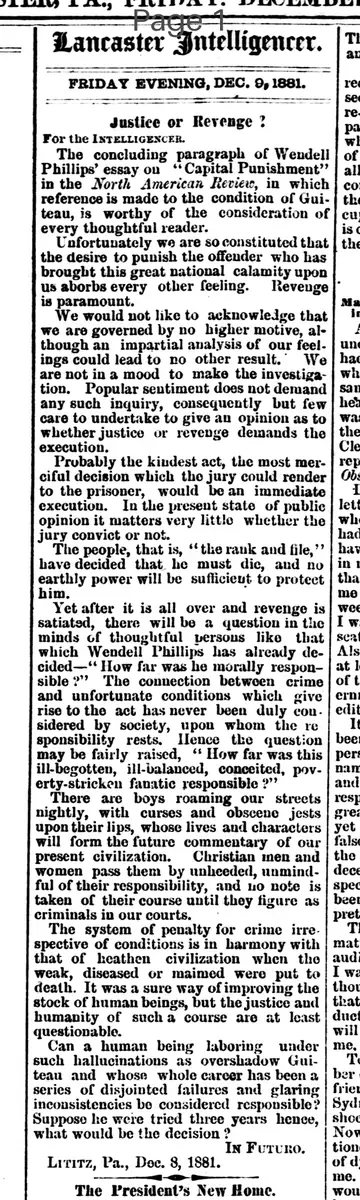
Lancaster Intelligencer.
FRIDAY EVENING, DEC. 9, 1881.
Justice or Revenge?
For the Intelligencer
The concluding paragraph of Wendell
Phillips' essay on "Capital Punishment"
in the North American Review, in which
reference is made to the condition of Gui-
teau, is worthy of the consideration of
every thoughtful reader.
Unfortunately we are so constituted that
the desire to punish the offender who has
brought this great national calamity upon
us absorbs every other feeling.
Revenge
is paramount.
We would not like to acknowledge that
we are governed by no higher motive, al-
though an impartial analysis of our feel-
ings could lead to no other result. We
are not in a mood to make the investiga-
tion. Popular sentiment does not demand
any such inquiry, consequently but few
care to undertake to give an opinion as to
whether justice or revenge demands the
execution.
Probably the kindest act, the most mer-
ciful decision which the jury could render
to the prisoner, would be an immediate
execution. In the present state of public
opinion it matters very little whether the
jury convict or not.
The people, that is, "the rank and file,"
have decided that he must die, and no
earthly power will be sufficient to protect
him.
Yet after it is all over and revenge is
satiated, there will be a question in the
minds of thoughtful persons like that
which Wendell Phillips has already de-
cided—"How far was he morally respon-
sible?" The connection between crime
and unfortunate conditions which give
rise to the act has never been duly con-
sidered by society, upon whom the re-
sponsibility rests. Hence the question
may be fairly raised, "How far was this
ill-begotten, ill-balanced, conceited,
poverty-stricken fanatic responsible?"
There are boys roaming our streets
nightly, with curses and obscene jests
upon their lips, whose lives and characters
will form the future commentary of our
present civilization. Christian men and
women pass them by unheeded, unmind-
ful of their responsibility, and no note is
taken of their course until they figure as
criminals in our courts.
The system of penalty for crime irre-
spective of conditions is in harmony with
that of heathen civilization when the
weak, diseased or maimed were put to
death. It was a sure way of improving the
stock of human beings, but the justice and
humanity of such a course are at least
questionable.
Can a human being laboring under
such hallucinations as overshadow Gui-
teau and whose whole career has been a
series of disjointed failures and glaring
inconsistencies be considered responsible?
Suppose he were tried three years hence,
what would be the decision?
In Lititz.
Lititz, Pa., Dec. 8, 1881.
FRIDAY EVENING, DEC. 9, 1881.
Justice or Revenge?
For the Intelligencer
The concluding paragraph of Wendell
Phillips' essay on "Capital Punishment"
in the North American Review, in which
reference is made to the condition of Gui-
teau, is worthy of the consideration of
every thoughtful reader.
Unfortunately we are so constituted that
the desire to punish the offender who has
brought this great national calamity upon
us absorbs every other feeling.
Revenge
is paramount.
We would not like to acknowledge that
we are governed by no higher motive, al-
though an impartial analysis of our feel-
ings could lead to no other result. We
are not in a mood to make the investiga-
tion. Popular sentiment does not demand
any such inquiry, consequently but few
care to undertake to give an opinion as to
whether justice or revenge demands the
execution.
Probably the kindest act, the most mer-
ciful decision which the jury could render
to the prisoner, would be an immediate
execution. In the present state of public
opinion it matters very little whether the
jury convict or not.
The people, that is, "the rank and file,"
have decided that he must die, and no
earthly power will be sufficient to protect
him.
Yet after it is all over and revenge is
satiated, there will be a question in the
minds of thoughtful persons like that
which Wendell Phillips has already de-
cided—"How far was he morally respon-
sible?" The connection between crime
and unfortunate conditions which give
rise to the act has never been duly con-
sidered by society, upon whom the re-
sponsibility rests. Hence the question
may be fairly raised, "How far was this
ill-begotten, ill-balanced, conceited,
poverty-stricken fanatic responsible?"
There are boys roaming our streets
nightly, with curses and obscene jests
upon their lips, whose lives and characters
will form the future commentary of our
present civilization. Christian men and
women pass them by unheeded, unmind-
ful of their responsibility, and no note is
taken of their course until they figure as
criminals in our courts.
The system of penalty for crime irre-
spective of conditions is in harmony with
that of heathen civilization when the
weak, diseased or maimed were put to
death. It was a sure way of improving the
stock of human beings, but the justice and
humanity of such a course are at least
questionable.
Can a human being laboring under
such hallucinations as overshadow Gui-
teau and whose whole career has been a
series of disjointed failures and glaring
inconsistencies be considered responsible?
Suppose he were tried three years hence,
what would be the decision?
In Lititz.
Lititz, Pa., Dec. 8, 1881.
What sub-type of article is it?
Crime Story
Historical Event
What themes does it cover?
Crime Punishment
Justice
Moral Virtue
What keywords are associated?
Guiteau Trial
Capital Punishment
Justice Vs Revenge
Moral Responsibility
Societal Conditions
What entities or persons were involved?
Wendell Phillips
Guiteau
Where did it happen?
Lititz, Pa.
Story Details
Key Persons
Wendell Phillips
Guiteau
Location
Lititz, Pa.
Event Date
Dec. 9, 1881
Story Details
The essay debates if Guiteau's execution for assassinating the president is driven by justice or revenge, questions his moral responsibility due to mental state and societal conditions, and critiques punitive systems ignoring root causes.