Thank you for visiting SNEWPapers!
Sign up free
Daily National Intelligencer
Washington, District Of Columbia
What is this article about?
On April 7, the U.S. House of Representatives handled petitions on forfeitures, manufacturing protection, and arms contracts; reported bills on compensation; and debated extensively the bill to repeal the embargo and non-importation acts, passing it 115-37 after votes on amendments.
Merged-components note: Continuation of the same congressional proceedings article split across pages; relabel second part from story to domestic_news for consistency.
Clippings
1 of 2
OCR Quality
Full Text
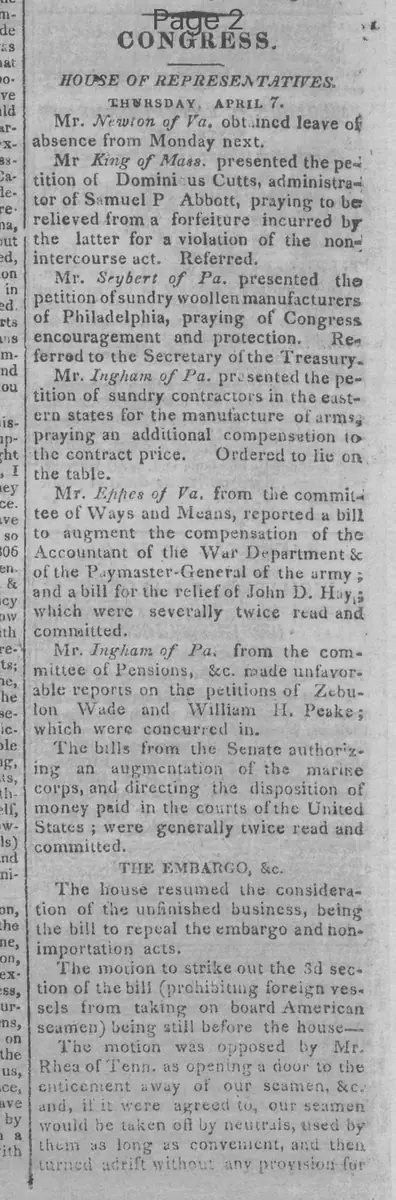
HOUSE OF REPRESENTATIVES.
THURSDAY, APRIL 7.
Mr. Newton of Va. obtained leave of absence from Monday next.
Mr. King of Mass. presented the petition of Dominicus Cutts, administrator of Samuel P. Abbott, praying to be relieved from a forfeiture incurred by the latter for a violation of the non-intercourse act. Referred.
Mr. Seybert of Pa. presented the petition of sundry woollen manufacturers of Philadelphia, praying of Congress encouragement and protection. Referred to the Secretary of the Treasury.
Mr. Ingham of Pa. presented the petition of sundry contractors in the eastern states for the manufacture of arms praying an additional compensation to the contract price. Ordered to lie on the table.
Mr. Hughes of Va. from the committee of Ways and Means, reported a bill to augment the compensation of the Accountant of the War Department & of the Paymaster-General of the army; and a bill for the relief of John D. Hays which were severally twice read and committed.
Mr. Ingham of Pa. from the committee of Pensions, &c. made unfavorable reports on the petitions of Zebulon Wade and William H. Peake; which were concurred in.
The bills from the Senate authorizing an augmentation of the marine corps, and directing the disposition of money paid in the courts of the United States; were severally twice read and committed.
THE EMBARGO, &c.
The house resumed the consideration of the unfinished business, being the bill to repeal the embargo and non-importation acts.
The motion to strike out the 3d section of the bill (prohibiting foreign vessels from taking on board American seamen) being still before the house—
The motion was opposed by Mr. Rhea of Tenn. as opening a door to the enticement away of our seamen, &c. and, if it were agreed to, our seamen would be taken off by neutrals, used by them as long as convenient, and then turned adrift without any provision for their return; that our seamen would besides be liable to impressment by the enemy: and that these evils were too great to be endured merely for the sake of conciliating neutrals.
The motion was supported by Mr. Robertson of Lou. Mr. Lowndes of S. Ca: Mr. Grosvenor of N. Y. Mr. Duvall of Ky. and Mr. Murfree of N. Ca. on various grounds, among which were the following: That it was in the nature of a sanction to the principle of impressment; that it would have an effect very different from that which was expected from it, because the appearance of restraint would tend to drive our seamen from our service: that it would in fact act oppressively on those seamen who, not being employed in our own marine, might be left destitute of employment by the retention of such a provision; that there was no occasion for this section to facilitate the manning of our public ships, because there would be no difficulty in manning them, nor ever had been of late, except for the fear in the seamen of being employed in the lake service; and, that, if there were any difficulty, the very passage of such an act, going to make a prison of our country, would increase rather than diminish it.
Mr. Grosvenor of N. Y. intimated also a doubt as to the constitutionality of this section. He took occasion to say, likewise, in relation to this bill generally, that he was so much rejoiced at the two first sections of this bill which he now found before the House, that he was not disposed to look at the circumstances which had produced them, and therefore should abstain from a discussion of them.
The question on striking out the 3d section of the bill was taken by yeas and Nays. There were
For striking out 70
Against it 78
So the House refused to strike out the said section.
Mr. M'Kim of Md. then moved to strike out the second section of the bill (which repeals the several non-importation acts)
The question having been stated—
Mr. M'Kim said the bill contained two distinct principles; the one to repeal the restrictions on exports, the other to repeal the restrictions on imports. All the arguments which he had heard in support of the bill went entirely to the first part of it, that which proposed to repeal the prohibition of exports. These arguments, he said, were intelligible to his mind. When he was told that the embargo locks up our exports, paralyzes the industry of the country; that under it our citizens cannot even move their property from one section of the community to another; that even a few loads of lime for building cannot be carried from one part of a state to another, nor can a vessel be removed which is caught by the embargo even though it is evidently exposed to destruction by the enemy; and that such a measure, operating so severely, ought not to be continued without the greatest necessity, or unless some correspondent benefit results from it—when these things were said, Mr. M'Kim could see the full force of this reasoning, and admit that such a state of things ought not to be continued; and therefore, although he could see advantages resulting from the embargo, he believed he could make up his mind to vote for the repeal of that measure. The embargo, however, was a measure which prohibited all exports: the non-importation was of a different character, prohibiting the importation of goods the growth and manufacture of the enemy only. Excepting these, our ports were now open to the admission of the produce of the whole world. What extraordinary necessity was there to repeal the prohibition of imports of British goods? Do we experience any suffering from the prohibition? We can obtain every thing we want from the ports of the other nations of the world, and he saw no necessity for calling in the products of the enemy to our aid. He felt unwilling to make the acknowledgment to the enemy that we cannot exist without her products. Seeing no reason why this restriction should be removed, and not believing any solid reason could be given, he said he would advert to some of the evils which he believed would result from it. From the restrictions on commerce imposed by the aggressions of the enemy, and by the acts of our government, many of our citizens had been obliged to seek support from new means of employing their industry to advantage. Much of the capital and industry of our citizens, usually employed in commerce, had from the operation of these circumstances been diverted to manufactures. Although in his opinion, Mr. M'Kim said, the duties now imposed on imports were abundantly sufficient in all ordinary times for the protection of manufactures, he doubted whether they were sufficient to support that interest against the shock which would be felt by letting in upon them, without restraint, a flood of British manufactures. The manufactures of G. Britain have been, metaphorically speaking, dammed up, for several years past. If they were let loose upon our infant establishments with their superior capital and strength, he feared our manufacturing institutions would be much disturbed if not overthrown. He did not believe the double duties would be sufficient to guard them, though he admitted they were sufficient and more than sufficient in ordinary times for that purpose. If there were any necessity, however, for the proposed repeal of the existing prohibitions of importation, he might vote for it; but he should be glad to know what was the necessity which called forth this provision of the bill. What was the necessity, he repeated. Are we suffering for clothing or for any articles which we have been in the habit of obtaining from Great Britain? He believed not, and therefore conceived it unwise to run the hazard which would result from this experiment. He admitted, that, if necessary to pass such a provision, the interest of the manufacturers was a consideration subordinate to the general good; though he must remark that it was proved by the returns of the marshals in 1810, which however inaccurate were the best data we could resort to, that the domestic manufactures of the United States amounted to about two hundred millions of dollars. The exports from the United States in domestic produce in the most favorable years had not exceeded sixty millions of dollars. It hence resulted that the manufacturing was more important in amount of its productive industry than the agricultural interest. At least an hundred millions of our manufactures had found a market at our own door, a market not liable to spoliations or vexations by any enemy. This statement of the value of our internal manufactures ought to induce the agricultural interest in this House and in the nation, which must derive so important a benefit from them, to reflect well on the expediency of any measure which might have a tendency to injure our growing manufactures. These considerations induced him to believe that an enlightened policy did not require the government at this time to remove the restrictions on the importation of British manufactures.
Mr. Calhoun of S. C. said he hoped the motion would not prevail. He thought the gentleman was mistaken in supposing that our infant manufacturing institutions would be embarrassed by this measure. What was the encouragement which they now received from the government? The ad valorem duties now averaged about 33 1/2 per cent. Most of the importations being in neutral bottoms, the discriminating duty of 10 per cent. on such importations in foreign vessels would make it 43 per cent. and when were added to this the freight and other expenses incident to a state of war, the actual duty on foreign and premium to domestic manufactures could not be less than fifty per cent. Was it wise to extend to our manufactures further encouragement than this? During a state of war, too great a stimulus was naturally given to manufactures--a stimulus so great that it could not be expected to be continued in a time of peace; and when peace comes, come when peace will, the vicissitude which manufacturers must experience will be much greater and injurious to them, if besides the double duties the restrictive system were retained, than it ought to or would otherwise be. The great requisite to the due encouragement of manufactures now was, that certain manufactures in cottons and woollens, which have kindly taken root in our soil, should have a moderate but permanent protection ensured to them. He knew not how that object could be better effected than by the scheme of establishing a new tariff of duties, which this House had shewn a determination to adopt. To continue the present non-importation system merely to protect manufactures, when they received already so much protection, would be dangerous instead of beneficial to them. Another circumstance than those he had adverted to now operated to encourage manufactures--the heavy expenditure for the clothing of our army. The government could and did regulate those expenditures as far as possible for the encouragement of manufactures. Having replied to the main point of the gentleman's argument, he would not follow him through the whole of his remarks. As to her manufactures, Mr. C. said, that all Europe was open to the enemy. The very circumstance of this demand for her manufactures which destroyed the efficiency of our non-importation system, by enhancing their price in the British market would furnish additional encouragement to our manufactures. Could it be expected, under the present circumstances of the world, that our non-importation, violated as it constantly was by smuggling and simulated papers, could produce much effect? He believed not. All the arguments he had yesterday urged applied as forcibly to this provision of the bill as to that which contemplated a repeal of the embargo. He hoped all the provisions of the bill would be permitted to share the same fate.
Mr. M'Kim said he had admitted, when up before, that the double duties would be abundantly sufficient encouragement to manufactures in ordinary times; but whenever British manufactures were let in, he believed they would not only break down the manufacturers, but the importers also. He had seen times like that which he apprehended, at the close of the last war, when an inundation of British goods flowed in. Mr. M. said he wanted to hear some of the reasons explained why we should declare to the enemy that we cannot live without her manufactures. The double duties, he repeated, were a sufficient protection in general to manufactures; but until our manufactures acquired greater strength, he did not wish to see them subjected to the pressure they would experience from a repeal of the non-importation.
Mr. Calhoun said that to the last part of the gentleman's argument, the answer was decisive. It was well known that there was nothing more difficult to execute than a non importation law, as well by direct smuggling as by false papers. This hazard ought not to be encountered, unless there was a prospect of very powerful good to result from it. Mr. C. contended that no such prospect existed now. Whatever it might have been formerly, there was no chance of decisive effect from this system now; all Europe being open to British manufactures. Such besides was the difficulty of executing such a system, that the President had at the present session recommended the prohibition entirely of certain articles known to be produced in G. Britain, the smuggling of which was so difficult to be prevented, that it could not be prevented unless their importation was also prohibited from all other parts of the world.
Mr. Post of N. Y. said he did not rise at this time to enter into the general argument on this subject, but merely to remark, in reply to the two gentlemen who had spoken, that they labored under a material mistake in regard to the manufacturing interest, and that much pains had been taken to diffuse through the public prints ideas of the same kind as those they appeared to entertain. He barely wished now to say, that it never would be to the interest of the manufacturers generally for government to take them under its fostering care. It was our true policy, in regard to them, to have laws of such a character as not to be subject to fluctuation, and then let industry take its own course. That manufacture which required the protection of high bounties was not worth the attention of the government. The experience of years past would support this remark, during which time our manufactures had grown rapidly without the aid of the government. It never ought to have been expected that government would lay protecting duties. When the subject of the general tariff came before the house, this subject might be fully discussed: he merely threw out these general remarks as they might tend in some degree to do away a mistake which appeared to pervade the nation in regard to our manufactures.
The question on striking out the 2d section of the bill was decided by the following vote:
YEAS--Messrs. Bard, Barnett, Caldwell, Clopton, Conard, Crawford, Denoyelles, Desha, Evans, Franklin, Griffin, Hall, Hasbrouck, Hawes, Hawkins, Ingham, Johnson of Ky. Lefferts, Lyle, M'Kim, Moore, Nelson, Newton, Ormsby, Parker, Piper, Potter, William Reed, Roane, Strong, Troup, Wood, Wright, Yancey--34.
NAYS--Messrs. Alexander, Alston, Anderson, Archer, Baylies, of Mass. Beall, Bigelow, Bowen, Boyd, Bradbury, Breckenridge, Brigham, Brown, Butler, Calhoun, Champion, Chap pell, Cilley, Clark, Comstock, Condict, Cooper, Cox, Creighton, Crouch, Culpeper, Cuthbert, Davenport, Davis of Penn. Duvall, Earle, Ely, Eppes, Farrow, Findley, Fisk of N. Y. Forney, Forsythe, Gaston, Gholson, Goodwyn, Gourdin, Grosvenor, Grundy, Hale, Harris, Howell, Humphreys, Hungerford, Ingersoll, Irving, Jackson of R I. Kennedy, Kent of N. Y Kent of Md. Kerr, Kershaw, Kilbourn, King of Mass. King of N. C. Law, Lewis, Lovett, Lowndes, Macon, Moffitt, Murfree, Markell, Oakley, Pearson, Pickering, Pickins, Pitkin, Pleasants, Post, John Reed, Rea of Penn. Rhea of Tenn Rich, Ridgely, Ringgold, Robertson, Ruggles, Sevier, Seybert, Sharp, Sherwood, Shipherd, Skinner, Smith of N. H. Smith of N. Y. Smith of Penn. Smith of Va. Stanford, Stuart, Sturges, Taggart, Tallmadge, Taylor, Telfair, Thompson, Vose, Ward of Mass. Ward of N.J. Wheaton, White, Wilcox, Wilson of Mass. Wilson of Penn. Winter--110.
So the house determined against the motion.
On motion of Mr. Bradbury of Mass. a fourth section was added to the bill, providing that the President should cause the collectors throughout the United States to be furnished with blank passports for the purpose described in the third section, with a view to save time to individuals desiring to procure the same.
Mr. Nelson of Va. then moved to strike out the first section of the bill, which contemplates a repeal of the embargo. Being opposed to every part of this bill, he wished to record his vote against every section of it.
The question on this motion was taken without debate, and decided as follows:
YEAS--Messrs. Bard, Barnett, Caldwell, Clopton, Denoyelles, Desha, Earle, Franklin, Hall, Hawkins, Johnson of Ky. Lyle, Macon, Nelson, Newton, Ormsby, Parker, Roane, Strong, Troup, Whitehill, Yancey--22.
NAYS--Messrs. Alexander, Alston, Anderson, Archer, Baylies of Mass. Beall, Bigelow, Bowen, Boyd, Bradbury, Breckenridge, Brigham, Brown, Calhoun, Champion, Chappell, Cilley, Clark, Comstock, Condict, Conard, Cooper, Cox, Crawford, Creighton, Crouch, Culpeper, Cuthbert, Davenport, Davis of Pa. Duvall, Ely, Eppes, Evans, Farrow, Findley, Fisk of N. Y. Forney, Forsyth, Gaston, Geddes, Gholson, Goodwyn, Gourdin, Griffin, Grosvenor, Grundy, Hale, Harris, Hasbrouck, Hawes, Howell, Humphreys, Hungerford, Ingersoll, Ingham, Irving, Jackson of R. I. Kennedy, Kent of N. Y. Kent of Md. Kerr, Kershaw, Kilbourn, King of Mass. King of N. C. Law, Lefferts, Lewis, Lovett, Lowndes, Miller, Moffitt, Montgomery, Moseley, Murfree, Markell, Oakley, Pearson, Pickering, Pickens, Piper, Pitkin, Pleasants, Post, John Reed, Rea of Pen. Rhea of Ten. Rich, Ridgely, Ringgold, Robertson, Ruggles, Sevier, Seybert, Sharp, Sheffey, Sherwood, Shipherd, Skinner, Smith of N. H. Smith of N. Y. Smith of Va. Stanford, Stuart, Sturges, Taggart, Tallmadge, Taylor, Telfair, Thompson, Udree, Vose, Ward of Mass Ward of N.J. Wheaton, White, Wilcox, Wilson of Mass. Winter, Wright--115.
Kennedy. Kent of N. Y. Kent of Md. Kerr, Kershaw, Kilbourn, King of Mass. King of N. C. Law, Lefferts, Lewis, Lovett, Lowndes, M'Kim, M'Lean, Moffitt, Montgomery, Moore Moseley, Murfree, Markell, Oakley, Pearson, Pickering, Pickens, Pitkin, Pleasants, Post, Potter. J. Reed. W. Reed, Rea of Pen Rhea, of Tenn. Rich, Ridgely, Ringgold, Robertson, Ruggles, Sevier, Seybert, sharp, Sherwood, Shipherd, Skinner, Smith of N. H Smith of N. Y. Smith of Pen. Smith of Va. Stanford, Stuart, Sturges, Taggart, Tallmadge, Tannehill, Taylor, Telfair, Thompson, Vose, Ward of Mass. Ward of N.J. Wheaton, White, Wilcox, Wilson of Mass. Wilson of Pen. Winter, Wood. Wright--116
So the house refused to strike out the said first section of the bill.
The question was then stated on engrossing the bill for a third reading.
A debate of considerable length now took place, for an abstract of which we are sorry that the preoccupation of our columns affords us no room. We merely notice the ground occupied by the respective Speakers.
Mr. Potter of R. I. opposed the bill in a decided manner, not on the ground of attachment to the restrictive system generally, but because it was now more useful than it had been, and this was not in his view a proper moment to repeal it. In support of this opinion he entered into a train of reasoning which occupied perhaps half an hour.
Mr. Rhea of Ten. briefly replied to Mr. P. in a strain of good-humored retort.
Mr. Clopton of Va in a decided and impressive manner, deriving additional interest from the debility with which a tedious illness has afflicted him, and under which he yet labors, vehemently opposed the bill, contending that to pass it would be to re-act the farce, as he termed it, of the repeal of the first embargo; that it would protract the war for years, and degrade the character of the nation for firmness, energy and consistency.
Mr. Shipherd of N. Y. supported the bill on the ground of his general detestation of the restrictive system; and congratulating the House and the nation on the effect which he hoped this measure would have to blunt the asperities of party, and unite the country, &c.
When Mr. S. concluded—
The question was decided on ordering the bill to be engrossed and read a third time, by the following vote:
For its engrossment 114
Against it 38
So the bill was passed to a third reading.
On the question when it should be read a third time, some conversation took place. Mr. Calhoun advocated this day, and Mr. Newton and Mr. Wright tomorrow.
The House determined it should be read a third time to-day.
The engrossed bill was then accordingly read a third time, and the question stated 'Shall the bill pass?
Mr. Hall of Geo. stated the reasons why he should vote against the bill. He believed its real object to be, notwithstanding what was avowed, to raise money for the service of the government. He did not think this would be a proper or beneficial mode of doing it, &c. and such was the system now pursued, that nothing but the interposition of Providence in producing a speedy peace could save the nation from disgrace, &c.
Mr. Wright of Md. stated the reasons why he should vote in favor of the bill. which were substantially the same as those assigned by Mr. Calhoun yesterday, viz. the late change in those circumstances which rendered the restrictive system an efficient weapon of war. He hoped the time now approached, when, as in the days of the revolution, all parties would rally round the standard of the country, and support the government in the prosecution of the war, &c.
A motion was then made to adjourn and negatived.
Mr. Newton next took the floor, and in a neat and forcible speech of half an hour spread before the house the reasons, founded on the utility of the restrictive system as a war measure, and the necessity of stability in the measures of government which induced him to vote against the bill. The causes which produced the embargo he conceived to operate imperiously at this moment, when the campaign in the North was about opening, and our supplies, which would certainly fall into the hands of the enemy, would be more useful to him than at any moment; &c. &c.
When Mr. Newton concluded, the question on the passage of the bill was decided as follows.
YEAS.--Messrs. Alston, Anderson, Archer, Baylies of Mass. Beall, Bigelow, Bowen, Boyd, Bradbury, Breckenridge, Brigham, Brown, Caperton, Calhoun, Champion, Chappell, Cilley, Clark, Comstock, Condict, Cooper, Cox, Creighton, Crouch, Culpeper, Cuthbert, Davenport, Davis of Pen. Duvall, Ely, Eppes, Evans, Farrow, Findley, Fisk of N.Y. Forney, Forsyth, Gaston, Geddes, Gholson, Goodwyn, Gourdin, Grosvenor, Hale, Harris, Hasbrouck, Howell, Humphreys, Hungerford, Ingersoll, Irving, Jackson of R I. Jackson of Virg Kennedy, Kent of N. Y. Kent of Md. Kerr, Kershaw, Kilbourn, King of Mass. King of N.C. Law, Lefferts, Lewis, Lovett, Lowndes, Miller, Moffitt, Montgomery, Moseley, Murfree, Markell, Oakley, Pearson, Pickering, Pickens, Piper, Pitkin, Pleasants, Post, John Reed, Rea of Pen. Rhea of Ten. Rich, Ridgely, Ringgold, Robertson, Ruggles, Sevier, Seybert, Sharp. Sheffey, Sherwood, Shipherd, Skinner, Smith of N. H. Smith of N. Y. Smith of Va. Stanford, Stuart, Sturges, Taggart, Tallmadge, Taylor, Telfair, Thompson, Udree, Vose, Ward of Mass Ward of N.J. Wheaton, White, Wilcox, Wilson of Mass. Winter, Wright.--115.
NAYS--Messrs. Alexander. Bard, Barnett Buler, Caldwell, Clopton, Conard, Crawford, Denoyelles, Desha, Earle, Franklin, Hall, Hawes, Hawkins, Ingham, Irwin, Johnson of Ky. Lyle, Macon, M'Kim, M'Lean, Moore, Murfree, Nelson, Newton, Ormsby, Parker, Potter, Wm. Reed, Roane Strong, Tannehill, Troup, Whitehill, Wilson of Pen Yancey--37.
So the bill was passed and sent to the Senate for concurrence.
And the house adjourned.
What sub-type of article is it?
What keywords are associated?
What entities or persons were involved?
Domestic News Details
Event Date
Thursday, April 7.
Key Persons
Outcome
the bill to repeal the embargo and non-importation acts passed the house 115-37 and was sent to the senate. motions to strike sections failed: 3d section (70-78), 2d section (34-110), 1st section (22-116, later 116). engrossment passed 114-38.
Event Details
The House processed petitions for relief from forfeiture, manufacturing protection, and arms compensation; reported bills on War Department pay and relief; received Senate bills on marine corps and court funds. Main debate on repealing embargo and non-importation acts focused on seamen protection, manufacturing impacts, smuggling, and war strategy, with speeches by Rhea, Robertson, Lowndes, Grosvenor, Duvall, Murfree, M'Kim, Calhoun, Post, Potter, Clopton, Shipherd, Hall, Wright, and Newton.