Thank you for visiting SNEWPapers!
Sign up free
Literary
February 16, 1881
Alpena Weekly Argus
Alpena, Alpena County, Michigan
What is this article about?
In 'THEO'S LOVE,' Isabel marries Horace Van Verst despite her lingering love for Theo Edmerton, who sends a bitter congratulatory letter. They die in a plague two years later, leaving their daughter Vivian, who years later falls in love with Theo, revealed as her mother's former lover, leading to their union.
Merged-components note: Parts of the serialized story 'THEO'S LOVE'; sequential reading order and narrative continuation.
Clipping
OCR Quality
95%
Excellent
Full Text
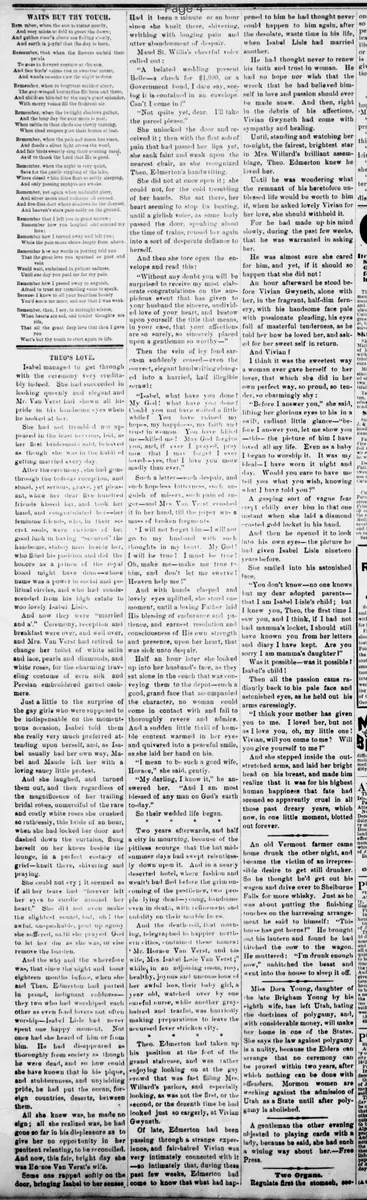
THEO'S LOVE.
Isabel managed to get through with the ceremony very creditably indeed. She had succeeded in looking queenly and elegant, and Mr. Van Verst had shown all his pride in his landsole eyes when he looked at her. She had not trembled nor appeared in the least nervous, but, as her first bridesmaid said, behaved as though she was in the habit of getting married every day.
After the ceremony, she had gone through the tedious reception, and stood, set serious, grave, yet pleasant, while her dear five hundred friends kissed her, and took her hand, and congratulated her—her feminine friends, who, in their secret souls, were envious of her good luck in making "secure" the handsome, stately man beside her, who filled his position and did the honors as a prince of the royal blood might have done—whose name was a power in social and political circles, and who had condescended from his high estate to woo lovely Isabel Lisle.
And now they were "married and a'." Ceremony, reception and breakfast were over, and well over, and Mrs. Van Verst had retired to change her toilet of white satin and lace, pearls and diamonds, and white roses, for the charming traveling costume of ecru silk and Persian embroidered garnet cashmere.
Just a little to the surprise of the gay girls who were supposed to be indispensable on the momentous occasion, Isabel told them she really very much preferred attending upon herself, and, as Isabel usually had her own way, Mabel and Maude left her with a loving saucy little protest.
And she laughed, and turned them out, and then regardless of the magnificence of her trailing bridal robes, unmerciful to the rare and costly white roses she crushed so ruthlessly, this bride of an hour, when she had locked her door and dashed down the curtains, flung herself on her knees beside the lounge, in a perfect ecstasy of grief—knelt there, shivering and praying.
She could not cry: it seemed as if all her tears had "forever left her eyes to curdle around her heart." She did not even make the slightest sound, but, oh! the awful, unspeakable, pent-up agony she suffered, until she prayed God to let her die as she was, or else remove the burden.
And the why and the wherefore was, that since the night and hour eighteen months before, when she and Theo. Edmerton had parted in proud, indignant coldness—they two who had worshiped each other as even fond lovers not often worship—Isabel Lisle had never spent one happy moment. Not once had she heard of him or from him. He had disappeared as thoroughly from society as though he were dead, and so how could she have known that in his pique, and stubbornness, and unyielding pride, he had put the ocean, foreign countries, deserts, between them.
All she knew was, he made no sign; all she realized was, he had gone so far in his displeasure as to give her no opportunity in her penitent relenting, to be reconciled.
And now, this fair, bright day she was Horace Van Verst's wife.
Some one rapped softly on the door, bringing Isabel to her senses.
Had it been a minute or an hour since she knelt there, shivering, writhing with longing pain and utter abandonment of despair.
Maud St. Willis's cheerful voice called out:
"A belated wedding present, Belle—a check for $1,000, or a Government bond, I dare say, seeing it is contained in an envelope. Can't I come in?"
"Not quite yet, dear. I'll take the parcel please."
She unlocked the door and received it: then with the first sob of pain that had passed her lips yet, she sank faint and weak upon the nearest chair, as she recognized Theo. Edmerton's handwriting.
She did not at once open it: she could not, for the cold trembling of her hands. She sat there, her heart seeming to stop its beating until a girlish voice, as somebody passed the door, speaking about the time of trains, roused her again into a sort of desperate defiance to herself.
And then she tore open the envelope and read this:
"Without any doubt you will be surprised to receive my most elaborate congratulations on the auspicious event that has given to your husband the sincere, undivided love of your heart, and bestow upon yourself the title that means in your case, that your affections are so surely, so sincerely placed upon a gentleman so worthy—"
Then the vein of iron fond sarcasm suddenly ceased—even the correct, elegant handwriting changed into a hurried, half illegible scrawl:
"Isabel, what have you done? My God! what have you done? Could you not have waited a little while? You have ruined my hopes, my happiness, my faith and trust in woman. You have killed me—killed me! May God forgive you, and, if ever I passed, pray for me that I may forget I ever loved—yes, that I love you more madly than ever."
Such a letter—such despair, and such hopeless bitterness, such anguish of misery, such pain of anger—and Mrs. Van Verst crushed it in her hand, till the paper was a mass of broken fragments.
"I will not forget him—I will not go to my husband with such thoughts in my heart. My God! I will be true! I must be true! Oh, make me—make me true to him, and don't let me swerve! Heaven help me!"
And with hands clasped and lovely eyes uplifted, she stood one moment, until a loving Father laid His blessing of endurance and patience, and earnest resolution and consciousness of His own strength and presence, upon her heart, that was sick unto despair.
Half an hour later she looked up into her husband's face, as they sat alone in the coach that was conveying them to the depot—such a good, grand face that accompanied the character, no woman could come in contact with and fail to thoroughly revere and admire.
And a sudden little thrill of humble content warmed in her eyes and quivered into a peaceful smile, as she laid her hand on his.
"I mean to be such a good wife, Horace," she said, gently.
"My darling, I know it," he answered her. "And I am most blessed of any man on God's earth to-day."
So their wedded life began.
Two years afterwards, and half a city in mourning, because of the pitiless scourge that the hot midsummer days had swept relentlessly down upon it. And in a nearly deserted hotel, where fashion and wealth had fled before the grim oncoming of the pestilence, two people lying dead—young, handsome even in death, with refinement and nobility on their marble faces.
And the death-roll, that morning, telegraphed to happier northern cities, contained these names: Mr. Horace Van Verst, and his wife, Mrs. Isabel Lisle Van Verst;
while, in an adjoining room, rosy, healthy, joyous and unconscious of her awful loss, their baby girl, a year old, watched over by one careful nurse, while another gray-haired and tearful, was hurriedly making preparations to leave the accursed fever stricken city.
*
Theo. Edmerton had taken up his position at the foot of the grand staircase, and was rather enjoying looking on at the gay crowd that was fast filling Mrs. Willard's parlors, and especially looking, as was not the first, or the second, or the dozenth time he had looked just so eagerly, at Vivian Gwyneth.
Of late, Edmerton had been passing through a strange experience, and fair-haired Vivian was very intimately connected with it—so intimately that, during these past few weeks, Edmerton had come to know that what had happened to him he had thought never could happen to him again, after the desolate, waste time in his life, when Isabel Lisle had married another.
He had thought never to renew his faith and trust in woman. He had no hope nor wish that the wreck that he had believed himself in love and passion should ever be made anew. And then, right in the debris of his affections, Vivian Gwyneth had come with sympathy and healing.
Until, standing and watching her to-night, the fairest, brightest star in Mrs. Willard's brilliant assemblage, Theo. Edmerton knew he loved her.
Until he was wondering what the remnant of his heretofore unblessed life would be worth to him if, when he asked lovely Vivian for her love, she should withhold it.
For he had made up his mind slowly, during the past few weeks, that he was warranted in asking her.
He was almost sure she cared for him, and yet, if it should so happen that she did not!
An hour afterward he stood before Vivian Gwyneth, alone with her, in the fragrant, half-dim fernery, with his handsome face pale with passionate pleading, his eyes full of masterful tenderness, as he told her how he loved her, and asked for her sweet self in return.
And Vivian—I think it was the sweetest way a woman ever gave herself to her lover, that which she did in her own perfect way, so proud, so tender, so charmingly shy:
"Before I answer you," she said, lifting her glorious eyes to his in a swift, radiant little glance—"before I answer you, let me show you—this—the picture of him I have loved all my life. Even as a baby I began to worship it. It was my ideal—I have worn it night and day. Would you care to have me tell you what you wish, knowing what I have told you?"
A gasping sort of vague fear crept chilly over him in that one instant when she laid a diamond crested gold locket in his hand.
And then he opened it to look into his own eyes—the picture he had given Isabel Lisle nineteen years before.
She smiled into his astonished face.
"You don't know—no one knows but my dear adopted parents—that I am Isabel Lisle's child; but I knew you, Theo., the first time I saw you, and I think, if I had not had mamma's locket, I should still have known you from her letters and diary I have kept. Are you sorry I am mamma's daughter?"
Was it possible—was it possible! Isabel's child!
Then all the passion came radiantly back to his pale face and astonished eyes, as he held out his arms caressingly.
"I think your mother has given you to me. I loved her, but not as I love you, oh, my little one! Vivian, will you come to me? Will you give yourself to me!"
And she stepped inside the outstretched arms, and laid her bright head on his breast, and made him realize that it was for his highest human happiness that fate had seemed so apparently cruel in all those past dreary years, which now, in one little moment, blotted out forever.
Isabel managed to get through with the ceremony very creditably indeed. She had succeeded in looking queenly and elegant, and Mr. Van Verst had shown all his pride in his landsole eyes when he looked at her. She had not trembled nor appeared in the least nervous, but, as her first bridesmaid said, behaved as though she was in the habit of getting married every day.
After the ceremony, she had gone through the tedious reception, and stood, set serious, grave, yet pleasant, while her dear five hundred friends kissed her, and took her hand, and congratulated her—her feminine friends, who, in their secret souls, were envious of her good luck in making "secure" the handsome, stately man beside her, who filled his position and did the honors as a prince of the royal blood might have done—whose name was a power in social and political circles, and who had condescended from his high estate to woo lovely Isabel Lisle.
And now they were "married and a'." Ceremony, reception and breakfast were over, and well over, and Mrs. Van Verst had retired to change her toilet of white satin and lace, pearls and diamonds, and white roses, for the charming traveling costume of ecru silk and Persian embroidered garnet cashmere.
Just a little to the surprise of the gay girls who were supposed to be indispensable on the momentous occasion, Isabel told them she really very much preferred attending upon herself, and, as Isabel usually had her own way, Mabel and Maude left her with a loving saucy little protest.
And she laughed, and turned them out, and then regardless of the magnificence of her trailing bridal robes, unmerciful to the rare and costly white roses she crushed so ruthlessly, this bride of an hour, when she had locked her door and dashed down the curtains, flung herself on her knees beside the lounge, in a perfect ecstasy of grief—knelt there, shivering and praying.
She could not cry: it seemed as if all her tears had "forever left her eyes to curdle around her heart." She did not even make the slightest sound, but, oh! the awful, unspeakable, pent-up agony she suffered, until she prayed God to let her die as she was, or else remove the burden.
And the why and the wherefore was, that since the night and hour eighteen months before, when she and Theo. Edmerton had parted in proud, indignant coldness—they two who had worshiped each other as even fond lovers not often worship—Isabel Lisle had never spent one happy moment. Not once had she heard of him or from him. He had disappeared as thoroughly from society as though he were dead, and so how could she have known that in his pique, and stubbornness, and unyielding pride, he had put the ocean, foreign countries, deserts, between them.
All she knew was, he made no sign; all she realized was, he had gone so far in his displeasure as to give her no opportunity in her penitent relenting, to be reconciled.
And now, this fair, bright day she was Horace Van Verst's wife.
Some one rapped softly on the door, bringing Isabel to her senses.
Had it been a minute or an hour since she knelt there, shivering, writhing with longing pain and utter abandonment of despair.
Maud St. Willis's cheerful voice called out:
"A belated wedding present, Belle—a check for $1,000, or a Government bond, I dare say, seeing it is contained in an envelope. Can't I come in?"
"Not quite yet, dear. I'll take the parcel please."
She unlocked the door and received it: then with the first sob of pain that had passed her lips yet, she sank faint and weak upon the nearest chair, as she recognized Theo. Edmerton's handwriting.
She did not at once open it: she could not, for the cold trembling of her hands. She sat there, her heart seeming to stop its beating until a girlish voice, as somebody passed the door, speaking about the time of trains, roused her again into a sort of desperate defiance to herself.
And then she tore open the envelope and read this:
"Without any doubt you will be surprised to receive my most elaborate congratulations on the auspicious event that has given to your husband the sincere, undivided love of your heart, and bestow upon yourself the title that means in your case, that your affections are so surely, so sincerely placed upon a gentleman so worthy—"
Then the vein of iron fond sarcasm suddenly ceased—even the correct, elegant handwriting changed into a hurried, half illegible scrawl:
"Isabel, what have you done? My God! what have you done? Could you not have waited a little while? You have ruined my hopes, my happiness, my faith and trust in woman. You have killed me—killed me! May God forgive you, and, if ever I passed, pray for me that I may forget I ever loved—yes, that I love you more madly than ever."
Such a letter—such despair, and such hopeless bitterness, such anguish of misery, such pain of anger—and Mrs. Van Verst crushed it in her hand, till the paper was a mass of broken fragments.
"I will not forget him—I will not go to my husband with such thoughts in my heart. My God! I will be true! I must be true! Oh, make me—make me true to him, and don't let me swerve! Heaven help me!"
And with hands clasped and lovely eyes uplifted, she stood one moment, until a loving Father laid His blessing of endurance and patience, and earnest resolution and consciousness of His own strength and presence, upon her heart, that was sick unto despair.
Half an hour later she looked up into her husband's face, as they sat alone in the coach that was conveying them to the depot—such a good, grand face that accompanied the character, no woman could come in contact with and fail to thoroughly revere and admire.
And a sudden little thrill of humble content warmed in her eyes and quivered into a peaceful smile, as she laid her hand on his.
"I mean to be such a good wife, Horace," she said, gently.
"My darling, I know it," he answered her. "And I am most blessed of any man on God's earth to-day."
So their wedded life began.
Two years afterwards, and half a city in mourning, because of the pitiless scourge that the hot midsummer days had swept relentlessly down upon it. And in a nearly deserted hotel, where fashion and wealth had fled before the grim oncoming of the pestilence, two people lying dead—young, handsome even in death, with refinement and nobility on their marble faces.
And the death-roll, that morning, telegraphed to happier northern cities, contained these names: Mr. Horace Van Verst, and his wife, Mrs. Isabel Lisle Van Verst;
while, in an adjoining room, rosy, healthy, joyous and unconscious of her awful loss, their baby girl, a year old, watched over by one careful nurse, while another gray-haired and tearful, was hurriedly making preparations to leave the accursed fever stricken city.
*
Theo. Edmerton had taken up his position at the foot of the grand staircase, and was rather enjoying looking on at the gay crowd that was fast filling Mrs. Willard's parlors, and especially looking, as was not the first, or the second, or the dozenth time he had looked just so eagerly, at Vivian Gwyneth.
Of late, Edmerton had been passing through a strange experience, and fair-haired Vivian was very intimately connected with it—so intimately that, during these past few weeks, Edmerton had come to know that what had happened to him he had thought never could happen to him again, after the desolate, waste time in his life, when Isabel Lisle had married another.
He had thought never to renew his faith and trust in woman. He had no hope nor wish that the wreck that he had believed himself in love and passion should ever be made anew. And then, right in the debris of his affections, Vivian Gwyneth had come with sympathy and healing.
Until, standing and watching her to-night, the fairest, brightest star in Mrs. Willard's brilliant assemblage, Theo. Edmerton knew he loved her.
Until he was wondering what the remnant of his heretofore unblessed life would be worth to him if, when he asked lovely Vivian for her love, she should withhold it.
For he had made up his mind slowly, during the past few weeks, that he was warranted in asking her.
He was almost sure she cared for him, and yet, if it should so happen that she did not!
An hour afterward he stood before Vivian Gwyneth, alone with her, in the fragrant, half-dim fernery, with his handsome face pale with passionate pleading, his eyes full of masterful tenderness, as he told her how he loved her, and asked for her sweet self in return.
And Vivian—I think it was the sweetest way a woman ever gave herself to her lover, that which she did in her own perfect way, so proud, so tender, so charmingly shy:
"Before I answer you," she said, lifting her glorious eyes to his in a swift, radiant little glance—"before I answer you, let me show you—this—the picture of him I have loved all my life. Even as a baby I began to worship it. It was my ideal—I have worn it night and day. Would you care to have me tell you what you wish, knowing what I have told you?"
A gasping sort of vague fear crept chilly over him in that one instant when she laid a diamond crested gold locket in his hand.
And then he opened it to look into his own eyes—the picture he had given Isabel Lisle nineteen years before.
She smiled into his astonished face.
"You don't know—no one knows but my dear adopted parents—that I am Isabel Lisle's child; but I knew you, Theo., the first time I saw you, and I think, if I had not had mamma's locket, I should still have known you from her letters and diary I have kept. Are you sorry I am mamma's daughter?"
Was it possible—was it possible! Isabel's child!
Then all the passion came radiantly back to his pale face and astonished eyes, as he held out his arms caressingly.
"I think your mother has given you to me. I loved her, but not as I love you, oh, my little one! Vivian, will you come to me? Will you give yourself to me!"
And she stepped inside the outstretched arms, and laid her bright head on his breast, and made him realize that it was for his highest human happiness that fate had seemed so apparently cruel in all those past dreary years, which now, in one little moment, blotted out forever.
What sub-type of article is it?
Prose Fiction
What themes does it cover?
Love Romance
Death Mortality
What keywords are associated?
Lost Love
Wedding Anguish
Plague Deaths
Reunion
Adopted Daughter
Romantic Fate
Literary Details
Title
Theo's Love.
Key Lines
"Isabel, What Have You Done? My God! What Have You Done? Could You Not Have Waited A Little While? You Have Ruined My Hopes, My Happiness, My Faith And Trust In Woman. You Have Killed Me—Killed Me!"
"I Will Not Forget Him—I Will Not Go To My Husband With Such Thoughts In My Heart. My God! I Will Be True! I Must Be True! Oh, Make Me—Make Me True To Him, And Don't Let Me Swerve! Heaven Help Me!"
"You Don't Know—No One Knows But My Dear Adopted Parents—That I Am Isabel Lisle's Child; But I Knew You, Theo., The First Time I Saw You"
"I Think Your Mother Has Given You To Me. I Loved Her, But Not As I Love You, Oh, My Little One! Vivian, Will You Come To Me? Will You Give Yourself To Me!"
And She Stepped Inside The Outstretched Arms, And Laid Her Bright Head On His Breast, And Made Him Realize That It Was For His Highest Human Happiness That Fate Had Seemed So Apparently Cruel In All Those Past Dreary Years, Which Now, In One Little Moment, Blotted Out Forever.