Thank you for visiting SNEWPapers!
Sign up free
Kentucky Gazette
Lexington, Fayette County, Kentucky
What is this article about?
Brig. Gen. John P. Boyd reports on a skirmish on November 11, 1813, near Cornwall on the St. Lawrence River during the War of 1812. U.S. forces under Boyd repelled a British and Indian attack protecting the flotilla, suffering losses including Gen. Covington's death, but achieving the objective despite ammunition shortages and superior enemy position.
Clipping
OCR Quality
Full Text
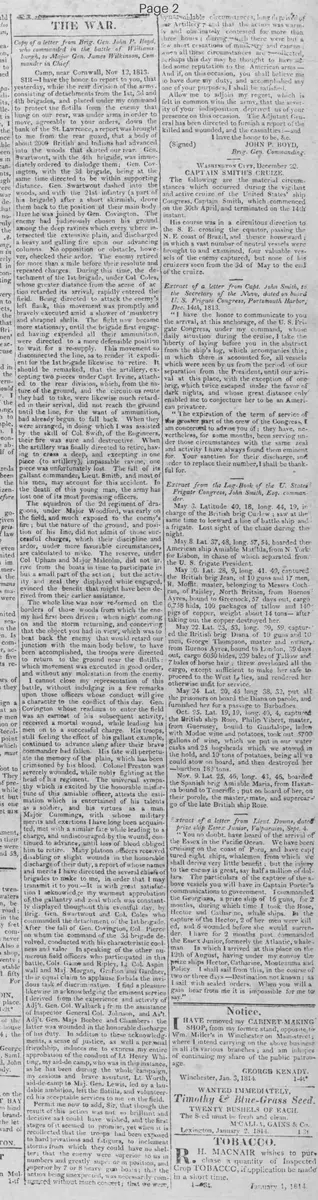
Copy of a letter from Brig. Gen. John P. Boyd, who commanded in the battle of Williamsburg, to Major Gen. James Wilkinson, Commander in Chief
Camp, near Cornwall, Nov 12, 1813.
SIR—I have the honor to report to you, that yesterday, while the rear division of the army, consisting of detachments from the 1st, 3d and 4th brigades, and placed under my command to protect the flotilla from the enemy that hung on our rear, was under arms in order to move, agreeably to your orders, down the bank of the St. Lawrence, a report was brought to me from the rear guard, that a body of about 2000 British and Indians had advanced into the woods that skirted our rear. Gen. Swartwout, with the 4th brigade, was immediately ordered to dislodge them; Gen. Covington, with the 3d brigade, being at the same time directed to be within supporting distance. Gen. Swartwout dashed into the woods, and with the 21st infantry (a part of his brigade) after a short skirmish, drove them back to the position of their main body. Here he was joined by Gen. Covington. The enemy had judiciously chosen his ground among the deep ravines which every where intersected the extensive plain, and discharged a heavy and galling fire upon our advancing columns. No opposition or obstacle, however, checked their ardor. The enemy retired for more than a mile before their resolute and repeated charges. During this time, the detachment of the 1st brigade, under Col. Coles, whose greater distance from the scene of action retarded its arrival, rapidly entered the field. Being directed to attack the enemy's left flank, this movement was promptly and bravely executed amid a shower of musketry and shrapnel shells. The fight now became more stationary, until the brigade first engaged having expended all their ammunition, were directed to a more defensible position to wait for a re-supply. This movement so disconnected the line, as to render it expedient for the 1st brigade likewise to retire. It should be remarked, that the artillery, excepting two pieces under Capt. Irvine, attached to the rear division, which, from the nature of the ground, and the circuitous route they had to take, were likewise much retarded in their arrival, did not reach the ground until the line, for the want of ammunition, had already begun to fall back. When they were arranged, in doing which I was assisted by the skill of Col. Swift, of the Engineers, their fire was sure and destructive. When the artillery was finally directed to retire, having to cross a deep, and excepting in one place (to artillery), impassable ravine, one piece was unfortunately lost. The fall of its gallant commander, Lieut. Smith, and most of his men, may account for this accident. In the death of this young man, the army has lost one of its most promising officers.
The squadron of the 2d regiment of dragoons, under Major Woodford, was early on the field, and much exposed to the enemy's fire; but the nature of the ground, and position of his line, did not admit of those successful charges, which their discipline and ardor, under more favorable circumstances, are calculated to make. The reserve, under Col. Upham and Major Malcolm, did not arrive from the boats in time to participate in but a small part of the action; but the activity and zeal they displayed while engaged, evinced the benefit that might have been derived from their earlier assistance.
The whole line was now re-formed on the borders of those woods from which the enemy had first been driven; when night coming on and the storm returning, and conceiving that the object you had in view, which was to beat back the enemy that would retard our junction with the main body below, to have been accomplished, the troops were directed to return to the ground near the flotilla: which movement was executed in good order, and without any molestation from the enemy.
I cannot close my representation of this battle, without indulging in a few remarks upon those officers whose conduct will give a character to the conflict of this day. Gen. Covington whose readiness to enter the field was an earnest of his subsequent activity, received a mortal wound, while leading his men on to a successful charge. His troops, still feeling the effect of his gallant example, continued to advance long after their brave commander had fallen. His fate will perpetuate the memory of the plain, which has been crimsoned by his blood. Colonel Preston was severely wounded, while nobly fighting at the head of his regiment. The universal sympathy which is excited by the honorable misfortune of this amiable officer, attests the estimation which is entertained of his talents as a soldier, and his virtues as a man.
Major Cummings, with whose military merits and exertions I have long been acquainted, met with a similar fate while leading to a charge, and undiscouraged by the wound, continued to advance, until loss of blood obliged him to retire. Many platoon officers received disabling or slight wounds in the honorable discharge of their duty, a report of whose names and merits I have directed the several chiefs of brigades to make to me, in order that I may transmit it to you.—It is with great satisfaction I acknowledge my warmest approbation of the gallantry and zeal which was constantly displayed throughout this eventful day, by Brig. Gen. Swartwout and Col. Coles who commanded the detachment of the 1st brigade. After the fall of Gen. Covington, Col. Pierce on whom the command of the 3d brigade devolved, conducted with his characteristic coolness and valor. In speaking of the other numerous field officers who participated in this battle, Cols. Gaine and Ripley, Col. Aspinwall and Maj. Morgan, Grafton and Gardner, their equal claim to applause forbids the invidious task of discrimination. I find a pleasure likewise in acknowledging the eminent service I derived from the experience and activity of Adj't. Gen. Col. Walback; from the assistance of inspector General Col. Johnson, and As't. Adj't. Gen. Majs. Beebee and Chambers: the latter was wounded in the honorable discharge of his duty. In addition to these acknowledgments, a sense of justice, as well a personal friendship, induces me to express my entire approbation of the conduct of Lt. Henry Whitting, my aid-de-camp, who was in this instance, as he has been during the whole campaign, my zealous and brave assistant, Lt. Worth, aid-de-camp to Maj. Gen. Lewis, led by a laudable ambition, left the flotilla, and volunteered his acceptable services to me on the field.
Permit me now to add, Sir, that though the result of this action was not so brilliant and decisive as I could have wished, and the first stages of it seemed to promise, yet when it is recollected that the troops had been exposed to hard privations and fatigues, to inclement storms from which they could have no shelter; that the enemy were superior to us in numbers and greatly superior in position, and superior by 7 or 8 heavy gun boats; that the action being unexpected, was necessarily commenced without much concert; that we were by unavoidable circumstances, long deprived of our Artillery; and that the action was warmly and obstinately contested for more than three hours; during which there were but a few short cessations of musketry and cannon: when all these circumstances are recollected, perhaps this day may be thought to have added some reputation to the American arms—And if, on this occasion, you shall believe me to have done my duty, and accomplished any one of your purposes, I shall be satisfied.
Allow me to join my regret, which is felt in common with the army, that the severity of your indisposition deprived us of your presence on this occasion. The Adjutant General has been directed to furnish a report of the killed and wounded, and the casualties:—and I have the honor to be, &c.
(Signed) JOHN P. BOYD,
Brig. Gen. Commanding
What sub-type of article is it?
What themes does it cover?
What keywords are associated?
What entities or persons were involved?
Where did it happen?
Story Details
Key Persons
Location
Near Cornwall, On The Bank Of The St. Lawrence
Event Date
November 11, 1813
Story Details
U.S. rear guard under Boyd engages 2000 British and Indians in woods near flotilla; Swartwout and Covington lead charges driving enemy back despite ravines and fire; ammunition shortage forces temporary retreat; artillery arrives late, one piece lost with Lt. Smith; Covington mortally wounded leading charge; action lasts over three hours, U.S. reforms and withdraws in order after achieving objective of repelling enemy.