Thank you for visiting SNEWPapers!
Sign up free
Letter to Editor
September 8, 1903
The Sun
New York, New York County, New York
What is this article about?
Arthur H. Case of Copperhill, Tenn., advocates for the Appalachian National Park by describing the desolate, eroded hills and gullied terrain around his home, once a rich botanical area per experts Shaler and Gray, now barren from soil loss and mining effects. Dated Sept. 5.
Clipping
OCR Quality
95%
Excellent
Full Text
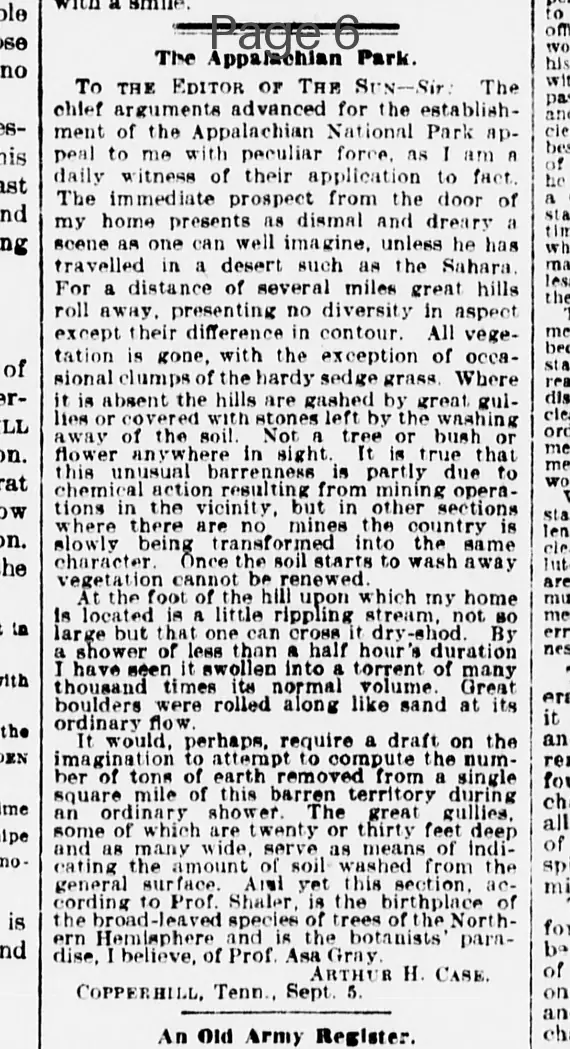
The Appalachian Park.
TO THE EDITOR OF THE SUN—Sir:
The chief arguments advanced for the establishment of the Appalachian National Park appeal to me with peculiar force, as I am a daily witness of their application to fact.
The immediate prospect from the door of my home presents as dismal and dreary a scene as one can well imagine, unless he has travelled in a desert such as the Sahara.
For a distance of several miles great hills roll away, presenting no diversity in aspect except their difference in contour. All vegetation is gone, with the exception of occasional clumps of the hardy sedge grass. Where it is absent the hills are gashed by great gullies or covered with stones left by the washing away of the soil. Not a tree or bush or flower anywhere in sight. It is true that this unusual barrenness is partly due to chemical action resulting from mining operations in the vicinity, but in other sections where there are no mines the country is slowly being transformed into the same character. Once the soil starts to wash away vegetation cannot be renewed.
At the foot of the hill upon which my home is located is a little rippling stream, not so large but that one can cross it dry-shod. By a shower of less than a half hour's duration I have seen it swollen into a torrent of many thousand times its normal volume. Great boulders were rolled along like sand at its ordinary flow.
It would, perhaps, require a draft on the imagination to attempt to compute the number of tons of earth removed from a single square mile of this barren territory during an ordinary shower. The great gullies, some of which are twenty or thirty feet deep and as many wide, serve as means of indicating the amount of soil washed from the general surface. And yet this section, according to Prof. Shaler, is the birthplace of the broad-leaved species of trees of the Northern Hemisphere and is the Botanists' paradise, I believe, of Prof. Asa Gray.
ARTHUR H. CASE.
COPPERHILL, Tenn., Sept. 5.
TO THE EDITOR OF THE SUN—Sir:
The chief arguments advanced for the establishment of the Appalachian National Park appeal to me with peculiar force, as I am a daily witness of their application to fact.
The immediate prospect from the door of my home presents as dismal and dreary a scene as one can well imagine, unless he has travelled in a desert such as the Sahara.
For a distance of several miles great hills roll away, presenting no diversity in aspect except their difference in contour. All vegetation is gone, with the exception of occasional clumps of the hardy sedge grass. Where it is absent the hills are gashed by great gullies or covered with stones left by the washing away of the soil. Not a tree or bush or flower anywhere in sight. It is true that this unusual barrenness is partly due to chemical action resulting from mining operations in the vicinity, but in other sections where there are no mines the country is slowly being transformed into the same character. Once the soil starts to wash away vegetation cannot be renewed.
At the foot of the hill upon which my home is located is a little rippling stream, not so large but that one can cross it dry-shod. By a shower of less than a half hour's duration I have seen it swollen into a torrent of many thousand times its normal volume. Great boulders were rolled along like sand at its ordinary flow.
It would, perhaps, require a draft on the imagination to attempt to compute the number of tons of earth removed from a single square mile of this barren territory during an ordinary shower. The great gullies, some of which are twenty or thirty feet deep and as many wide, serve as means of indicating the amount of soil washed from the general surface. And yet this section, according to Prof. Shaler, is the birthplace of the broad-leaved species of trees of the Northern Hemisphere and is the Botanists' paradise, I believe, of Prof. Asa Gray.
ARTHUR H. CASE.
COPPERHILL, Tenn., Sept. 5.
What sub-type of article is it?
Persuasive
Informative
What keywords are associated?
Appalachian National Park
Soil Erosion
Barren Landscape
Environmental Degradation
Botanical Paradise
Copperhill Tennessee
What entities or persons were involved?
Arthur H. Case
The Editor Of The Sun
Letter to Editor Details
Author
Arthur H. Case
Recipient
The Editor Of The Sun
Main Argument
supports the establishment of the appalachian national park, emphasizing the barren, eroded landscape near the author's home as evidence of the need for conservation, contrasting it with the area's historical botanical richness.
Notable Details
Daily Witness Of Barren Hills With Gullies And No Vegetation Due To Soil Washing Away
Stream Swells Dramatically After Short Showers, Rolling Boulders
References Prof. Shaler On Birthplace Of Broad Leaved Trees
Cited As Botanists' Paradise By Prof. Asa Gray
Partly Due To Chemical Action From Nearby Mining Operations