Thank you for visiting SNEWPapers!
Sign up free
The Western Democrat
Charlotte, Mecklenburg County, North Carolina
What is this article about?
In Philadelphia's Court of Quarter Sessions, during Donnelly's larceny trial, a juror shared pertinent unsworn information with the District Attorney and fellow jurors, prompting a debate on whether the jury should be dismissed. Judge Allison upheld the jury's continuation, resulting in conviction and a new trial motion.
Clipping
OCR Quality
Full Text
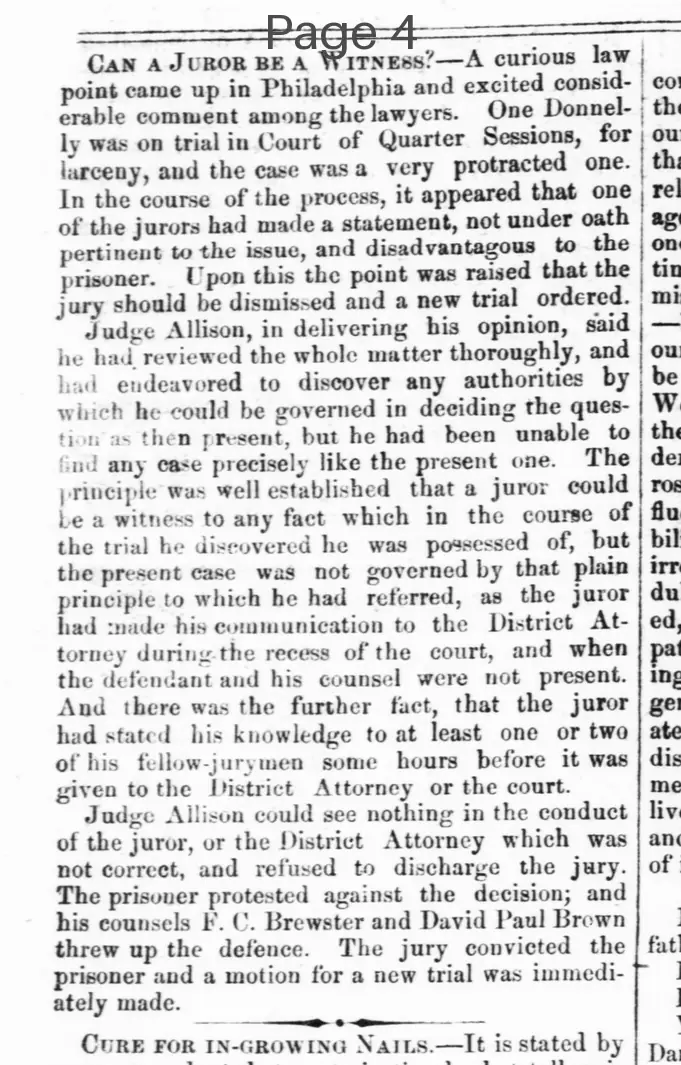
A curious law point came up in Philadelphia and excited considerable comment among the lawyers. One Donnelly was on trial in Court of Quarter Sessions, for larceny, and the case was a very protracted one.
In the course of the process, it appeared that one of the jurors had made a statement, not under oath, pertinent to the issue, and disadvantageous to the prisoner. Upon this the point was raised that the jury should be dismissed and a new trial ordered.
Judge Allison, in delivering his opinion, said he had reviewed the whole matter thoroughly, and had endeavored to discover any authorities by which he could be governed in deciding the question as then present. but he had been unable to find any case precisely like the present one. The principle was well established that a juror could be a witness to any fact which in the course of the trial he discovered he was possessed of, but the present case was not governed by that plain principle to which he had referred, as the juror had made his communication to the District Attorney during the recess of the court, and when the defendant and his counsel were not present.
And there was the further fact, that the juror had stated his knowledge to at least one or two of his fellow-jurymen some hours before it was given to the District Attorney or the court.
Judge Allison could see nothing in the conduct of the juror, or the District Attorney which was not correct, and refused to discharge the jury.
The prisoner protested against the decision; and his counsels F. C. Brewster and David Paul Brown threw up the defence. The jury convicted the prisoner and a motion for a new trial was immediately made.
What sub-type of article is it?
What themes does it cover?
What keywords are associated?
What entities or persons were involved?
Where did it happen?
Story Details
Key Persons
Location
Philadelphia, Court Of Quarter Sessions
Story Details
In a larceny trial, a juror shared unsworn knowledge disadvantageous to the defendant with the District Attorney during recess, without the defense present, and earlier with fellow jurors. Judge Allison ruled it proper, refused to discharge the jury, leading to conviction and motion for new trial.