Thank you for visiting SNEWPapers!
Sign up free
Alexandria Daily Gazette, Commercial & Political
Alexandria, Virginia
What is this article about?
Lords Grey and Grenville, in a letter dated February 15, 1812, to the Duke of York on behalf of the Prince Regent, decline to join the government. They cite irreconcilable differences on key policies, particularly the need for Catholic emancipation and repeal of civil disabilities in Ireland, emphasizing their commitment to national unity only on honorable terms.
Merged-components note: Continuation of the letter from Lords Grey and Grenville; original label of second component was foreign_news, changed to letter_to_editor to match content.
Clippings
1 of 2
OCR Quality
Full Text
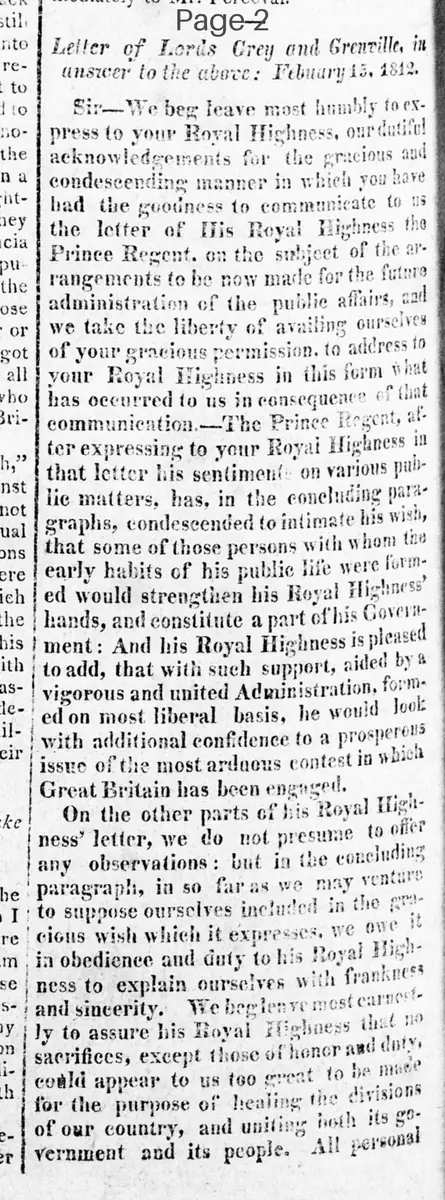
Sir--We beg leave most humbly to express to your Royal Highness, our dutiful acknowledgments for the gracious and condescending manner in which you have had the goodness to communicate to us the letter of His Royal Highness the Prince Regent, on the subject of the arrangements to be now made for the future administration of the public affairs, and we take the liberty of availing ourselves of your gracious permission, to address to your Royal Highness in this form what has occurred to us in consequence of that communication.--The Prince Regent, after expressing to your Royal Highness in that letter his sentiments on various public matters, has, in the concluding paragraphs, condescended to intimate his wish, that some of those persons with whom the early habits of his public life were formed, would strengthen his Royal Highness' hands, and constitute a part of his Government: And his Royal Highness is pleased to add, that with such support, aided by a vigorous and united Administration, formed on most liberal basis, he would look with additional confidence to a prosperous issue of the most arduous contest in which Great Britain has been engaged.
On the other parts of his Royal Highness' letter, we do not presume to offer any observations: but in the concluding paragraph, in so far as we may venture to suppose ourselves included in the gracious wish which it expresses, we owe it in obedience and duty to his Royal Highness to assure his Royal Highness that no considerations of personal ease or interest should induce us to withhold our most zealous and cordial support from any Administration which held out a reasonable prospect of uniting, with firmness and efficiency, the confidence and affections of our country, and uniting both its government and its people. All personal sacrifices, except those of honor and duty, for the purpose of healing the divisions could appear to us too great to be made. We disclaim all motives: we rest upon God alone that we may expect his blessing on our public measures; and it is on this ground, with the most profound reverence, that we presume to state to your Royal Highness the impossibility of our uniting in the present Government. Our differences of opinion are too many and fundamental to allow us [to do otherwise]; we beg to remember, that we have twice already acted on this impression: and last year, when his Royal Highness the Prince Regent, by his Majesty's authority, was pleased to require our advice respecting the formation of a new Government.
The reasons which we then humbly submitted to your Royal Highness, respecting the increasing dangers of the times, have been strengthened by the events there down to the present moment, nor has there appeared any towards such an agreement of opinion on the basis for the honorable union of parties in the public interests, as can alone form a basis for the honorable union of parties in the public interests. Into the detail of those differences we are, unfortunately, unwilling to enter; they embrace almost all the leading features of the present policy of the empire: but his Royal Highness has, himself, been pleased to advert to the late deliberations of Parliament on the affairs of Ireland. This subject, above all others, is important in itself, and connected with the most pressing dangers.
Far from concurring in the sentiments which his Majesty's Ministers have, on that occasion, so recently expressed, we entertain opinions directly opposite: we are firmly persuaded of the necessity of a total change in the present system of that country, and of the immediate repeal of these civil disabilities under which so large a portion of his Majesty's subjects, still labor on account of their religious opinions.
To recommend to Parliament this repeal [would be] the first advice which it would be our duty to offer to his Royal Highness, could we, even for the shortest time, make ourselves responsible for any farther delay in the prospect of a measure, without which we could entertain no hope of rendering ourselves useful to his Royal Highness or to the country. We have only further [to] obey your Royal Highness to lay before his Royal Highness the Prince Regent, the expression of our earnest wishes for whatever may best promote the ease, honor and advantage of his Royal Highness Government, and the success of his endeavors for the public welfare. We have the honor to be, &c.
(Signed) GREY. GRENVILLE
To his Royal Highness the Duke of York.
What sub-type of article is it?
What themes does it cover?
What keywords are associated?
What entities or persons were involved?
Letter to Editor Details
Author
Grey, Grenville
Recipient
His Royal Highness The Duke Of York
Main Argument
lords grey and grenville decline to join the prince regent's government due to irreconcilable differences on major policies, particularly the urgent need for catholic emancipation and repeal of religious civil disabilities in ireland, which they see as essential for national unity and effective administration.
Notable Details