Thank you for visiting SNEWPapers!
Sign up free
Editorial
August 13, 1836
The Liberator
Boston, Suffolk County, Massachusetts
What is this article about?
An editorial in an abolitionist newspaper critiques a letter by Rev. R. J. Breckenridge published in the London Patriot, accusing him of misrepresenting American slavery, George Thompson's work, and the abolitionist movement. It defends abolitionists and highlights national complicity in slavery.
Merged-components note: These two components form a single continuous editorial article critiquing R. J. Breckenridge's letter on slavery and abolitionism.
Clipping
OCR Quality
95%
Excellent
Full Text
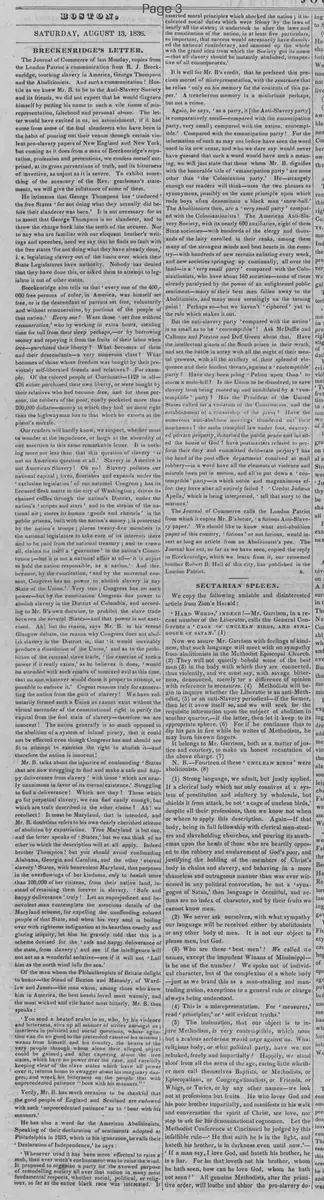
BRECKENRIDGE'S LETTER.
The Journal of Commerce of last Monday, copies from the London Patriot a communication from R. J. Breckenridge, touching slavery in America, George Thompson and the Abolitionists. And such a communication! Hostile as we knew Mr. B. to be to the Anti-Slavery Society and its friends, we did not expect that he would disgrace himself by putting his name to such a vile tissue of misrepresentation, falsehood and personal abuse. The letter would have excited in us, no astonishment, if it had come from some of the foul slanderers who have been in the habit of pouring out their venom through certain violent pro-slavery papers of New England and New York but coming as it does from a man of Breckenridge's reputation, profession and pretensions, we confess ourself surprised, at its gross perversions of truth, and its bitterness of invective, as unjust as it is severe. To exhibit something of the accuracy of the Rev. gentleman's statements, we will give the substance of some of them.
He intimates that George Thompson has traduced the free States 'for not doing what they actually did before their slanderer was born.' It is not necessary for us to assert that George Thompson is no slanderer, and to throw the charge back into the teeth of the accuser. Nor to any who are familiar with our eloquent brother's writings and speeches, need we say that he finds no fault with the free states 'for not doing what they have already done, i. e. legislating slavery out of the limits over which their State Legislatures have authority. Nobody has denied that they have done this, or asked them to attempt to legislate it out of other states.
Breckenridge also tells us that 'every one of the 400,000 free persons of color, in America, was himself set free, or is the descendant of parents set free, voluntarily and without remuneration, by portions of the people of that nation.' Every one! Were those 'set free without remuneration,' who by working in extra hours, stealing time for toil from their sleep perhaps,—or by borrowing money and repaying it from the fruits of their labor when free—purchased their liberty? What becomes of them and their descendants—a very numerous class? What becomes of those whose freedom was bought by their previously self-liberated friends and relatives? For example. Of the colored people of Cincinnati 1129 in all—476 either purchased their own liberty, or were bought by their relatives who had become free, and for these persons, the robbers of the poor, coolly pocketed more than 200,000 dollars—money to which they had no more right than the highwayman has to that which he extorts at the pistol's muzzle.
Our readers will hardly know, we suspect, whether most to wonder at the impudence, or laugh at the absurdity of one assertion in this same remarkable letter. It is nothing more nor less than that this question of slavery 'is not an American question at all.' Slavery in America is not American Slavery! Oh no! Slavery pollutes our national capital; lives, flourishes and expands under the 'exclusive legislation' of our national Congress; has its licensed flesh marts in the city of Washington; drives its chained coffles through the nation's District, under the nation's 'stripes and stars' and to the strains of the national air; stores its human 'goods and chattels' in the public prisons, built with the nation's money; is protected by the nation's troops; places twenty-five members in the national legislature to take care of its interests there and to be paid from the national treasury; and to crown all, claims for itself a 'guarantee' in the nation's Constitution;—but it is not a national affair at all—'it is unjust to hold the nation responsible, as a nation.' And this, because, by the constitution, 'and by the universal consent, Congress has no power to abolish slavery in any State of the Union.' Very true; Congress has no such power—but by the constitution Congress has power to abolish slavery in the District of Columbia, and according to Mr. B's own doctrine, to prohibit the slave trade between the several States—and that power is not exercised. Ah! but the reason, says Mr. B. in his recent Glasgow debate, the reason why Congress does not abolish slavery in the District is, that 'it would inevitably produce a dissolution of the Union,' and as to the prohibition of the internal slave trade, 'the exercise of such a power if it really exists,' as he believes it does, 'would be attended with such results of unmixed evil at this time, that no one whatever would deem it proper to attempt, or possible to enforce it.' Cogent reasons truly for exonerating the nation from the guilt of slavery! We have voluntarily formed such a Union as cannot exist without the virtual surrender of the constitutional right to purify the capital from the foul stain of slavery—therefore we are innocent! The nation generally is so much opposed to the abolition of a system of inland piracy, that it could not be effected even though Congress has and should see fit to attempt to exercise the right to abolish it—and therefore the nation is innocent
Mr. B. talks about the injustice of confounding 'States that are now struggling to find and make a safe and happy deliverance from slavery' with those 'which are nearly unanimous in favor of its eternal existence.' Struggling to find a deliverance! Which are they? Those which go for perpetual slavery, we can find easily enough, but which are truly described in the other clause? Ah! we recollect! It must be Maryland, that is intended, and Mr. B. doubtless refers to his own dearly cherished scheme of abolition by expatriation. True Maryland is but one, and the letter speaks of 'States,' but we can think of no other to which the description will at all apply. Indeed brother Thompson! but you should avoid confounding Alabama, Georgia and Carolina, and the other 'eternal slavery' States, with benevolent Maryland, that purposes in the overflowings of her kindness, only to banish more than 100,000 of her citizens, from their native land, instead of retaining them forever in slavery. Safe and happy deliverance' truly! Let an unprejudiced and benevolent man contemplate the atrocious details of the Maryland scheme, for expelling the unoffending colored people of that State, and when his very soul is boiling over with righteous indignation at its heartless cruelty and glaring iniquity, let him be gravely told that this is a scheme devised for the 'safe and happy deliverance of the state, from slavery;' and see if the intelligence will not act as a wonderful sedative—see if it will not lull him as the north wind lulls the sea.
Of the man whom the Philanthropists of Britain delight to honor—the friend of Buxton and Macauley, of Wardlaw and James—the man whom, among those who knew him in America, the best hearts loved most warmly, and the most wicked and vile hated most bitterly, Mr. B. thus speaks :
You send a heated zealot to us, who, by his violence and bitterness, stirs up all manner of strifes amongst us; interferes in political and social questions, whose agitation can do no good to the pretended cause of his mission; weans from himself and his country, the hearts of the very people through whom alone their alleged object could be gained; and after capering about the free states, which have no power over the case, and carefully keeping clear of the slave states which have all power over it, returns home to swagger about his imaginary dangers, and wreak his bitterness on the people that with unprecedented patience 'bore with his manners.'
Verily, Mr. B. has much occasion to be thankful that the good people of England and Scotland are endowed with such 'unprecedented patience' as to 'bear with his manners.'
He has also a word for the American Abolitionists. Speaking of their declaration of sentiments adopted at Philadelphia in 1833, which in his ignorance, he calls their 'Declaration of Independence,' he says:
Whenever tried it has been more effectual to raise a mob, than ever witch's enchantment was to raise the wind. It proposed to organize a party for the avowed purpose of remodelling society all over that nation in many most fundamental respects, whether social, political, or religious, so far as the entire black race was interested. It
asserted moral principles which shocked the nation; it inculcated social duties which were felony by the laws of nearly all the states; it undertook to alter the laws and the constitution of the nation, in at least five particulars, so important, that success would necessarily have dissolved the national confederacy, and summed up the whole with the grand idea from which the Society got its name -that all slavery should be instantly abolished, irrespective of all consequences.
It is well for Mr. B's credit, that he prefaced this precious morsel of misrepresentation, with the assurance that he relies 'only on his memory for the contents of this paper.' A treacherous memory is a misfortune perhaps, but not a crime.
Again, he says, 'as a party, it [the Anti-Slavery party] is comparatively small—compared with the emancipation party, very small; compared with the nation, contemptible.' Compared with the emancipation party! For the information of such as may not before have seen the word used in its new sense, and who we dare say would never have guessed that such a word would have such a meaning, we will just state that those whom Mr. B. dignifies with the honorable title of 'emancipation party' are none other than the Colonization party.' He strangely enough our readers will think—uses the two phrases as synonymous, possibly on the same principle upon which rude boys often denominate a black man 'snow-ball.'
The Abolitionists then, are a 'very small party' compared with the Colonizationists! The American Anti-Slavery Society, with its nearly 600 auxiliaries, eight of them State societies—with hundreds of the clergy and thousands of the laity enrolled in their ranks, among them many of the strongest minds and best hearts in the country—with hundreds of new recruits enlisting every week, and new societies springing up continually, all over the land—is a 'very small party' compared with the Colonizationists, who have about 160 societies—some of them already paralyzed by the power of an enlightened public sentiment—many of their best men fallen away to the Abolitionists, and many more seemingly on the turning point! Perhaps so—but we haven't ciphered' yet to the rule which makes it out.
But the anti-slavery party 'compared with the nation' is so small as to be 'contemptible'! Ask McDuffie and Calhoun and Preston and Duff Green about that. Have the intellectual giants of the South arisen in their wrath, and set the battle in array with all the might of their mental prowess, with all the artillery of their splendid eloquence and their loudest threats, against a 'contemptible party? Have they been piling 'Pelion upon Ossa' to storm a mole-hill? Is the Union to be dissolved, to save slavery from being rooted up and annihilated by a 'contemptible' party? Has the President of the United States called for a violation of the Constitution, and the establishment of a censorship of the press? Have the numerous anti-abolition meetings thundered out' their anathemas? the mobs trampled law under foot, destroyed private property, disturbed the public peace and invaded the house of God? have postmasters refused to perform their duty and committed deliberate perjury? has the head of the post office department connived at mail robbery—in a word have all the elements of violence and misrule been put in motion, and all to put down a 'contemptible' party—in which noble and magnanimous effort they have after all entirely failed? Credat Judaeus Apella,' which is being interpreted, 'tell that story to the marines.'
The Journal of Commerce calls the London Patriot from which it copies Mr. B's letter, 'a furious Anti-Slavery paper.' We should like to know what anti-abolition paper of this country, 'furious' or not furious, would insert as long an article from an Abolitionist's pen. The Journal has not, so far as we have seen, copied the reply to Breckenridge, which we learn from it, our esteemed brother Robert B. Hall of this city, has published in the London Patriot
B.
The Journal of Commerce of last Monday, copies from the London Patriot a communication from R. J. Breckenridge, touching slavery in America, George Thompson and the Abolitionists. And such a communication! Hostile as we knew Mr. B. to be to the Anti-Slavery Society and its friends, we did not expect that he would disgrace himself by putting his name to such a vile tissue of misrepresentation, falsehood and personal abuse. The letter would have excited in us, no astonishment, if it had come from some of the foul slanderers who have been in the habit of pouring out their venom through certain violent pro-slavery papers of New England and New York but coming as it does from a man of Breckenridge's reputation, profession and pretensions, we confess ourself surprised, at its gross perversions of truth, and its bitterness of invective, as unjust as it is severe. To exhibit something of the accuracy of the Rev. gentleman's statements, we will give the substance of some of them.
He intimates that George Thompson has traduced the free States 'for not doing what they actually did before their slanderer was born.' It is not necessary for us to assert that George Thompson is no slanderer, and to throw the charge back into the teeth of the accuser. Nor to any who are familiar with our eloquent brother's writings and speeches, need we say that he finds no fault with the free states 'for not doing what they have already done, i. e. legislating slavery out of the limits over which their State Legislatures have authority. Nobody has denied that they have done this, or asked them to attempt to legislate it out of other states.
Breckenridge also tells us that 'every one of the 400,000 free persons of color, in America, was himself set free, or is the descendant of parents set free, voluntarily and without remuneration, by portions of the people of that nation.' Every one! Were those 'set free without remuneration,' who by working in extra hours, stealing time for toil from their sleep perhaps,—or by borrowing money and repaying it from the fruits of their labor when free—purchased their liberty? What becomes of them and their descendants—a very numerous class? What becomes of those whose freedom was bought by their previously self-liberated friends and relatives? For example. Of the colored people of Cincinnati 1129 in all—476 either purchased their own liberty, or were bought by their relatives who had become free, and for these persons, the robbers of the poor, coolly pocketed more than 200,000 dollars—money to which they had no more right than the highwayman has to that which he extorts at the pistol's muzzle.
Our readers will hardly know, we suspect, whether most to wonder at the impudence, or laugh at the absurdity of one assertion in this same remarkable letter. It is nothing more nor less than that this question of slavery 'is not an American question at all.' Slavery in America is not American Slavery! Oh no! Slavery pollutes our national capital; lives, flourishes and expands under the 'exclusive legislation' of our national Congress; has its licensed flesh marts in the city of Washington; drives its chained coffles through the nation's District, under the nation's 'stripes and stars' and to the strains of the national air; stores its human 'goods and chattels' in the public prisons, built with the nation's money; is protected by the nation's troops; places twenty-five members in the national legislature to take care of its interests there and to be paid from the national treasury; and to crown all, claims for itself a 'guarantee' in the nation's Constitution;—but it is not a national affair at all—'it is unjust to hold the nation responsible, as a nation.' And this, because, by the constitution, 'and by the universal consent, Congress has no power to abolish slavery in any State of the Union.' Very true; Congress has no such power—but by the constitution Congress has power to abolish slavery in the District of Columbia, and according to Mr. B's own doctrine, to prohibit the slave trade between the several States—and that power is not exercised. Ah! but the reason, says Mr. B. in his recent Glasgow debate, the reason why Congress does not abolish slavery in the District is, that 'it would inevitably produce a dissolution of the Union,' and as to the prohibition of the internal slave trade, 'the exercise of such a power if it really exists,' as he believes it does, 'would be attended with such results of unmixed evil at this time, that no one whatever would deem it proper to attempt, or possible to enforce it.' Cogent reasons truly for exonerating the nation from the guilt of slavery! We have voluntarily formed such a Union as cannot exist without the virtual surrender of the constitutional right to purify the capital from the foul stain of slavery—therefore we are innocent! The nation generally is so much opposed to the abolition of a system of inland piracy, that it could not be effected even though Congress has and should see fit to attempt to exercise the right to abolish it—and therefore the nation is innocent
Mr. B. talks about the injustice of confounding 'States that are now struggling to find and make a safe and happy deliverance from slavery' with those 'which are nearly unanimous in favor of its eternal existence.' Struggling to find a deliverance! Which are they? Those which go for perpetual slavery, we can find easily enough, but which are truly described in the other clause? Ah! we recollect! It must be Maryland, that is intended, and Mr. B. doubtless refers to his own dearly cherished scheme of abolition by expatriation. True Maryland is but one, and the letter speaks of 'States,' but we can think of no other to which the description will at all apply. Indeed brother Thompson! but you should avoid confounding Alabama, Georgia and Carolina, and the other 'eternal slavery' States, with benevolent Maryland, that purposes in the overflowings of her kindness, only to banish more than 100,000 of her citizens, from their native land, instead of retaining them forever in slavery. Safe and happy deliverance' truly! Let an unprejudiced and benevolent man contemplate the atrocious details of the Maryland scheme, for expelling the unoffending colored people of that State, and when his very soul is boiling over with righteous indignation at its heartless cruelty and glaring iniquity, let him be gravely told that this is a scheme devised for the 'safe and happy deliverance of the state, from slavery;' and see if the intelligence will not act as a wonderful sedative—see if it will not lull him as the north wind lulls the sea.
Of the man whom the Philanthropists of Britain delight to honor—the friend of Buxton and Macauley, of Wardlaw and James—the man whom, among those who knew him in America, the best hearts loved most warmly, and the most wicked and vile hated most bitterly, Mr. B. thus speaks :
You send a heated zealot to us, who, by his violence and bitterness, stirs up all manner of strifes amongst us; interferes in political and social questions, whose agitation can do no good to the pretended cause of his mission; weans from himself and his country, the hearts of the very people through whom alone their alleged object could be gained; and after capering about the free states, which have no power over the case, and carefully keeping clear of the slave states which have all power over it, returns home to swagger about his imaginary dangers, and wreak his bitterness on the people that with unprecedented patience 'bore with his manners.'
Verily, Mr. B. has much occasion to be thankful that the good people of England and Scotland are endowed with such 'unprecedented patience' as to 'bear with his manners.'
He has also a word for the American Abolitionists. Speaking of their declaration of sentiments adopted at Philadelphia in 1833, which in his ignorance, he calls their 'Declaration of Independence,' he says:
Whenever tried it has been more effectual to raise a mob, than ever witch's enchantment was to raise the wind. It proposed to organize a party for the avowed purpose of remodelling society all over that nation in many most fundamental respects, whether social, political, or religious, so far as the entire black race was interested. It
asserted moral principles which shocked the nation; it inculcated social duties which were felony by the laws of nearly all the states; it undertook to alter the laws and the constitution of the nation, in at least five particulars, so important, that success would necessarily have dissolved the national confederacy, and summed up the whole with the grand idea from which the Society got its name -that all slavery should be instantly abolished, irrespective of all consequences.
It is well for Mr. B's credit, that he prefaced this precious morsel of misrepresentation, with the assurance that he relies 'only on his memory for the contents of this paper.' A treacherous memory is a misfortune perhaps, but not a crime.
Again, he says, 'as a party, it [the Anti-Slavery party] is comparatively small—compared with the emancipation party, very small; compared with the nation, contemptible.' Compared with the emancipation party! For the information of such as may not before have seen the word used in its new sense, and who we dare say would never have guessed that such a word would have such a meaning, we will just state that those whom Mr. B. dignifies with the honorable title of 'emancipation party' are none other than the Colonization party.' He strangely enough our readers will think—uses the two phrases as synonymous, possibly on the same principle upon which rude boys often denominate a black man 'snow-ball.'
The Abolitionists then, are a 'very small party' compared with the Colonizationists! The American Anti-Slavery Society, with its nearly 600 auxiliaries, eight of them State societies—with hundreds of the clergy and thousands of the laity enrolled in their ranks, among them many of the strongest minds and best hearts in the country—with hundreds of new recruits enlisting every week, and new societies springing up continually, all over the land—is a 'very small party' compared with the Colonizationists, who have about 160 societies—some of them already paralyzed by the power of an enlightened public sentiment—many of their best men fallen away to the Abolitionists, and many more seemingly on the turning point! Perhaps so—but we haven't ciphered' yet to the rule which makes it out.
But the anti-slavery party 'compared with the nation' is so small as to be 'contemptible'! Ask McDuffie and Calhoun and Preston and Duff Green about that. Have the intellectual giants of the South arisen in their wrath, and set the battle in array with all the might of their mental prowess, with all the artillery of their splendid eloquence and their loudest threats, against a 'contemptible party? Have they been piling 'Pelion upon Ossa' to storm a mole-hill? Is the Union to be dissolved, to save slavery from being rooted up and annihilated by a 'contemptible' party? Has the President of the United States called for a violation of the Constitution, and the establishment of a censorship of the press? Have the numerous anti-abolition meetings thundered out' their anathemas? the mobs trampled law under foot, destroyed private property, disturbed the public peace and invaded the house of God? have postmasters refused to perform their duty and committed deliberate perjury? has the head of the post office department connived at mail robbery—in a word have all the elements of violence and misrule been put in motion, and all to put down a 'contemptible' party—in which noble and magnanimous effort they have after all entirely failed? Credat Judaeus Apella,' which is being interpreted, 'tell that story to the marines.'
The Journal of Commerce calls the London Patriot from which it copies Mr. B's letter, 'a furious Anti-Slavery paper.' We should like to know what anti-abolition paper of this country, 'furious' or not furious, would insert as long an article from an Abolitionist's pen. The Journal has not, so far as we have seen, copied the reply to Breckenridge, which we learn from it, our esteemed brother Robert B. Hall of this city, has published in the London Patriot
B.
What sub-type of article is it?
Slavery Abolition
What keywords are associated?
Slavery
Abolition
Breckenridge
Thompson
Colonization
Anti Slavery Society
National Responsibility
Expatriation
What entities or persons were involved?
R. J. Breckenridge
George Thompson
American Anti Slavery Society
Colonization Party
Maryland
Congress
President Of The United States
Editorial Details
Primary Topic
Critique Of R. J. Breckenridge's Letter On Slavery And Abolitionists
Stance / Tone
Strongly Pro Abolitionist And Critical Of Breckenridge
Key Figures
R. J. Breckenridge
George Thompson
American Anti Slavery Society
Colonization Party
Maryland
Congress
President Of The United States
Key Arguments
George Thompson Does Not Slander Free States For Past Actions Against Slavery
Many Free Persons Of Color Purchased Their Own Freedom Or Were Bought By Relatives, Contradicting Claims Of Voluntary Emancipation Without Remuneration
Slavery Is A National Issue Due To Its Presence In The District Of Columbia And Constitutional Protections
Congress Has Power To Abolish Slavery In D.C. And Internal Slave Trade But Does Not Exercise It To Avoid Union Dissolution
Maryland's Expatriation Scheme Is Cruel, Not A Safe Deliverance From Slavery
Abolitionists' Declaration Of Sentiments Is Misrepresented; It Advocates Immediate Abolition
Abolitionist Party Is Growing And Significant, Not Small Or Contemptible Compared To Nation Or Colonizationists