Thank you for visiting SNEWPapers!
Sign up free
Mcallen Daily Press
Mcallen, Hidalgo County, Texas
What is this article about?
Overview of Haiti's geography, economy, and history of independence from French colonial rule, highlighting key figures like Toussaint Louverture and Jean Jacques Dessalines, and its current agricultural focus.
Merged-components note: Continuation of Know Your Neighbor Haiti story within page 2; minor appended notice at end is incidental and retained in merge.
Clipping
OCR Quality
Full Text
C. P. A. U.
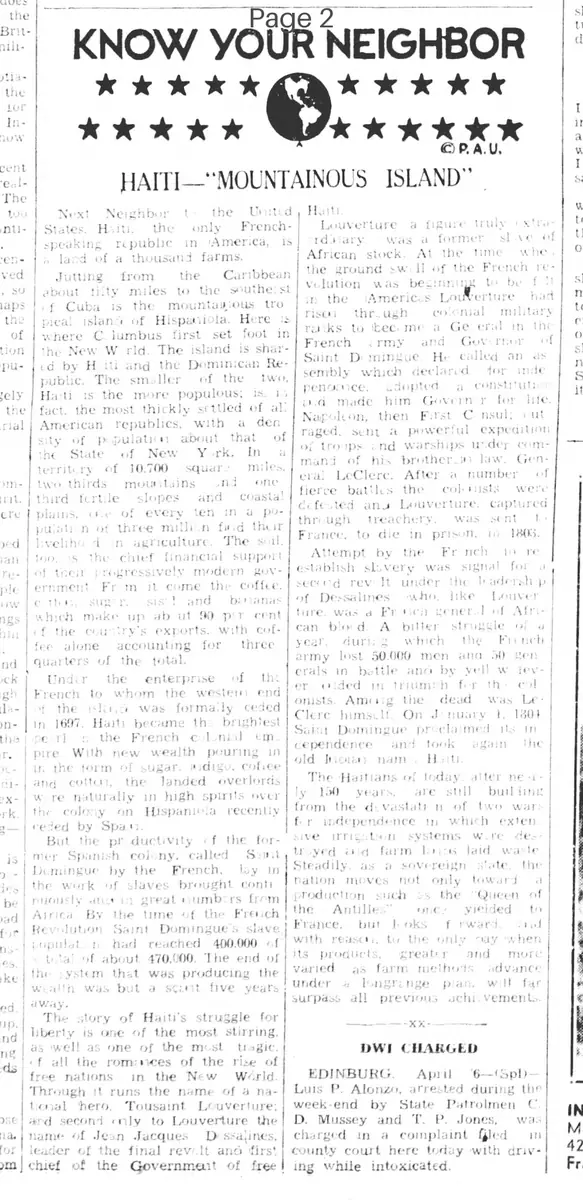
HAITI—"MOUNTAINOUS ISLAND"
Next Neighbor to the United States, Haiti the only French-speaking republic in America, is land of a thousand farms.
Jutting from the Caribbean about thirty miles to the southeast of Cuba is the mountainous tropical island of Hispaniola. Here is where Columbus first set foot in the New World. The island is shared by Haiti and the Dominican Republic. The smaller of the two, Haiti is the more populous, is in fact, the most thickly settled of all American republics, with a density of population about that of the State of New York. In a territory of 10,000 square miles two-thirds mountains in one third fertile slopes and coastal plains, out of every ten in a population of three million find their livelihood in agriculture. The soil is the chief financial support of these progressively modern government. From it come the coffee, sisal and bauxite which make up about 90 per cent of the country's exports, with coffee alone accounting for three quarters of the total.
Under the enterprise of the French to whom the western end the island was formally ceded in 1697, Haiti, became the brightest jewel in the French colonial empire. With new wealth pouring in it the form of sugar, indigo, coffee and cotton, the landed overlords were naturally in high spirits over the colony on Hispaniola recently ceded by Spain.
But the productivity of the former Spanish colony, called Saint Domingue by the French, lay in the work of slaves brought continuously in great numbers from Africa. By the time of the French Revolution Saint Domingue's slave population had reached 400,000 as against about 470,000. The end of the system that was producing the wealth was but a short five years away.
The story of Haiti's struggle for liberty is one of the most stirring, as well as one of the most tragic of all the romances of the rise of free nations in the New World. Through it runs the name of a national hero, Toussaint Louverture, and second only to Louverture the name of Jean Jacques Dessalines, leader of the final revolt and first chief of the Government of free.
Louverture a figure in history was a former slave of African stock. At the time when the ground-swell of the French Revolution was beginning to be felt in the Americas Louverture had risen, through colonial military ranks to become a General in the French army and Governor of Saint Domingue. He called an assembly which declared for independence, adopted a constitution and made him Governor for life.
Napoleon, then First Consul, was outraged, sent a powerful expedition of troops and warships under command of his brother-in-law, Gen. LeClerc. After a number of fierce battles the colonists were defeated and Louverture captured through treachery, was sent to France, to die in prison, in 1803.
Attempt by the French to establish slavery was signal for second revolt under the leadership of Dessalines. Also like Louverture was a French general of African blood. A bitter struggle of a year during which the French army lost 50,000 men and 50 generals in battle and by yellow fever, eradicated in triumph for the colonists. Among the dead was LeClerc himself. On January 1, 1804, Saint Domingue proclaimed its independence and took again the old Arawak name Haiti.
The Haitians of today, after nearly 150 years are still building from the devastation of two wars for independence on which extensive irrigation systems were destroyed and farm lands laid waste.
Steadily, as a sovereign state the nation moves not only toward production such as the Queen of the Antilles yielded to France, but looks forward and with reason to the day when its products greater and more varied as farm methods advance under stringent plans will far surpass all previous achievement.
XX
DWI CHARGED
EDINBURG April 6—(Spl)— Luis P. Alonzo, arrested during the week end by State Patrolmen C. D. Mussey and T. P. Jones, was charged in a complaint filed in county court here today with driving while intoxicated.
What sub-type of article is it?
What keywords are associated?
What entities or persons were involved?
Where did it happen?
Foreign News Details
Primary Location
Haiti
Key Persons
Outcome
french army lost 50,000 men and 50 generals; independence proclaimed on january 1, 1804.
Event Details
Haiti, a mountainous island shared with the Dominican Republic, was a French colony known as Saint Domingue, ceded in 1697, thriving on slave labor producing sugar, indigo, coffee, and cotton. Inspired by the French Revolution, Toussaint Louverture, a former slave, rose to general and governor, declaring independence. Napoleon sent an expedition under Gen. LeClerc, capturing Louverture who died in prison in 1803. Dessalines led a second revolt against reimposed slavery, defeating the French after heavy losses, achieving independence as Haiti on January 1, 1804. Today, Haiti focuses on agriculture with coffee, sisal, and bauxite as main exports.