Thank you for visiting SNEWPapers!
Sign up free
The Massachusetts Spy, And Worcester County Advertiser
Worcester, Worcester County, Massachusetts
What is this article about?
The Worcester County Agricultural Society's committee reports on judging milch cows and fat cattle at their cattle show, noting deficiencies in competitor statements, praising high-quality entries, and awarding premiums to top producers like Thomas B. Eaton and Henry Penniman for exceptional milk yields and fattened oxen.
Clipping
OCR Quality
Full Text
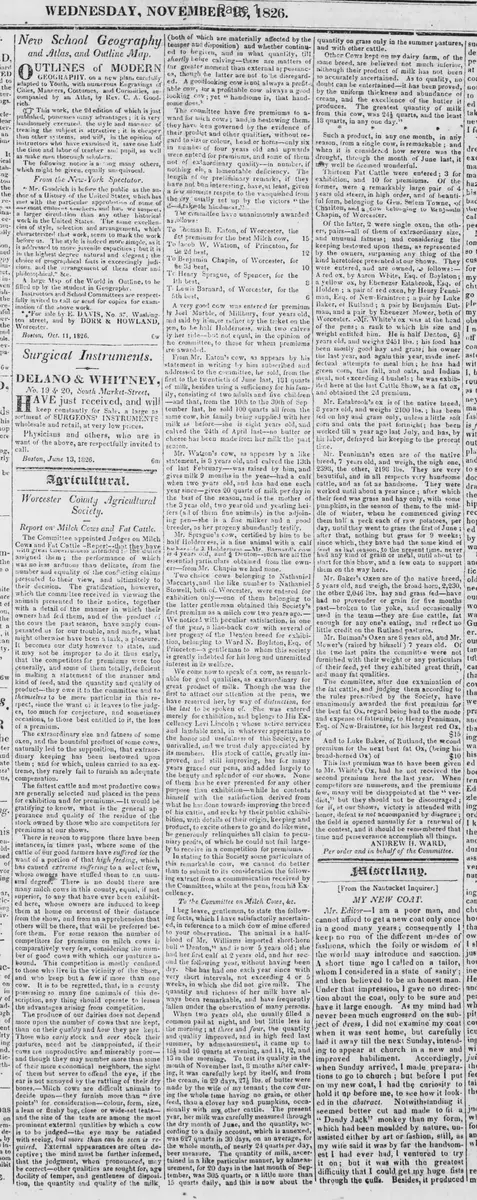
Worcester County Agricultural Society.
Report on Milch Cows and Fat Cattle.
The Committee appointed Judges on Milch Cows and Fat Cattle—Report—that they have with great willingness attended to the duties assigned them; the performance of which was no less arduous than delicate, from the number and equality of the conflicting claims presented to their view, and ultimately to their decision. The gratification, however, which the committee received in viewing the animals presented to their notice, together with a detail of the manner in which their owners had fed them, and of the product of the cows the past season, have amply compensated us for our trouble, and made, what might otherwise have been a task, a pleasure.
It becomes our duty however to state, and it may not be improper to do it thus early, that the competitors for premiums were too generally, and some of them totally, deficient in making a statement of the manner and kind of feed, and the quantity and quality of product—they owe it to the committee and to themselves to be more particular in this respect, since the want of it leaves to the judges, too much for conjecture, and sometimes occasions, to those best entitled to it, the loss of a premium.
The extraordinary size and fatness of some oxen, and the bountiful product of some cows, naturally led to the supposition, that extraordinary keeping has been bestowed upon them; and for which, unless carried to an extreme, they rarely fail to furnish an adequate compensation.
The fattest cattle and most productive cows are generally selected and placed in the pens for exhibition and for premiums. It would be gratifying to know, what is the general appearance and quality of the residue of the stock owned by those who are competitors for premiums at our shows.
There is reason to suppose there have been instances, in times past, where some of the cattle of our good farmers have suffered for the want of a portion of that high feeding, which has caused extreme suffering to a select few, whose owners have stuffed them to an unusual degree. There is no doubt there are many milch cows in this county, equal, if not superior, to any that have ever been exhibited here, whose owners are induced to keep them at home on account of their distance from the show, and from an apprehension that others will be there, that will be preferred before them. For some reason the number of competitors for premiums on milch cows is comparatively very few, considering the number of good cows with which our pastures abound. This competition is mostly confined to those who live in the vicinity of the Show, and who keep but a few if more than one cow. It is to be regretted, that, in a county possessing so many fine animals of this description, any thing should operate to lessen the advantages arising from competition.
The produce of our dairies does not depend more upon the number of cows that are kept, than on their quality and how they are kept. Those who early stock and over stock their pastures, need not be disappointed, if their cows are unproductive and miserably poor—and though they may number more than some of their more economical neighbors, the sight of them but serves to offend the eye, if the ear is not annoyed by the rattling of their dry bones. Milch cows are difficult animals to decide upon—they furnish more than "five points" for consideration—colour, form, size, a lean or fleshy bag, close or wide-set teats—and the size of the teats are among the most prominent external qualities by which a cow is to be judged—the eye may be satisfied with seeing, but more than can be seen is required. External appearances are often deceptive; the mind must be further informed, that the judgment, when pronounced, may be correct—other qualities are sought for, age docility of temper, and gentleness of disposition, the quantity and quality of the milk (both of which are materially affected by the temper and disposition) and whether continued to be given, and in what quantity, till shortly before calving—these are matters of far greater moment than external appearances, though the latter are not to be disregarded. A good looking cow is not always a profitable cow, nor a profitable cow always a good looking cow; yet "handsome is, that handsome does."
The committee have five premiums to award for milch cows; and in bestowing them, they have been governed by the evidence of their product and other qualities, without regard to size or colour, head or horns—only six in number of four years old and upwards were entered for premiums, and some of them not of extraordinary quality—in number, if nothing else, a lamentable deficiency. The length of our preliminary remarks, if they have not been interesting, have, at least, given a few moments respite to the vanquished from the cry usually set up by the victors "the devil take the hindmost."
The committee have unanimously awarded as follows:
To Thomas B. Eaton, of Worcester, the 1st premium for the best Milch cow, $15
To Jacob W. Watson, of Princeton, for the 2d best, $12
To Benjamin Chapin, of Worcester, for the 3d best, $10
To Henry Sprague, of Spencer, for the 4th best, $8
To Lewis Barnard, of Worcester, for the 5th best, $6
A very good cow was entered for premium by Joel Marble, of Millbury, four years old, and said by him, or rather by the ticket on the pen, to be half Holderness, with two calves by her side—but not equal, in the opinion of the committee, to those for whom premiums are awarded.
From Mr. Eaton's cow, as appears by his statement in writing by him subscribed and addressed to the committee, he sold, from the first to the twentieth of June last, 181 quarts of milk, besides using a sufficiency for his family, consisting of two adults and five children—and that, from the 10th to the 30th of September last, he sold 100 quarts all from the same cow, his family being supplied with her milk as before—she is eight years old, and calved the 24th of April last—no butter or cheese has been made from her milk the past season.
Mr. Watson's cow, as appears by a like statement, is 3 years old, and calved the 13th of last February—was raised by him, and gives milk 9 months in the year—had a calf when two years old, and has had one each year since—gives 20 quarts of milk per day in the best of the season, and is the mother of the 3 year old, two year old and yearling heifers (all of them fine animals) in the adjoining pen—she is a fine milker and a good breeder, as her progeny abundantly testify.
Mr. Sprague's cow, certified by him to be half Holderness, is a fine animal with a calf by her side a Holderness—Mr. Barnard's cow is 4 years old, and Devon—such are all the essential particulars obtained from the owners—from Mr. Chapin we had none.
Two choice cows belonging to Nathaniel Maccarty, and the like number to Nathaniel Stowell, both of Worcester, were entered for exhibition only—one of them belonging to the latter gentleman obtained this Society's first premium as a milch cow two years ago.
We noticed with peculiar satisfaction, in one of the pens, a line-back cow with several of her progeny of the Devon breed for exhibition, belonging to Ward N. Boylston, Esq. of Princeton—a gentleman to whom this society is greatly indebted for his long and unremitted interest in its welfare.
We come now to speak of a cow, as remarkable for good qualities, as extraordinary for great product of milk. Though she was the first to attract our attention at the pens, we have reserved her, by way of distinction, for the last to be spoken of. She was entered merely for exhibition, and belongs to His Excellency Levi Lincoln: whose active services and laudable zeal, in whatever appertains to the honor and usefulness of this Society, are unrivalled, and we trust duly appreciated by its members. His stock of cattle, greatly improved, and still improving, has for many years graced our pens, and added largely to the beauty and splendor of our shows. None of them has he ever presented for any other purpose than exhibition—while he contents himself with the satisfaction derived from what he has done towards improving the breed of his cattle, and seeks by their public exhibition, with details of their origin, keeping and product, to excite others to go and do likewise, he generously relinquishes all claim to pecuniary profits, of which he could not fail largely to receive in a competition for premiums.
In stating to this Society some particulars of this remarkable cow, we cannot do better than to submit to its consideration the following extract from a communication received by the Committee, while at the pens, from his Excellency.
To the Committee on Milch Cows, &c.
I beg leave, gentlemen, to state the following facts, which I have satisfactorily ascertained, in reference to a milch cow of mine offered to your observation. The animal is a half-blood of Mr. Williams imported short-horn bull "Denton," and is now 5 years old; she had her first calf at 2 years old, and her second the following year, without having been dry. She has had one each year since with very short intervals, not exceeding 4 or 5 weeks, in which she did not give milk. The quantity and richness of her milk have always been remarkable, and have frequently fallen under the observation of many persons. When two years old, she usually filled a common pail at night, and but little less in the morning; at three and four, the quantity and quality improved, and in high feed last summer, by admeasurement, it came up to 15 and 16 quarts at evening, and 11, 12, and 13 in the morning. To test its quality in the month of November last, 8 months after calving, it was carefully kept by itself, and from the cream, in 29 days, 27 lbs. of butter were made by the wife of my tenant; the cow during the whole time having no grain, or other feed, than a clover hay and pumpkins, occasionally with my other cattle. The present year, her milk was carefully measured through the dry month of June, and the quantity, according to a daily account, which is annexed, was 627 quarts in 30 days, on an average, for the whole month, of nearly 24 quarts per day, beer measure. The quantity of milk, ascertained in a like particular manner, by admeasurement, for 20 days in the last month of September, was 305 quarts, or a little more than 15 quarts daily, and this is now about the quantity on grass only in the summer pastures, and with other cattle.
Other Cows kept on my dairy farm, of the same breed, are believed not much inferior, although their product of milk has not been so accurately ascertained. As to quality, no doubt can be entertained—it has been proved, by the uniform thickness and abundance of cream, and the excellence of the butter it produces. The greatest quantity of milk from this cow, was 24 quarts, and the least 18 quarts, in any one day.
Such a product, in any one month, in any season, from a single cow, is remarkable; and when it is considered how severe was the drought, through the month of June last, it may well be deemed wonderful.
Thirteen Fat Cattle were entered; 3 for exhibition, and 10 for premiums. Of the former, were a remarkably large pair of 4 years old steers, in high order, and of beautiful form, belonging to Gen. Salem Towne, of Charlton, and a cow belonging to Benjamin Chapin, of Worcester.
Of the latter, 2 were single oxen, the others, pairs—all of them of extraordinary size, and unusual fatness; and considering the keeping bestowed upon them, as represented by the owners, surpassing any thing of the kind heretofore presented at our Shows. They were entered, and are owned, as follows: A red ox, by Aaron White, Esq. of Boylston; a yellow ox, by Ebenezer Estabrook, Esq. of Holden; a pair of red oxen, by Henry Penniman, Esq. of New-Braintree; a pair by Luke Baker, of Rutland; a pair by Benjamin Butman, and a pair by Ebenezer Mower, both of Worcester. Mr. White's ox was at the head of the pens; a rank to which his size and weight entitled him. He is half Denton, 6 years old, and weighs 2451 lbs.; his food has been mostly good hay and grass; his owner the last year, and again this year, made ineffectual attempts to meal him; he has had green corn, this fall, and oats, and Indian meal, not exceeding 4 bushels; he was exhibited here at the last Cattle Show, as a fat ox, and obtained the 2d premium.
Mr. Estabrook's ox is of the native breed, 8 years old, and weighs 2100 lbs.; has been fed on hay and grass only, unless a little soft corn and oats the past fortnight; has been worked till a year ago last July, and has, by his labor, defrayed his keeping to the present time.
Mr. Penniman's oxen are of the native breed, 7 years old, and weigh, the nigh one, 2393, the other, 2198 lbs. They are very beautiful, and in all respects very handsome cattle, and as fat as handsome. They were worked until about a year since; after which their feed was grass and hay only, with some pumpkins, in the season of them, to the middle of winter, when he commenced giving them half a peck each of raw potatoes, per day, until they went to grass the first of June; after that, nothing but grass for 9 weeks; since which, they have had the same kind of feed as last season, to the present time, never had any kind of grain or meal, until about to start for this Show, and a few oats to support them on the way here.
Mr. Baker's Oxen are of the native breed, 5 years old, and weigh, the broad-horn, 2,230, the other 2,046 lbs. hay and grass fed have had no provender or grain for five months past—broken to the yoke, and occasionally used in the team—they are fine cattle, fat enough for any one's eating, and reflect no little credit on the Rutland pastures.
Mr. Butman's Oxen are 8 years old, and Mr. Mower's (raised by himself) 7 years old. Of the two last pairs the committee were not furnished with their weight or any particulars of their feed, yet they exhibited great thrift, and many fat qualities.
The committee, after due examination of the fat cattle, and judging them according to the rules prescribed by the Society, have unanimously awarded the first premium for the best fat Ox, regard being had to the mode and expense of fattening, to Henry Penniman, Esq. of New-Braintree, for his largest red Ox, of $15
And to Luke Baker, of Rutland, the second premium for the next best fat Ox, (being his broad-horned Ox) of $10
This last premium was to have been given to Mr. White's Ox, had he not received the second premium here the last year. When competitors are numerous, and the premiums few, many will be disappointed at the "verdict," but they should not be discouraged; for if, at our Shows, victory is attended with honor, defeat is not accompanied by disgrace; the field is opened annually for a renewal of the contest, and it should be remembered that time and perseverance accomplish all things.
ANDREW H. WARD,
Per order and in behalf of the Committee.
What sub-type of article is it?
What keywords are associated?
What entities or persons were involved?
Where did it happen?
Domestic News Details
Primary Location
Worcester County
Key Persons
Outcome
premiums awarded: milch cows - 1st $15 to thomas b. eaton (worcester), 2nd $12 to jacob w. watson (princeton), 3rd $10 to benjamin chapin (worcester), 4th $8 to henry sprague (spencer), 5th $6 to lewis barnard (worcester). fat oxen - 1st $15 to henry penniman (new-braintree), 2nd $10 to luke baker (rutland). exhibitions noted for levi lincoln's high-producing cow and others.
Event Details
The Worcester County Agricultural Society's committee judged milch cows and fat cattle at their show, emphasizing the importance of detailed feed and product statements from competitors. They awarded premiums based on productivity, quality, and feeding methods, highlighting exceptional entries like Levi Lincoln's cow producing up to 24 quarts daily despite drought, and detailed weights and feeds for fat oxen up to 2451 lbs.