Thank you for visiting SNEWPapers!
Sign up free
Anti Slavery Bugle
New Lisbon, Salem, Columbiana County, Ohio
What is this article about?
An essay on the historical persecution faced by reformers, innovators, and scientists from clergy, authorities, and masses. Examples include opposition to agricultural tools, medical advances like vaccination and inoculation, and a sermon by Rev. Charles Beecher critiquing creed-bound Protestant ministry stifling biblical freedom and reform.
Clipping
OCR Quality
Full Text
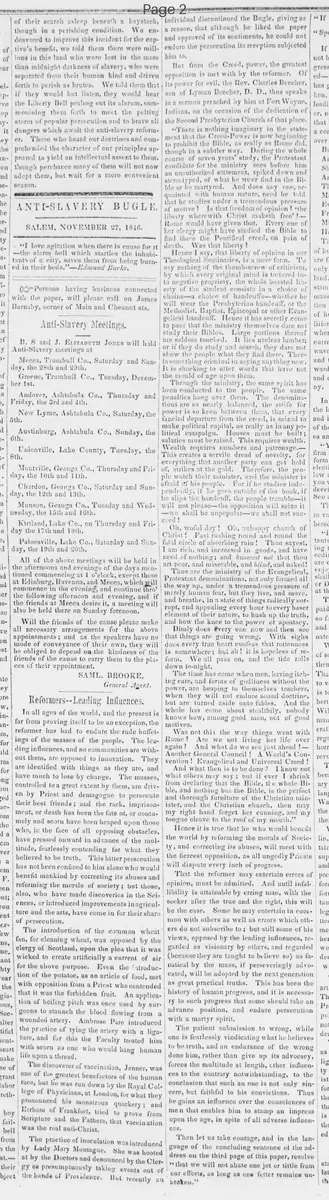
In all ages of the world, and the present is far from proving itself to be an exception, the reformer has had to endure the rude buffetings of the masses of the people. The leading influences, and no communities are without them, are opposed to innovation. They are identified with things as they are, and have much to lose by change. The masses, controlled to a great extent by them, are driven by Priest and demagogue to persecute their best friends; and the rack, imprisonment, or death has been the fate of, or contumely and scorn have been heaped upon those who, in the face of all opposing obstacles, have pressed onward in advance of the multitude, fearlessly contending for what they believed to be truth. This bitter persecution has not been confined to him alone who would benefit mankind by correcting its abuses and reforming the morals of society; but those, also, who have made discoveries in the Sciences, or introduced improvements in agriculture and the arts, have come in for their share of persecution.
The introduction of the common wheat fan, for cleaning wheat, was opposed by the clergy of Scotland, upon the plea that it was wicked to create artificially a current of air for the above purpose. Even the introduction of the potatoe, as an article of food, met with opposition from a Priest who contended that it was the forbidden fruit. An application of boiling pitch was once used by surgeons to staunch the blood flowing from a wounded artery. Ambrose Pare introduced the practice of tying the artery with a ligature, and for this the Faculty treated him with scorn as one who would hang human life upon a thread.
The discoverer of vaccination, Jenner, was one of the greatest benefactors of the human race, but he was run down by the Royal College of Physicians, at London, for what they pronounced his monstrous quackery; and Errham of Frankfort, tried to prove from Scripture and the Fathers, that vaccination was the real anti-Christ.
The practice of inoculation was introduced by Lady Mary Montague. She was hooted at by the Doctors and denounced by the Clergy as presumptuously taking events out of the hands of Providence.
But recently an individual discontinued the Bugle, giving as a reason, that although he liked the paper and approved of its sentiments, he could not endure the persecution its reception subjected him to. But from the Creed, power, the greatest opposition is met with by the reformer. Of its power for evil, the Rev. Charles Beecher, son of Lyman Beecher, D. D., thus speaks in a sermon preached by him at Fort Wayne, Indiana, on the occasion of the dedication of the Second Presbyterian Church of that place.
"There is nothing imaginary in the statement that the Creed-Power is now beginning to prohibit the Bible, as really as Rome did. though in a subtler way. During the whole course of seven years' study, the Protestant candidate for the ministry sees before him an unauthorized statement, spiked down and stereotyped, of what he Must find in the Bible or be martyred. And does any one, ac-quainted with human nature, need be told that he studies under a tremendous pressure of motive? Is that freedom of opinion? 'the liberty wherewith Christ maketh free'? Rome would have given that. Every one of her clergy might have studied the Bible to find there the Pontifical creed, on pain of death. Was that liberty ?
Hence I say, that liberty of opinion in our Theological Seminaries, is a mere form. To say nothing of the thumb-screw of criticism, by which every original mind is tortured into negative propriety, the whole boasted liberty of the student consists in a choice of chains—a choice of handcuffs—whether he will wear the Presbyterian handcuff, or the Methodist. Baptist, Episcopal or other Evangelical handcuff. Hence it has secretly come to pass that the ministry themselves dare not study their Bibles. Large portions thereof are seldom touched. It lies useless lumber; or if they do study and search, they dare not show the people what they find there. There is something criminal in saying anything new. It is shocking to utter words that have not the mould of age upon them.
Through the ministry, the same spirit has been conducted to the people. The same penalties hang over them. The denominations are so nearly balanced. the strife for power is so keen between them, that every fancied departure from the creed, is seized to make political capital, as really as in any political campaign. Houses must be built: salaries must be raised. This requires wealth. Wealth requires numbers and patronage.—This creates a servile dread of novelty, for everything that another party can get hold of, strikes at the gold. Therefore, the people watch their minister, and the minister is afraid of his people. For if he studies independently, if he goes outside of the book, if he slips the handcuff, the people tremble—it will not please—the opposition will seize it —we shall be unpopular—we shall not succeed!
Oh, woful day! Oh, unhappy church of Christ! Fast rushing round and round the fatal circle of absorbing ruin! 'Thou sayest, I am rich, and increased in goods, and have need of nothing; and knowest not that thou art poor, and miserable, and blind, and naked! Thus are the ministry of the Evangelical, Protestant denominations, not only formed all the way up, under a tremendous pressure of merely human fear, but they live, and move, and breathe, in a state of things radically corrupt, and appealing every hour to every baser element of their nature, to hush up the truth, and bow the knee to the power of apostacy. Dimly does every one now and then see that things are going wrong. With sighs does every true heart confess that rottenness is somewhere: but ah! it is hopeless of reform. We all pass on, and the tide rolls down to-night.
The time has come when men, having itching ears, and forms of godliness without the power, are heaping to themselves teachers, when they will not endure sound doctrine, but are turned aside unto fables. And the whole has come about stealthily, nobody knows how, among good men, out of good motives.
Was not this the way things went with Rome? Are we not living her life over again? And what do we see just ahead ?—Another General Council ! A World's Convention! Evangelical and Universal Creed ! And what then is to be done ? I know not what others may say; but if ever I shrink from declaring that the Bible, the whole Bible, and nothing but the Bible. is the perfect and thorough furniture of the Christian minister, and the Christian church, then may my right hand forget her cunning, and my tongue cleave to the roof of my mouth."
Hence it is true that he who would benefit the world by reforming the morals of Society, and correcting its abuses, will meet with the fiercest opposition, as all ungodly Priests will dispute every inch of progress.
That the reformer may entertain errors of opinion, must be admitted. And until infallibility is attainable by erring man, with the seeker after the true and the right, this will be the case. Some he may entertain in common with others as well as errors which others do not subscribe to; but still some of his views, opposed by the leading influences, regarded as visionary by others, and regarded (because they are taught to believe so) as fanatical by the mass, if perseveringly advocated, will be adopted by the next generation as great practical truths. This has been the history of human progress, and it is necessary to such progress that some should take an advance position, and endure persecution with a martyr spirit.
The patient submission to wrong, while one is fearlessly vindicating what he believes to be truth, and an endurance of the wrong done him, rather than give up its advocacy, forces the multitude at length, other influences to the contrary notwithstanding, to the conclusion that such an one is not only sincere, but faithful to his convictions. Thus he gains an influence over the consciences of men that enables him to stamp an impress upon the age, in spite of all adverse influences.
Then let us take courage, and in the language of the concluding sentence of the address on the third page of this paper, resolve "that we will not abate one jot or tittle from our efforts, as long as one fetter remains unbroken."
What sub-type of article is it?
What themes does it cover?
What keywords are associated?
What entities or persons were involved?
Where did it happen?
Story Details
Key Persons
Location
Various Historical Locations Including Scotland, London, Frankfort, Fort Wayne Indiana
Event Date
Historical Periods And Recent
Story Details
Essay arguing that reformers and innovators face persecution from clergy and authorities, with examples of opposition to inventions like the wheat fan, potato, surgical ligature, vaccination, and inoculation; includes excerpt from Rev. Charles Beecher's sermon on creed-power stifling Protestant ministry and biblical study, concluding that persistent advocacy leads to eventual acceptance of truths.