Thank you for visiting SNEWPapers!
Sign up free
Editorial
February 24, 1774
The Massachusetts Spy, Or, Thomas's Boston Journal
Boston, Suffolk County, Massachusetts
What is this article about?
On February 23, 1774, inhabitants of Marshfield, Massachusetts, protest their town's January 31 resolves condemning the Boston Tea Party destruction as illegal, defending it as a response to British forced tea importation under revenue acts, affirming loyalty to the King, and criticizing instructions to their representative and reflections on Plymouth.
Clipping
OCR Quality
95%
Excellent
Full Text
WEDNESDAY, February 23. BOSTON.
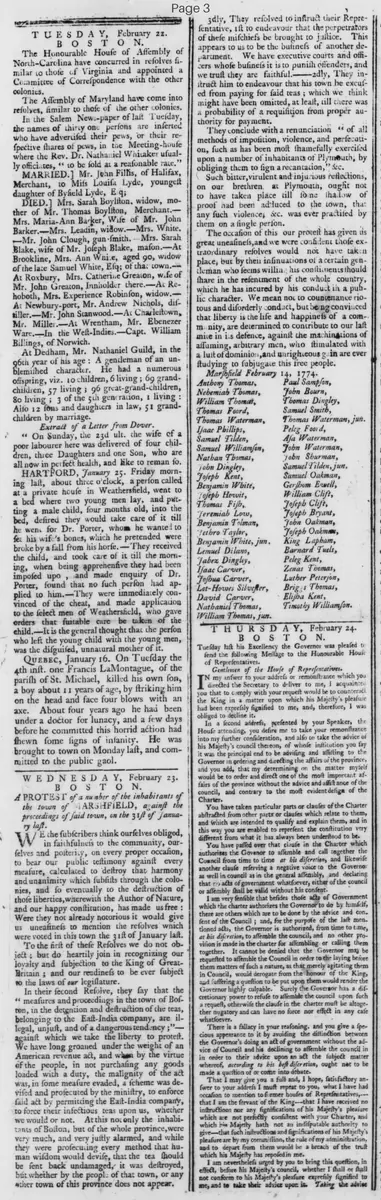
A PROTEST of a number of the inhabitants of the town of MARSHFIELD, against the proceedings of said town, on the 31st of January last.
We the subscribers think ourselves obliged, in faithfulness to the community, ourselves and posterity, on every proper occasion, to bear our public testimony against every measure, calculated to destroy that harmony and unanimity which subsists through the colonies, and so eventually to the destruction of those liberties, wherewith the Author of Nature, and our happy constitution, has made us free: Were they not already notorious it would give us uneasiness to mention the resolves which were voted in this town the 31st of January last. To the first of these Resolves we do not object; but do heartily join in recognizing our loyalty and subjection to the King of Great-Britain; and our readiness to be ever subject to the laws of our legislature. In their second Resolve, they say that the "measures and proceedings in the town of Boston, in the detention and destruction of the teas, belonging to the East-India company, are illegal, unjust, and of a dangerous tendency;" against which we take the liberty to protest. We have long groaned under the weight of an American revenue act, and when by the virtue of the people, in not purchasing any goods loaded with a duty, the malignity of the act was, in some measure evaded, a scheme was devised and prosecuted by the ministry, to enforce said act by permitting the East-India company, to force their infectious teas upon us, whether we would or not. At this not only the inhabitants of Boston, but of the whole province, were very much, and very justly alarmed, and while they were prosecuting every method that human wisdom would devise, that the tea should be sent back undamaged, it was destroyed, but whether by the people of that town, or any other town of this province does not appear.
3dly, They resolved to instruct their Representative, 1st to endeavour that the perpetrators of these mischiefs be brought to justice. This appears to us to be the business of another department. We have executive courts and officers whose business it is to punish offenders, and we trust they are faithful. 2dly, They instruct him to endeavour that his town be excused from paying for said teas; which we think might have been omitted, at least, till there was a probability of a requisition from proper authority for payment. They conclude with a renunciation "of all methods of imposition, violence, and persecution, such as has been most shamefully exercised upon a number of inhabitants of Plymouth, by obliging them to sign a recantation," &c. Such bitter, virulent and injurious reflections, on our brethren at Plymouth, ought not to have taken place till some shadow of proof had been adduced to the town, that any such violence, &c. was ever practised by them on a single person. The occasion of this our protest has given us great uneasiness, and we were confident those extraordinary resolves would not have taken place, but by their insinuations of a certain gentleman who seems willing, his constituents should share in the resentment of the whole country, which he has incurred by his conduct in a public character. We mean not to countenance riotous and disorderly conduct, but being convinced that liberty is the life and happiness of a community, are determined to contribute to our last mite in its defence, against the machinations of assuming, arbitrary men, who stimulated with a lust of dominion, and unrighteous gain are ever studying to subjugate this free people.
Marshfield February 23, 1774.
Anthony Thomas, Nehemiah Thomas, William Thomas, Thomas Foord, Thomas Waterman, Isaac Phillips, Samuel Tilden, Samuel Williamson, Nathan Thomas, John Dingley, Joseph Kent, Benjamin White, Joseph Hervey, Thomas Fish, Jeremiah Low, Benjamin Tolman, Sethro Taylor, Benjamin White, jun. Lemuel Dilano, Jabez Dingley, Isaac Carver, Joshua Carver, Lot-Howes Silvester, David Carver, Nathaniel Thomas, William Thomas, jun. Paul Sampson, John Bourn, Thomas Dingley, Samuel Smith, Thomas Waterman, jun. Peleg Foord, Asa Waterman, John Waterman, John Sherman, Samuel Tilden, jun. Samuel Oakman, Gershom Ewell, William Clift, Joseph Clift, Joseph Bryant, John Oakman, Joseph Oakman, King Lapham, Barnard Tuels, Peleg Kent, Zenas Thomas, Luther Peterson, Briggs Thomas, Elijah Kent, Timothy Williamson.
A PROTEST of a number of the inhabitants of the town of MARSHFIELD, against the proceedings of said town, on the 31st of January last.
We the subscribers think ourselves obliged, in faithfulness to the community, ourselves and posterity, on every proper occasion, to bear our public testimony against every measure, calculated to destroy that harmony and unanimity which subsists through the colonies, and so eventually to the destruction of those liberties, wherewith the Author of Nature, and our happy constitution, has made us free: Were they not already notorious it would give us uneasiness to mention the resolves which were voted in this town the 31st of January last. To the first of these Resolves we do not object; but do heartily join in recognizing our loyalty and subjection to the King of Great-Britain; and our readiness to be ever subject to the laws of our legislature. In their second Resolve, they say that the "measures and proceedings in the town of Boston, in the detention and destruction of the teas, belonging to the East-India company, are illegal, unjust, and of a dangerous tendency;" against which we take the liberty to protest. We have long groaned under the weight of an American revenue act, and when by the virtue of the people, in not purchasing any goods loaded with a duty, the malignity of the act was, in some measure evaded, a scheme was devised and prosecuted by the ministry, to enforce said act by permitting the East-India company, to force their infectious teas upon us, whether we would or not. At this not only the inhabitants of Boston, but of the whole province, were very much, and very justly alarmed, and while they were prosecuting every method that human wisdom would devise, that the tea should be sent back undamaged, it was destroyed, but whether by the people of that town, or any other town of this province does not appear.
3dly, They resolved to instruct their Representative, 1st to endeavour that the perpetrators of these mischiefs be brought to justice. This appears to us to be the business of another department. We have executive courts and officers whose business it is to punish offenders, and we trust they are faithful. 2dly, They instruct him to endeavour that his town be excused from paying for said teas; which we think might have been omitted, at least, till there was a probability of a requisition from proper authority for payment. They conclude with a renunciation "of all methods of imposition, violence, and persecution, such as has been most shamefully exercised upon a number of inhabitants of Plymouth, by obliging them to sign a recantation," &c. Such bitter, virulent and injurious reflections, on our brethren at Plymouth, ought not to have taken place till some shadow of proof had been adduced to the town, that any such violence, &c. was ever practised by them on a single person. The occasion of this our protest has given us great uneasiness, and we were confident those extraordinary resolves would not have taken place, but by their insinuations of a certain gentleman who seems willing, his constituents should share in the resentment of the whole country, which he has incurred by his conduct in a public character. We mean not to countenance riotous and disorderly conduct, but being convinced that liberty is the life and happiness of a community, are determined to contribute to our last mite in its defence, against the machinations of assuming, arbitrary men, who stimulated with a lust of dominion, and unrighteous gain are ever studying to subjugate this free people.
Marshfield February 23, 1774.
Anthony Thomas, Nehemiah Thomas, William Thomas, Thomas Foord, Thomas Waterman, Isaac Phillips, Samuel Tilden, Samuel Williamson, Nathan Thomas, John Dingley, Joseph Kent, Benjamin White, Joseph Hervey, Thomas Fish, Jeremiah Low, Benjamin Tolman, Sethro Taylor, Benjamin White, jun. Lemuel Dilano, Jabez Dingley, Isaac Carver, Joshua Carver, Lot-Howes Silvester, David Carver, Nathaniel Thomas, William Thomas, jun. Paul Sampson, John Bourn, Thomas Dingley, Samuel Smith, Thomas Waterman, jun. Peleg Foord, Asa Waterman, John Waterman, John Sherman, Samuel Tilden, jun. Samuel Oakman, Gershom Ewell, William Clift, Joseph Clift, Joseph Bryant, John Oakman, Joseph Oakman, King Lapham, Barnard Tuels, Peleg Kent, Zenas Thomas, Luther Peterson, Briggs Thomas, Elijah Kent, Timothy Williamson.
What sub-type of article is it?
Constitutional
Partisan Politics
What keywords are associated?
Marshfield Protest
Boston Tea Party
Colonial Liberties
East India Company
American Revenue Act
Town Resolves
What entities or persons were involved?
King Of Great Britain
East India Company
Town Of Boston
Marshfield Town
Plymouth Inhabitants
Editorial Details
Primary Topic
Protest Against Town's Condemnation Of Boston Tea Destruction
Stance / Tone
Defense Of Colonial Liberties Against British Revenue Acts
Key Figures
King Of Great Britain
East India Company
Town Of Boston
Marshfield Town
Plymouth Inhabitants
Key Arguments
Affirm Loyalty To The King And Subjection To Legislature Laws
Protest Against Labeling Boston Tea Destruction As Illegal And Unjust
Tea Destruction Resulted From British Ministry's Scheme To Force Taxed Teas On Colonies
Instructing Representative To Seek Justice For Perpetrators Is Executive Matter
Opposition To Seeking Exemption From Tea Payment Without Proper Requisition
Condemnation Of Unproven Reflections On Plymouth For Alleged Violence