Thank you for visiting SNEWPapers!
Sign up free
The Laurens Advertiser
Laurens, Laurens County, South Carolina
What is this article about?
South Carolina's Commissioner E.J. Watson launches a concerted campaign across the cotton belt to hold 1910-11 cotton until it reaches 13 cents per pound or September 1, 1912, and reduce 1912 cotton acreage to 60% of arable land, with pledges and assessments to fund the effort.
Merged-components note: Continuation of article on cotton reducing movement across pages; relabeled to domestic_news for agricultural/economic focus.
Clippings
1 of 2
OCR Quality
Full Text
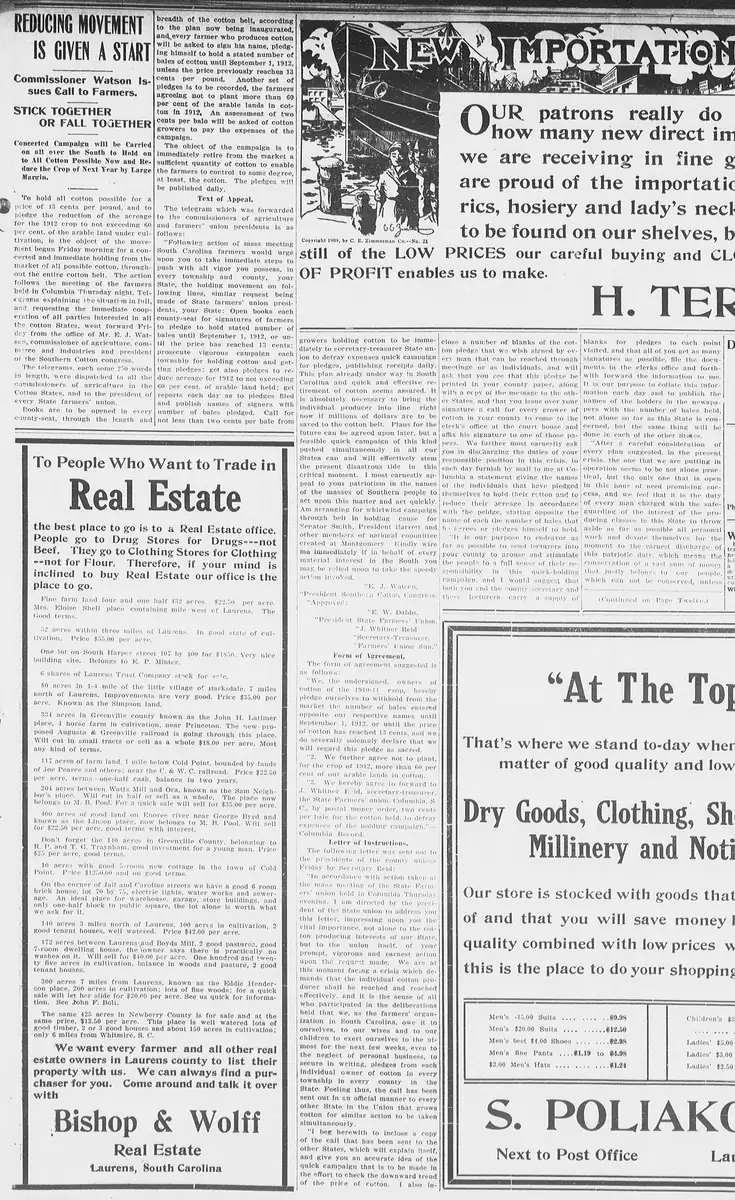
IS GIVEN A START
Commissioner Watson Issues Call to Farmers.
STICK TOGETHER
OR FALL TOGETHER
Concerted Campaign will be Carried on all over the South to Hold on to All Cotton Possible Now and Reduce the Crop of Next Year by Large Margin.
To hold all cotton possible for a price of 13 cents per pound, and to pledge the reduction of the acreage for the 1912 crop to not exceeding 60 per cent. of the arable land under cultivation, is the object of the movement begun Friday morning for a concerted and immediate holding from the market of all possible cotton, throughout the entire cotton belt. The action follows the meeting of the farmers held in Columbia Thursday night. Telegrams explaining the situation in full, and requesting the immediate cooperation of all parties interested in all the cotton States, went forward Friday from the office of Mr. E. J. Watson, commissioner of agriculture, commerce and industries and president of the Southern Cotton Congress.
The telegrams, each some 250 words in length, were dispatched to all the commissioners of agriculture in the Cotton States, and to the president of every State farmers' union.
Books are to be opened in every county-seat, through the length and breadth of the cotton belt, according to the plan now being inaugurated, and every farmer who produces cotton will be asked to sign his name, pledging himself to hold a stated number of bales of cotton until September 1, 1912, unless the price previously reaches 13 cents per pound.
Another set of pledges is to be recorded, the farmers agreeing not to plant more than 60 per cent of the arable lands in cotton in 1912. An assessment of two cents per bale will be asked of cotton growers to pay the expenses of the campaign.
The object of the campaign is to immediately retire from the market a sufficient quantity of cotton to enable the farmers to control to some degree, at least, the cotton. The pledges will be published daily.
Text of Appeal.
The telegram which was forwarded to the commissioners of agriculture and farmers' union presidents is as follows:
"Following action of mass meeting South Carolina farmers would urge upon you to take immediate steps to push with all vigor you possess, in every township and county, your State, the holding movement on following lines, similar request being made of State farmers' union presidents, your State: Open books each county-seat for signatures of farmers to pledge to hold stated number of bales until September 1, 1912, or until the price has reached 13 cents; prosecute vigorous campaign each township for holding cotton and getting pledges; get also pledges to reduce acreage for 1912 to not exceeding 60 per cent. of arable land held; get reports each day as to pledges filed and publish names of signers with number of bales pledged. Call for not less than two cents per bale from growers holding cotton to be immediately to secretary-treasurer State union to defray expenses quick campaign for pledges, publishing receipts daily.
This plan already under way in South Carolina and quick and effective retirement of cotton seems assured. It is absolutely necessary to bring the individual producer into line right now if millions of dollars are to be saved to the cotton belt. Plans for the future can be agreed upon later, but a feasible quick campaign of this kind pushed simultaneously in all our States can and will effectively stem the present disastrous tide in this critical moment. I most earnestly appeal to your patriotism in the names of the masses of Southern people to act upon this matter and act quickly.
Am arranging for whirlwind campaign through belt in holding cause for Senator Smith, President Barrett and other members of national committee created at Montgomery. Kindly wire me immediately if in behalf of every material interest in the South you may be relied upon to take the speedy action invoked.
"E. J. Watson,
"President Southern Cotton Congress.
"Approved:
"E. W. Dabbs,
"President State Farmers' Union.
"J. Whitner Reid
"Secretary-Treasurer.
"Farmers' Union Sun."
Form of Agreement.
The form of agreement suggested is as follows:
"We, the undersigned, owners of cotton of the 1910-11 crop, hereby pledge ourselves to withhold from the market the number of bales entered opposite our respective names until September 1, 1912, or until the price of cotton has reached 13 cents, and we do severally solemnly declare that we will regard this pledge as sacred.
"2. We further agree not to plant, for the crop of 1912, more than 60 per cent of our arable lands in cotton.
"3. We hereby agree to forward to J. Whitner Reid, secretary-treasurer, the State Farmers' union, Columbia, S. C., by postal money order, two cents per bale for the cotton held, to defray expenses of the holding campaign."
Columbia Record.
Letter of Instructions.
The following letter was sent out to the presidents of the county unions Friday by Secretary Reid:
"In accordance with action taken at the mass meeting of the State Farmers' union held in Columbia Thursday evening, I am directed by the president of the State union to address you this letter, impressing upon you the vital importance, not alone to the cotton producing interests of our State, but to the union itself, of your prompt, vigorous and earnest action upon the request made. We are at this moment facing a crisis which demands that the individual cotton producer shall be reached and reached effectively, and it is the sense of all who participated in the deliberations held that we, as the farmers' organization in South Carolina, owe it to ourselves, to our wives and to our children to exert ourselves to the utmost for the next few weeks, even to the neglect of personal business, to secure in writing, pledges from each individual owner of cotton in every township in every county in the State. Feeling thus, the call has been sent out in an official manner to every other State in the Union that grows cotton for similar action to be taken simultaneously.
"I beg herewith to inclose a copy of the call that has been sent to the other States, which will explain itself, and give you an accurate idea of the quick campaign that is to be made in the effort to check the downward trend of the price of cotton. I also inclose a number of blanks of the cotton pledge that we wish signed by every man that can be reached through meetings or as individuals, and will ask that you see that this pledge be printed in your county paper, along with a copy of the message to the other States, and that you issue over your signature a call for every grower of cotton in your county to come to the clerk's office at the court house and affix his signature to one of those papers.
We further most earnestly ask you in discharging the duties of your responsible position in this crisis, to each day furnish by mail to me at Columbia a statement giving the names of the individuals that have pledged themselves to hold their cotton and to reduce their acreage in accordance with the pledge, stating opposite the name of each the number of bales that he agrees or pledges himself to hold.
"It is our purpose to endeavor as far as possible to send lecturers into your county to arouse and stimulate the people to a full sense of their responsibility in this quick-holding campaign, and I would suggest that both you and the county secretary and these lecturers carry a supply of blanks for pledges to each point visited, and that all of you get as many signatures as possible, file the documents in the clerks office and forthwith forward the information to me.
It is our purpose to collate this information each day and to publish the names of the holders in the newspapers with the number of bales held, not alone so far as this State is concerned, but the same thing will be done in each of the other States.
"After a careful consideration of every plan suggested, in the present crisis, the one that we are putting in operation seems to be not alone practical, but the only one that is open in this hour of need promising success, and we feel that it is the duty of every man charged with the safeguarding of the interest of the producing classes in this State to throw aside as far as possible all personal work and devote themselves for the moment to the earnest discharge of this patriotic duty, which means the conservation of a vast sum of money that justly belongs to our people, which can not be conserved, unless (Continued on Page Twelve.)
REDUCING MOVEMENT IS GIVEN A START
(Continued From Page Nine.)
...our men heed the call to arms and go into the battle with the spirit that has animated our people ever since the commonwealth was founded.
"In regard to the two cents per bale, in order that the accounts may be kept without any danger of misapprehension or misplacing of funds, it is earnestly desired that you advise and direct every man who signs the pledge to remit this small sum by postal money order direct to me by mail. We desire postal money order remittance for the reason that it enables us to keep an exact record and any miscarriage in the mails can be easily traced immediately upon complaint, and, further, there is no charge for collection.
"In sending in your daily reports, simply use one of the blanks, a supply of which is sent you, thus making a duplicate of the record in the hands of the clerk of the court.
"We desire you to show this letter and all of the accompanying documents to the clerk of the court of your county, ask him to receive and keep these pledges on file and assist you in every way possible with the undertaking. I feel sure that there is not a clerk of court in the State who will not be willing to lend this measure of assistance to a cause which means so much to the masses of people."
Commissioner Watson received a telegram from the commissioner of agriculture of Alabama approving the plan for holding cotton as proposed by the South Carolina Farmers' union. The telegram stated that cotton "was moving slowly" to the market in Alabama.
What sub-type of article is it?
What keywords are associated?
What entities or persons were involved?
Where did it happen?
Domestic News Details
Primary Location
Columbia, South Carolina
Event Date
Begun Friday Morning Following Meeting Thursday Night In Columbia
Key Persons
Outcome
campaign aims to hold cotton until 13 cents per pound or september 1, 1912, reduce 1912 acreage to 60% of arable land, with 2 cents per bale assessment; approved in alabama
Event Details
Commissioner E. J. Watson initiates a movement to hold 1910-11 cotton crop from market and reduce 1912 planting, following a farmers' meeting in Columbia; telegrams sent to cotton states for cooperation; pledges to be signed at county seats and published daily.