Thank you for visiting SNEWPapers!
Sign up free
Martinsburgh Gazette
Martinsburg, Berkeley County, West Virginia
What is this article about?
Official US diplomatic correspondence from Secretary of State James Monroe to peace commissioners, dated 1813-1814, providing instructions on negotiating treaty with Britain to end War of 1812, addressing impressment, blockades, boundaries, neutral rights, and indemnities amid shifting European events.
Merged-components note: This is a continuous article consisting of extracts from letters by Secretary Monroe regarding peace negotiations with Great Britain, spanning pages 1-2. The text flows seamlessly across these components, so they are merged. Label changed from 'story' for the first component to 'foreign_news' as it pertains to international diplomacy.
Clippings
1 of 2
OCR Quality
Full Text
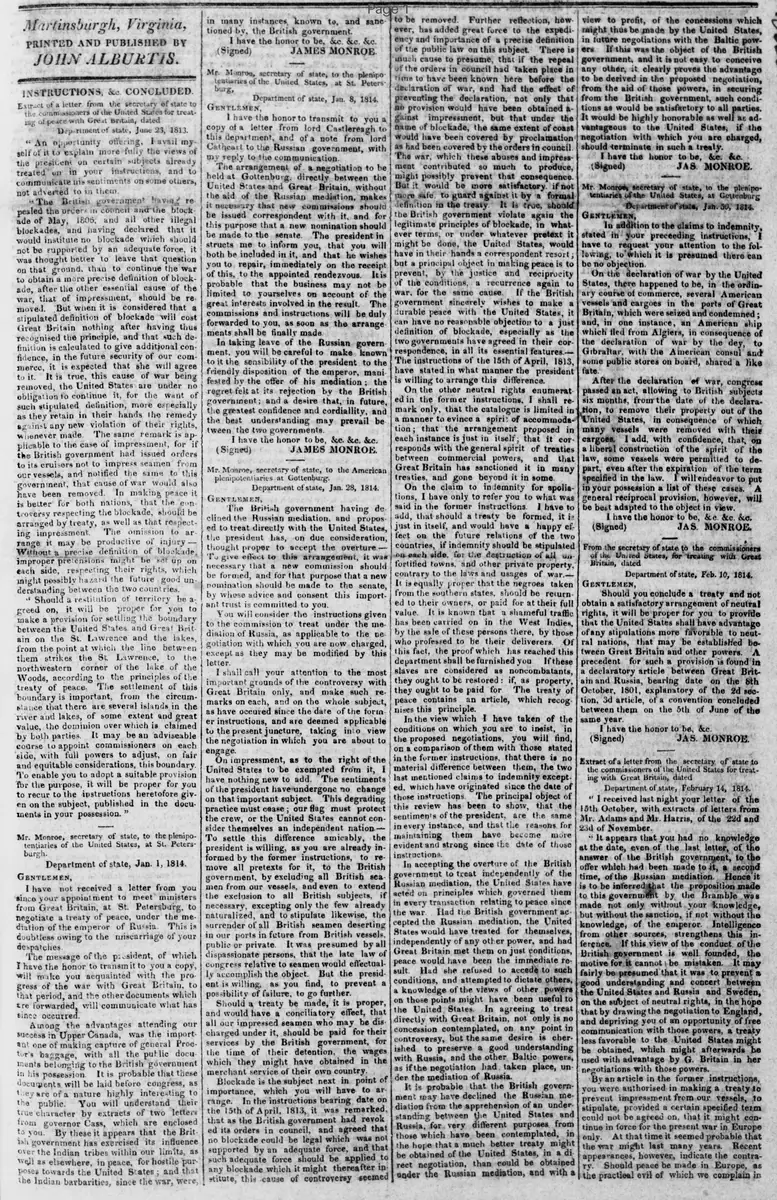
PRINTED AND PUBLISHED BY
JOHN ALBURTIS.
INSTRUCTIONS, &c. CONCLUDED.
Extract of a letter from the secretary of state to the commissioners of the United States for treating of peace with Great Britain, dated
Department of state, June 23, 1813.
"An opportunity offering, I avail myself of it to explain more fully the views of the president on certain subjects already treated on in your instructions, and to communicate his sentiments on some others, not adverted to in them.
"The British government having repealed the orders in council and the blockade of May, 1806, and all other illegal blockades, and having declared that it would institute no blockade which should not be supported by an adequate force, it was thought better to leave that question on that ground, than to continue the war to obtain a more precise definition of blockade, after the other essential cause of the war, that of impressment, should be removed. But when it is considered that a stipulated definition of blockade will cost Great Britain nothing after having thus recognised the principle, and that such definition is calculated to give additional confidence, in the future security of our commerce, it is expected that she will agree to it. It is true, this cause of war being removed, the United States are under no obligation to continue it, for the want of such stipulated definition, more especially as they retain in their hands the remedy against any new violation of their rights, whenever made. The same remark is applicable to the case of impressment, for if the British government had issued orders to its cruisers not to impress seamen from our vessels, and notified the same to this government, that cause of war would also have been removed. In making peace it is better for both nations, that the controversy respecting the blockade, should be arranged by treaty, as well as that respecting impressment. The omission to arrange it may be productive of injury—
Without a precise definition of blockade, improper pretensions might be set up on each side, respecting their rights, which might possibly hazard the future good understanding between the two countries.
"Should a restitution of territory be agreed on, it will be proper for you to make a provision for settling the boundary between the United States and Great Britain on the St. Lawrence and the lakes, from the point at which the line between them strikes the St. Lawrence, to the northwestern corner of the lake of the Woods, according to the principles of the treaty of peace. The settlement of this boundary is important, from the circumstance that there are several islands in the river and lakes, of some extent and great value, the dominion over which is claimed by both parties. It may be an advisable course to appoint commissioners on each side, with full powers to adjust, on fair and equitable considerations, this boundary. To enable you to adopt a suitable provision for the purpose, it will be proper for you to recur to the instructions heretofore given on the subject, published in the documents in your possession."
Mr. Monroe, secretary of state, to the plenipotentiaries of the United States, at St. Petersburg.
Department of state, Jan. 1, 1814.
Gentlemen,
I have not received a letter from you since your appointment to meet ministers from Great Britain, at St. Petersburg, to negotiate a treaty of peace, under the mediation of the emperor of Russia. This is doubtless owing to the miscarriage of your despatches.
The message of the president, of which I have the honor to transmit to you a copy, will make you acquainted with the progress of the war with Great Britain, to that period, and the other documents which were forwarded, will communicate what has since occurred.
Among the advantages attending our success in Upper Canada, was the important one of making capture of general Proctor's baggage, with all the public documents belonging to the British government in his possession. It is probable that these documents will be laid before congress, as they are of a nature highly interesting to the public. You will understand their true character by extracts of two letters from governor Cass, which are enclosed to you. By these it appears that the British government has exercised its influence over the Indian tribes within our limits, as well as elsewhere, in peace, for hostile purposes towards the United States; and that the Indian barbarities, since the war, were, in many instances known to, and sanctioned by, the British government.
I have the honor to be, &c. &c. &c.
(Signed)
JAMES MONROE
Mr. Monroe, secretary of state, to the plenipotentiaries of the United States, at St. Petersburg,
Department of state, Jan. 8, 1814.
Gentlemen,
I have the honor to transmit to you a copy of a letter from lord Castlereagh to this department, and of a note from lord Cathcart to the Russian government, with my reply to the communication.
The arrangement of a negotiation to be held at Gottenburg, directly between the United States and Great Britain, without the aid of the Russian mediation, makes it necessary that new commissions should be issued correspondent with it, and for this purpose that a new nomination should be made to the senate. The president instructs me to inform you, that you will both be included in it, and that he wishes you to repair, immediately on the receipt of this, to the appointed rendezvous. It is probable that the business may not be limited to yourselves on account of the great interests involved in the result. The commissions and instructions will be duly forwarded to you, as soon as the arrangements shall be finally made.
In taking leave of the Russian government, you will be careful to make known to it the sensibility of the president to the friendly disposition of the emperor, manifested by the offer of his mediation; the regret felt at its rejection by the British government; and a desire that, in future, the greatest confidence and cordiality, and the best understanding may prevail between the two governments.
I have the honor to be, &c. &c. &c.
(Signed)
JAMES MONROE.
Mr. Monroe, secretary of state, to the American plenipotentiaries at Gottenburg
Department of state, Jan. 28, 1814.
GENTLEMEN,
The British government having declined the Russian mediation, and proposed to treat directly with the United States, the president has, on due consideration, thought proper to accept the overture.
To give effect to this arrangement, it was necessary that a new commission should be formed, and for that purpose that a new nomination should be made to the senate, by whose advice and consent this important trust is committed to you.
You will consider the instructions given to the commission to treat under the mediation of Russia, as applicable to the negotiation with which you are now charged, except as they may be modified by this letter.
I shall call your attention to the most important grounds of the controversy with Great Britain only, and make such remarks on each, and on the whole subject, as have occurred since the date of the former instructions, and are deemed applicable to the present juncture, taking into view the negotiation in which you are about to engage.
On impressment, as to the right of the United States to be exempted from it, I have nothing new to add. The sentiments of the president have undergone no change on that important subject. This degrading practice must cease; our flag must protect the crew, or the United States cannot consider themselves an independent nation.
To settle this difference amicably, the president is willing, as you are already informed by the former instructions, to remove all pretexts for it, to the British government, by excluding all British seamen from our vessels, and even to extend the exclusion to all British subjects, if necessary, excepting only the few already naturalized, and to stipulate likewise, the surrender of all British seamen deserting in our ports in future from British vessels, public or private. It was presumed by all dispassionate persons, that the late law of congress relative to seamen would effectually accomplish the object. But the president is willing, as you find, to prevent a possibility of failure, to go further.
Should a treaty be made, it is proper, and would have a conciliatory effect, that all our impressed seamen who may be discharged under it, should be paid for their services by the British government, for the time of their detention, the wages which they might have obtained in the merchant service of their own country.
Blockade is the subject next in point of importance, which you will have to arrange. In the instructions bearing date on the 15th of April, 1813, it was remarked, that as the British government had revoked its orders in council, and agreed that no blockade could be legal which was not supported by an adequate force, and that such adequate force should be applied to any blockade which it might thereafter institute, this cause of controversy seemed to be removed. Further reflection, however, has added great force to the expediency and importance of a precise definition of the public law on this subject. There is much cause to presume, that if the repeal of the orders in council had taken place in time to have been known here before the declaration of war, and had the effect of preventing the declaration, not only that no provision would have been obtained against impressment, but that under the name of blockade, the same extent of coast would have been covered by proclamation as had been covered by the orders in council. The war, which these abuses and impressment contributed so much to produce, might possibly prevent that consequence. But it would be more satisfactory, if not more safe, to guard against it by a formal definition in the treaty. It is true, should the British government violate again the legitimate principles of blockade, in whatever terms, or under whatever pretext it might be done, the United States, would have in their hands a correspondent resort; but a principal object in making peace is to prevent, by the justice and reciprocity of the conditions, a recurrence again to war, for the same cause. If the British government sincerely wishes to make a durable peace with the United States, it can have no reasonable objection to a just definition of blockade, especially as the two governments have agreed in their correspondence, in all its essential features.
The instructions of the 15th of April, 1813, have stated in what manner the president is willing to arrange this difference.
On the other neutral rights enumerated in the former instructions, I shall remark only, that the catalogue is limited in a manner to evince a spirit of accommodation; that the arrangement proposed in each instance is just in itself; that it corresponds with the general spirit of treaties between commercial powers, and that Great Britain has sanctioned it in many treaties, and gone beyond it in some.
On the claim to indemnity for spoliations, I have only to refer you to what was said in the former instructions. I have to add, that should a treaty be formed, it is just in itself, and would have a happy effect on the future relations of the two countries, if indemnity should be stipulated on each side, for the destruction of all unfortified towns, and other private property, contrary to the laws and usages of war.
It is equally proper that the negroes taken from the southern states, should be returned to their owners, or paid for at their full value. It is known that a shameful traffic has been carried on in the West Indies, by the sale of these persons there, by those who professed to be their deliverers. Of this fact, the proof which has reached this department shall be furnished you. If these slaves are considered as noncombatants, they ought to be restored: if, as property, they ought to be paid for. The treaty of peace contains an article, which recognises this principle.
In the view which I have taken of the conditions on which you are to insist, in the proposed negotiations, you will find, on a comparison of them with those stated in the former instructions, that there is no material difference between them, the two last mentioned claims to indemnity excepted, which have originated since the date of those instructions. The principal object of this review has been to show, that the sentiments of the president, are the same in every instance, and that the reasons for maintaining them have become more evident and strong since the date of those instructions.
In accepting the overture of the British government to treat independently of the Russian mediation, the United States have acted on principles which governed them in every transaction relating to peace since the war. Had the British government accepted the Russian mediation, the United States would have treated for themselves, independently of any other power, and had Great Britain met them on just conditions, peace would have been the immediate result. Had she refused to accede to such conditions, and attempted to dictate others, a knowledge of the views of other powers on those points might have been useful to the United States. In agreeing to treat directly with Great Britain, not only is no concession contemplated, on any point in controversy, but the same desire is cherished to preserve a good understanding with Russia, and the other Baltic powers, as if the negotiation had taken place, under the mediation of Russia.
It is probable that the British government may have declined the Russian mediation from the apprehension of an understanding between the United States and Russia, for very different purposes from those which have been contemplated, in the hope that a much better treaty might be obtained of the United States, in a direct negotiation, than could be obtained under the Russian mediation, and with a view to profit, of the concessions which might thus be made by the United States, in future negotiations with the Baltic powers. If this was the object of the British government, and it is not easy to conceive any other, it clearly proves the advantage to be derived in the proposed negotiation, from the aid of those powers, in securing from the British government, such conditions as would be satisfactory to all parties.
It would be highly honorable as well as advantageous to the United States, if the negotiation with which you are charged, should terminate in such a treaty.
I have the honor to be, &c. &c.
(Signed)
JAS. MONROE.
Mr. Monroe, secretary of state, to the plenipotentiaries of the United States, at Gottenburg
Department of state, Jan. 30, 1814.
GENTLEMEN,
In addition to the claims to indemnity, stated in your preceding instructions, I have to request your attention to the following, to which it is presumed there can be no objection.
On the declaration of war by the United States, there happened to be, in the ordinary course of commerce, several American vessels and cargoes in the ports of Great Britain, which were seized and condemned; and, in one instance, an American ship which fled from Algiers, in consequence of the declaration of war by the dey, to Gibraltar, with the American consul and some public stores on board, shared a like fate.
After the declaration of war, congress passed an act, allowing to British subjects six months, from the date of the declaration, to remove their property out of the United States, in consequence of which many vessels were removed with their cargoes. I add, with confidence, that, on a liberal construction of the spirit of the law, some vessels were permitted to depart, even after the expiration of the term specified in the law. I will endeavor to put in your possession a list of these cases. A general reciprocal provision, however, will be best adapted to the object in view.
I have the honor to be, &c. &c. &c.
(Signed)
JAS. MONROE.
From the secretary of state to the commissioners of the United States, for treating with Great Britain, dated
Department of state, Feb. 10, 1814.
Gentlemen,
Should you conclude a treaty and not obtain a satisfactory arrangement of neutral rights, it will be proper for you to provide that the United States shall have advantage of any stipulations more favorable to neutral nations, that may be established between Great Britain and other powers. A precedent for such a provision is found in a declaratory article between Great Britain and Russia, bearing date on the 5th October, 1801, explanatory of the 2d section, 3d article, of a convention concluded between them on the 5th of June of the same year.
I have the honor to be, &c.
(Signed)
JAS. MONROE.
Extract of a letter from the secretary of state to the commissioners of the United States for treating with Great Britain, dated
Department of state, February 14, 1814.
"I received last night your letter of the 15th October, with extracts of letters from Mr. Adams and Mr. Harris, of the 22d and 23d of November.
"It appears that you had no knowledge at the date, even of the last letter, of the answer of the British government, to the offer which had been made to it, a second time, of the Russian mediation. Hence it is to be inferred that the proposition made to this government by the Bramble was made not only without your knowledge, but without the sanction, if not without the knowledge, of the emperor. Intelligence from other sources, strengthens this inference. If this view of the conduct, of the British government is well founded, the motive for it cannot be mistaken. It may fairly be presumed that it was to prevent a good understanding and concert between the United States and Russia and Sweden, on the subject of neutral rights, in the hope that by drawing the negotiation to England, and depriving you of an opportunity of free communication with those powers, a treaty less favorable to the United States might be obtained, which might afterwards be used with advantage by G. Britain in her negotiations with those powers.
By an article in the former instructions, you were authorised in making a treaty to prevent impressment from our vessels, to stipulate, provided a certain specified term could not be agreed on, that it might continue in force for the present war in Europe only. At that time it seemed probable that the war might last many years. Recent appearances, however, indicate the contrary. Should peace be made in Europe, as the practical evil of which we complain in"
In regard to impressment would cease, it is presumed that the British government would have less objection to a stipulation to forbear that practice for a specified term, than it would have, should the war continue. In concluding a peace with Great Britain, even in case of a previous general peace in Europe, it is important to the United States to obtain such a stipulation."
Mr. Monroe, secretary of state, to the plenipotentiaries of the United States, at Gothenburg.
Department of state, 21st of March, 1814.
GENTLEMEN,
By the cartel Chauncey you will receive this, with duplicates of the commission to treat with Great Britain; and of the instructions and other documents that were forwarded by the John Adams. This vessel is sent to guard against any accident that might attend the other.
If a satisfactory arrangement can be concluded with Great Britain, the sooner it is accomplished the happier for both countries. If such an arrangement cannot be obtained, it is important for the United States to be acquainted with it without delay. I hope, therefore to receive from you an account of the state of the negotiation and its prospects, as soon as you may be able to communicate anything of an interesting nature respecting them.
I have the honor to be, &c.
(Signed)
JAS. MONROE.
Mr. Monroe to the envoys extraordinary and ministers plenipotentiary of the United States.
Department of state, June 25, 1814.
GENTLEMEN,
No communication has been received from the joint mission which was appointed to meet the commissioners of the British government, at Gothenburg. A letter from Mr. Bayard, at Amsterdam, of the 18th of March, was the last from either of our commissioners. It was inferred, from that letter, and other communications, that Mr. Bayard, Mr. Gallatin, and Mr. Adams, would be in Gothenburg,--and it has been understood, from other sources, that Mr. Clay and Mr. Russell had arrived there about the 15th of April. It is therefore, expected, that a meeting will have taken place in May, and that we shall soon be made acquainted with your sentiments of the probable result of the negotiation.
It is impossible, with the lights which have reached us, to ascertain the present disposition of the British government towards an accommodation with the United States. We think it probable that the late events in France may have had a tendency to increase its pretensions.
At war with Great Britain, and injured by France, the United States have sustained the attitude founded on those relations. No reliance was placed on the good offices of France, in bringing the war with Great Britain to a satisfactory conclusion. Looking steadily to an honorable peace, and the ultimate attainment of justice from both powers, the president has endeavored, by a consistent and honorable policy, to take advantage of every circumstance that might promote that result. He, nevertheless, knew that France held a place in the political system of Europe and of the world, which, as a check on England, could not fail to be useful to us. What effect the late events may have had, in these respects, is the important circumstance of which you are doubtless better informed than we can be.
The president accepted the mediation of Russia, from a respect for the character of the emperor, and a belief that our cause, in all the points in controversy, would gain strength by being made known to him.
On the same principle, he preferred (in accepting the British overture, to treat independently of the Russian mediation) to open the negotiation on the continent, rather than at London.
It was inferred from the general policy of Russia, and the friendly sentiments and interposition of the emperor, that a respect for both would have much influence, with the British cabinet, in promoting a pacific policy towards us. The manner, however, in which it is understood that a general pacification is taking place; the influence Great Britain may have in modifying the arrangements involved in it; the resources she may be able to employ exclusively against the United States; and the uncertainty of the precise course which Russia may pursue in relation to the war between the United States and Great Britain, naturally claim attention, and raise the important question, in reference to the subject of impressment, on which it is presumed your negotiations will essentially turn, whether your powers ought not to be enlarged, so as to enable you to give to those circumstances all the weight to which they may be entitled. On full consideration, it has been decided, that in case no stipulation can be obtained from the British government at this moment, when its pretensions may have been much heightened by recent events, and the state of Europe be most favorable to them, either relinquishing the claim to impress from American vessels, or discontinuing the practice, even in consideration of the proposed exclusion from them of British seamen, you may concur in an article, stipulating, that the subject of impressment, together with that of commerce between the two countries, be referred to a separate negotiation, to be undertaken without delay, at such place as you may be able to agree on, preferring this city, if to be obtained.
I annex, at the close of this letter a project of an article, expressing, more distinctly, the idea which it is intended to communicate, not meaning thereby to restrain you in any respect as to the form.
Commerce and seamen, the objects of impressment, may, with great propriety, be arranged in the same instrument. By stipulating that commissioners shall forthwith be appointed for the purpose, and that all rights on this subject shall, in the meantime, be reserved, the faith of the British government will be pledged to a fair experiment in an amicable mode, and the honor and rights of the United States secured.
The United States having resisted, by war, the practice of impressment, and continued the war until the practice had ceased, by a peace in Europe, their object has been essentially obtained for the present. It may reasonably be expected, that the arrangement contemplated and provided for, will take effect before a new war in Europe shall furnish an occasion for reviving the practice. Should this arrangement, however, fail, and the practice be again revived, the United States will be again at liberty to repel it by war; and that they will do so cannot be doubted: for after the proof which they have already given of a firm resistance, in that mode, persevered in until the practice had ceased, under circumstances the most unfavorable, it cannot be presumed that the practice will ever be tolerated again. Certain it is, that every day will render it more ineligible in Great Britain to make the attempt.
In contemplating the appointment of commissioners, to be made after the ratification of the present treaty, to negotiate and conclude a treaty to regulate commerce and provide against impressment, it is meant only to show the extent to which you may go, in a spirit of accommodation, if necessary. Should the British government be willing to take the subject up immediately with you, it would be much preferred, in which case the proposed article would, of course, be adapted to the purpose.
Information has been received from a quarter deserving attention, that the late events in France have produced such an effect on the British government, as to make it probable that a demand will be made at Gothenburg, to surrender our right to the fisheries, to abandon all trade beyond the Cape of Good Hope, and to cede Louisiana to Spain. We cannot believe that such a demand will be made; should it be you will of course treat it as it deserves. These rights must not be brought into discussion. If insisted on, your negotiation will cease.
I have the honor to be,
With great respect, gentlemen,
Your most obedient servant,
(Signed)
JAS. MONROE.
"Whereas by the peace in Europe, the essential causes of the war between the United States and Great Britain, and particularly the practice of impressment, have ceased, and a sincere desire exists to arrange, in a manner satisfactory to both parties, all questions concerning seamen; and it is also their desire and intention to arrange, in a like satisfactory manner, the commerce between the two countries, it is therefore agreed, that commissioners shall forthwith be appointed on each side, to meet at-- with full power to negotiate and conclude a treaty, as soon as it may be practicable, for the arrangement of those important interests. It is nevertheless understood, that until such treaty be formed, each party shall retain all its rights, and that all American citizens who have been impressed into the British service shall be forthwith discharged."
Extract of a letter from the secretary of state to the commissioners of the United States for treating peace with Great Britain, dated
Department of state, June 27, 1814.
"The omission to send ministers to Gothenburg without a previous and official notification of the appointment and arrival there of those of the United States, a formality, which, if due from either party, might have been expected from that making the overture, rather than that accepting it, is a proof of a dilatory policy, and would, in other respects justify animadversion, if there was less disposition here to overlook circumstances of form, when interfering with more substantial objects.
"By my letter of the 25th inst. which goes with this, you will find that the subjects had already been acted on under similar impressions with those which Mr. Bayard and Mr. Gallatin's letter could not fail to produce. The view, however, presented by them is much stronger, and entitled to much greater attention. The president has taken the subject into consideration again and given to their suggestions all the weight to which they are justly entitled.
"On mature consideration it has been decided, that under all the circumstances above alluded to, incident to a prosecution of the war, you may omit any stipulation on the subject of impressment, if found indispensably necessary to terminate it. You will, of course, not recur to this expedient until all your efforts to adjust the controversy in a more satisfactory manner have failed. As it is not the intention of the United States, in suffering the treaty to be silent on the subject of impressment, to admit British claim thereon, or to relinquish that of the United States, it is highly important that any such inference be entirely precluded, by a declaration or protest in some form or other, that the omission is not to have any such effect or tendency. Any modification of the practice, to prevent abuses, being an acknowledgment of the right in Great Britain, is utterly inadmissible.
"Although Gothenburg was contemplated at the time your commission was made out, as the seat of the negotiation, yet your commission itself does not confine you to it. You are at liberty, therefore, to transfer the negotiation to any other place made more eligible by a change of circumstances. Amsterdam and the Hague readily present themselves as preferable to any place in England. If, however, you should be of opinion, that under all circumstances, the negotiation in that country will be attended with advantages, outweighing the objections to it, you are at liberty to transfer it there."
Extract of a letter from the secretary of state, to the commissioners of the United States, for treating of peace with Great Britain, dated
Department of state, Aug. 11, 1814.
"I had the honor to receive on the 3d of this month a letter from Mr. Bayard and Mr. Gallatin, of the 23d of May, and one from Mr. Gallatin, of the 2d of June.
"The president approves the arrangement communicated by those gentlemen for transferring the negotiation with the British government from Gothenburg, to Ghent. It is presumed from Mr. Gallatin's letter that the meeting took place towards the latter end of June, and that we shall soon hear from you what will be its probable result.
"By my letters of the 25th and 27th June, of which another copy is now forwarded, the sentiments of the president, as to the conditions, on which it will be proper for you to conclude a treaty of peace, are made known to you. It is presumed that either in the mode suggested in my letter of the 25th June, which is much preferred, or by permitting the treaty to be silent on the subject, as is authorised in the letter of the 27th June, the question of impressment may be so disposed of, as to form no obstacle to a pacification. This government can go no further, because it will make no sacrifice of the rights or honor of the nation.
"If Great Britain does not terminate the war on the conditions which you are authorised to adopt, she has other objects in it than those for which she has hitherto professed to contend. That such are entertained, there is much reason to presume. These, whatever they may be, must and will be resisted by the United States. The conflict may be severe, but it will be borne with firmness, and as we confidently believe, be attended with success."
What sub-type of article is it?
What keywords are associated?
What entities or persons were involved?
Where did it happen?
Foreign News Details
Primary Location
Gothenburg
Event Date
June 23, 1813 To August 11, 1814
Key Persons
Outcome
ongoing peace negotiations; instructions allow flexibility on impressment if necessary, but no concessions on core rights; transfer to ghent approved; potential separate negotiation on commerce and seamen.
Event Details
Series of instructions from US Secretary of State James Monroe to commissioners negotiating peace with Britain, covering repeal of orders in council, definition of blockade, end to impressment via exclusions and payments, boundary settlements on St. Lawrence and lakes, neutral rights, indemnities for spoliations and property destruction, return or compensation for enslaved persons, and responses to European events including Russian mediation decline and shift to direct talks at Gothenburg then Ghent.