Thank you for visiting SNEWPapers!
Sign up free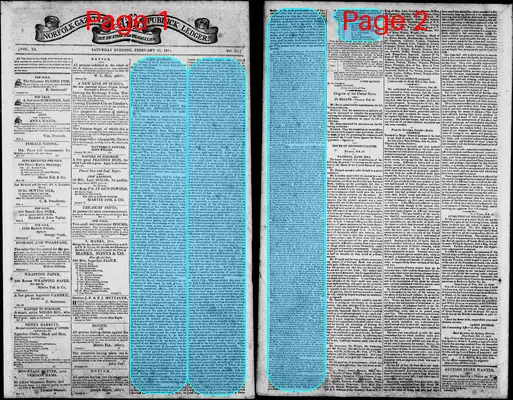
Norfolk Gazette And Publick Ledger
Norfolk, Virginia
What is this article about?
Proclamation by President James Madison of the Treaty of Peace and Amity between the United States and Great Britain, signed at Ghent on December 24, 1814, and ratified February 17, 1815, ending the War of 1812 with restoration of territories, cessation of hostilities, boundary settlements, and provisions for Native American tribes.
Merged-components note: Continuation of the Treaty of Ghent proclamation text across pages, with signatures table as concluding element; sequential reading order and topic coherence indicate single component.
Clippings
1 of 2
OCR Quality
Full Text
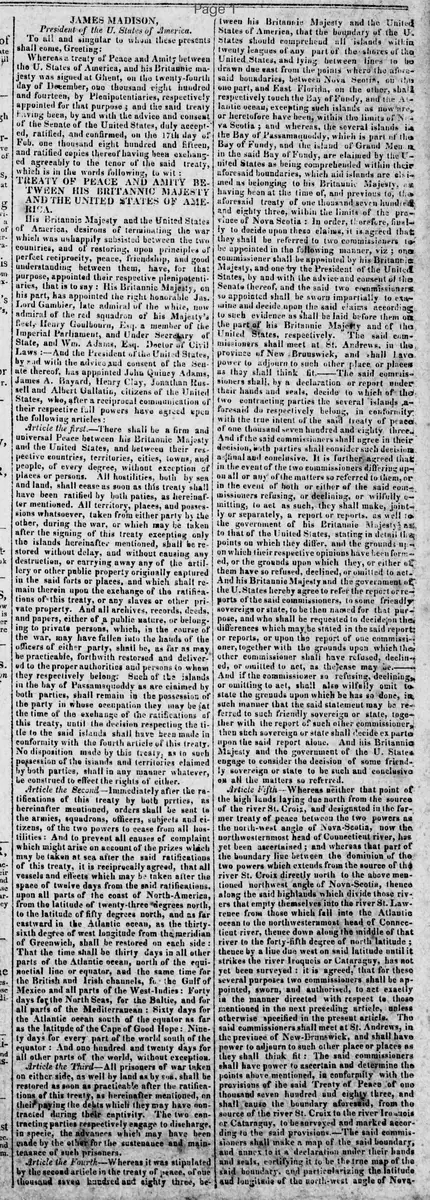
President of the U. States of America.
To all and singular to whom these presents
shall come, Greeting:
Whereas a treaty of Peace and Amity between
the U. States of America, and his Britannic ma-
jesty was signed at Ghent, on the twenty-fourth
day of December, one thousand eight hundred
and fourteen, by Plenipotentiaries, respectively
appointed for that purpose; and the said treaty
having been, by and with the advice and consent
of the Senate of the United States, duly accept-
ed, ratified, and confirmed, on the 17th day of
Feb. one thousand eight hundred and fifteen,
and ratified copies thereof having been exchang-
ed agreeably to the tenor of the said treaty,
which is in the words following, to wit:
TREATY OF PEACE AND AMITY BE-
TWEEN HIS BRITANNIC MAJESTY
AND THE UNITED STATES OF AME-
RICA.
His Britannic Majesty and the United States
of America, desirous of terminating the war
which was unhappily subsisted between the two
countries, and of restoring, upon principles of
perfect reciprocity, peace, friendship, and good
understanding between them, have, for that
purpose, appointed their respective plenipotenti-
aries, that is to say: His Britannic Majesty, on
his part, has appointed the right honorable Jas.
Lord Gambier, late admiral of the white, now
admiral of the red squadron of his Majesty's
fleet, Henry Goulburn, Esq. a member of the
Imperial Parliament, and Under Secretary
of State, and Wm. Adams, Esq. Doctor of Civil
Laws:--And the President of the United States,
by and with the advice and consent of the Sen-
ate thereof, has appointed John Quincy Adams,
James A. Bayard, Henry Clay, Jonathan Rus-
sell and Albert Gallatin, citizens of the United
States, who, after a reciprocal communication of
their respective full powers have agreed upon
the following articles:
Article the first.--There shall be a firm and
universal Peace between his Britannic Majesty
and the United States, and between their res-
pective countries, territories, cities, towns, and
people, of every degree, without exception of
places or persons. All hostilities, both by sea
and land, shall cease as soon as this treaty shall
have been ratified by both parties, as hereinaf-
ter mentioned. All territory, places, and posses-
sions whatsoever, taken from either party by the
other, during the war, or which may be taken
after the signing of this treaty excepting only
the islands hereinafter mentioned, shall be re-
stored without delay, and without causing any
destruction, or carrying away any of the artil-
ler y or other public property originally captured
in the said forts or places, and which shall re-
main therein upon the exchange of the ratifica-
tions of this treaty, or any slaves or other pri-
vate property. And all archives, records, deeds,
and papers, either of a public nature, or belong-
ing to private persons, which, in the course of
the war, may have fallen into the hands of the
officers of either party, shall be, as far as may
be practicable, forthwith restored and deliver-
ed to the proper authorities and persons to whom
they respectively belong: Such of the islands
in the bay of Passamaquoddy as are claimed by
both parties, shall remain in the possession of
the party in whose occupation they may be at
the time of the exchange of the ratifications of
this treaty, until the decision respecting the ti-
tle to the said islands shall have been made in
conformity with the fourth article of this treaty.
No disposition made by this treaty, as to such
possession of the islands and territories claimed
by both parties, shall in any manner whatever,
be construed to affect the rights of either.
Article the Second--Immediately after the ra-
tifications of this treaty by both parties, as
hereinafter mentioned, orders shall be sent to
the armies, squadrons, officers, subjects and ci-
tizens, of the two powers to cease from all hos-
tilities: And to prevent all causes of complaint
which might arise on account of the prizes which
may be taken at sea after the said ratifications
of this treaty, it is reciprocally agreed, that all
vessels and effects which may be taken after the
space of twelve days from the said ratifications,
upon all parts of the coast of North-America,
from the latitude of twenty-three degrees north,
to the latitude of fifty degrees north, and as far
eastward in the Atlantic ocean, as the thirty-
sixth degree of west longitude from the meridian
of Greenwich, shall be restored on each side:
That the time shall be thirty days in all other
parts of the Atlantic ocean, north of the equi-
noctial line or equator, and the same time for
the British and Irish channels, for the Gulf of
Mexico and all parts of the West-Indies: Forty
days for the North Seas, for the Baltic, and for
all parts of the Mediterranean: Sixty days for
the Atlantic ocean south of the equator as far
as the latitude of the Cape of Good Hope: Nine-
ty days for every part of the world south of the
equator: And one hundred and twenty days for
all other parts of the world, without exception.
Article the Third--All prisoners of war taken
on either side, as well by land as by sea, shall be
restored as soon as practicable after the ratifica-
tions of this treaty, as hereinafter mentioned, on
their paying the debts which they may have con-
tracted during their captivity. The two con-
tracting parties respectively engage to discharge,
in specie, the advances which may have been
made by the other for the sustenance and main-
tenance of such prisoners.
Article the Fourth--Whereas it was stipulated
by the second article in the treaty of peace, of one
the high lands laying due north from the source
of the river St. Croix, and designated in the for-
mer treaty of peace between the two powers as
the north-west angle of Nova-Scotia, now the
northwesternmost head of Connecticut river, has
yet been ascertained; and whereas that part of
the boundary line between the dominion of the
two powers which extends from the source of the
river St. Croix directly north to the above men-
tioned northwest angle of Nova-Scotia, thence
along the said highlands which divide those riv-
ers that empty themselves into the river St. Law-
rence from those which fall into the Atlantic
ocean to the northwesternmost head of Connec-
ticut river, thence down along the middle of that
river to the forty-fifth degree of north latitude;
thence by a line due west on said latitude until it
strikes the river Iroquois or Cataraqui, has not
yet been surveyed: it is agreed, that for these
several purposes two commissioners shall be ap-
pointed, sworn, and authorised, to act exactly
in the manner directed with respect to those
mentioned in the next preceding article, unless
otherwise specified in the present article. The
said commissioners shall meet at St. Andrews, in
the province of New-Brunswick, and shall have
power to adjourn to such other place or places as
they shall think fit: The said commissioners
shall have power to ascertain and determine the
points above mentioned, in conformity with the
provisions of the said Treaty of Peace of one
thousand seven hundred and eighty three, and
shall cause the boundary aforesaid, from the
source of the river St. Croix to the river Iroquois
or Cataraqui, to be surveyed and marked accor-
ding to the said provisions.--The said commis-
sioners shall make a map of the said boundary,
and annex to it a declaration under their hands
and seals, certifying it to be the true map of the
said boundary, and particularizing the latitude
and longitude of the north-west angle of Nova-
Scotia.
Article the Fifth. Whereas neither that point of the highlands lying under the forty-fifth degree of north latitude, which was fixed between New York and Nova Scotia by the former treaty of peace, nor that which was intended to be fixed between Nova Scotia and the Bay of Fundy, has been ascertained; and whereas that part of the boundary line between the dominions of his Britannic Majesty and the United States, which extends from the above mentioned highlands to the north-westernmost head of Connecticut river, and of such other points of the said boundary as they may deem proper. And both parties agree to consider such map and declaration as finally and conclusively fixing the said boundary. And in the event of the said two commissioners differing, or both, or either, of them, refusing or declining, or wilfully omitting to act, such reports, declarations, or statements, shall be made by them, or either of them. And such reference to a friendly sovereign or state shall be made, in all respects as in the latter part of the fourth article is contained, and in as full a manner as if the same was herein repeated.
Article the Sixth. Whereas, by the former treaty of peace that portion of the boundary of the United States from the point where the forty-fifth degree of north latitude strikes the river Iroquois or Cataraqui to the Lake Superior, was declared to be "along the middle of said river into Lake Ontario, thro' the middle of said lake until it strikes the communication by water between that lake and Lake Erie, thence along the middle of said communication into Lake Erie, through the middle of said lake until it arrives at the water communication into the Lake Huron, thence through the middle of said lake to the water communication between that lake and Lake Superior:" And whereas doubts have arisen what was the middle of said river, lakes and water communications, and whether certain islands lying in the same were within the dominions of his Britannic Majesty or of the United States: In order, therefore, finally to decide these doubts, they shall be referred to two Commissioners, to be appointed, sworn, and authorised to act exactly in the manner directed with respect to those mentioned in the next preceding article, unless otherwise specified in this present article. The said commissioners shall meet, in the first instance at Albany, in the state of New York, and shall have power to adjourn to such other place or places as they shall think fit: The said commissioners shall by a report or declaration, under their hands and seals, designate the boundary through the said river, lakes, and water communications, and decide to which of the two contracting parties the several islands lying within the said river, lakes, and water communications, do respectively belong, in conformity with the true intent of the said treaty of one thousand seven hundred and eighty three. And both parties agree to consider such designation and decision as final and conclusive. And in the event of the said two commissioners differing, or both, or either of them, refusing, declining or wilfully omitting to act, such reports declarations or statements, shall be made by them or either of them, and such reference to a friendly sovereign or state shall be made in all respects as in the latter part of the fourth article is contained, and in as full a manner as if the same was herein repeated.
Article the Seventh. It is further agreed that the said two last mentioned commissioners, after they shall have executed the duties assigned to them in the preceding article, shall be, and they are hereby authorised, upon their oaths impartially to fix and determine, according to the true intent of the said Treaty of Peace, of one thousand seven hundred and eighty-three, that part of the boundary between the dominions of the two powers, which extends from the water communication between Lake Huron and Lake Superior, to the most northwestern point of the Lake of the Woods, to decide to which of the two parties the several islands lying in the lakes, water communications, and rivers forming the said boundary, do respectively belong, in conformity with the true intent of the said Treaty of Peace, of one thousand seven hundred and eighty-three; and to cause such parts of the said boundary, as require it, to be surveyed and marked. The said commissioners shall, by a report or declaration under their hands and seals, designate the boundary aforesaid, state their decision on the points thus referred to them, and particularise the latitude and longitude of the most northwestern point of the Lake of the Woods, and of such other parts of the said boundary as they may deem proper. And both parties agree to consider such designation and decision as final and conclusive. And in the event of the said two commissioners differing, or both, or either of them refusing, declining, or wilfully omitting to act, such reports, declarations or statements, shall be made by them, or either of them, and such reference to a friendly sovereign or state shall be made in all respects, as in the latter part of the fourth article is contained, and in as full a manner as if the same was herein repeated.
Article the Eighth. The several boards of two commissioners mentioned in the four preceding articles, shall respectively have power to appoint a secretary, and to employ such surveyors or other persons as they shall judge necessary. Duplicates of all their respective reports, declarations, statements and decisions, and of their accounts, and of the journal of their proceedings, shall be delivered by them to the agent of his Britannic Majesty, and to the agents of the United States, who may be respectively appointed and authorised to manage the business on behalf of their respective governments. The said commissioners shall be respectively paid in such manner as shall be agreed between the two contracting parties, such agreement being to be settled at the time of the exchange of the Ratifications of this treaty. And all other expenses attending the said commissioners shall be defrayed equally by the two parties. And in the case of death, sickness, resignation, or necessary absence, the place of every such commissioner respectively shall be supplied in the same manner as such commissioner was first appointed, and the new commissioner shall take the same oath or affirmation, and do the same duties. It is further agreed between the two contracting parties that in case any of the islands mentioned in any of the preceding articles, which were in the possession of one of the parties prior to the commencement of the present war between the two countries, should, by the decision of any of the boards of commissioners aforesaid, or of the sovereign or state so referred to, as in the four next preceding articles contained, fall within the dominions of the other party, all grants of land made previous to the commencement of the war by the party having had such possession, shall be as valid as if such island or islands, had by such decision or decisions, been adjudged to be within the dominions of the party having had such possession.
Article the Ninth. The United States of America engage to put an end immediately after the ratification of the present treaty, to hostilities with all the tribes or nations of Indians, with whom they may be at war at the time of such ratification; and forthwith to restore to such tribes or nations, respectively, all the possessions, rights and privileges, which they may have enjoyed or been entitled to in one thousand eight hundred and eleven, previous to such hostilities: Provided always, that such tribes or nations shall agree to desist from all hostilities against the United States of America, their citizens and subjects, upon the ratification of the present treaty being notified to such tribes or nations, and shall so desist accordingly. And his Britannic Majesty engages, on his part, to put an end immediately after the ratification of the present treaty, to hostilities with all the tribes or nations of Indians with whom he may be at war at the time of such ratification, and forthwith to restore to such tribes or nations respectively, all the possessions, rights and privileges, which they may have enjoyed or been entitled to, in one thousand eight hundred and eleven, previous to such hostilities: Provided always, that such tribes or nations shall agree to desist from all hostilities against his Britannic Majesty, and his subjects, upon the ratification of the present treaty being notified to such tribes or nations, and shall so desist accordingly.
Article the Tenth. Whereas the traffic in slaves is irreconcilable with the principles of humanity and justice, and whereas both his Majesty and the United States, are desirous of continuing their efforts to promote its entire abolition, it is hereby agreed that both the contracting parties shall use their best endeavors to accomplish so desirable an object.
Article the Eleventh. This treaty, when the same shall have been ratified on both sides, without alteration by either of the contracting parties and the ratifications mutually exchanged, shall be binding on both parties, and the ratifications shall be exchanged at Washington, in the space of four months from this day, or sooner if practicable.
In faith whereof, we the respective plenipotentiaries have signed this treaty, and have thereunto affixed our seals.
Done, in triplicate, at Ghent the twenty fourth day of December, one thousand eight hundred and fourteen.
Now, therefore, to the end that the said treaty of peace and amity may be observed with good faith, on the part of the United States, I, JAMES MADISON, President as aforesaid, have caused the premises to be made public; and I do hereby enjoin all persons bearing office, civil or military, within the United States, and all others, citizens or inhabitants thereof, or being within the same, faithfully to observe and fulfil the said treaty and every clause and article thereof.
In testimony whereof, I have caused the seal of the United States to be affixed to these presents, and signed the same with my hand.
Done at the City of Washington, this eighteenth day of February, in the year of our Lord one thousand eight hundred and fifteen, and of the sovereignty and independence of the United States the thirty-ninth.
JAMES MADISON.
By the President:
JAMES MONROE
Acting Secretary of State.
| (L. S.) | GAMBIER, |
| (L. S.) | HENRY GOULBURN, |
| (L. S.) | WILLIAM ADAMS, |
| (L. S.) | JOHN QUINCY ADAMS, |
| (L. S.) | J. A. BAYARD, |
| (L. S.) | H. CLAY, |
| (L. S.) | JON. RUSSELL, |
| (L. S.) | ALBERT GALLATIN. |
What sub-type of article is it?
What keywords are associated?
What entities or persons were involved?
Where did it happen?
Foreign News Details
Primary Location
Ghent
Event Date
Signed At Ghent, On The Twenty Fourth Day Of December, One Thousand Eight Hundred And Fourteen; Ratified On The 17th Day Of Feb. One Thousand Eight Hundred And Fifteen; Proclaimed This Eighteenth Day Of February, In The Year Of Our Lord One Thousand Eight Hundred And Fifteen
Key Persons
Outcome
firm and universal peace established; all hostilities to cease; territories, possessions, archives, and private property to be restored without delay; prisoners of war to be restored; boundary commissions to settle disputed borders; hostilities with native american tribes to end and possessions restored to 1811 status; efforts to abolish slave trade agreed upon
Event Details
The treaty terminates the war between the United States and Great Britain, restores pre-war territories and possessions, mandates cessation of hostilities and restoration of prisoners, establishes commissions to resolve boundary disputes along the US-Canadian border including rivers, lakes, and islands, requires both parties to end hostilities with Native American tribes and restore their 1811 rights upon reciprocal agreement, and commits to efforts against the slave trade. Ratifications to be exchanged within four months.