Thank you for visiting SNEWPapers!
Sign up free
New York Dispatch
New York, New York County, New York
What is this article about?
In 1871 Paris, lodger Andre Gelon overhears a murder through a gas pipe, accusing innocent Madame Pedrix of killing her bigamous husband Jules. The true culprit, his first wife Angele Duvrez, confesses after a failed Seine suicide, exonerating the wrongfully imprisoned woman.
Merged-components note: Continuation of 'The Two Wives' story across sequential reading orders and adjacent bboxes on page 1.
Clipping
OCR Quality
Full Text
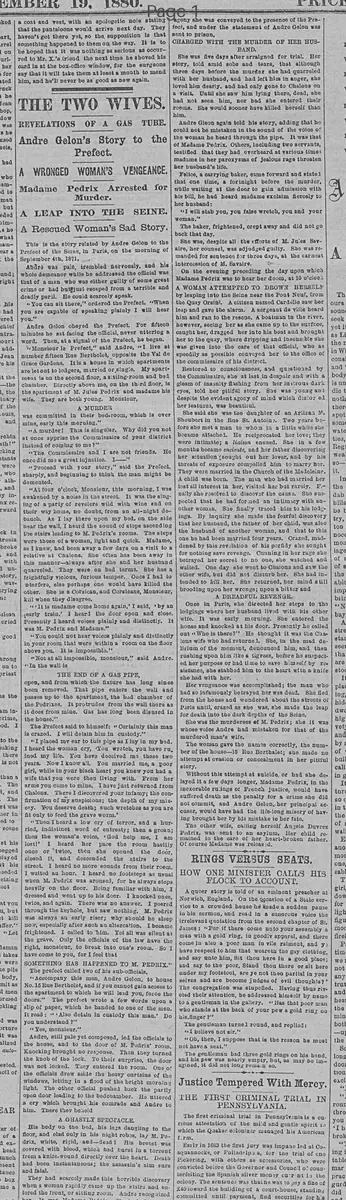
REVELATIONS
OF A
GAS
TUBE.
Andre Gelon's Story to the
Prefect.
WRONGED WOMAN'S
VENGEANCE.
Madame
Pedrix
Arrested for
Murder.
A LEAP INTO THE
SEINE.
A Rescued Woman's Sad Story.
This is the story related by Andre Gelon to the Prefect of the Seine, in Paris, on the morning of September 4th, 1871.
Andre was pale, trembled nervously, and his whole demeanor while he addressed the official was that of a man who was either guilty of some great crime or had but just escaped from a terrible and deadly peril. He could scarcely speak.
"You can sit there," ordered the Prefect. "When you are capable of speaking plainly I will hear you."
Andre Gelon obeyed the Prefect. For fifteen minutes he sat facing the official, never uttering a word. Then, at a signal of the Prefect, he began.
"Monsieur le Prefect," said Andre, "I live at number fifteen Rue Bertholet, opposite the Val de Grace Gardens. It is a house in which apartments are let out to lodgers, married or single. My apartment is on the second floor, a sitting-room and bed chamber. Directly above me, on the third floor, is the apartment of M. Jules Pedrix and madame his wife. They are both young. Monsieur,
A MURDER
was committed in their bed-room, which is over mine, early this morning."
"A murder! This is singular. Why did you not at once apprise the Commissaire of your district instead of coming to me?"
"The Commissaire and I are not friends. He once did me a great injustice. I"
"Proceed with your story," said the Prefect, sharply, and beginning to think the man might be demented,
"At four o'clock, Monsieur, this morning, I was awakened by a noise in the street. It was the singing of a party of revelers wild with wine and on their way home, no doubt, from an all-night debauch. As I lay there upon my bed, on the side near the wall, I heard the sound of steps ascending the stairs leading to M. Pedrix's rooms. The steps were those of a woman, light and quick. Madame, as I knew, had been away a few days on a visit to a relative at Chalons. She often has been away in this manner-always after she and her husband quarreled. They were on bad terms. She has a frightfully vicious, furious temper. Once I had to interfere, else perhaps one would have killed the other. She is a Corsican, and Corsicans, Monsieur, kill when they disagree.
"It is madame come home again,' I said, by an early train.' I heard the door open and close. Presently I heard voices plainly and distinctly. It was M. Pedrix and Madame."
"You could not hear voices plainly and distinctly in your room that were within a room on the floor above you. It is impossible."
"Not at all impossible, monsieur," said Andre. "In the wall is
THE END OF A GAS PIPE,
open, and from which the fixture has long since been removed. That pipe enters the wall and passes up to the apartment, the bed chamber of the Pedrixes. It protrudes from the wall there as it does from mine. Gas has long been disused in the house."
The Prefect said to himself: "Certainly this man is crazed. I will detain him in custody.'
"I placed my ear to this pipe as I lay in my bed. I heard the woman cry, 'You wretch, you have ruined my life. You have deceived me these two years. Now I know all. You married me, a poor girl, while in your black heart you knew you had a wife that you were then living with. From her arms you came to mine. I have just returned from Chalons. There I discovered your infamy; the confirmation of my suspicions; the depth of my misery. You deserve death; such wretches as you are fit only to feed the grave worm.'
"Then I heard a low cry of terror, and a hurried, indistinct word of entreaty; then a groan; then the woman's voice, 'God help me, I am lost!' I heard her pace the room hastily once or twice, then she opened the door, closed it, and descended the stairs to the street. I heard no more sounds from their room. I waited an hour. I heard no footsteps as usual when M. Pedrix was aroused, for he always steps heavily on the floor. Being familiar with him, I dressed and went up to his door. I knocked once, twice, and again. There was no answer. I peered through the keyhole, but saw nothing. M. Pedrix was always an early riser; why should he sleep now, especially after such an altercation. I became frightened. I called to him. Yet all was silent as the grave. Only the officials of the law have the right, monsieur, to break into one's room. So I have come to you, for I feel that
SOMETHING HAS HAPPENED TO M. PEDRIX."
The prefect called two of his sub-officials.
"Accompany this man, Andre Gelon, to house No. 15 Rue Bertholet, and if you cannot gain access to the apartment to which he will lead you, force the doors." The prefect wrote a few words upon a slip of paper, which he handed to one of the men. It read: "Also detain in custody this man.' Do you understand?"
"Yes, monsieur."
Andre, still pale yet composed, led the officials to the house, and to the door of M. Pedrix' room. Knocking brought no response. Then they turned the knob of the lock. To their surprise, the door was not locked. They entered the room. One of the officials drew aside the heavy curtains of the windows, letting in a flood of the bright morning light. The other official pushed back the partly open door leading to the bedchamber. He uttered a cry which brought his comrade and Andre to him. There they beheld
A GHASTLY SPECTACLE
His body on the bed, his legs dangling to the floor, and clad only in his night robes, lay M. Pedrix, white, rigid, and--dead! His breast was covered with blood, which had burst in a torrent from a knife-wound directly over the heart. Death had been instantaneous; the assassin's aim sure and fatal.
They had scarcely made this horrible discovery when a woman rapidly came up the stairs and entered the front, or sitting room. Andre recognized her. It was Madame Pedrix. She looked bright, joyous, happy. Seeing the officers and Andre, her expression changed to one of apparent astonishment; then a deadly pallor overspread her face.
"What does this mean? Where is my husband? Surely nothing has happened!" She glanced tremblingly at each of the three silent men.
Andre was confounded at what he supposed to be the audacity of this woman, whom he was ready to denounce as the murderess of her husband,
"She is like all the Corsicans. They are serpents; they are all deceit"
She hesitated a moment; then ran past the officials into the bedroom. One glimpse at the horrible vision of the dead was enough. She uttered a wild shriek of terror, and, staggering forward, fell heavily across the body of her husband, motionless and insensible. An hour later Madam Pedrix recovered. In spite of her prayers, insinuations and
agony she was conveyed to the presence of the Prefect, and under the statement of Andre Gelon was
sent to prison,
CHARGED WITH THE MURDER OF HER HUSBAND.
She was five days after arraigned for trial. Her story, told amid sobs and tears. that although three days before the murder she had quarreled with her husband, and had left him in anger, she loved him dearly, and had only gone to Chalons on a visit. Until she saw him lying there, dead, she had not seen him, nor had she entered their rooms. She would sooner have killed herself than him.
Andre Gelon again told his story, adding that he could not be mistaken in the sound of the voice of the woman he heard through the pipe. It was that of Madame Pedrix. Others, including two Servants, testified that they had overheard at various times madame in her paroxysms of jealous rage threaten her husband's life.
Felice, a carrying baker, came forward and stated that one time, a fortnight before the murder, while waiting at the door to gain admission with his bill. he had heard madame exclaim fiercely to her husband:
"I will stab you, you false wretch, you and your woman."
The baker, frightened, crept away and did not go back that day.
She was, despite all the efforts of M. Jules Sayaire, her counsel, was adjudged guilty. She was remanded for sentence for three days, at the earnest intercession of M. Sayaire.
On the evening preceding the day upon which Madame Pedrix was to hear her doom, at 10 o'clock
A WOMAN ATTEMPTED TO DROWN HERSELF
by leaping into the Seine near the Pont Neuf, from the Quay Orsini. A citizen named Carjelle saw her leap and gave the alarm. A sergeant de ville heard him and ran to the rescue. A boatman in the river however, seeing her as she came up to the surface, caught her, dragged her into his boat and brought her to the quay, where dripping and insensible she was given into the care of that official, who as speedily as possible conveyed her to the office of the commissarie of his district.
Restored to consciousness, and questioned by the Commissaire, she at last in despair and with a gleam of insanity flashing from her lustrous dark eyes, told her pitiful story. She was young and despite the evident agony of mind which distorted her features, was beautiful.
She said she was the daughter of an Artizan M. Shoubert in the Rue St. Antoine. Two years before she met a man to whom in a little while she became attached. He reciprocated her love; they were intimate; a liaison ensued. She in a few months became enceinte, and her father discovering her situation sought out her lover, and by his threats of exposure compelled him to marry her.
They were married in the Church of the Madeleine. A child was born. The man who had married her lost all interest in her. visited her but rarely. Finally she resolved to discover the cause. She suspected that he had formed an intimacy with another woman. She finally traced him to his lodgings. By inquiry she made the fearful discovery that her husband, the father of her child, was also the husband of another woman, and that to this one he had been married four years. Crazed, maddened by this revelation of his perfidy she sought for nothing save revenge. Cunning in her rage she betrayed her secret to no one, she watched and waited. One day she went to Chalons and saw the other wife, but did not disturb her. She had intended to kill her. She returned, her mind still brooding upon her wrongs; upon a bitter and
A DREADFUL REVENGE.
Once in Paris, she directed her steps to the lodgings where her husband lived with his other wife. It was early morning. She entered the house and knocked at his door. Presently he called out "Who is there?" He thought it was the Chalons wife who had returned. She, in the mad delirium of the moment, denounced him, and then rushing upon him like a tigress, before he suspected her purpose or had time to save himself by resistance, she stabbed him to the heart with a knife she had with her.
Her vengeance was accomplished; the man who had so infamously betrayed her was dead. She fled from the house and wandered about the streets of Paris until, crazed as she was, she made the leap for death into the dark depths of the Seine.
She was the murderess of M. Pedrix; she it was whose voice Andre had mistaken for that of the murdered man's wife.
The woman gave the names correctly, the number of the house-15 Rue Bertholet; she made no attempt at evasion or concealment in her pitiful story.
Without this attempt at suicide, or had she delayed it a few days longer, Madame Pedrix, in the inexorable rulings of French justice, would have suffered death as the penalty for a crime she did not commit, and Andre Gelon, her principal accuser, would have had the life-long misery of having brought her by his mistake to her fate.
The other wife, calling herself Angele Duvrez Pedrix, was sent to an asylum. Her child remained in the care of her heart-broken father. Of course Madame was released.
What sub-type of article is it?
What themes does it cover?
What keywords are associated?
What entities or persons were involved?
Where did it happen?
Story Details
Key Persons
Location
15 Rue Bertholet, Paris; Seine River Near Pont Neuf
Event Date
September 4th, 1871
Story Details
Andre Gelon overhears through a gas pipe what he believes is Madame Pedrix murdering her husband Jules Pedrix after discovering his bigamy. He reports it, leading to her wrongful arrest. The real killer is Pedrix's first wife, Angele Duvrez, who confesses after attempting suicide in the Seine, revealing the mistaken identity and securing Madame Pedrix's release.