Thank you for visiting SNEWPapers!
Sign up free
Story
May 17, 1947
The Chicago Star
Chicago, Cook County, Illinois
What is this article about?
Profile of Chicago radio personality Studs Terkel, highlighting his transition from soap opera acting to hosting insightful shows on ABC-WENR that blend music, social commentary, and human interest, emphasizing dignity and understanding.
Clipping
OCR Quality
95%
Excellent
Full Text
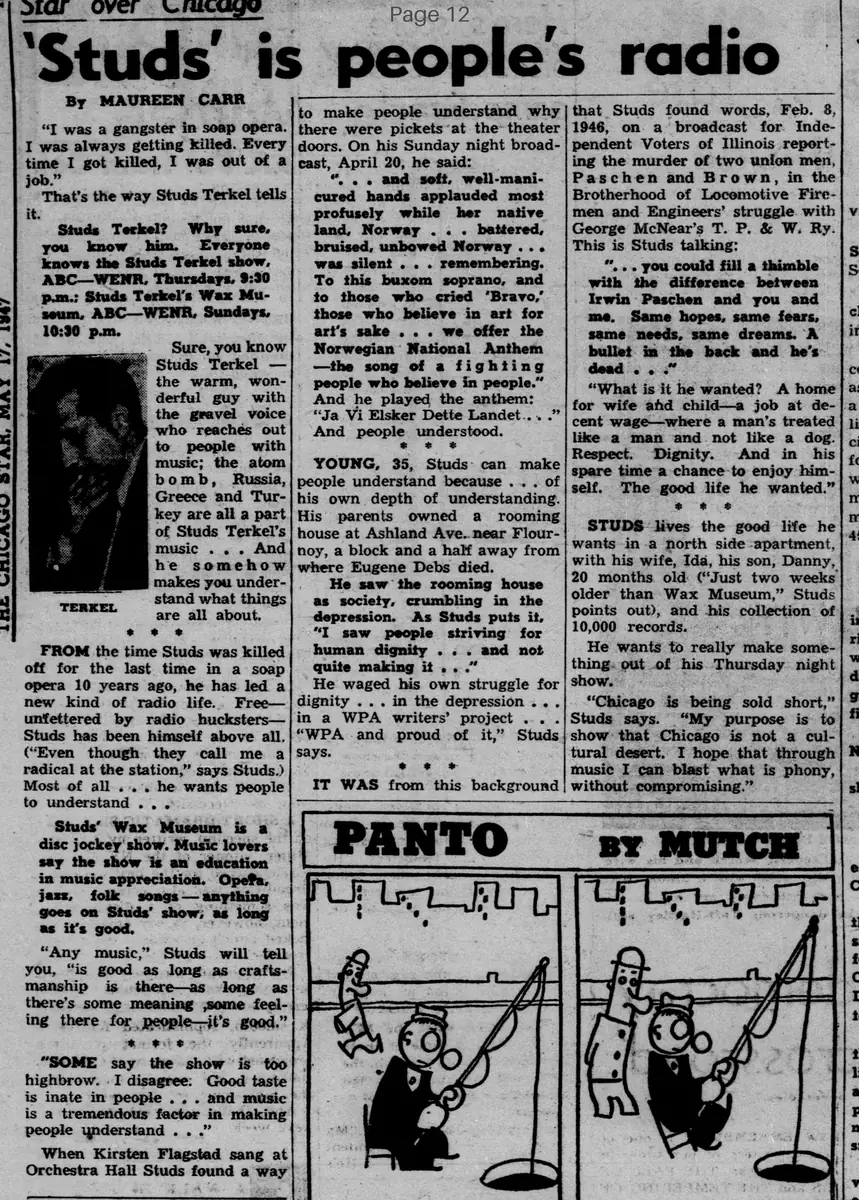
Studs is people's radio
By MAUREEN CARR
"I was a gangster in soap opera.
I was always getting killed. Every
time I got killed, I was out of a
job."
That's the way Studs Terkel tells
it.
Studs Terkel?
Why sure,
you know him. Everyone
knows the Studs Terkel show,
ABC--WENR, Thursdays, 9:30
p.m.; Studs Terkel's Wax Museum,
ABC--WENR, Sundays,
10:30 p.m.
Sure, you know
Studs Terkel--
the warm, wonderful guy with
the gravel voice
who reaches out
to people with
music; the atom
bomb, Russia,
music... And
he somehow
makes you under-
stand what things
are all about.
Greece and Tur-
key are all a part
of Studs Terkel's
world.
FROM the time Studs was killed
off for the last time in a soap
opera 10 years ago, he has led a
new kind of radio life. Free--
unfettered by radio hucksters--
Studs has been himself above all
("Even though they call me a
radical at the station," says Studs.)
Most of all... he wants people
to understand...
Studs' Wax Museum is a
disc jockey show. Music lovers
say the show is an education
in music appreciation. Opera,
jazz, folk songs--anything
goes on Studs' show; as long
as it's good.
"Any music," Studs will tell
you, "is good as long as crafts-
manship is there as long as
there's some meaning, some feel-
ing there for people--it's good."
"SOME say the show is too
highbrow... I disagree: Good taste
is innate in people... and music
is a tremendous factor in making
people understand..."
When Kirsten Flagstad sang at
Orchestra Hall, Studs found a way
to make people understand why
there were pickets at the theater
doors. On his Sunday night broad-
cast, April 20, he said:
"...and soft, well-mani-
cured hands applauded most
profusely while her native
land, Norway... battered,
bruised, unbowed Norway...
was silent... remembering.
To this buxom soprano, and
to those who cried 'Bravo,"
those who believe in art for
art's sake... we offer the
Norwegian National Anthem
--the song of a fighting
people who believe in people."
And he played the anthem:
"Ja Vi Elsker Dette Landet..."
And people understood.
YOUNG, 35. Studs can make
people understand because... of
his own depth of understanding.
His parents owned a rooming
house at Ashland Ave. near Flour-
noy, a block and a half away from
where Eugene Debs died.
He saw the rooming house
as society, crumbling in the
depression. As Studs puts it,
"I saw people striving for
human dignity... and not
quite making it..."
He waged his own struggle for
dignity... in the depression...
in a WPA writers' project...
"WPA and proud of it," Studs
says.
IT WAS from this background
that Studs found words, Feb. 8,
1946, on a broadcast for Inde-
pendent Voters of Illinois report-
ing the murder of two union men,
Paschen and Brown, in the
Brotherhood of Locomotive Fire-
men and Engineers' struggle with
George McNear's T. P. & W. Ry.
This is Studs talking:
"...you could fill a thimble
with the difference between
Irwin Paschen and you and
me. Same hopes, same fears,
same needs, same dreams. A
bullet in the back and he's
dead..."
"What is it he wanted? A home
for wife and child--a job at de-
cent wage--where a man's treated
like a man and not like a dog.
Respect. Dignity. And in his
spare time a chance to enjoy him-
self. The good life he wanted."
STUDS lives the good life he
wants in a north side apartment
with his wife, Ida, his son, Danny,
20 months old ("Just two weeks
older than Wax Museum," Studs
points out), and his collection of
10,000 records.
He wants to really make some-
thing out of his Thursday night
show.
"Chicago is being sold short,"
Studs says. "My purpose is to
show that Chicago is not a cul-
tural desert. I hope that through
music I can blast what is phony,
without compromising."
By MAUREEN CARR
"I was a gangster in soap opera.
I was always getting killed. Every
time I got killed, I was out of a
job."
That's the way Studs Terkel tells
it.
Studs Terkel?
Why sure,
you know him. Everyone
knows the Studs Terkel show,
ABC--WENR, Thursdays, 9:30
p.m.; Studs Terkel's Wax Museum,
ABC--WENR, Sundays,
10:30 p.m.
Sure, you know
Studs Terkel--
the warm, wonderful guy with
the gravel voice
who reaches out
to people with
music; the atom
bomb, Russia,
music... And
he somehow
makes you under-
stand what things
are all about.
Greece and Tur-
key are all a part
of Studs Terkel's
world.
FROM the time Studs was killed
off for the last time in a soap
opera 10 years ago, he has led a
new kind of radio life. Free--
unfettered by radio hucksters--
Studs has been himself above all
("Even though they call me a
radical at the station," says Studs.)
Most of all... he wants people
to understand...
Studs' Wax Museum is a
disc jockey show. Music lovers
say the show is an education
in music appreciation. Opera,
jazz, folk songs--anything
goes on Studs' show; as long
as it's good.
"Any music," Studs will tell
you, "is good as long as crafts-
manship is there as long as
there's some meaning, some feel-
ing there for people--it's good."
"SOME say the show is too
highbrow... I disagree: Good taste
is innate in people... and music
is a tremendous factor in making
people understand..."
When Kirsten Flagstad sang at
Orchestra Hall, Studs found a way
to make people understand why
there were pickets at the theater
doors. On his Sunday night broad-
cast, April 20, he said:
"...and soft, well-mani-
cured hands applauded most
profusely while her native
land, Norway... battered,
bruised, unbowed Norway...
was silent... remembering.
To this buxom soprano, and
to those who cried 'Bravo,"
those who believe in art for
art's sake... we offer the
Norwegian National Anthem
--the song of a fighting
people who believe in people."
And he played the anthem:
"Ja Vi Elsker Dette Landet..."
And people understood.
YOUNG, 35. Studs can make
people understand because... of
his own depth of understanding.
His parents owned a rooming
house at Ashland Ave. near Flour-
noy, a block and a half away from
where Eugene Debs died.
He saw the rooming house
as society, crumbling in the
depression. As Studs puts it,
"I saw people striving for
human dignity... and not
quite making it..."
He waged his own struggle for
dignity... in the depression...
in a WPA writers' project...
"WPA and proud of it," Studs
says.
IT WAS from this background
that Studs found words, Feb. 8,
1946, on a broadcast for Inde-
pendent Voters of Illinois report-
ing the murder of two union men,
Paschen and Brown, in the
Brotherhood of Locomotive Fire-
men and Engineers' struggle with
George McNear's T. P. & W. Ry.
This is Studs talking:
"...you could fill a thimble
with the difference between
Irwin Paschen and you and
me. Same hopes, same fears,
same needs, same dreams. A
bullet in the back and he's
dead..."
"What is it he wanted? A home
for wife and child--a job at de-
cent wage--where a man's treated
like a man and not like a dog.
Respect. Dignity. And in his
spare time a chance to enjoy him-
self. The good life he wanted."
STUDS lives the good life he
wants in a north side apartment
with his wife, Ida, his son, Danny,
20 months old ("Just two weeks
older than Wax Museum," Studs
points out), and his collection of
10,000 records.
He wants to really make some-
thing out of his Thursday night
show.
"Chicago is being sold short,"
Studs says. "My purpose is to
show that Chicago is not a cul-
tural desert. I hope that through
music I can blast what is phony,
without compromising."
What sub-type of article is it?
Biography
What themes does it cover?
Moral Virtue
Justice
What keywords are associated?
Studs Terkel
Radio Host
Chicago Radio
Music Appreciation
Human Dignity
Wpa
Union Murder
What entities or persons were involved?
Studs Terkel
Maureen Carr
Kirsten Flagstad
Irwin Paschen
Eugene Debs
Where did it happen?
Chicago
Story Details
Key Persons
Studs Terkel
Maureen Carr
Kirsten Flagstad
Irwin Paschen
Eugene Debs
Location
Chicago
Event Date
1946 02 08
Story Details
Studs Terkel, former soap opera actor, hosts radio shows on ABC-WENR focusing on music and social issues to promote understanding and human dignity, drawing from his Depression-era background and WPA experience.