Thank you for visiting SNEWPapers!
Sign up free
Editorial
June 13, 1943
Atlanta Daily World
Atlanta, Fulton County, Georgia
What is this article about?
The editorial critiques the gap between democratic ideals in American education and the reality of fear-based control, highlighting reprisals against Negro teachers and principals advocating for equal pay in Virginia, Arkansas, and Georgia.
Clipping
OCR Quality
95%
Excellent
Full Text
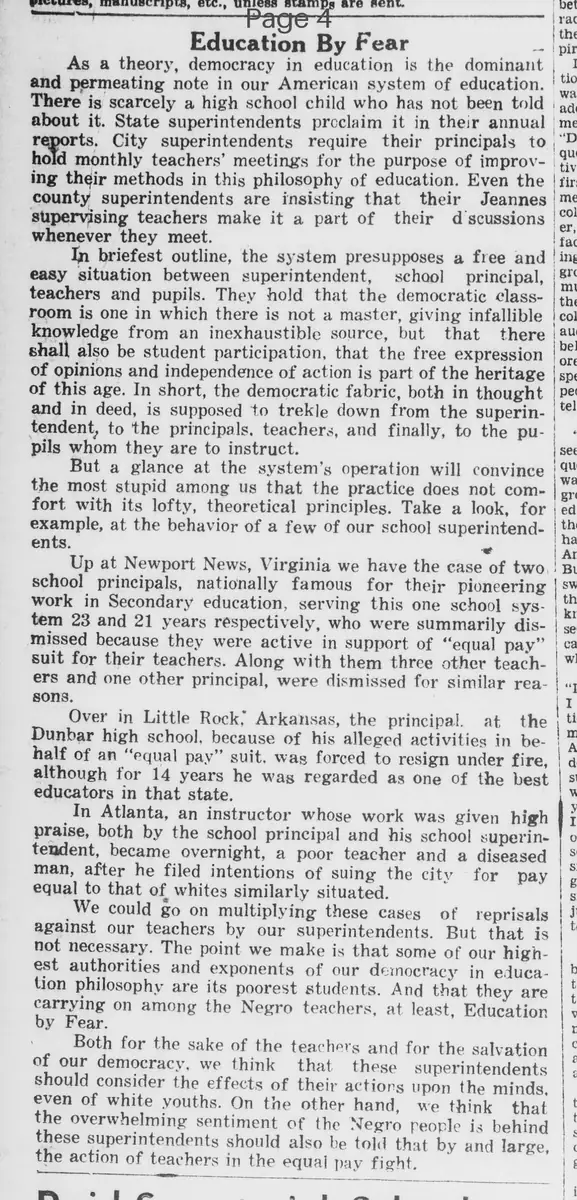
Education By Fear
As a theory, democracy in education is the dominant
and permeating note in our American system of education.
There is scarcely a high school child who has not been told
about it. State superintendents proclaim it in their annual
reports. City superintendents require their principals to
hold monthly teachers' meetings for the purpose of improv-
ing their methods in this philosophy of education. Even the
county superintendents are insisting that their general
supervising teachers make it a part of their discussions
whenever they meet.
In briefest outline, the system presupposes a free and
easy situation between superintendent, school principal,
teachers and pupils. They hold that the democratic class-
room is one in which there is not a master giving infallible
knowledge from an inexhaustible source, but that there
shall also be student participation, that the free expression
of opinions and independence of action is part of the heritage
of this age. In short, the democratic fabric, both in thought
and in deed, is supposed to trickle down from the superin-
tendent, to the principals, teachers, and finally, to the pu-
pils whom they are to instruct.
But a glance at the system's operation will convince
the most stupid among us that the practice does not con-
form with its lofty, theoretical principles. Take a look, for
example, at the behavior of a few of our school superintend-
ents.
Up at Newport News, Virginia we have the case of two
school principals, nationally famous for their pioneering
work in Secondary education, serving this one school sys-
tem 23 and 21 years respectively, who were summarily dis-
missed because they were active in support of "equal pay"
suit for their teachers. Along with them three other teach-
ers and one other principal, were dismissed for similar rea-
sons.
Over in Little Rock, Arkansas, the principal, at the
Dunbar high school, because of his alleged activities in be-
half of an "equal pay" suit, was forced to resign under fire,
although for 14 years he was regarded as one of the best
educators in that state.
In Atlanta, an instructor whose work was given high
praise, both by the school principal and his school superin-
tendent, became overnight, a poor teacher and a diseased
man, after he filed intentions of suing the city for
pay
equal to that of whites similarly situated.
We could go on multiplying these cases of reprisals
against our teachers by our superintendents. But that is
not necessary. The point we make is that some of our high-
est authorities and exponents of our democracy in educa-
tion philosophy are its poorest students. And that they
are
carrying on among the Negro teachers, at least, Education
by Fear.
Both for the sake of the teachers and for the salvation
of our democracy, we think that these superintendents
should consider the effects of their actions upon the minds.
even of white youths. On the other hand, we think that
the overwhelming sentiment of the Negro people is behind
these teachers in the equal pay fight.
As a theory, democracy in education is the dominant
and permeating note in our American system of education.
There is scarcely a high school child who has not been told
about it. State superintendents proclaim it in their annual
reports. City superintendents require their principals to
hold monthly teachers' meetings for the purpose of improv-
ing their methods in this philosophy of education. Even the
county superintendents are insisting that their general
supervising teachers make it a part of their discussions
whenever they meet.
In briefest outline, the system presupposes a free and
easy situation between superintendent, school principal,
teachers and pupils. They hold that the democratic class-
room is one in which there is not a master giving infallible
knowledge from an inexhaustible source, but that there
shall also be student participation, that the free expression
of opinions and independence of action is part of the heritage
of this age. In short, the democratic fabric, both in thought
and in deed, is supposed to trickle down from the superin-
tendent, to the principals, teachers, and finally, to the pu-
pils whom they are to instruct.
But a glance at the system's operation will convince
the most stupid among us that the practice does not con-
form with its lofty, theoretical principles. Take a look, for
example, at the behavior of a few of our school superintend-
ents.
Up at Newport News, Virginia we have the case of two
school principals, nationally famous for their pioneering
work in Secondary education, serving this one school sys-
tem 23 and 21 years respectively, who were summarily dis-
missed because they were active in support of "equal pay"
suit for their teachers. Along with them three other teach-
ers and one other principal, were dismissed for similar rea-
sons.
Over in Little Rock, Arkansas, the principal, at the
Dunbar high school, because of his alleged activities in be-
half of an "equal pay" suit, was forced to resign under fire,
although for 14 years he was regarded as one of the best
educators in that state.
In Atlanta, an instructor whose work was given high
praise, both by the school principal and his school superin-
tendent, became overnight, a poor teacher and a diseased
man, after he filed intentions of suing the city for
pay
equal to that of whites similarly situated.
We could go on multiplying these cases of reprisals
against our teachers by our superintendents. But that is
not necessary. The point we make is that some of our high-
est authorities and exponents of our democracy in educa-
tion philosophy are its poorest students. And that they
are
carrying on among the Negro teachers, at least, Education
by Fear.
Both for the sake of the teachers and for the salvation
of our democracy, we think that these superintendents
should consider the effects of their actions upon the minds.
even of white youths. On the other hand, we think that
the overwhelming sentiment of the Negro people is behind
these teachers in the equal pay fight.
What sub-type of article is it?
Education
Social Reform
What keywords are associated?
Democracy In Education
Equal Pay Suit
Negro Teachers
Education By Fear
School Reprisals
Teacher Dismissals
What entities or persons were involved?
School Superintendents
Negro Teachers
School Principals
Newport News Virginia
Little Rock Arkansas
Atlanta Georgia
Editorial Details
Primary Topic
Critique Of Reprisals Against Teachers Supporting Equal Pay
Stance / Tone
Critical Of Superintendents' Fear Based Practices
Key Figures
School Superintendents
Negro Teachers
School Principals
Newport News Virginia
Little Rock Arkansas
Atlanta Georgia
Key Arguments
Democratic Education Theory Promotes Free Expression And Participation
Practice Involves Reprisals Against Teachers Advocating Equal Pay
Examples Of Dismissals In Newport News, Little Rock, And Atlanta
Such Actions Undermine Democracy And Instill Fear Among Negro Teachers
Superintendents Should Consider Impacts On All Youths