Thank you for visiting SNEWPapers!
Sign up free
Richmond Enquirer
Richmond, Richmond County, Virginia
What is this article about?
On January 4, 1819, in the U.S. Senate, Mr. J. Barbour delivers a speech opposing a bill to reorganize federal courts and appoint circuit judges. He proposes abolishing circuit courts, transferring jurisdiction to district courts, and allowing direct appeals to the Supreme Court, arguing it relieves Supreme Court justices, reduces costs, and avoids unnecessary federal expansion.
Clipping
OCR Quality
Full Text
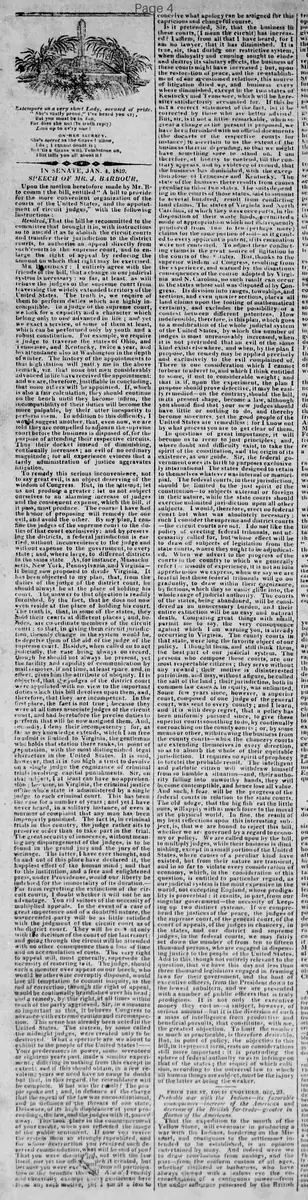
SPEECH OF MR. J. BARBOUR.
Upon the motion heretofore made by Mr. B. to commit the bill, entitled "A bill to provide for the more convenient organization of the courts of the United States, and the appointment of circuit judges," with the following instructions:
Resolved, That the bill be recommitted to the committee that brought it in, with instructions so to amend it as to abolish the circuit courts and transfer their jurisdiction to the district courts, to authorize an appeal directly from such courts to the supreme court, and to enlarge the right of appeal by reducing the amount on which that right may be exercised.
Mr. President: I entirely agree with the friends of the bill, that a change in our judicial system is necessary: so far, at least, as will relieve the judges of the supreme court from traversing the widely extended territory of the United States. The truth is, we require of them to perform duties which are highly incompatible. In a judge of the supreme court, we look for a capacity and a character which belong only to one advanced in life; and yet we exact a service, of some of them at least, which can be performed only by youth and a robust constitution. For example, we require a judge to traverse the states of Ohio, and Tennessee, and Kentucky, twice a year, and his attendance also at Washington in the depth of winter. The history of the appointments to that high station will justify me in the above remark, viz. that none but men considerably advanced in life have received the appointment: and we are, therefore, justifiable in concluding, that none others will be appointed. If, which is also a fair calculation, they should continue on the bench until they become infirm, the incompatibility of their duties will become the more palpable, by their utter incapacity to perform them. In addition to this difficulty, I would suggest another, that, even now, we are told they are compelled to adjourn the supreme court before the business is disposed of, for the purpose of attending their respective circuits. Thus their docket instead of diminishing, continually increases; an evil of no ordinary magnitude; for all experience evinces that a tardy administration of justice aggravates litigation.
To remedy this serious inconvenience, not to say great evil, is an object deserving of the wisdom of Congress. But, in the attempt, let us not produce a greater: let us not subject ourselves to an alarming increase of judges and the consequent expense, which the bill, if it pass, must produce. The course I have had the honor of proposing will remedy the one evil, and avoid the other. By my plan, I confine the judges of the supreme court to the duties of that court exclusively: and by preserving the districts, a federal jurisdiction is carried, without inconvenience to the judge and without expense to the government, to every state; and, where large, to different districts in the same state. As, for instance, Massachusetts, New York, Pennsylvania, and Virginia—it being now proposed to divide Virginia. It has been objected to my plan, that, from the duties of the judge of the district court, he should always be at the place of holding his court. The answer to that objection is readily furnished. By the fact, that he does not now even reside at the place of holding his court. The truth is, that, in some of the states, they hold their courts at different places; and, besides, are co-ordinate members of the circuit court: so that, in giving them circuit jurisdiction, the only change in the system would be, to deprive them of the aid of the judge of the supreme court. Besides, when called on to act judicially, the case being always on record, although he should not always be present, yet the facility and rapidity of communication by mail removes, if not time, at least space, and, in effect, gives him the attribute of ubiquity. It is objected, that the judges of the district court were appointed with no view to the important duties which this bill devolves upon them, and, therefore, that they are incompetent. In the first place, the fact is not true; because they were at all times associate judges of the circuit court, and had heretofore the precise duties to perform that will be now assigned them. And, secondly, I deny their incompetency; for, as far as my knowledge extends, which I am free to admit is limited to Virginia, the gentleman who holds that station there ranks, in point of reputation, with the most distinguished legal characters in the United States. It is said, however, that it is too high a trust to devolve on a single judge the cognizance of criminal trials involving capital punishments. Sir, on that subject, I at least can have no apprehension; because, in Virginia, the criminal justice of the whole state is administered by a single judge to each criminal court. This has been the case for a number of years; and yet I have never heard, in a solitary instance, of even a murmur of complaint that any man has been improperly punished. The fact is, in criminal trials in this country, the judge rather sits to preserve order than to take part in the trial. The great security of innocence, without meaning any disparagement of the judges, is to be found in the grand jury and the jury of the vicinage. The latter, I have ever thought, and in and out of this place have declared it, the happiest effort of the human mind; and that to this institution, and a free and enlightened press, under Providence, would our liberty be indebted for the immortality of its duration.
Far from regretting the extinction of the circuit courts, I doubt whether it will not be an advantage. You rid suitors of the necessity of multiplied appeals. In the event of a case of great importance and of a doubtful nature, the unsuccessful party will be as little satisfied with the judgment of the circuit court as of the district court. They will be content only with the decision of the court of the last resort: and going through the circuit will be attended with no other consequence than a loss of time and an accumulation of costs. The very right to appeal will, most generally, supersede the necessity of resorting to it. The judge, should such a monster ever appear on our bench, who would be otherwise corruptly disposed, would lose all temptation to commit iniquity, as the rod of correction, through the right of appeal, would be continually brandished over his head; and a remedy, by this right, at all times within reach of the party aggrieved. Sir, in a measure so important as this, it behooves Congress to advance with extreme caution and circumspection. This scene has already been acted in the United States. The sixteen, by some called the midnight judges, were created only to be destroyed. What a spectacle are we about to exhibit to the people of the United States!-- Your predecessors in power, some seventeen or eighteen years past, made a similar experiment; differing in nothing from this except in extent: and if this should obtain, in a few revolving years we need have no cause to doubt but that, in this regard, the resemblance will be complete. What was the result? The people spoke out; and, in defiance of the charge that the repeal of the law was unconstitutional, and in defiance of the threats of one state, Delaware, of its high displeasure at your proceedings, the law, and the judges with it, passed away. Thus took place in the commencement of your career, when you reflected the image of the public sentiment. If now you revive the system then so strongly reprobated, and for whose destruction you received such deserved commendation, what will be said of you? That you were dissatisfied, not with the law itself, nor yet the offices which it created, but with the benefits the real law of '93 readily and cheerfully exempt every gentleman here from any such native, yet I am at a loss to conceive what apology can be assigned for this capricious and changeable course.
I. It is pretended, Sir, that the business of these courts (I mean the circuit) has increased? I affirm not. From all that I have heard, for I am no lawyer, that it has diminished. It is true, sir, that during our restrictive system, when disloyalty and cunning sought to elude and destroy its salutary effects, the business of these courts might have increased: but, upon the restoration of peace, and the re-establishment of our uncombined relations, this source of litigation dried up, and business everywhere diminished, except in the two states of Kentucky and Tennessee, which will be hereafter satisfactorily accounted for. If this be not a correct statement of the fact, I wish it be corrected by those who are better informed. But, sir, is it not a little remarkable, when so great a change in the present is proposed, we have been furnished with no official documents (the dockets of the respective courts for instance) to ascertain to us the extent of the business there on trial, so that we might have something sure to stand on. I know therefore, at liberty to conclude, that the ordinary appeals, and evidence of record, gratify the business has diminished, with the exception alone of Tennessee and Kentucky. The state of the business there results from causes peculiar to those two states. The suits depending in the courts of those states, said to amount to several hundred, result from conflicting land claims. The states of Virginia and North Carolina, of which they were parcels, in the disposition of their waste lands,--permitted a mode of appropriation which not subsequently provided just law to ten (perhaps more) claims for the same portion of virgin soil granted to every applicant a patent, if its emanation were not contested. To adjust these conflicting claims in the great source of litigation in the courts of those states. But, thanks to the superior wisdom of Congress, resulting from the experience, and warned by the devastations consequences of the course adopted by Virginia and N. Carolina, no such result can occur in the states where land was disposed of by Congress. Its division into ranges, townships, and sections, and even quarter-sections, places all land claims upon the footing of mathematical certainty, and excludes the possibility of a contest between different patentees. How indubitable, therefore, is this plan, which goes to a modification of the whole judicial system of the United States, by which the number of judges is most unreasonably increased, when it is not pretended that an evil of the same kind exists elsewhere, and when, by the plan I propose, the remedy may be applied precisely and exclusively to the evil complained of.
There is one consideration which I cannot forbear to advert to, and which I think entitled to some, if not to considerable weight: and that is, if, upon the experiment, the plan I propose should prove defective, it may be easily remedied—on the contrary, should the bill, in its present shape, become a law, although you should find that your new judges should have little or nothing to do, and thereby become sinecures; yet the good people of the United States are remediless: for I know not by what process you are to get clear of them.
In questions of great importance, it will become us to recur to just principles; and, where doubt and difficulty exist, to take the spirit of the constitution, and the origin of its existence, as our guide. Sir, the federal government owes its birth to purposes exclusively international. The states designed to retain to themselves whatever was internal or municipal. The federal courts, in their jurisdiction, should be limited to the just spirit of the constitution—to subjects external or foreign in their nature, while the state courts should exercise unlimited jurisdiction upon all other subjects. I would, therefore, erect no federal court but what was absolutely necessary: such I consider the supreme and district courts—the circuit courts are not. I do not like the policy of erecting federal tribunals, not necessarily called for, but whose effect will be to draw off subjects of litigation from the state courts, where they ought to be adjudicated. When we advert to the progress of the courts in the country to which we generally refer for lessons of experience, it is not an idle apprehension we express, when we say we are fearful lest these federal tribunals will go on gradually, to draw within their cognizance, by fictions, which they so easily glide into, the whole range of judicial authority. The courts of the states, being abandoned, will be considered as an unnecessary burden, and their entire extinction will be an easy and natural death. Comparing great things with small, permit me to say, the very consequence against which I am warning you, is already occurring in Virginia. The county courts in that state, were long the favorite object of our policy. I thought them, and still think them, the best part of our judicial system. The persons who compose those courts, are our most respectable citizens; they serve without any reward; their motive is disinterested patriotism, and may, without figure, be called the salt of the land; their jurisdiction, both in common law cases & in equity, was unlimited. Some few years since, however, a superior court, composed of one judge of the general court, was sent to every county; and I learn, and it is with deep regret, that a policy has uniformly pursued since, to give these superior courts something to do, by continually encroaching on the county courts; or, by some means or other, withdrawing the business from the county courts—while the chancery courts are extending themselves in every direction, so as to absorb the whole of their equitable jurisdiction. It requires no spirit of prophecy to foretell the probable result. The intelligent and patriotic citizen will withdraw himself from so humble a situation—and, their authority falling into unworthy hands, they will become contemptible, and hence lose all value. And such, I fear, will be the progress of the federal courts in relation to the state courts. The old adage, that the big fish eat the little ones, will apply with as much force to the moral as the physical world. In fine, the result of my best reflections upon this interesting subject, is, that we are bound to reject this bill, whether we are governed by a regard to economy or policy. We are called upon by the bill, to multiply judges, while their business is diminishing, except in a small portion of the United States, where causes of a peculiar kind have existed, but from their nature are transient, and in so far to violate every consideration of economy, which, in the consideration of this question, is entitled to particular regard, as our judicial system is the most expensive in the world, not excepting England, whose prodigality is proverbial: it results, in part, from our singular government—the necessity of keeping up two distinct systems. If we comprehend the justices of the peace, the judges of the supreme court, of the general court, of the court of appeals, of the judges in chancery, in the states, and our district and supreme judges, in the federal courts, we may fairly set down the number of from ten to fifteen thousand persons, who are engaged in dispensing justice to the people of the United States. Add to this, though not entirely relevant to the question, that we have this day not less than three thousand legislators engaged in framing laws for their government, and the host of executive officers, from the President down to the lowest subaltern, and we are presented with a number of public officers that is truly prodigious. It is not only the executive money they cost us—a subject, however, of serious amount—but it is the diversion of such a mass of intelligence from productive and beneficial pursuits, that constitutes, with me, the greatest objection. To limit the number as much as practicable, is therefore desirable. But, in point of policy, the objection to this bill, in its present form, rests on considerations still more important: it is protruding the sphere of federal authority so as to infringe on that of the states: the sequel of which collision, according to the universal law to which all human things are subject, must be the injury of the latter as being the weaker.
What sub-type of article is it?
What themes does it cover?
What keywords are associated?
What entities or persons were involved?
Where did it happen?
Story Details
Key Persons
Location
United States Senate
Event Date
January 4, 1819
Story Details
Mr. J. Barbour argues for amending a bill to abolish circuit courts, transfer jurisdiction to district courts, allow direct appeals to the Supreme Court, and reduce appeal amounts, to relieve Supreme Court judges, cut costs, and limit federal overreach while maintaining efficiency.