Thank you for visiting SNEWPapers!
Sign up free
Springfield Weekly Republican
Springfield, Hampden County, Massachusetts
What is this article about?
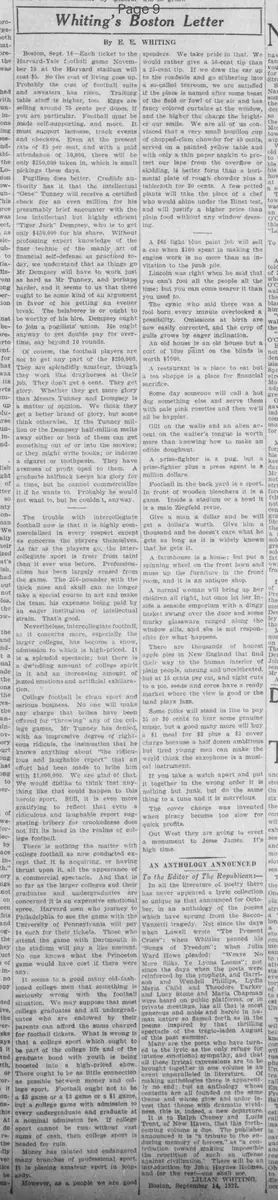
Whiting's Boston letter satirizes the rising costs of college football tickets (e.g., $5 for Harvard-Yale) and its commercialization, contrasting it with high boxing purses for Tunney and Dempsey, arguing it should stay affordable and amateur to avoid professional taint and preserve college spirit. Extends critique to broader consumer extravagance.
Clipping
OCR Quality
Full Text
Boston, Sept. 14—Each ticket to the
Harvard-Yale football game Novem-
ber 19 at the Harvard stadium will
cost $5. So the cost of living goes up.
Probably the cost of football suits
and sweaters, has risen. Training
table stuff is higher, too. Eggs are
selling around 75 cents per dozen, if
you are particular. Football must be
made self-supporting, and more. It
must support lacrosse, track events
and checkers.
Even at the present
rate of $5 per seat, and with a paid
attendance of 50,000, there will be
only $250,000 taken in, which is small
pickings these days.
Pugilism does better. Credible au-
thority has it that the intellectual
"Gene" Tunney will receive a certified
check for an even million for his
presumably brief encounter with the
less intellectual but highly efficient
"Tiger Jack" Dempsey, who is to get
only $450,000 for his share. Without
professing expert knowledge of the
finer technic of the manly art of
financial self-defense as practiced to-
day, we understand that as things go
Mr. Dempsey will have to work just
as hard as Mr. Tunney, and perhaps
harder, and it seems to us that there
ought to be some kind of an argument
in favor of his getting an evener
break. The belaborer is or ought to
be worthy of his hire. Dempsey ought
to join a pugilists' union. He ought
anyway to get double pay for over-
time, say beyond 10 rounds.
Of course, the football players are
not to get any part of the $250,000.
They are splendidly amateur, though
they work like drayhorses at their
job. They don't get a cent. They get
glory. Whether they get more glory
than Messrs. Tunney and Dempsey is
a matter of opinion. We think they
get a better brand of glory, but some
think otherwise. If the Tunney mil-
lion or the Dempsey half-million melts
away either or both of them can get
something out of or into the movies;
or they might write books; or indorse
a cigaret or toothpaste. They have
avenues of profit open to them. A
graduate halfback keeps his glory for
a time, but he cannot commercialize
it if he wants to. Probably he would
not want to, but he couldn't, anyway.
The trouble with intercollegiate
football now is that it is highly com-
mercialized in every respect except
as concerns the players themselves.
As far as the players go, the inter-
collegiate sport is freer from taint
than it ever was before. Profession-
alism has been largely erased from
the game. The 250-pounder with the
thick nose and skull can no longer
take a special course in art and make
the team, his expenses being paid by
an eager institution of intellectual
strain. That's good.
Nevertheless, intercollegiate football,
as it concerns more, especially the
larger colleges, has become a show,
admission to which is high-priced. It
is a splendid spectacle; but there is
a dwindling amount of college spirit
in it and an increasing amount of
jazzed emotions and artificial exhilara-
tion.
College football is clean sport and
serious business. No one will make
any charge that bribes have been
offered for "throwing" any of the col-
lege games. Mr. Tunney has denied,
with an impressive degree of right-
eous ridicule, the insinuation that he
knows anything about "the ridicu-
lous and laughable report" that an
effort had been made to bribe him
with $1,000,000. We are glad of that.
We would dislike to think that any-
thing like that could happen to this
heroic sport. Still, it is even more
gratifying to reflect that even a
ridiculous and laughable report sug-
gesting bribery for crookedness does
not lift its head in the realms of col-
lege football.
There is nothing the matter with
college football as now conducted ex-
cept that it is acquiring, or having
thrust upon it, all the appearance of
a commercial spectacle. And that in
so far as the larger colleges and their
graduates and undergraduates are
concerned it is an expensive emotional
spree. Harvard men who journey to
Philadelphia to see the game with the
University of Pennsylvania will pay
$4 each for their tickets. Those who
attend the game with Dartmouth in
the stadium will pay a like amount.
No one knows what the Princeton
game would have cost if there were
any.
It seems to a good many old-fash-
ioned college men that something is
seriously wrong with the football
situation. We may suppose that most
college graduates and all undergrad-
uates who are endowed by their
parents can afford the sums charged
for football tickets. What is wrong is
that a college sport which ought to
be part of the college life and of the
graduate bond with youth is being
boosted into a high-priced show.
There ought to be as little connection
as possible between money and col-
lege sport. Football ought not to be
a $5 game or a $3 game or a $1 game,
but a college game with admission to
every undergraduate and graduate at
a nominal admission fee. If college
sport cannot be run without vast
sums of cash, then college sport is
headed for ruin.
Money has tainted and endangered
many branches of professional sport.
It is placing amateur sport in jeop-
ardy.
However, as a people we are good
spenders. We take pride in that. We
would rather give a 50-cent tip than
a 25-cent tip. If we draw the car up
to the roadside and go slithering into
a so-called tearoom, we are satisfied
if the place is named after some beast
of the field or fowl of the air and has
fancy colored curtains at the window,
and the higher the charge the bright-
er our smile. We are all of us con-
vinced that a very small bouillon cup
of chopped-clam chowder for 40 cents,
served on a painted yellow table and
with only a thin paper napkin to pro-
tect our laps from the overflow or
skidding, is better form than a hori-
zontal plate of rough chowder plus a
tablecloth for 30 cents. A few potted
plants will take the place of a chef
who would shine under the Binet test,
and will justify a higher price than
plain food without any window dress-
ing.
A $65 light blue paint job will sell
a car when $100 spent in making the
engine work is no more than an in-
vitation to the junk pile.
Lincoln was right when he said that
you can't fool all the people all the
time; but you can come nearer it than
you used to.
The cynic who said there was a
fool born every minute overlooked a
possibility. Omissions at birth are
now easily corrected, and the crop of
gulls grows by eager inclination.
An old house is an old house but a
coat of blue paint on the blinds is
worth $7000.
A restaurant is a place to eat but
a tea shoppe is a place for financial
sacrifice.
Some day someone will call a hot
dog something else and serve them
with pale pink rosettes and then we'll
all be happier.
Gilt on the walls and an alien ac-
cent on the waiter's tongue is worth
more than knowing how to make an
edible doughnut.
A prize-fighter is a pug, but a
prize-fighter plus a press agent is a
million dollars.
Football in the back yard is a sport.
In front of wooden bleachers it is a
game. Inside a stadium or a bowl it
is a male Ziegfeld revue.
Give a man a dollar and he will
get a dollar's worth. Give him a
thousand and he doesn't care what he
gets as long as it is widely known
that he gets it.
A farmhouse is a home; but put a
spinning wheel on the front lawn and
muss up the furniture in the front
room, and it is an antique shop.
A normal woman will bring up her
children all right, but once let her in-
side a seaside emporium with a dingy
basket swung over the door and some
murky glassware ranged along the
window sills, and she is not respon-
sible for what happens.
There are thousands of honest
apple pies in New England that find
their way to the human interior of
plain people, unsung and uncelebrated,
but at 15 cents per cut, and eight cuts
to a pie, seeds and cores have a ready
market where the view is good or the
band plays jazz.
Some folks will stand in line to pay
25 or 30 cents to hear some genuine
music, but a good many more will buy
a $1 meal for $3 plus a $2 cover
charge because a half dozen ambitious
but tired young men can make the
world think the saxophone is a musi-
cal instrument.
If you take a watch apart and put
it together in the wrong order it is
nothing but junk, but do the same
thing to a tune and it is marvelous.
The cover charge was invented
when piracy
became too slow for
quick profits.
Out West they are going to erect
a monument to Jesse James.
It's
high time.
What sub-type of article is it?
What themes does it cover?
What keywords are associated?
What entities or persons were involved?
Letter to Editor Details
Author
Whiting
Recipient
The Printer
Main Argument
college football has become overly commercialized and expensive, resembling a high-priced spectacle rather than an amateur sport integral to college life; it should be accessible at nominal fees to preserve its purity and avoid the taint of professionalism seen in boxing.
Notable Details