Thank you for visiting SNEWPapers!
Sign up free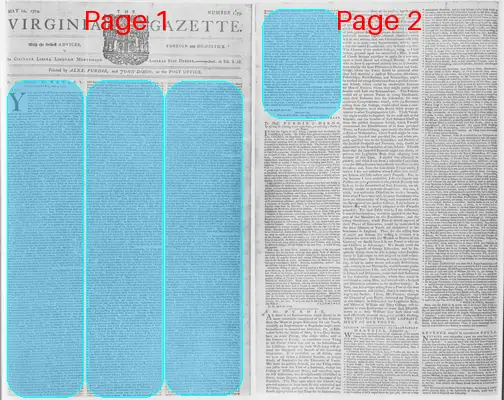
The Virginia Gazette
Richmond, Williamsburg, Richmond County, Virginia
What is this article about?
In this 1774 letter from Williamsburg, Ro. C. Nicholas responds to Rev. Samuel Henley's pamphlet, defending the Church of England's doctrines, ordination vows, and religious establishment against Henley's criticisms of heresy and private judgment. Nicholas accuses Henley of inconsistency, misrepresentation, and violating his ministerial duties.
Merged-components note: Continuation of the same letter to the editor across pages, signed by RO. C. NICHOLAS.
Clippings
1 of 2
OCR Quality
Full Text
Reverend Mr. HENLEY.
WILLIAMSBURG, May 5, 1774.
SIR,
You can have no just Reason to complain that I once more take the Liberty of addressing you through this Channel; it was a Walk of your own choosing, in which I was not only invited, but repeatedly dared to meet you. It seems therefore a little contrary to Rule that you should shift your Ground, and expect my Attendance wherever else you may be pleased to lead. In this enlightened Age of free Inquiry the Author of any extensive Work, decorated with the various Parades of Learning, must unquestionably make a conspicuous Figure. You, no Doubt, will receive the cordial Thanks of those different Booksellers, for whom you write, for contributing, by your last Performance, so very liberally to their Emolument, and, if, amongst the Reviewers, there should be found some Kindred, some congenial Spirits, we may expect to see it puffed off with every flattering Encomium. After saying thus much, I need not tell you, Sir, that I have, at last, seen your long expected Pamphlet. The Dexterity, with which it has been distributed and the Pains taken by you, and several of your Friends, to give it the most favourable Impression, furnish an additional Reason for this Mode of Address. Would not your Title have carried with it some few Marks of Modesty and Respect for your Readers, had it been left to them to judge of the Candour of your Work, and whether it contained Refutation or not? This, indeed, might have kept you too long in Suspense; the Event, at last, might have been too uncertain, and therefore it was better, perhaps, at once to anticipate their Judgments and pronounce their Sentence in your own Favour. That Aversion to a farther Discordance, as hinted in your prefixed Advertisement, would have been laudable, had it been sincere; but, is it to be collected from your Intimation that some other Circumstances might have been mentioned, which seem to have escaped my Memory? An Insinuation of this Sort was the most likely to lay a broad Foundation of Discord, were I prone to harbour Resentments. How strange must it appear that any other Circumstances should be reserved in Petto, after every Topick of Rancour and Abuse had been long since exhausted? The great Appearance of Candour, with which you declare to have "admitted the Facts upon my own Representation," might have had the desired Effect on some of your Readers and I might also have been taken in by it, had not Experience taught me to view whatever drops from your Pen with some Degrees of Suspicion. But how great must have been their Surprise to find you, in an early Part of your Pamphlet, denying some of the most material Facts and endeavouring to explain away others, which you pretend to admit; and how must this Surprise be worked up to Astonishment, should I be able, in the Sequel, to detect you in several palpable Misrepresentations? Did your Production really carry with it any of those Marks of hasty Composition, which, with so much Humility, you endeavour to persuade us you think it does, your Apology for any slight Errors or Mistakes might be admitted; but, when we find it impregnated with the rankest Ollos of the Lamp, we shall be apt to conclude it to be the Offspring not only of much Deliberation, but of the hardest Labour. I know it is so great a Darling that I shall not be surprised, if, because, we find the Merit of its Birth claimed by different Pretenders; and the World, perhaps, at last, to do Justice to the right Owners, will be obliged to ascribe it to some original Conins, who first trod that untrodden Path, in which you became a humble Follower; or else to a certain unts, with whom, your principal Office seems to have been that of Amanuensis. I hazard this Peradventure with the less Scruple, as I find so many of your Quotations in Languages, with which I have many Reasons to believe you have but a slight Acquaintance. I shall not question the Propriety of your Division of polemical Writings in general; but which of us, in the course of this Controversy, with its several Concomitants, hath displayed the greatest Affectation of Wit and Buffoonery, or dealt most profusely in personal Abuse, I will not trust to your Decision, but submit to the impartial Reader. After complimenting yourself for that Moderation, Civility and Diffidence in your own Works, you have given us an admirable Specimen of each in a few quick Arguments, which form the leading Characteristics of all your Compositions: into an Archangel and degrade me into a Devil. So much for Civility, succeeding Words, by which, in Contrast, you would transform yourself into Politeness and your pompous Exordium.
Should I now take a Stride to the Close of your Pamphlet, I hope you will not suspect me of a Design to fly from my Colours; you will presently find me returning to receive your hottest Fire, from which I hope to escape without being totally annihilated. Had I, unacquainted with the Occasion of it, read your Conclusion, it must have melted me into Compassion and Pity; but having been taught by your Friend Hoadleianus (being only a little diversified in Expression) I must own to you that I believe "the Mob," or, if "I have tried Expedients to excite a popular Odium" I became callous. But pray, Sir, If "I have so liberally sacrificed to" them, to what have you offered up these your Sacrifices? It is sometimes of great Advantage warmly to solicit the Passions of our Readers; this may Interest them in our Favour; and, if by such Means, they can be diverted from the principal Object, their Resentment, may be roused against an Opponent. Pompous Professions of Regard for the Liberties of Mankind have often been vociferated from the Mouths of the arrantest Pludo-Patriots, that ever existed upon Earth; but what hath been the End? Like some Generals, of old, they have wheedled themselves into the good Graces of the Multitude, and, after plundering Men's Fortunes. Some devious, soaring Geniuses observing the good Effect of the People. "Fiat tibi erunt Astra." Opportunities are said to make establishing their own Importance, have rode triumphant on the Necks of old Tract already beaten and possessed by others, find there is little left to gratify their Ambition; and then, par Fas aut Nefas, they attempt to Break out Something new and extraordinary, without regarding Consequences. Were I disposed to boasting, I could tell you of my ardent Love for Liberty and that I am a Friend to a just Government, both in Church and State; since, upon this, must depend the Preservation of the Liberties of America have, of late Years, been greatly infringed, is a Truth nue Liberties of the People, religious as well as civil. That the civil Li- mticl to be lamented; but, as to our religious Liberty, point out an En- croachment upon that. In this Country we have hitherto thought ourselves Happy in an established Church; a Church, which I will venture to pro- nounce the most tolerant in the known World. We have, it is true, Dissent- ers amongst us; do not they all, who behave orderly and peaceably in So- ciety, enjoy their own religious Sentiments? If the Toleration hitherto allowed is not sufficient for this Purpose, have you not had abundant Reasons to be convinced of the Inclination of our Legislature to make it as extensive as they can reasonably desire or wish even much more so than is known liberally sacrificed, and undoubtedly recompence my most sanguine m Great Britain?
But it seems that this "Mob, to which I have so" with Applause, which you as a devoted Heretic, with consecrated Curses "Expectations; the Resolution of my Conduct is to be echoed back are to be delivered over to the Devil" For Shame, Sir, recall these every Turn, of sounding in our Ears the Word Heretic; have I ever used Words, as indecent and unwarranted. I observe you are very loud, at it May not disapprove of Gentleman religious Principles epe l, if he will propagate them, so far as to think him an improper Per- Son. L. Candidness and Constancy.
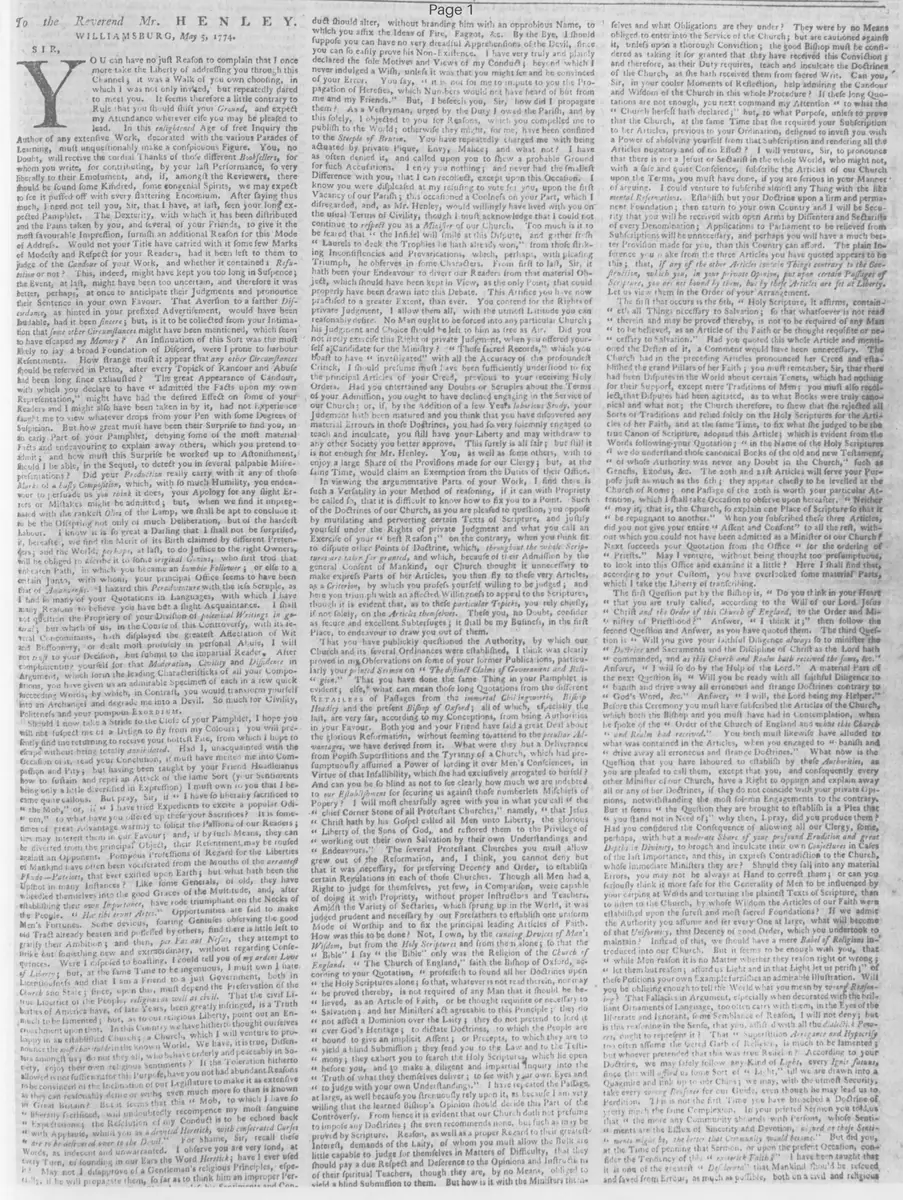
duet should alter, without branding him with an opprobrious Name, to which you affix the Ideas of Fire, Faggot, &c. By the Bye, I should suppose you can have no very dreadful Apprehensions of the Devil, since you can so easily prove his Non-Existence. I have very truly and plainly declared the sole Motives and Views of my Conduct; they and which I never indulged a Wish, unless it was that you might see and be convinced of your Error. You say, "it is not for me to impute to you the Pro- pagation of Heresies, which Numbers would not have heard of but from me and my Friends." But, I beseech you, Sir, how did I propagate them? As a Vestyman, urged by the Duty I owed the Parish, and by this solely, I objected to you for Reasons, which you compelled me to publish to the World; otherwise they might, for me, have been confined to the Steeple of Bruton. You have repeatedly charged me with being actuated by private Pique, Envy, Malice; and what not? I have as often denied it, and called upon you to show a probable Ground for such Accusations. I envy you nothing; and never had the smallest Difference with you, that I can recollect, except upon this Occasion. I know you were displeased at my refusing to vote for you, upon the first Vacancy of our Parish; this occasioned a Coolness on your Part, which I disregarded, and, as Mr. Henley, would willingly have lived with you on the usual Terms of Civility, though I must acknowledge that I could not continue to respect you as a Minister of our Church. Too much is it to be feared that the Infidel will smile at this Dispute, and gather fresh Laurels to deck the Trophies he hath already won, from those striking Inconsistencies and Prevarications, which, perhaps, with pleasing Triumph, he observes in some Characters. From first to last, Sir, it hath been your Endeavour to divert our Readers from that material Ob- ject, which should have been kept in View, as the only Point, that could properly have been drawn into this Debate. This Artifice you have now practised to a greater Extent, than ever. You contend for the Rights of private Judgment, I allow them all, with the utmost Latitude you can reasonabiy desire. No Man ought to be forced into any particular Church; his Judgment and Choice should be left to him as free as Air. Did you not freely exercise this Right of private Judgment, when you offered your- self as Candidate for the Ministry? "Those sacred Records," which you boast to have "investigated" with all the Accuracy of the profoundest Critic, I should presume must have been sufficiently understood to fix the principal Articles of your Creed, previous to your receiving Holy Orders. Had you entertained any Doubts or Scruples about the Terms of your Admission, you ought to have declined engaging in the Service of our Church; or, if, by the Addition of a few Years laborious Study, your Judgment hath been matured and you think that you have discovered any material Errors in those Doctrines, you had so very solemnly engaged to teach and inculcate, you still have your Liberty and may withdraw to any other Society you better approve. This surely is all fair; but still it is not enough for Mr. Henley. You, as well as some others, wish to enjoy a large Share of the Provisions made for our Clergy; but, at the same Time, would claim an Exemption from the Duties of their Office. In viewing the argumentative Parts of your Work, I find there is such a Versatility in your Method of reasoning, if it can with Propriety be called so, that it is difficult to know how to fix you to a Point. Such of the Doctrines of our Church, as you are pleased to question, you oppose by mutilating and perverting certain Texts of Scripture, and justify yourself under the Rights of private Judgment and what you call an Exercise of your "best Reason;" on the contrary, when you think fit to dispute other Points of Doctrine, which, throughout the whole Scrip- tures are taken for granted, and which, because of their Admission by the general Consent of Mankind, our Church thought it unnecessary to make express Parts of her Articles, you then fly to these very Articles, as a Criterion, by which you profess yourself willing to be judged; and here you triumph with an affected Willingness to appeal to the Scriptures, though it is evident that, as to these particular Topicks, you rely chiefly, if not solely, on the Articles themselves. These you, no Doubt, consider as secure and excellent Subterfuges; it shall be my Business, in the first Place, to endeavour to draw you out of them. That you have publickly questioned the Authority, by which our Church and its several Ordinances were established, I think was clearly proved in my Observations on some of your former Publications, particu- larly your printed Sermon on "The distinct Claims of Government and Reli- gion." That you have done the same Thing in your Pamphlet is evident; else, what can mean those long Quotations from the different Retailers of Passages from the immortal Chillingworth, Bishop Hoadley and the present Bishop of Oxford; all of which, especially the last, are very far, according to my Conceptions, from being Authorities in your Favour. Both you and your Friend have said a great Deal about the glorious Reformation, without seeming to attend to the peculiar Ad- vantages, we have derived from it. What were they but a Deliverance from Popish Superstitions and the Tyranny of a Church, which had pre- sumptuously assumed a Power of lording it over Men's Consciences, in Virtue of that Infallibility, which she had exclusively arrogated to herself? And can you be so blind as not to see clearly how much we are indebted to our Establishment for Securing us against those numberless Mischiefs of Popery? I will most cheerfully agree with you in what you call "the chief Corner Stone of all Protestant Churches," namely, "that Jesus Christ hath by his Gospel called all Men unto Liberty, the glorious Liberty of the Sons of God, and restored them to the Privilege of working out their own Salvation by their own Understandings and Endeavours." The several Protestant Churches you must allow grew out of the Reformation, and, I think, you cannot deny but that it was necessary, for preserving Decency and Order, to establish certain Regulations in each of those Churches. Though all Men had a Right to judge for themselves, yet few, in Comparison, were capable of doing it with Propriety, without proper Instructors and Teachers. Amongst the Variety of Sectaries, which Sprung up in the World, it was judged prudent and necessary by our Forefathers to establish one uniform Mode of Worship and to fix the principal leading Articles of Faith. How was this to be done? Not, I own, by the cunning Devices of Man's Wisdom, but from the Holy Scriptures and from them alone; So that the "Bible" I say "the Bible" only was the Religion of the Church of England. "The Church of England," faith the Bishop of Oxford, ac- cording to your Quotation, "professeth to found all her Doctrines upon the Holy Scriptures alone; so that, whatever is not read therein, nor may be proved thereby, is not required of any Man that it should be be- lieved, as an Article of Faith, or be thought requisite or necessary to Salvation; and her Ministers act agreeable to this Principle; they do not affect a Dominion over the Laity; they do not pretend to lord it over God's Heritage; to dictate Doctrines, to which the People are bound to give an implicit Assent; or Precepts, to which they are to yield a blind Submission; they send you to the Law and to the Testimony; they exhort you to search the Holy Scriptures, which lie open before you, and to make a diligent and impartial Inquiry into the Truth of what they themselves deliver; to see with your own Eyes and to judge with your own Understanding," I have repeated the Passage, at large, as well because you strenuously rely upon it, as because I am very Controverfy. From hence it is evident that our Church doth not presume to impose any Doctrines; she even recommends none, but such as may be proved by Scripture. Reason, as well as a proper Regard to their greatest Interest, demands of the Laity, of whom you must allow the Bulk die little capable to judge for themselves in Matters of Difficulty, that they should pay a due Respect and Deference to the Opinions and Instructions of their spiritual Teachers, though they are, by no Means, obliged to yield a blind Submission to them. But how is it with the Ministers themselves and what Obligations are they under? They were by no Means obliged to enter into the Service of the Church; but are cautioned against it, unless upon a thorough Conviction; the good Bishop must be considered as taking it for granted that they have received this Conviction and therefore, as their Duty requires, teach and inculcate the Doctrines of the Church, as she hath received them from sacred Writ. Can you, Sir, in your cooler Moments of Reflection, help admiring the Candour and Wisdom of the Church in this whole Procedure? If these long Quo- tations are not enough, you next command my Attention "to what the Church herself hath declared;" but, to what Purpose, unless to prove that the Church, at the same Time that she required your Subscription to her Articles, previous to your Ordination, designed to invest you with a Power of absolving yourself from that Subscription and rendering all the Articles nugatory and of no Effect? I will venture, Sir, to pronounce that there is not a Jesuit or Sectarist in the whole World, who might not, with a safe and quiet Conscience, subscribe the Articles of our Church upon the Terms, you must have done, if you are serious in your Manner of arguing. I could venture to subscribe almost any Thing with the like mental Reservations. Enable but your Doctrine upon a firm and perma- nent Foundation; then return to your own Country and I will be Secu- rity that you will be received with open Arms by Dissenters and Sectarists of every Denomination; Applications to Parliament to be relieved from Subscriptions will be unnecessary, and perhaps you will have a much bet- ter Provision made for you, than this Country can afford. The plain In- ference you make from the three Articles you have quoted appears to be this; that, if any of the other Articles contain Things contrary to the Con- struction, which you, in your private Opinion, put upon certain Passages of Scryy'ture, you are not bound by them, but by these Articles are set at Liberty. Let us view them in the Order of your Arrangement. The first that occurs is the 6th, "Holy Scripture, it affirms, contain- et all Things necessary to Salvation; so that whatsoever is not read therein and may be proved thereby, is not to be required of any Man to be believed, as an Article of the Faith or be thought requisite or ne- cessary to Salvation." Had you quoted this whole Article and mentioned the Design of it, a Comment would have been unnecessary. The Church had in the preceding Articles pronounced her Creed and esta- blished the grand Pillars of her Faith; you must remember, Sir, that there had been Disputes in the World about certain Tenets, which had nothing for their Support, except mere Traditions of Men; you must also reco- llect, that Discourses had been agitated, as to what Books were truly ca- nonical and what not; the Church therefore, to show that she rejected all Sorts of Traditions and relied solely on the Holy Scriptures for the Arti- cles of her Faith, and at the same Time, to fix what she judged to be the true Canon of Scripture, adopted this Article; which is evident from the Words following your Quotation; "in the Name of the Holy Scriptures we do understand those canonical Books of the old and new Testament, of whose Authority was never any Doubt in the Church," such as Genesis, Exodus, &c. The 20th and 21st Articles will serve your Pur- Pose just as much as the 6th; they appear chiefly to be levelled at the Church of Rome; one Passage of the 20th is worth your particular At- tention, which I shall take Occasion to observe upon hereafter. "Neither may it, that is, the Church, so explain one Place of Scripture so that it be repugnant to another." When you subscribed these three Articles, did you not give your entire "Assent and Consent" to all the rest, with- out which you could not have been admitted as a Minister of our Church? Next succeeds your Quotation from the Office "for the ordering of Priests," May I venture, without being thought too presumptuous, to look into this Office and examine it a little? Here I shall find that, according to your Custom, you have overlooked some material Parts, which I take the Liberty of transcribing. The first Question put by the Bishop is, "Do you think in your Heart that you are truly called, according to the Will of our Lord Jesus Christ and the Order of this Church of England, to the Order and Mi- nistry of Priesthood?" Answer, "I think it;" then follow the second Question and Answer, as you have quoted them. The third Ques- tion is "Will you give your faithful Diligence always so to minister the Doctrine and Sacraments and the Discipline of Christ as the Lord hath commanded, and as this Church and Realm hath received the same, &c." Answer, "I will so do by the Help of the Lord." A material Part of the next Question is, "Will you be ready with all faithful Diligence to banish and drive away all erroneous and strange Doctrines contrary to God's Word, &c." Answer, "I will, the Lord being my Helper." Before this Ceremony you must have subscribed the Articles of the Church, which both the Bishop and you must have had in contemplation, when he spoke of the "Order of the Church of England and what this Church and Realm had received." You both must likewise have alluded to what was contained in the Articles, when you engaged to "banish and drive away all erroneous and strange Doctrines." What now is the Question that you have laboured to establish by these Authorities, as you are pleased to call them, except that you, and consequently every other Minister of our Church, have a Right to oppugn and explain away all or any of her Doctrines, if they do not coincide with your private Opi- nions, notwithstanding the most solemn Engagements to the contrary. But it seems "the Question they are brought to establish is a Plea that you stand not in Need of;" why then, I pray, did you produce them? Had you considered the Consequence of allowing all our Clergy, some, perhaps, with but a moderate Share of your profound Erudition and great Depths in Divinity, to broach and inculcate their own Conjectures in Cases of the last Importance, and this, in express Contradiction to the Church, whose immediate Ministers they are? Should they fall into any material Errors, you may not be always at Hand to correct them; or can you seriously think it more safe for the Generality of Men to be influenced by your carping at Words and torturing the plainest Texts of Scripture, than to listen to the Church, by whose Wisdom the Articles of our Faith were established upon the surest and most Sacred Foundations? If we admit the Authority you assume and set every One at large, what will become of that Uniformity, that Decency and Order, which you undertook to maintain? Instead of this, we should have a mere Babel of Religions in- troduced into our Church, But it seems to be enough with you, that "while Men reason it is no Matter whether they reason right or wrong; let them but reason; afford us Light and in that Light let us perish;" of these Positions your own Example furnishes an admirable Illustration. Will you be obliging enough to tell the World what you mean by such Reasoning? That Fallacies in Argument, especially when decorated with the bril- liant Ornaments of Language, too often carry with them, in the Eyes of the Illiterate and Ignorant, Some Semblance of Reason, I will not deny; but is this reasoning in the Sense, that you, armed with all the deepest Pow- er, ought to represent it? That "superstition arrogance and Hypocrisy to often assume the sacred Garb of Religion, is much to be lamented; but whoever pretended that this was true Religion? According to your Doctrine, we may safely follow any Kind of Light, every Ignis fatuus, since this will afford us some Sort of "Light," till we are drawn into a Quagmire and sink up to our Chins; we may, with the utmost Security, take every wrong Reasoner for our Guide, even though he may lead us to Perdition. This is not the first time you have broached a Doctrine of very much the same Complexion. In your printed sermon you told us that "the more any Community abounds with Persons, Whose Sentiments are the Llux of Security and Devotion, as wild those Sentiments might be, the better that Community would become." But did you, at the Time of penning that Sermon, or upon the present Occasion, con- sider the Tendency of this, "erroneous Faith" I have been taught that it in one of the greatest "Delereta" that Mankind should be rescued and saved from Error, as much as possible, both en a civil and religious
Account. Be pleased to reflect how many Evils have flowed in upon the World, partly through the Ignorance of some and so want of proper Attention and due Consideration in others; this is not likely to be corrected by that Supineness, Indifference and Self-sufficiency, which you repeatedly recommend. I will admit the warmest Enthusiast, the most rivetted Bigot in Error to be sincere; that he thinks he sees the true Light and persuades himself that he reasons; it is to be feared that some of the most abominable Deeds have been committed by those, who thought they did God Service, and were even Zealous in so doing; can Men of this Stamp be useful either in a civil or religious Society? Or is there any Prospect of their Amendment upon your Principles? Multiply them to your Extent; let them abound more and more and tell me what will be the Consequence. Of the Dissenters in this Country, you must allow some to be of a strange Turn; the chief Cause of their Increase is much to be lamented by the true Friends of our Establishment; I believe they are sincere, they think that they reason; that they are in the right Way; and God forbid that they should meet with any Kind of Persecution from us. What, in this Situation, have we a Right to expect of our Clergy, but that they reason with and exhort them upon proper Grounds; to speak to them in your Language is, according to my Ideas, to recommend Perseverance in Error. It is much to be wished that all Mankind would drink largely at the pure Fountain of Benevolence (you may call it the "pure Well-Head," if you please) and that none of us would think or speak of our Neighbours, but with Charity; this with me is a sine qua non in Religion; but is it sufficient to instruct the Ignorant and reclaim Men from an erroneous to the true Faith? According to what seem to be your Notions, founded on a Scrap of Latin said to be taken from Tacitus, our Church hath committed an egregious Blunder in recommending those Means for preserving Decency and Uniformity within her own Pale, which are most likely to render her desolate.
Having thus far attempted to remove those Prejudices, which you have laboured to excite, and endeavoured to beat down that grand Fortress, in which you have exerted the boldest Efforts to intrench yourself, I should now proceed to take a View of some other Parts of your Work, which appear to me just as harmless, as they are candid and ingenuous; but, to avoid too great a Trespass at once upon your own and the Reader's Patience, for the present, I take Leave, proposing to pay my father Respects, when Health and Leisure will permit.
I am with as much Truth and Sincerity, as you can expect me to be,
Reverend Sir,
Your most obedient, and most humble Servant,
RO. C. NICHOLAS.
What sub-type of article is it?
What themes does it cover?
What keywords are associated?
What entities or persons were involved?
Letter to Editor Details
Author
Ro. C. Nicholas
Recipient
Reverend Mr. Henley
Main Argument
the writer defends the church of england's doctrines and establishment against rev. henley's pamphlet, accusing him of misrepresenting facts, violating ordination vows through private judgment, and promoting heresy while seeking clerical benefits without fulfilling duties.
Notable Details